


AA5342 Down DCA


Joined: Mar 2007
Posts: 1,017
Likes: 165
From: Hobe Sound, Florida
Amen Lonewolf, re the non argument incl bridges and obstacles. And, as I recall, the 209 accuracy is either 1 ft or 1.5 ft.
Last edited by JohnDixson; 1st August 2025 at 18:32. Reason: old/out of date Rad alt number


Joined: Aug 2009
Aviation Qualifications: Military
Posts: 9,346
Likes: 2,187
From: Texas
Do you understand what translational lift is?
If they were flying at 100 kts (which is roughly what speed they seem to have been going) their static ports will work fine.


Joined: Aug 2019
Posts: 62
Likes: 8
From: Rocket City
They weren't in a hover. And backwash, when in forward flight at 100 kts? Where are you coming up with this?
Do you understand what translational lift is?
If they were flying at 100 kts (which is roughly what speed they seem to have been going) their static ports will work fine.
Do you understand what translational lift is?
If they were flying at 100 kts (which is roughly what speed they seem to have been going) their static ports will work fine.
Joined: Aug 2019
Posts: 62
Likes: 8
From: Rocket City
Don’t recall hearing that. Roth referred to the river clutter causing the radalt to bounce around.
To complicate further, the Army Day 1 witness, CW4 Lewis, indicated she would have flown route 1/4 using radalt as her altitude reference. She also offered that she had zero DC route experience.
To complicate further, the Army Day 1 witness, CW4 Lewis, indicated she would have flown route 1/4 using radalt as her altitude reference. She also offered that she had zero DC route experience.
It was her.
Lewis: In my experience, when flying at low altitude, I would be referencing the radar altimeter.
Mueller: And when would you transition roughly between the two?
Lewis: In my experience, certainly 200 feet and below, I would be referencing the radar altimeter. However, if I was flying on a published MSL route, I would be referencing barometric altitude.
and later
(unsure): This is a scenario based, one based on what the chairman asked about flying over the Potomac River route. If you had a route ceiling of about 200 feet and you were to look at your barometric altimeter and see about 160 feet, but then it's all on your radar altimeter, about 280 feet. How would you triage that situation in your experience?
Lewis: So if the barometric altimeter is reading 160 feet, you're saying and the radar altimeter is reading significantly higher than that, I would still my primary concern on the MSL route would be staying below the 200 feet. And I would definitely, you know, take note of that and and maybe write the aircraft up for some, you know, maintenance action. But at that particular time I would as long as there was nothing wrong with the aircraft before we took off. As far as the field elevation and barometric altimeter, I would, you know, continue to assume that I was below that 200 foot MSL.
Joined: Dec 2007
Posts: 953
Likes: 451
From: same planet as yours
And they acknowledged it, although in a very short reply (understandable to keep R/T's as short as possible).
But replying with "traffic circling 33 in sight" just might have improved their own SA, helping to build the mental picture that mentioned traffic was going to move slightly to their left and was at some point going to cross their route from left to right. And if they didn't have that mental picture of what "circling 33" meant for their routing, then a lot was wrong long before the impact.
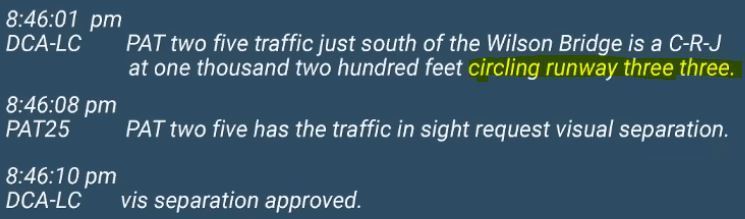
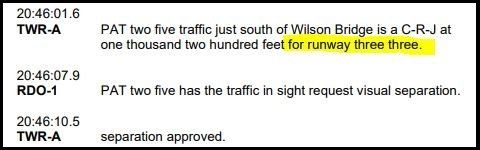
And what strikes me over and over again, is this mutual 'pavlovian' "request visual separation"-"approved" thing, as if proclaiming these words, absolves all involved from any rules/restriction that might hinder the smooth flow of things (which it does - kind of).
Even at the last chance of averting disaster by the controller (by clearly indicating the target), the pavlovian reaction was there again (totally meaningless as it was already requested and approved 96 second earlier)...
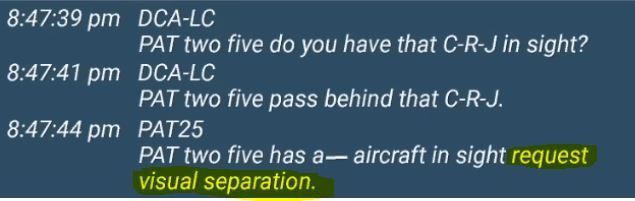
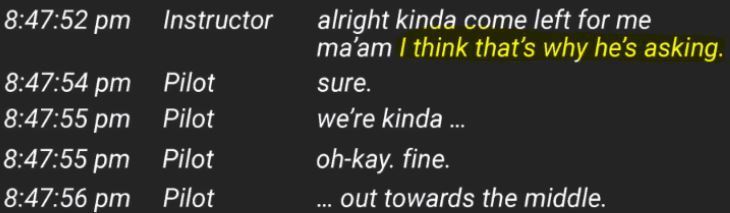
Last edited by DIBO; 2nd August 2025 at 21:03. Reason: add extract from UH60 CVR transcript (not available/included in NTSB debrief animation)


Joined: Nov 2000
Aviation Qualifications: ATPL
Posts: 282
Likes: 137
From: South East
I’ve been listening to the NTSB hearings while doing other things last couple of days. All I can say is the FAA testimony is wild.
Normalisation of deviance doesn’t even come close.
- Airspace design. The heli route stepping down to 200ft max lead some army pilots to believe it gave clearance from DCA traffic. Spoiler. It did not.
- Controller workload “Just make it work” was a common attitude at DCA
- FAA not actively tracking TCAS RA “incidents” as it could skew data.. maybe it was correctly applied visual separation etc. Need to look at the background etc. Yeah. But it generated an RA 🤬
- FAA refusing requests for traffic “hot spots” on low level VFR charts as “hot spots” are on ground charts only.
- PAT25 wanted visual separation from the CRJ. ATC was required to inform the CRJ crew another aircraft was applying visual separation to them. They didn’t.
Honestly from a European perspective. It’s quite bone chilling.
I feel this was a systemic failure. Airspace design and Risk Normalisation.
And my heartfelt condolences for the pilots, of both aircraft, and everyone else involved including the ATCOs. Not that there weren’t issues… but in the Swiss cheese model, the FAA bought the cheese, drilled holes in it, and invited everyone to take a look inside.
Slightly surprised by some NTSB comments as well… they were presented that the heli was straight ahead on the CRJ TCAS simulation presentation. But in actual fact the CRJ was circling in a left turn for runway 33. It was stable at 500ft but in a left turn to line up with the runway… wings level at 300ft. It was challenged by the airline/ALPA but I would hope the NTSB would have picked up on that.
Low point of the whole hearing was Jennifer Homendy halting proceedings and moving witnesses to different seats, as one of the FAA managers elbowed a colleague while she was giving testimony - at which point she went quiet. Infernce being she was being reminded to stop talking.
Normalisation of deviance doesn’t even come close.
- Airspace design. The heli route stepping down to 200ft max lead some army pilots to believe it gave clearance from DCA traffic. Spoiler. It did not.
- Controller workload “Just make it work” was a common attitude at DCA
- FAA not actively tracking TCAS RA “incidents” as it could skew data.. maybe it was correctly applied visual separation etc. Need to look at the background etc. Yeah. But it generated an RA 🤬
- FAA refusing requests for traffic “hot spots” on low level VFR charts as “hot spots” are on ground charts only.
- PAT25 wanted visual separation from the CRJ. ATC was required to inform the CRJ crew another aircraft was applying visual separation to them. They didn’t.
Honestly from a European perspective. It’s quite bone chilling.
I feel this was a systemic failure. Airspace design and Risk Normalisation.
And my heartfelt condolences for the pilots, of both aircraft, and everyone else involved including the ATCOs. Not that there weren’t issues… but in the Swiss cheese model, the FAA bought the cheese, drilled holes in it, and invited everyone to take a look inside.
Slightly surprised by some NTSB comments as well… they were presented that the heli was straight ahead on the CRJ TCAS simulation presentation. But in actual fact the CRJ was circling in a left turn for runway 33. It was stable at 500ft but in a left turn to line up with the runway… wings level at 300ft. It was challenged by the airline/ALPA but I would hope the NTSB would have picked up on that.
Low point of the whole hearing was Jennifer Homendy halting proceedings and moving witnesses to different seats, as one of the FAA managers elbowed a colleague while she was giving testimony - at which point she went quiet. Infernce being she was being reminded to stop talking.


Joined: Jul 2013
Aviation Qualifications: Non-Aircrew
Posts: 1,391
Likes: 678
From: Within AM radio broadcast range of downtown Chicago
"Low point of the whole hearing....." (Downwind_Left)
Also a high point - let me explain. ..... First, it was one of a goodly number of instances when Chairwoman Homendy proved all over again why she is an outstanding servant of the public interest.
But most observers of how the Board has operated over the past several years already would have agreed with that (imo).
Personally I didn't observe the elbowing on livestream but when the Chair noted it and that witnesses would be moved, it made sense. Together with the now widely derided rationale (on Wednesday) for not adding a notation on the helicopter route charts - in some terminology or nomenclature if "hot spots" was unavailable - the FAA witnesses in question, as I assessed their statements until that point, had been working mightily to give this accident an air of "excused inevitably." I need to point out this slam on their apparently questionable sincerity-plus-candor explicitly does not include the ATCT supervisor who testified at length and, in my view, honorably.
I don't want to comment yet on whether the accident victims' families will have a valid legal argument about the issue of "in trail" spacing, with regard to which one of the FAA witnesses in question described the matter in quite divergent terms from the way in which the Potomac Tracon official described it. But even reserving further comment, still it appears that if the answer for why the "in trail" memo was not acted upon favorably is that Runway 3-3 was going to be used more frequently, doesn't that answer: (a) mean that the pace of approaching and landing aircraft, in and of itself and also when combined with departures, would remain intense for DCA, and (b) the continued high tempo would also continue to complicate the proper - which is to say safe - control of helicopter flights most especially in the glaring light of the fact that Route 4 intersects the approach path to 3-3? As raw material for the legal argumentation that the FAA's actions and omissions were ministerial, and not matters of policy, this could be another call of, blood in the water.
(Of course all concerned know that the "unwritten policy" choice was to move traffic and hope for safe outcomes only. Maybe that often-criticized approach taken in the United States would prove out in an actual courtroom battle as a regrettable but nevertheless sufficient "policy decision" so as to allow sovereign immunity. But does the United States FAA really want to litigate this issue? Against some of the strongest and most experienced advocates ever to enunciate "Approach" in a courtroom? My understanding is the families, or some of them at least, are rep'd by attorneys and counselors who .... aren't finding time to sit in Starbux and post here.)
There were two other, at least, pieces of FAA testimony that, in my deposition-taking days, would have gone on for some hours more. No one could say what the Assistant LC was doing at the critical times. How could this not have been nailed down in the interviews? Also, what in the world is "debriefing" after training? How and why was that more important than keeping the helicopter position staffed?
I wish not to cast aspersions on any DCA ATCOs whatsoever. The testimony about why FAA did not get both alcohol and drug testing done in accordance with established rules was just another piece of shattered credibility - but as Board Member Inman stated, there is no basis to believe or think those kinds of problems were factors, and so that's not the point here. I mean, it wasn't clear fatalities had occurred very, very soon after the event? Good grief.
Perhaps the contretemps afoot in the investigations - and surrounding public relations affairs - in Korea and India have led me to some misunderstandings, but has it become time to think about whether the U.S. should have an AAIB? and not combine aviation into the general category of Transportation? For now, Member Inman said it well and succinctly: "Do better."
Also a high point - let me explain. ..... First, it was one of a goodly number of instances when Chairwoman Homendy proved all over again why she is an outstanding servant of the public interest.
But most observers of how the Board has operated over the past several years already would have agreed with that (imo).
Personally I didn't observe the elbowing on livestream but when the Chair noted it and that witnesses would be moved, it made sense. Together with the now widely derided rationale (on Wednesday) for not adding a notation on the helicopter route charts - in some terminology or nomenclature if "hot spots" was unavailable - the FAA witnesses in question, as I assessed their statements until that point, had been working mightily to give this accident an air of "excused inevitably." I need to point out this slam on their apparently questionable sincerity-plus-candor explicitly does not include the ATCT supervisor who testified at length and, in my view, honorably.
I don't want to comment yet on whether the accident victims' families will have a valid legal argument about the issue of "in trail" spacing, with regard to which one of the FAA witnesses in question described the matter in quite divergent terms from the way in which the Potomac Tracon official described it. But even reserving further comment, still it appears that if the answer for why the "in trail" memo was not acted upon favorably is that Runway 3-3 was going to be used more frequently, doesn't that answer: (a) mean that the pace of approaching and landing aircraft, in and of itself and also when combined with departures, would remain intense for DCA, and (b) the continued high tempo would also continue to complicate the proper - which is to say safe - control of helicopter flights most especially in the glaring light of the fact that Route 4 intersects the approach path to 3-3? As raw material for the legal argumentation that the FAA's actions and omissions were ministerial, and not matters of policy, this could be another call of, blood in the water.
(Of course all concerned know that the "unwritten policy" choice was to move traffic and hope for safe outcomes only. Maybe that often-criticized approach taken in the United States would prove out in an actual courtroom battle as a regrettable but nevertheless sufficient "policy decision" so as to allow sovereign immunity. But does the United States FAA really want to litigate this issue? Against some of the strongest and most experienced advocates ever to enunciate "Approach" in a courtroom? My understanding is the families, or some of them at least, are rep'd by attorneys and counselors who .... aren't finding time to sit in Starbux and post here.)
There were two other, at least, pieces of FAA testimony that, in my deposition-taking days, would have gone on for some hours more. No one could say what the Assistant LC was doing at the critical times. How could this not have been nailed down in the interviews? Also, what in the world is "debriefing" after training? How and why was that more important than keeping the helicopter position staffed?
I wish not to cast aspersions on any DCA ATCOs whatsoever. The testimony about why FAA did not get both alcohol and drug testing done in accordance with established rules was just another piece of shattered credibility - but as Board Member Inman stated, there is no basis to believe or think those kinds of problems were factors, and so that's not the point here. I mean, it wasn't clear fatalities had occurred very, very soon after the event? Good grief.
Perhaps the contretemps afoot in the investigations - and surrounding public relations affairs - in Korea and India have led me to some misunderstandings, but has it become time to think about whether the U.S. should have an AAIB? and not combine aviation into the general category of Transportation? For now, Member Inman said it well and succinctly: "Do better."
Joined: Aug 2019
Posts: 62
Likes: 8
From: Rocket City
Low point of the whole hearing was Jennifer Homendy halting proceedings and moving witnesses to different seats, as one of the FAA managers elbowed a colleague while she was giving testimony - at which point she went quiet. Inference being she was being reminded to stop talking.
She was really not happy with the FAA more than once.
Was was hoping to rewatch this weekend but for some reason day 1 isn't on YouTube (but day 2 is).
I do have links for the live transcripts but they can be hard to follow.
Day 1
https://transcript.verbit.co/?transcriptJobId=c8273991-7823-4761-8ab1-95618f517981
Day 2
https://transcript.verbit.co/?transcriptJobId=02727bab-a1a2-4efd-95cb-de7991bdce87
Day 3
https://transcript.verbit.co/?transcriptJobId=42394932-5289-4aa9-b9ea-4a5d3ee725f6
Joined: Nov 2000
Aviation Qualifications: ATPL
Posts: 282
Likes: 137
From: South East
They managed to sink lower when questioned about SMS and just culture. They said they’d heard of it. But struggled to describe it… especially when the NTSB questioned why so many people were reassigned to new jobs straight after the accident. Many questioned said, “I’ve only been in this job a month, so I can’t comment”.
Again the formidable Jennifer called it out. The NTSB has seen this before…Radom job replacement, deniability etc
Joined: Nov 2000
Aviation Qualifications: ATPL
Posts: 282
Likes: 137
From: South East
Joined: Jul 2013
Aviation Qualifications: Non-Aircrew
Posts: 1,391
Likes: 678
From: Within AM radio broadcast range of downtown Chicago
I completely understand. I work on the operational side. I meant low for the FAA
They managed to sink lower when questioned about SMS and just culture. They said they’d heard of it. But struggled to describe it… especially when the NTSB questioned why so many people were reassigned to new jobs straight after the accident. Many questioned said, “I’ve only been in this job a month, so I can’t comment”.
Again the formidable Jennifer called it out. The NTSB has seen this before…Radom job replacement, deniability etc
They managed to sink lower when questioned about SMS and just culture. They said they’d heard of it. But struggled to describe it… especially when the NTSB questioned why so many people were reassigned to new jobs straight after the accident. Many questioned said, “I’ve only been in this job a month, so I can’t comment”.
Again the formidable Jennifer called it out. The NTSB has seen this before…Radom job replacement, deniability etc
As Panel 5 was getting set, there were follow-up questions about the post-accident testing. At least two witnesses weren't familiar with previous revisions of the relevant FAA written rules (iirc they're referred to as "orders" but I wouldn't swear to that). FAA testified that the agency is revising that order, in light of things not having been done properly at DCA on the night ofJanuary 29 into January 30. Member Inman hit a towering home run, I thought. He noted that he was with DoT when FAA set to work on revising a previous iteration of the pertinent order ..... many years ago. Deja vu, all over again.
Joined: Jul 2014
Aviation Qualifications: Spotter
Posts: 397
Likes: 397
From: UK
Holmedy also had to tell witnesses to switch off their phones, as they were clearly texting each other about testimony. Along with moving witnesses so they couldn't nudge each other's elbows at critical moments, it was like watching an exasperated teacher with a class of eight year-olds.

Joined: Sep 2017
Aviation Qualifications: Non-Aircrew
Posts: 1,037
Likes: 1,065
From: Bremen
I do have links for the live transcripts but they can be hard to follow.
Day 1
https://transcript.verbit.co/?transcriptJobId=c8273991-7823-4761-8ab1-95618f517981
Day 2
https://transcript.verbit.co/?transcriptJobId=02727bab-a1a2-4efd-95cb-de7991bdce87
Day 3
https://transcript.verbit.co/?transcriptJobId=42394932-5289-4aa9-b9ea-4a5d3ee725f6
Day 1
https://transcript.verbit.co/?transcriptJobId=c8273991-7823-4761-8ab1-95618f517981
Day 2
https://transcript.verbit.co/?transcriptJobId=02727bab-a1a2-4efd-95cb-de7991bdce87
Day 3
https://transcript.verbit.co/?transcriptJobId=42394932-5289-4aa9-b9ea-4a5d3ee725f6
Spoiler
Joined: Jul 2013
Aviation Qualifications: Non-Aircrew
Posts: 1,391
Likes: 678
From: Within AM radio broadcast range of downtown Chicago
Edited
After having completed three days of its formal proceedings - which I'll predict will long be remembered for the Board Chair ordering witnesses from FAA to turn off their cellular devices and to relocate because one had been seen elbowing another during the latter's testimony - the Board may be about to enter a new kind of Washington ball game.
Twelve billion dollars here, eighteen billion dollars additional there, pretty soon you're talking real money (with apologies to anyone who recalls the originator, Illinois Senator Everett McKinley Dirksen). With all that federal largesse provided by the American taxpayer destined to be spent on the so-called "new ATC system", I have a question. Isn't it necessary to know what conclusions the Board reaches in this investigatory process before committing to - and I'm going to use my own phrase - the "new National Airspace Architecture"?
The United States needs a new FAA organization, on two fronts at least. One, separate the ANSP from the regulator (as probably hundreds of real-life aviation industry worthies have long advocated). Second, a new organizational structure, ethos, culture, set of career pathways, and everything else that is not fit for purpose for the immient and dramatic changes dead-ahead (such as automation, Advanced Air Mobility, environmental pressures, and oh yeah, increased traffic correlated with increased demands from the traveling public for the precise kind of bag of peanuts to which they believe they're entitled). Is it not the case that FAA has failed in its fundamental mission, because under no ConOps should it have been possible for this accident to take place? (Of course, there will never be a guarantee against one or more persons conducting relevant activities with gross negligence - but if that harsh judgment is levied against the Black Hawk, nonetheless the system should have provided stronger procedural separation.)
And all this is before decisions are made about what technologies to build into the new Nat'l Airspace Arch., what vendors, what geographic arrangement, and what connectivity the entire system will have with ATM in Europe and globally (and European ATM especially is moving rapidly into the future).
But the Board final report is what, 12 months away? 18 months perhaps?
And as the new National Airspace Architecture is supposed to be undergoing definition and development, what assurance is there that the upcoming 42nd Triennial Assembly of ICAO in Montreal will not take action which will seriously impact the U.S. process? Or set ICAO on further intitiatives which would constrain U.S. plans, and not necessarily for the better? Recall that the United States has not had a designated Permanent Representative to ICAO since Capt. Sully abruptly resigned (July 2022), and while the career Foreign Service officials heading up the U.S. Mission undoubtedly are fine and excellent public servants, they are not (afaik) aviation industry professionals.
None of this is to say that the NTSB should speed up its process and deliberations. But at the same time, if during this Assembly the Secretary of Transportation shows up - as happened during the previous Assembly - to speak on behalf of the United States, I hope the Secretary has very, very good speechwriters because it will be hard to say anything meaningful when the state of affairs is in such disarray.
Edit:
On July 17 the White House nominated former Delta Airlines Capt. and U.S. Navy aviator Jeffrey Anderson to the position of Permanent Representative to ICAO with the rank of Ambassador. Timing of Senate confirmation hearing is presently unknown.
Twelve billion dollars here, eighteen billion dollars additional there, pretty soon you're talking real money (with apologies to anyone who recalls the originator, Illinois Senator Everett McKinley Dirksen). With all that federal largesse provided by the American taxpayer destined to be spent on the so-called "new ATC system", I have a question. Isn't it necessary to know what conclusions the Board reaches in this investigatory process before committing to - and I'm going to use my own phrase - the "new National Airspace Architecture"?
The United States needs a new FAA organization, on two fronts at least. One, separate the ANSP from the regulator (as probably hundreds of real-life aviation industry worthies have long advocated). Second, a new organizational structure, ethos, culture, set of career pathways, and everything else that is not fit for purpose for the immient and dramatic changes dead-ahead (such as automation, Advanced Air Mobility, environmental pressures, and oh yeah, increased traffic correlated with increased demands from the traveling public for the precise kind of bag of peanuts to which they believe they're entitled). Is it not the case that FAA has failed in its fundamental mission, because under no ConOps should it have been possible for this accident to take place? (Of course, there will never be a guarantee against one or more persons conducting relevant activities with gross negligence - but if that harsh judgment is levied against the Black Hawk, nonetheless the system should have provided stronger procedural separation.)
And all this is before decisions are made about what technologies to build into the new Nat'l Airspace Arch., what vendors, what geographic arrangement, and what connectivity the entire system will have with ATM in Europe and globally (and European ATM especially is moving rapidly into the future).
But the Board final report is what, 12 months away? 18 months perhaps?
And as the new National Airspace Architecture is supposed to be undergoing definition and development, what assurance is there that the upcoming 42nd Triennial Assembly of ICAO in Montreal will not take action which will seriously impact the U.S. process? Or set ICAO on further intitiatives which would constrain U.S. plans, and not necessarily for the better? Recall that the United States has not had a designated Permanent Representative to ICAO since Capt. Sully abruptly resigned (July 2022), and while the career Foreign Service officials heading up the U.S. Mission undoubtedly are fine and excellent public servants, they are not (afaik) aviation industry professionals.
None of this is to say that the NTSB should speed up its process and deliberations. But at the same time, if during this Assembly the Secretary of Transportation shows up - as happened during the previous Assembly - to speak on behalf of the United States, I hope the Secretary has very, very good speechwriters because it will be hard to say anything meaningful when the state of affairs is in such disarray.
Edit:
On July 17 the White House nominated former Delta Airlines Capt. and U.S. Navy aviator Jeffrey Anderson to the position of Permanent Representative to ICAO with the rank of Ambassador. Timing of Senate confirmation hearing is presently unknown.
Last edited by WillowRun 6-3; 3rd August 2025 at 21:34.
Joined: Dec 2013
Aviation Qualifications: ATP+Mil
Posts: 990
Likes: 554
From: US
Something smells wrong about some of this.
(I need to see a bit more of the documentation on the difference between the hard altitude (200') that I was under the impression was on that route, as opposed to the "recommended altitude" statement made there...maybe it will make more sense to me then).
As to altimeter errors.
The UH-60L has a radalt.
Are you trying to tell me that the alleged acceptable error for a rad alt is 80'-130'?
I think not.
I doubt that the rules have changed that much since I was last flying a Blackhawk. (yes, it has been a while).
Will do a bit more reading, thanks.
(I need to see a bit more of the documentation on the difference between the hard altitude (200') that I was under the impression was on that route, as opposed to the "recommended altitude" statement made there...maybe it will make more sense to me then).
As to altimeter errors.
The UH-60L has a radalt.
Are you trying to tell me that the alleged acceptable error for a rad alt is 80'-130'?
I think not.
I doubt that the rules have changed that much since I was last flying a Blackhawk. (yes, it has been a while).
Will do a bit more reading, thanks.
Joined: Mar 2015
Posts: 905
Likes: 321
From: Virginia, USA
Joined: Sep 2017
Aviation Qualifications: Non-Aircrew
Posts: 1,037
Likes: 1,065
From: Bremen
NTSB links
NTSB Overview/Updates
https://www.ntsb.gov/investigations/...CA25MA108.aspx
The docket is linked at the bottom of that page.
NTSB Public Docket
https://data.ntsb.gov/Docket/?NTSBNumber=DCA25MA108
The docket contains evidence related to the investigation. Many NTSB investigations have public dockets; often they're released with the final report.
In the docket:
10-HELO-A FLIGHT DATA RECORDER - HELICOPTER - GROUP CHAIRMAN'S FACTUAL REPORT
https://data.ntsb.gov/Docket/Documen...0L_FDR-Rel.pdf
https://www.ntsb.gov/investigations/...CA25MA108.aspx
The docket is linked at the bottom of that page.
NTSB Public Docket
https://data.ntsb.gov/Docket/?NTSBNumber=DCA25MA108
The docket contains evidence related to the investigation. Many NTSB investigations have public dockets; often they're released with the final report.
In the docket:
10-HELO-A FLIGHT DATA RECORDER - HELICOPTER - GROUP CHAIRMAN'S FACTUAL REPORT
https://data.ntsb.gov/Docket/Documen...0L_FDR-Rel.pdf