


AA5342 Down DCA

Joined: Mar 2002
Aviation Qualifications: ATPL
Posts: 9,225
Likes: 992
From: Seat 1A
Sailvi767, you're doing nothing more that Monday-morning quarterbacking. To say "yes, we're below 900ft so it won't give us a RA so let's get out of here" is totally unrealistic in these circumstances. Statements like "Watching an aircraft track in on a collision course and doing nothing takes a lot of courage." are just nonsense, in that, of course it would take a lot of courage and no-one in their right mind would do that in a normal situation, cruising along higher up. But these guys were 500ft off the water, at night, manoeuvring to a late-change final approach.
Last edited by Capn Bloggs; 11th August 2025 at 10:10. Reason: grammar

Pegase Driver

Joined: May 1997
Aviation Qualifications: ATCO
Posts: 4,456
Likes: 1,168
From: Europe
@ Sailvi767 : Are you suggesting that somehow the CRJ crew bears some responsibility in not acting on a TA and therefore bears some responsibility in this accident ? At least this is what I am making of your posting .
If I am correct can you stop this discussion Remember journalists and possibly families members of those 2 pilots are watching too.
To close that bit just read the CRJ CVR transcript (*)
47:29 : eGPWS : 500 hundred
47:35 : I got 2 whites and 2 red
47:37 : cool ( my note : so they were looking at the PAPI )
47::40 : "Traffic traffic " ( my note : TA audio)
47:47 : TWR :" PAT 25 pass behind the CRJ "
47:55 : eGPWS : ...hundred ..
47:58 " Oh Sh!!!!!
47:59 : sound of impact .
If I am correct can you stop this discussion Remember journalists and possibly families members of those 2 pilots are watching too.
To close that bit just read the CRJ CVR transcript (*)
47:29 : eGPWS : 500 hundred
47:35 : I got 2 whites and 2 red
47:37 : cool ( my note : so they were looking at the PAPI )
47::40 : "Traffic traffic " ( my note : TA audio)
47:47 : TWR :" PAT 25 pass behind the CRJ "
47:55 : eGPWS : ...hundred ..
47:58 " Oh Sh!!!!!
47:59 : sound of impact .

Joined: Sep 2017
Aviation Qualifications: Non-Aircrew
Posts: 1,037
Likes: 1,065
From: Bremen
What was the rationale behind putting the helicopter route that low anyway?
Shouldn't aircraft have 1000 ft ground/obstacle clearance in built-up areas, in general? and 500 ft. otherwise?
That route forced helicopters below 200 ft., how can that not be unsafe?
Shouldn't aircraft have 1000 ft ground/obstacle clearance in built-up areas, in general? and 500 ft. otherwise?
That route forced helicopters below 200 ft., how can that not be unsafe?


Joined: Jul 2013
Aviation Qualifications: Non-Aircrew
Posts: 1,391
Likes: 678
From: Within AM radio broadcast range of downtown Chicago
Sailvi767, you're doing nothing more that Monday-morning quarterbacking. To say "yes, we're below 900ft so it won't give us a RA so let's get out of here" is totally unrealistic in these circumstances. Statements like "Watching an aircraft track in on a collision course and doing nothing takes a lot of courage." are just nonsense, in that, of course it would take a lot of courage and no-one in their right mind would do that in a normal situation, cruising along higher up. But these guys were 500ft off the water, at night, manoeuvring to a late-change final approach.
Then second, Monday-morning quarterbacking, second-guessing, is one of media-saturated contemporary life's unfortunate and unpleasant irritants, and here is especially unwarranted. As one of this forum's usual suspects for legal aspects and issues, I will go further and say that even a thousand hours of Monday morning signal-calling will never, in this accident, show negligence of the two lost - senselessly lost - professional pilots.
The 1969 film "Z", directed by Costa-Gavras, depicts "a thinly fictionalized account of events surrounding the assassination of [a] democratic" European politician (from Wikipedia). The action centers on the work of a dedicated magistrate conducting the investigation. One hopes the DoT Inspector General staff will present such a dedicated person to examine how, for example, the helicopter route structure could have been thought to have been constructed safely. The film strikes this observer (I have no professional or otherwise occupational role in this accident) as relevant, inasmuch as "Z" was a slogan meaning, "He lives." A professional pilots forum could do worse for an overall attitude toward the CRJ pilots. . . . .Though with hope for a far more honorable epilogue to this investigation than occurs in the film.
Joined: Apr 2010
Posts: 1,320
Likes: 102
From: IRS NAV ONLY
That route forced helicopters below 200 ft., how can that not be unsafe?
Joined: Dec 2013
Aviation Qualifications: ATP+Mil
Posts: 990
Likes: 554
From: US
@ Sailvi767 : Are you suggesting that somehow the CRJ crew bears some responsibility in not acting on a TA and therefore bears some responsibility in this accident ? At least this is what I am making of your posting .
If I am correct can you stop this discussion Remember journalists and possibly families members of those 2 pilots are watching too.
To close that bit just read the CRJ CVR transcript (*)
47:29 : eGPWS : 500 hundred
47:35 : I got 2 whites and 2 red
47:37 : cool ( my note : so they were looking at the PAPI )
47::40 : "Traffic traffic " ( my note : TA audio)
47:47 : TWR :" PAT 25 pass behind the CRJ "
47:55 : eGPWS : ...hundred ..
47:58 " Oh Sh!!!!!
47:59 : sound of impact .
If I am correct can you stop this discussion Remember journalists and possibly families members of those 2 pilots are watching too.
To close that bit just read the CRJ CVR transcript (*)
47:29 : eGPWS : 500 hundred
47:35 : I got 2 whites and 2 red
47:37 : cool ( my note : so they were looking at the PAPI )
47::40 : "Traffic traffic " ( my note : TA audio)
47:47 : TWR :" PAT 25 pass behind the CRJ "
47:55 : eGPWS : ...hundred ..
47:58 " Oh Sh!!!!!
47:59 : sound of impact .
Joined: Dec 2007
Posts: 953
Likes: 451
From: same planet as yours
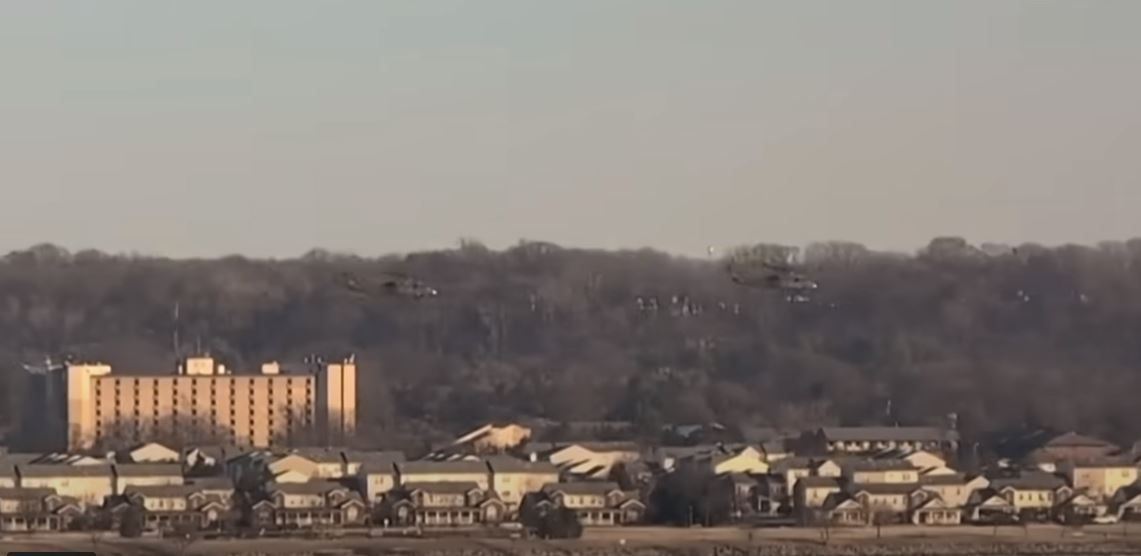
I wonder how many pilots on rwy 01/19 really perceived this section of the routing as unsafe (when flown correctly = hugging the shoreline at max 200ft).
A nuisance, undoubtedly. And the whole helicopter traffic surrounding DCA, pretty unsafe, I can understand.
And then we have nighttime...
§ 91.119 d 1:
A helicopter may be operated at less than the minimums prescribed in paragraph (b) or (c) of this section, provided each person operating the helicopter complies with any routes or altitudes specifically prescribed for helicopters by the FAA
A helicopter may be operated at less than the minimums prescribed in paragraph (b) or (c) of this section, provided each person operating the helicopter complies with any routes or altitudes specifically prescribed for helicopters by the FAA
Joined: Mar 2022
Posts: 74
Likes: 39
From: Nearby
No, they're exactly the same. If you say "traffic in sight" then the controller will immediately say "Maintain visual separation."
"Request visual separation" is non-standard.
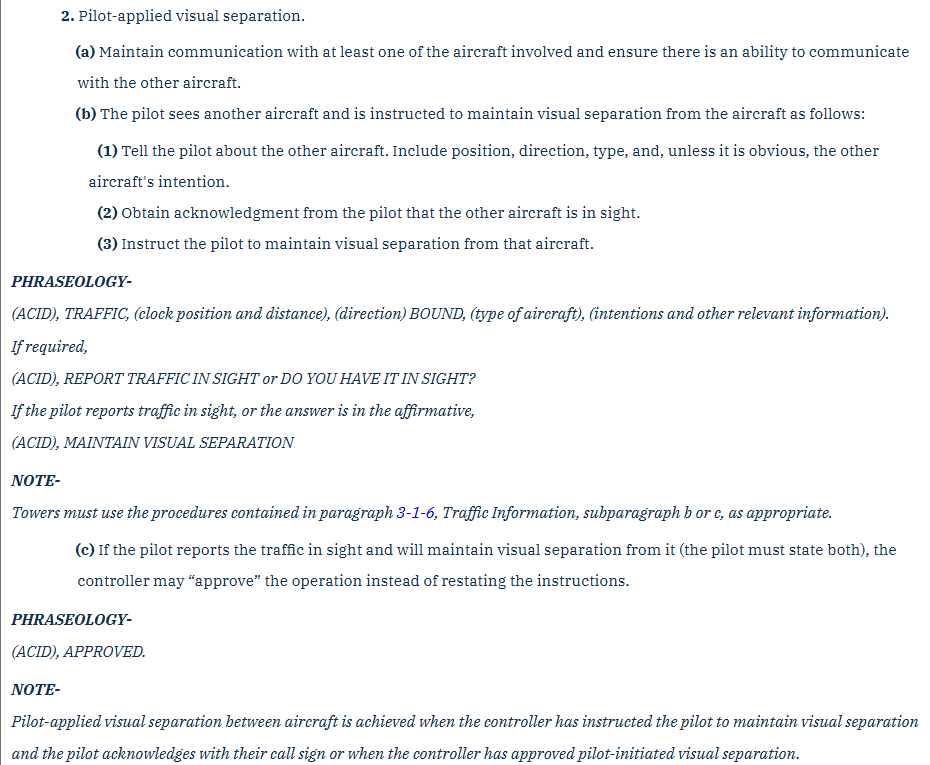
https://www.faa.gov/air_traffic/publ...section_2.html
"Request visual separation" is non-standard.
https://www.faa.gov/air_traffic/publ...section_2.html
Absolutely, it was a non-standard discourse. But however you look at what was said, PAT 25 requested the change to visual separation. Meaning PAT25 correctly believed he was under standard 1.5nm/500ft separation at the time and that he needed LC approval for Visual separation to be applied. The change in the separation standard being applied did not happen until the LC accepted PAT 25’s traffic visual report and authorised the change. It’s not an automatic change made just on the pilot’s say so, ie by reporting visual, which I think is what you may be implying (happy if you correct me). Both pilot and LC are necessary (and both made errors here).
Joined: Feb 2025
Posts: 153
Likes: 248
From: Earth
Absolutely, it was a non-standard discourse. But however you look at what was said, PAT 25 requested the change to visual separation. Meaning PAT25 correctly believed he was under standard 1.5nm/500ft separation at the time and that he needed LC approval for Visual separation to be applied. The change in the separation standard being applied did not happen until the LC accepted PAT 25’s traffic visual report and authorised the change. It’s not an automatic change made just on the pilot’s say so, ie by reporting visual, which I think is what you may be implying (happy if you correct me). Both pilot and LC are necessary (and both made errors here).
Joined: Mar 2000
Posts: 831
Likes: 141
From: You live where
As I posted on here before I had that exact same scenario happen to me on runway 33 in DCA. Traffic closing on a collision course on TCAS. Tower reported the traffic had us in sight. When the traffic closed to ½ mile with no vector change apparent We went around from 400 feet. We never saw the traffic. Tower chewed my butt saying the traffic had us in sight. I didn’t care.
In the case you quote, Tower reported the traffic had you in sight. In the case in question, AA5342 was not provided traffic by the DCA LC.
In the case you quote, did Tower say that the traffic was going to maintain own separation? Did Tower provide a bearing/direction and distance to this traffic? Did Tower provide the height of the traffic?

Joined: Dec 2001
Posts: 1,484
Likes: 860
From: Here 'n' there!
 . I'd often get from Twr on joining the circuit at my various destinations, and having confirmed I'd got traffic XYZ in sight, a clearance "Roger, C/S, keeping that traffic in sight, report Final XX. You are No 2 to the XYZ.". From that point on, my positioning was determined by me based on visual separation with the other traffic - so not totally identical to the DCA accident but the principle was the same - I was responsible for remaining clear of XYZ and positioning appropriately behind them (including accounting for wake/runway occupancy effects etc). Occasionally I'd then get "C/S, new clearance - report ready for L/R base." usually with a reason if there was time - often it was App not leaving TWR a big enough gap to sneak me in between 2 IFR arrivals.
In other words, Twr would delegate separation to me with the initial clearance but, if for whatever reason, they became unhappy - I got issued with a revised, more restrictive, clearance. Similarly, if I lost sight of the traffic at any point after the initial "Report Final" clearance, it was my responsibility to advise ATC that I was no longer visual with XYZ (ie I could no longer comply with the clearance ATC had given me) and ATC would then update my clearance on that basis - "..... report ready for base" or similar until they could visually assure themselves of separation. Indeed, on those occasions, it was not unknown for ATC to say "C/S, I have you both in sight - that traffic is well ahead of you, report Final XX, No 2". I was thus relieved of my responsibility to self-position.
What ATC giveth away in their airspace ATC can taketh back again in their airspace!
Now, "normalised deviation" may skew such a way of working such as PAT routinely expecting to get what they ask for and ATC routinely giving them what they want......... Not saying that happened at DCA but............ Also, I've lost track in the Thread if PAT were visual but with another a/c or the intended one but simply "lost it" at some point........... And whether visual separation at night in such busy airspace was wise ............
Last edited by Hot 'n' High; 12th August 2025 at 09:23.
Joined: Mar 2002
Aviation Qualifications: ATPL
Posts: 9,225
Likes: 992
From: Seat 1A
Re ATC assigning own separation, that happens here in Oz. IIRC, it went like this: "Report sighting the 737 on final"..."Traffic sighted"..."Follow as number two". Although critically, Our Oz AIP states:
Re TCAS, my Boeing manual states
Change 7 came in some years ago. I wonder if the CRJ's TCAS was the same and the TA was inhibited a few seconds before the collision, which was below 500ft?
Re "normalised deviation", I'm not sure this applies here. Normalised deviation means deviating from published (perportedly safe) procedures, with no adverse consequences, so the deviations continue. In this case, it's pretty obvious that the "published procedures" were flawed in the first place.
Originally Posted by AIP Australia
(3) where an aircraft has been instructed to maintain own separation from an IFR aircraft, ATC will issue traffic information to the pilot of the IFR aircraft, including advice that responsibility for separation has been assigned to the other aircraft;
Originally Posted by Boeing
The Traffic Advisory (TA) is inhibited below 1,100 feet (+100 feet) AGL for TCAS change 6 computers and below 500 feet (+100 feet) for TCAS change 7 computers.
Re "normalised deviation", I'm not sure this applies here. Normalised deviation means deviating from published (perportedly safe) procedures, with no adverse consequences, so the deviations continue. In this case, it's pretty obvious that the "published procedures" were flawed in the first place.
Joined: Mar 2022
Posts: 74
Likes: 39
From: Nearby
Last edited by Stagformation; 12th August 2025 at 18:11.
Moderator

Joined: May 1997
Aviation Qualifications: ATCO
Posts: 295
Likes: 138
From: Europe
17 seconds before the collision , sadly he did not receive a clear readback on that instruction .
Joined: Dec 2001
Posts: 1,484
Likes: 860
From: Here 'n' there!
......... Re "normalised deviation", I'm not sure this applies here. Normalised deviation means deviating from published (perportedly safe) procedures, with no adverse consequences, so the deviations continue. In this case, it's pretty obvious that the "published procedures" were flawed in the first place.
If the airspace design had been used with positive control (ie holding traffic off R4 while 33 was in use or even holding R4 traffic at bridges or somewhere clear of 33 while it was in use) that would work.
Using that same airspace design with "see and avoid" was far less safe and, as reported, led to quite a few incidents of TA's before this fateful day.
But, as the "see and avoid" system was seen by the users at the coal face at least to work, despite the TA's, the operational use of the design became "normalised" to use "see and avoid".
Sadly, no-one (such as DCA management) seems to have studied the extra issues so this more dangerous way of using the design has became "normalised", particularly where ATC is busy.
That's just my take on it.
Joined: Mar 2022
Posts: 74
Likes: 39
From: Nearby
But he kind of did issue it : 20:47:42.0 TWR- (LC): " PAT two five pass behind the C-R-J " . [[i]sounds of rapid beeping consistent with conflict alert audible in background while tower is transmitting]
17 seconds before the collision , sadly he did not receive a clear readback on that instruction .
17 seconds before the collision , sadly he did not receive a clear readback on that instruction .
Yes he did, you’re right— but it wasn’t proactive enough. Clearly the LC was conflicted, his eyes telling him PAT might not be visual, but the pilot saying he was. What an awful situation to be in. One which really needed a decisive move, not the easiest one, eg order a direct turn for PAT and/or a go around for the CRJ.
Joined: Sep 2017
Aviation Qualifications: Non-Aircrew
Posts: 1,037
Likes: 1,065
From: Bremen
I may be mistaken, but my understanding is that the controller doesn't really have the option to deny visual separation. The regulations don't mention any response except 'approved.' The word 'approved' does seem to imply that it could also be denied, but there's no mention of how, when, or why that would be done. Even if they do have the option to deny, as far as I can tell there's no guidance on how to make that decision. Obviously there's no way for a controller to know whether a pilot truly has the correct aircraft in sight.
Here, the helicopter pilots had obviously routinely been lying to LC (and getting away with it!), so the system broke down.
Joined: Sep 2017
Aviation Qualifications: Non-Aircrew
Posts: 1,037
Likes: 1,065
From: Bremen
thank you for your reply!
It looks safe if the jet crews can't see the helicopters? 
Good thing they let only professional operators use heli route 4, then.
I take your point that the route was legal (if unsafe).
My impression is that the 500/1000 ft clearance rule exists so when a pilot gets disoriented, or suffers a flight control problem, they don't immediately smash into things; and that they have a chance to find a suitable place tocrash land, should the need arise. The latter is obviously solved when the river is right there.
If you don't have that altitude, you're missing a slice of cheese; and of course you won't feel it missing unless you need it, which is often the case with safety.
If the heli route had been higher up, then letting helicopters fly it on visual separation while runway 33 was in use wouldn't be "normalising deviance", it'd be normalising insanity, i.e. the illusion of "safety" that the 200 ft restriction provided would have been absent. The fact that someone at the FAA thought, "it'll be ok if we force the helicopters down to an unsafe altitude routinely" speaks of eroded safety standards to me. There are some disasters (and at least one impressive Space Shuttle fireball) that resulted from eroded safety standards, where managers convinced themselves it would still be ok--until it wasn't.
not intending to be cynical, but it makes the helos blend in nicely with the background, sort of out of the way for rwy 01/19 traffic (=95% of total)
I wonder how many pilots on rwy 01/19 really perceived this section of the routing as unsafe (when flown correctly = hugging the shoreline at max 200ft).
I wonder how many pilots on rwy 01/19 really perceived this section of the routing as unsafe (when flown correctly = hugging the shoreline at max 200ft).
taking the nearby airport out of the equation, I wonder if any of the professional operators on this route 4 section, ever felt that this low-level flying was (unnecessarily) unsafe
I take your point that the route was legal (if unsafe).
My impression is that the 500/1000 ft clearance rule exists so when a pilot gets disoriented, or suffers a flight control problem, they don't immediately smash into things; and that they have a chance to find a suitable place to
If you don't have that altitude, you're missing a slice of cheese; and of course you won't feel it missing unless you need it, which is often the case with safety.
If the heli route had been higher up, then letting helicopters fly it on visual separation while runway 33 was in use wouldn't be "normalising deviance", it'd be normalising insanity, i.e. the illusion of "safety" that the 200 ft restriction provided would have been absent. The fact that someone at the FAA thought, "it'll be ok if we force the helicopters down to an unsafe altitude routinely" speaks of eroded safety standards to me. There are some disasters (and at least one impressive Space Shuttle fireball) that resulted from eroded safety standards, where managers convinced themselves it would still be ok--until it wasn't.
Joined: Jul 2013
Aviation Qualifications: Non-Aircrew
Posts: 1,391
Likes: 678
From: Within AM radio broadcast range of downtown Chicago