


AA5342 Down DCA


Joined: Jul 2016
Posts: 14
Likes: 21
From: The Hague


Joined: Mar 2007
Posts: 1,017
Likes: 165
From: Hobe Sound, Florida
Is it time to think about the now non existant Heli-route#4 and the other DC area heliroutes?
Paris and London have heliroutes. Been awhile since flying both of these, but my recollection is that they were tightly managed by theATC folks with radar. Ignore their instructions and be met by the gendarmerie ( at least thats what happened to a pilot in front of us who ignored a hold at Bagnolet instruction -when we arrived at LeBourget, the cops had him, and there was a big black van awaiting.
The FAA might look into these two examples.
Paris and London have heliroutes. Been awhile since flying both of these, but my recollection is that they were tightly managed by theATC folks with radar. Ignore their instructions and be met by the gendarmerie ( at least thats what happened to a pilot in front of us who ignored a hold at Bagnolet instruction -when we arrived at LeBourget, the cops had him, and there was a big black van awaiting.
The FAA might look into these two examples.
Joined: Jun 2025
Aviation Qualifications: ATCO
Posts: 111
Likes: 205
From: Karlsruhe
That is ultimately the call of the crew. ATC only gives the option, it's the PICs responsibility to assess whether it is feasible and safe. I don't personally know any ATCo who would be comfortable offering that in this particular scenario, but that's coming from the European perspective where we have nothing even close to the proximity of military/civilian mixed traffic. I only did a little approach familiarization and no tower work, but just talking to colleagues who did, I don't think I'd be comfortable to offer visual separation in that environment. But then again threat normalization is a pretty effective thing.

Joined: Aug 2019
Posts: 62
Likes: 8
From: Rocket City
My inquiry was meant to refer to an internal investigation process, possibly with witness testimony. Or does the NTSB investigation in effect preempt any internal Army investigation and reporting functions which presumably are conducted when there is no civilian involvement in an Army aviation accident?
I've not seen a public release for the AH-64 that crashed in Galveston Bay Dec 2016. I know a few ASAMs were issued late 2017/early 2018, basically some pre and post flight inspections. Apache helicopter down in Galveston Bay, Texas
And that's about par for the course, particularly the Army.
It wasn't mentioned (afaik) in the NTSB hearings but does the Policy Board on Federal Aviation (which I understand is situated within DoD) have any investigation role in this accident? Or in deciding upon and possibly implementing recommendations the NTSB presumably will make when its report is complete, to the extent the recommendations are directed to Army aviation specifically (or other types of military aviation generally) as these operate in the NAS?


Joined: Dec 2002
Aviation Qualifications: ATP+Mil
Posts: 3,985
Likes: 568
From: Where the Quaboag River flows, USA
The DOD has its own investigation process which is detailed and regulated by each service. Any fatal serious injury accident or substantial damage is investigated in a Safety Investigation Board (SIB) usually under a O-6 or O-7 grade officer. Just like an NTSB investigation the Board President can accredit subject matter experts, outside contractors, JAGs to interview, gather data, etc. The SIB runs under a tighter timeline than an NTSB investigation, usually the report is due within 90 days, but obviously that’s subject to the complexity of the mishap. The report is “privileged” releasable only within the service, generally only within the Major Command in the USAF. It is NOT public released. The SIB recommendations do not include disciplinary or administrative actions for DoD members. It cannot be used in the courts. The MAJCOM commander is usually briefed in a meeting without coffee or cookies. It’s a tense briefing.
At some point during the SIB, the command convenes an Accident Investigation Board (AIB), also run by a senior officer. The AIB can use factual data from the SIB, but must conduct its own interviews, on scene investigations, etc, to ensure its independence from the SIB. The AIB report is releasable, may recommend disciplinary or administrative actions, may have recommendations to outside contractors or suppliers. Being public, it can be used in court actions, FEB or courts martial.
The Congressional “privileged” status came out in the 50s when the military accident was astronomical and needed a process to establish what happened and what actions could prevent a repeat mishap. The privilege took away anyone’s Article 31 rights, basically everyone had immunity in the SIB process but not in the AIB process. You get “rights” read to you in a AIB and a Defense Counsel is offered.
I would guess the Army is or will run an AIB as there’s, at least, the possibility of disciplinary actions or specific recommendations for regulatory changes that must come out of a military process, as the NTSB cannot issue recommendations to the military authority. It might just be an echo of the NTSB report.
This mishap maybe the first since the Ron Brown accident in FRY where the NTSB was involved, mostly for political reasons. The AIB ripped a bunch of officers new orifices ending their careers. I believe, at least one flag officer retired as a Major or Lt. Col.
BTW, the military uses “mishap” to indicate the crash was preventable whereas “accident” implies God reached down and just took them out. I always laugh cynically at the news of a car accident where it’s written like it was the driver became a passenger and had no agency. Car went out of control. No, the driver was (fill in the blank) and crashed the car.
At some point during the SIB, the command convenes an Accident Investigation Board (AIB), also run by a senior officer. The AIB can use factual data from the SIB, but must conduct its own interviews, on scene investigations, etc, to ensure its independence from the SIB. The AIB report is releasable, may recommend disciplinary or administrative actions, may have recommendations to outside contractors or suppliers. Being public, it can be used in court actions, FEB or courts martial.
The Congressional “privileged” status came out in the 50s when the military accident was astronomical and needed a process to establish what happened and what actions could prevent a repeat mishap. The privilege took away anyone’s Article 31 rights, basically everyone had immunity in the SIB process but not in the AIB process. You get “rights” read to you in a AIB and a Defense Counsel is offered.
I would guess the Army is or will run an AIB as there’s, at least, the possibility of disciplinary actions or specific recommendations for regulatory changes that must come out of a military process, as the NTSB cannot issue recommendations to the military authority. It might just be an echo of the NTSB report.
This mishap maybe the first since the Ron Brown accident in FRY where the NTSB was involved, mostly for political reasons. The AIB ripped a bunch of officers new orifices ending their careers. I believe, at least one flag officer retired as a Major or Lt. Col.
BTW, the military uses “mishap” to indicate the crash was preventable whereas “accident” implies God reached down and just took them out. I always laugh cynically at the news of a car accident where it’s written like it was the driver became a passenger and had no agency. Car went out of control. No, the driver was (fill in the blank) and crashed the car.


Joined: Jul 2013
Aviation Qualifications: Non-Aircrew
Posts: 1,391
Likes: 678
From: Within AM radio broadcast range of downtown Chicago
....@ST Dog
Those replies are appreciated. As the questions I asked probably reveal, I cannot claim any familiarity or experience with U.S. military aviation accident or incident investigations. But I think the course of events following this accident, especially the lawsuits, could lead to more activities becoming public than is usually the case.
Starting with the Army's response to the accident, the likely path the litigation will take could lead to some pressure for its internal inquiry - if an inquiry is conducted and in whatever form - to be disclosed. Apart from classified subjects, parts of the inquiry could be disclosed, even if only as a subject of discovery. Even more so if the case involves all-out legal fighting.
The PBFA also could emerge in a somewhat more public role. As the three days of hearings progressed, at least twice, a former Army helicopter pilot who also later served as an officer in the Air Force, and who works with medical helicopter flights, expressed regret for having to testify about safety concerns about Army and Air Force helicopter operations in the relevant airspace. (He supervises 10 pilots who "frequently fly within DCA airspace as we transport critically ill patients".) Together with several other pieces of testimonial evidence, this testimony showed there are a set of problems in the way the airspace is designed and used.
But the military aviation operations generally involve quite high priority roles and missions, as the letters PAT themselves indicate, even without trying to say anything intellilgent about another helicopter unit which (I read someplace) conducts training flights on a certain grassed-in, lawn area.
So there will be some level of intensity in the litigation. There will be keen Congressional interest, among other reasons because although Senators and Representatives (and their staffs and the cadres of K-Street et cetera) will not say so out loud, the current service level of DCA is something they want to maintain, not reduce. Of course FAA will be the immediate respondent to the investigation result, but in this situation FAA (imo) will not be able to act on its own. Some unit, office, group, or ad hoc assemblage of authorities someplace also will have to pick up the result of the NTSB investigation and do so within the context of intensified public attention.
It should not be assumed that the lawsuit will have proceeded very far in the time it takes for NTSB to reach its conclusions and complete its report. Worse, the discovery process in federal district court can very easily lead to additional pressure for more public involvement (yes, NTSB is thorough, but adversarial litigators do have a way of developing and presenting additional layers of information). None of this is meant as predictions, but there are a lot of unuusal pressures in this situation.
Edit: this post was written before I saw Galaxy Flyer's post. As a guest on this forum, I believe it is expected that I not try to revise content (as opposed to correcting typos) and so I'm leaving this post as written, despite now seeing some gaps in information or understanding.
Those replies are appreciated. As the questions I asked probably reveal, I cannot claim any familiarity or experience with U.S. military aviation accident or incident investigations. But I think the course of events following this accident, especially the lawsuits, could lead to more activities becoming public than is usually the case.
Starting with the Army's response to the accident, the likely path the litigation will take could lead to some pressure for its internal inquiry - if an inquiry is conducted and in whatever form - to be disclosed. Apart from classified subjects, parts of the inquiry could be disclosed, even if only as a subject of discovery. Even more so if the case involves all-out legal fighting.
The PBFA also could emerge in a somewhat more public role. As the three days of hearings progressed, at least twice, a former Army helicopter pilot who also later served as an officer in the Air Force, and who works with medical helicopter flights, expressed regret for having to testify about safety concerns about Army and Air Force helicopter operations in the relevant airspace. (He supervises 10 pilots who "frequently fly within DCA airspace as we transport critically ill patients".) Together with several other pieces of testimonial evidence, this testimony showed there are a set of problems in the way the airspace is designed and used.
But the military aviation operations generally involve quite high priority roles and missions, as the letters PAT themselves indicate, even without trying to say anything intellilgent about another helicopter unit which (I read someplace) conducts training flights on a certain grassed-in, lawn area.
So there will be some level of intensity in the litigation. There will be keen Congressional interest, among other reasons because although Senators and Representatives (and their staffs and the cadres of K-Street et cetera) will not say so out loud, the current service level of DCA is something they want to maintain, not reduce. Of course FAA will be the immediate respondent to the investigation result, but in this situation FAA (imo) will not be able to act on its own. Some unit, office, group, or ad hoc assemblage of authorities someplace also will have to pick up the result of the NTSB investigation and do so within the context of intensified public attention.
It should not be assumed that the lawsuit will have proceeded very far in the time it takes for NTSB to reach its conclusions and complete its report. Worse, the discovery process in federal district court can very easily lead to additional pressure for more public involvement (yes, NTSB is thorough, but adversarial litigators do have a way of developing and presenting additional layers of information). None of this is meant as predictions, but there are a lot of unuusal pressures in this situation.
Edit: this post was written before I saw Galaxy Flyer's post. As a guest on this forum, I believe it is expected that I not try to revise content (as opposed to correcting typos) and so I'm leaving this post as written, despite now seeing some gaps in information or understanding.
Last edited by WillowRun 6-3; 7th August 2025 at 02:54.

Joined: Aug 2009
Aviation Qualifications: Military
Posts: 9,346
Likes: 2,187
From: Texas
Galaxy Flyer covered most of it.
I have also been involved with the other kind of investigation, which in the Navy we called te JAG Manual Investigation. I have also had the opportunity to review both kinds of reports and arrive at the Flag Officer recommendation / position / summary / endorsement when I was on a flag staff.
Spoiler
Note: the last time I did any of the above is a bit over 20 years ago, but I doubt much has changed other than the increases in pressure to 'say something' based on how the Information age has evolved. I must say that I am grateful that I no longer have that task on the list of things I may be required to do in the course of my job.
Joined: Dec 2002
Aviation Qualifications: ATP+Mil
Posts: 3,985
Likes: 568
From: Where the Quaboag River flows, USA
I suspect the JAG Manual investigation is similar to what the USAF calls an AIB, as the AIB reports are the result of a JAG process. It has to be JAG in the AF to produce any disciplinary or administrative actions. For example, an AIB can recommend a court martial or a flying evaluation board, which has an equivalent in the USN. I’ve been, in various positions, involved in several FEBs. About the same time interval, too.
Joined: Aug 2009
Aviation Qualifications: Military
Posts: 9,346
Likes: 2,187
From: Texas
I suspect the JAG Manual investigation is similar to what the USAF calls an AIB, as the AIB reports are the result of a JAG process. It has to be JAG in the AF to produce any disciplinary or administrative actions. For example, an AIB can recommend a court martial or a flying evaluation board, which has an equivalent in the USN.
 And yes, the JAG Manual Investigation can go into disciplinary and/or administrative actions.
For the Journos who may be reading this: to get access to the JAG Manual investigations (or what GF refers to as AIB), usually a FOIA request will suffice.
I expect that in this case the Army investigation process will follow similar procedures (I would assert that the core policy is DoD wide, but this is based on two decades old memory so a few things might have changed). That report will take some time to get completed with all of the required endorsements. This one may go up to the Chief of Staff of the Army, given the political factors involved.
Spoiler
Joined: Dec 2002
Aviation Qualifications: ATP+Mil
Posts: 3,985
Likes: 568
From: Where the Quaboag River flows, USA
Here’s the USAF JAG reports website,
https://www.afjag.af.mil/AIB-Reports/
Being months after an event the reports rarely make headlines, so when someone says they never see the reports it’s because it isn’t news.
https://www.afjag.af.mil/AIB-Reports/
Being months after an event the reports rarely make headlines, so when someone says they never see the reports it’s because it isn’t news.
Joined: Dec 2007
Posts: 953
Likes: 451
From: same planet as yours
That's why I don't understand all the fuzz about ADS-B in the UH60. TCAS in the CRJ worked as designed, including RA inhibit down low.
It was the last chance to avert this accident.
I've wondered a couple of times, what if.... the CRJ crew had failed to spot the UH60 all together. Now a left-banking evasive manoeuver was started, and only the left wing was substantially shredded by the rotor.
If they would has kept wings level, maybe both wings would have narrowly escaped major damage, only MLG and belly at risk of the main rotor.
But it all doesn't matter, really. 'Fate is the hunter' and they got caught.
Joined: Sep 2017
Aviation Qualifications: Non-Aircrew
Posts: 1,037
Likes: 1,065
From: Bremen
I've wondered a couple of times, what if.... the CRJ crew had failed to spot the UH60 all together. Now a left-banking evasive manoeuver was started, and only the left wing was substantially shredded by the rotor.
If they would has kept wings level, maybe both wings would have narrowly escaped major damage, only MLG and belly at risk of the main rotor.
But it all doesn't matter, really. 'Fate is the hunter' and they got caught.
If they would has kept wings level, maybe both wings would have narrowly escaped major damage, only MLG and belly at risk of the main rotor.
But it all doesn't matter, really. 'Fate is the hunter' and they got caught.
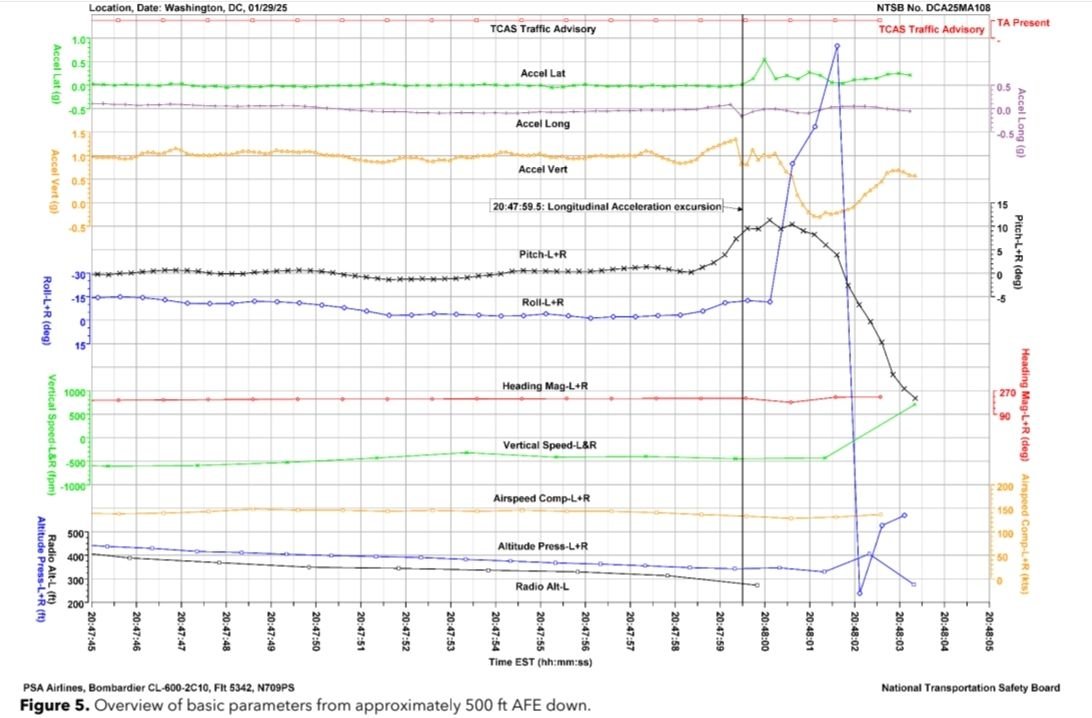
You can see that the pitch-up reduced the airspeed, and the vertical speed was mostly unaffected. This would have had a net effect of making the descent steeper (as the Radio Alt suggests).
If the CRJ crew had remained unaware, we would've learned how the downwash of a helicopter affects the wings of a jet.
The ultimate point is that a situation where a helicopter scrapes by the underside of a jet is not supposed to occur. At this point, all bets are off anyway, and rather than pondering what to do in such a situation, the focus should be on how to prevent it in the first place.
Pegase Driver

Joined: May 1997
Aviation Qualifications: ATCO
Posts: 4,456
Likes: 1,168
From: Europe
Just went ,very selectively of course, through the thousand of pages of to the dockets and they give a clearer picture , to me at least . of the huge normalization of deviance that took place from both the DCA control staff and the RAT pilots.. I went mainly thought the interviews and the TCAS dockets.
What I learned:
Interestingly the Local controller involved was also a CPL pilot
Pressure to use 33 for landing during high departure rates was there to avoid the queue blocking the taxi ways for arriving aircraft : ( my comment : when you get to that situation traffic should be reduced by departure slots , that what we do in Europe with the Network manager CTOTs..)
No reaction to Conflict alert because visual acquisition was prioritized , i.e if you saw the helicopter passing behind you disregarded the CA. and this was almost always the case so CA with helicopters became disregarded
Advanced training was poor or non existent ( e.g Threat/Error management training).
On the PAT pilots interviews the most flagrant normalization of deviance is requesting visual separation with an aircraft you do not see ( yet) I realize that was declared by pilots other that the one operating that flight , but gives a good indication of the local " best practices " in that area.
Finally on the TCAS issue, one of the screenshots shows other traffic, and we can see that there were 2 TAs one in front -2 and one behind +6 , that could ( emphasis on could) have been one of the reason the CRJ crew missed the urgency of the -2 , but also probably were more focusing on the PAPI so both looking outside instead of at the display .
And to reply to a question earlier by DIBO on the discussion about ADS-B out not avail on the RAT, and its relevance for TCAS, well it would have influenced the degree of accuracy of the Tau calculation ( with Alt returns every 25 ft instead of 100 feet) and could ( again emphasis on could) have changed the alert logic/timing of the TA. Non installation of ADS-B and flying 70 ft too high are probably one of the points the lawyers are going to get into to prove negligence from the military to get more money for their clients , possibly shadowing the real causes. ; which for me are still the design of the procedure and routes, and the failure of the Regulator to act on the alerts. . Love to hear Willow-Run 6-3 comment on this .
.
What I learned:
Interestingly the Local controller involved was also a CPL pilot
Pressure to use 33 for landing during high departure rates was there to avoid the queue blocking the taxi ways for arriving aircraft : ( my comment : when you get to that situation traffic should be reduced by departure slots , that what we do in Europe with the Network manager CTOTs..)
No reaction to Conflict alert because visual acquisition was prioritized , i.e if you saw the helicopter passing behind you disregarded the CA. and this was almost always the case so CA with helicopters became disregarded
Advanced training was poor or non existent ( e.g Threat/Error management training).
On the PAT pilots interviews the most flagrant normalization of deviance is requesting visual separation with an aircraft you do not see ( yet) I realize that was declared by pilots other that the one operating that flight , but gives a good indication of the local " best practices " in that area.
Finally on the TCAS issue, one of the screenshots shows other traffic, and we can see that there were 2 TAs one in front -2 and one behind +6 , that could ( emphasis on could) have been one of the reason the CRJ crew missed the urgency of the -2 , but also probably were more focusing on the PAPI so both looking outside instead of at the display .
And to reply to a question earlier by DIBO on the discussion about ADS-B out not avail on the RAT, and its relevance for TCAS, well it would have influenced the degree of accuracy of the Tau calculation ( with Alt returns every 25 ft instead of 100 feet) and could ( again emphasis on could) have changed the alert logic/timing of the TA. Non installation of ADS-B and flying 70 ft too high are probably one of the points the lawyers are going to get into to prove negligence from the military to get more money for their clients , possibly shadowing the real causes. ; which for me are still the design of the procedure and routes, and the failure of the Regulator to act on the alerts. . Love to hear Willow-Run 6-3 comment on this .
.

Joined: Mar 2022
Posts: 74
Likes: 39
From: Nearby
Absolutely, but the other side of the normalisation of unsafe practices coin is Local Controllers conveniently believing that pilots have instantly picked up distant traffic visually and granting their request!

Joined: Jun 2023
Posts: 4
Likes: 0
From: United States
Aircraft interaction
There has been much speculation recently about the "what if's" regarding the passage of these two aircraft - had one gone higher or lower, etc. There is one fact about aviation that seems to be overlooked in all of these discussions, and that is how aviation works in the first place. For an aircraft to fly, the air pressure above the wing must be lower than the air pressure below the wing. Likewise, for a helicopter to fly, the pressure above the rotor must be lower than the pressure below the rotor. So, there is by definition a pressure differential that is required for all of this "magic" to work. (I refer you to the Merion, Pennsylvania mid-air collision of April 4, 1991, where the collision occurred because the helicopter pilot was attempting the fly underneath an aircraft with a reported landing gear issue, in order to perform an assessment of the landing gear issue.) As a result of this pressure difference requirement, if a helicopter (or another aircraft, for that matter) were to fly beneath another flying aircraft, the downdraft from the helicopter would suck the airplane down (by virtue of reducing or elimination the higher under-wing pressure) into its own rotor. This would happen without either pilot doing any flight adjustment of their own. By virtue of the now altered pressures surrounding both aircraft, they would migrate towards each other all on their own. Now if the helicopter were to fly above the aircraft, the same thing would happen, but in reverse - the higher under-rotor air pressure would be reduced or eliminated by the actions of the aircraft's wing, and again, the two aircraft would be drawn towards each other entirely on their own.
I am reminded of an instance in perhaps the late 2000's where a U.S. military aircraft was buzzed by a Russian MIG. The MIG approached the U.S. aircraft on the right side, and passed very near to the aircraft, and very near to the aircraft's right wing, passing just above the right wing. This action caused the downdraft from the MIG's wings to press downward on the U.S. aircraft's right wing, causing a reduction in lift, and causing the U.S. aircraft to begin banking to the right. The MIG pilot asserted that the U.S. pilot did this on purpose, but the fact of the matter is that the interaction of the two pressure systems interacting that actually caused this behavior. Fortunately, in that case there was no collision, but there very well could have been.
I am reminded of an instance in perhaps the late 2000's where a U.S. military aircraft was buzzed by a Russian MIG. The MIG approached the U.S. aircraft on the right side, and passed very near to the aircraft, and very near to the aircraft's right wing, passing just above the right wing. This action caused the downdraft from the MIG's wings to press downward on the U.S. aircraft's right wing, causing a reduction in lift, and causing the U.S. aircraft to begin banking to the right. The MIG pilot asserted that the U.S. pilot did this on purpose, but the fact of the matter is that the interaction of the two pressure systems interacting that actually caused this behavior. Fortunately, in that case there was no collision, but there very well could have been.
Joined: May 2025
Aviation Qualifications: PPL
Posts: 83
Likes: 71
From: AK
Otherwise, if you watched the hearing, you'll remember that on day 1 the Army pilots and the medivac helo operator stated that they do not underfly aircraft.
Joined: Jul 2013
Aviation Qualifications: Non-Aircrew
Posts: 1,391
Likes: 678
From: Within AM radio broadcast range of downtown Chicago
Just went ,very selectively of course, through the thousand of pages of to the dockets and they give a clearer picture , to me at least . of the huge normalization of deviance that took place from both the DCA control staff and the [P]AT pilots. . . .
And to reply to a question earlier by DIBO on the discussion about ADS-B out not avail on the [P]AT, and its relevance for TCAS, well it would have influenced the degree of accuracy of the Tau calculation ( with Alt returns every 25 ft instead of 100 feet) and could ( again emphasis on could) have changed the alert logic/timing of the TA. Non installation of ADS-B and flying 70 ft too high are probably one of the points the lawyers are going to get into to prove negligence from the military to get more money for their clients , possibly shadowing the real causes. ; which for me are still the design of the procedure and routes, and the failure of the Regulator to act on the alerts. . Love to hear Willow-Run 6-3 comment on this .
.
And to reply to a question earlier by DIBO on the discussion about ADS-B out not avail on the [P]AT, and its relevance for TCAS, well it would have influenced the degree of accuracy of the Tau calculation ( with Alt returns every 25 ft instead of 100 feet) and could ( again emphasis on could) have changed the alert logic/timing of the TA. Non installation of ADS-B and flying 70 ft too high are probably one of the points the lawyers are going to get into to prove negligence from the military to get more money for their clients , possibly shadowing the real causes. ; which for me are still the design of the procedure and routes, and the failure of the Regulator to act on the alerts. . Love to hear Willow-Run 6-3 comment on this .
.
As for the airline, to fault the pilots when they were on short finals and expected to concentrate on flying - as others have expressed here numerous times - seems very ill-founded. Whether the airline company could be alleged to have responsibility for not having spoken up more effectively to cause the airspace design and procedure to be redone also strikes me as far too oblivious to the actual operation of the NAS, and the FAA and Congressional processes, to have any validity as an approach to liability. The airline and even Sikorski could still be named as defendants but, to reiterate, this would be just for leverage and not because there is any real pathway to liability for either one.
That having been set as background, the first context ignores the existence of sovereign immunity issues and looks just at what happened and who was responsible. As a rubric for this, "normalization of deviance" seems very accurate. This includes the fact that over time, ignoring Conflict Alerts came to be routine. It includes the practice of confirming "traffic in sight" or related proper terminology, for visual separation even though no traffic had been sighted yet - because it had become routine that the traffic would come into view and be properly identified as the traffic ATC had called out. The testimony about "just make it work", as I heard it, similarly was very concerning; iirc an overall very credible FAA witness acknowledged that the "just make it work" attitude also resulted in decreased safety margins. As did the medical helicopter operator who also had Army helicopter service background. Add in the lack of advanced training, and though I have not practiced law as legal counsel for accident victims' families, the liability theories here appear strong.
Then factor in the use of 3-3 to allievate congestion from high departure rates, rather than slowing or reducing departure slots. Part of the pressure to use 3-3 (as I understood the testimony) was that the Potomac Tracon wanted to increase in-trail separation but DCA instead increased use of 3-3. This was consistent with the attitude, "just make it work".
As to ADS-B on the helicopters, my understanding is that given the roles and missions of the helicopter operations, ADS-B is not equippage the military and its civilian control (in the sense of oversight) could have approved consistent with those roles and missions generally, and especially the continuing-of-government function.
Putting all the causal factors together into a "theory of the case" is perhaps better left to advocates for the accident victims' families (just as defense theories better left to defense counsel in this matter). But since you've impliedly asked, I would not - in this first context - parse out three of the four factors you noted, the lack of ADS-B being the one left out. That leaves the helicopter operating approximately 70 feet too high, the airspace design and procedures including the helicopter routes, and the inaction following the several safety alerts in databases and other reporting functions prior to the occurence of the accident. And including the forced enlistment of DCA for handling more traffic than the widely accepted airspace utilization and safe operation rules and procedures would allow - but they "just made it work." In other words, all of these three factors combine into the most likely theory of liability.
There is a second context, however. Federal government defendants are protected, despite the broad removal (waiver) of sovereign immunity by federal statute, from liability if the alleged negligence resulted from the exercise of discretion. If the actions or omissions being challenged resulted from decisions in which the federal entity weighed economic, social, political and other factors against each other in a form of "policy" decision-making, sovereign immunity remains in place. You can see where this is leading, of course. At what point does the over-use of DCA move out of the protection of "discretionary functions and decision-making" and into the realm of ... just plain negiligence which needs to be addressed in a court action. And likewise, at what point does the Army's set of decisions about how the routes are flown, and how visual separation and traffic sightings are handled, move out of the protection given by discretionary decisions and into the realm of significant negligence not deserving of such protection? Same question for FAA - surely the presence of safety concerns in databases and reporting systems - as unorganized as they may be and as lacking in systematic review as they may be - are matters within the FAA's discretionary functions and decision-making . . . until they're not. (And not equipping PAT helicopters or other D.C.-based Very Important air transport operations by helicopter with ADS-B would have no chance of being ruled not resulting from a discretionary function and decision - it's not even arguable imo.)
I almost included with this (already lengthy) post the "syllabus" of the U.S. Supreme Court's decision in the United States v. Varig Airlines case, which I think is the most pertinent aviation case in which the discretionary function rule is fundamentally involved....but this isn't a legal forum. Still, the U.S. S. Ct. opinion (467 U.S. 797 1984) gives me uncertainty about how any court of competent jurisdiction will draw the line between what would in a case against a not-federal defendant definitely appear to be negligence, and the actions and omissions of the federal defendants here. (My personal view is that the federal defendants acted with such severe negligence that the discretionary function protection has been lost - but that is a gut reaction to the "this accident never should have happened" idea and not legal analysis.)
Finally and last for a reason, I am not commenting about the motives of legal counsel who are representing or advising clients involved in this matter. I have not practiced law a single day, or a single billable hour, or otherwise, on behalf of the families or representatives of aviation accident victims, or the defendants in such matters. As a result, in participation as a guest on this forum I think it's much wiser to let the members of the bar who do have clients and who do practice in this area let their conduct in their professional capacities speak for itself.
Joined: Sep 2001
Aviation Qualifications: CPL
Posts: 2,787
Likes: 208
From: Toronto
Military Helicopter vs Civil Altimeter Requirements
Most of us are thoroughly familiar with the civil requirements for altimeter and transponder calibration, including allowable error.
But it seems military helicopters are not subject to the civil requirements - which is acceptable until these helicopters enter civil regulated airspace where heretofore unexamined databases show a litany of CAs that were neglected.
Static port issues in rotor downwash seem to produce significant altimeter errors.
But it seems military helicopters are not subject to the civil requirements - which is acceptable until these helicopters enter civil regulated airspace where heretofore unexamined databases show a litany of CAs that were neglected.
Static port issues in rotor downwash seem to produce significant altimeter errors.
Joined: Dec 2002
Aviation Qualifications: ATP+Mil
Posts: 3,985
Likes: 568
From: Where the Quaboag River flows, USA
Most of us are thoroughly familiar with the civil requirements for altimeter and transponder calibration, including allowable error.
But it seems military helicopters are not subject to the civil requirements - which is acceptable until these helicopters enter civil regulated airspace where heretofore unexamined databases show a litany of CAs that were neglected.
Static port issues in rotor downwash seem to produce significant altimeter errors.
But it seems military helicopters are not subject to the civil requirements - which is acceptable until these helicopters enter civil regulated airspace where heretofore unexamined databases show a litany of CAs that were neglected.
Static port issues in rotor downwash seem to produce significant altimeter errors.