


Future Carrier (Including Costs)


Thread Starter

Joined: Feb 2002
Posts: 2,968
Likes: 102
From: Devon
The CSG21 deployment has been completed successfully.
I found this the other day..
Ready for Take-Off? The Next Generation of UK Maritime Air Power
The United Kingdom views its investment in maritime airpower as an important part of its contributions to the NATO Alliance. In 2020, it committed the CSG to the NATO Readiness Initiative, alongside other inputs such as the British Army's leadership of the NATO Enhanced Forward Presence in Estonia. Reflecting its historical areas of strength, the United Kingdom also hosts Allied Maritime Command (MARCOM) in Northwood, England, and the RN regularly contributes to the Standing NATO Maritime Groups and Standing NATO Maritime Countermeasures Groups. The RAF is similarly active in supporting NATO exercises and air policing missions.
Rebuilding the capability to deploy a CSG with embarked F-35Bs and a mix of helicopters presents not only the United Kingdom, but also NATO, with a new range of tactical options. This includes the added operational flexibility that comes with increased capacity (or 'mass') and new ways of bolstering the NATO Alliance's conventional deterrence and defence posture.
This enhancement in European NATO Allies' contributions to NATO maritime airpower—alongside the smaller and older carriers operated by France, Italy, and Spain—comes at a time when the U.S. Navy's own (much larger) fleet of aircraft carriers is facing growing demands from other theatres. Most notably, the U.S. military is increasingly having to juggle its ongoing presence and commitments in Europe with efforts to deter China's fast-growing People's Liberation Army, Navy, and Air Force in the Western Pacific. The return to United Kingdom carrier operations therefore presents opportunities for the RN and RAF to 'take some of the slack' from their U.S. counterparts, either by deploying the CSG within Europe or by taking up station elsewhere—for example, in waters off the Middle East—to help free up a U.S. task group for operations in other parts of the world.
It also comes as Russia continues to develop and deploy capabilities intended to deny NATO access to waters and airspace off Norway in the event of a conflict (so-called 'anti-access, area denial'), securing Russia's northern bastion and approaches and making any Allied reinforcement of Norway a more complicated and risky undertaking. Russia's naval and air forces similarly hope to contest NATO's access and control as far as the Greenland-Iceland-UK gap, directly threatening the SLOCs of the North Atlantic that lie beyond. These waters are vital to NATO's broader strategy and resilience, enabling the safe and timely movement of troops and materiel from North America to reinforce the European theatre in the event of a crisis or full-blown conflict.
The connections with the Future Commando Force and the Littoral Response/Strike Group are also mentioned.
The RN and Royal Marines are currently developing concepts for Littoral Strike, complementing the new CSG with Littoral Response Groups (LRGs) bringing together different amphibious assets. One (LRG North) is to be focused on the Euro-Atlantic region, and another (LRG South) is reportedly to be stationed in the Middle East and spend time as far afield as the Pacific. The United Kingdom's carriers will have an important role to play, for example deploying the CSG alongside LRG (North) in event of NATO amphibious operations in the High North and enabling aerial missions in support of forces deployed on shore. In June 2021, the United Kingdom conducted tests involving RAF Chinooks and Apache attack helicopters from the Army Air Corps' 656 Squadron operating from the deck of HMS Prince of Wales. This presents new options for deploying rotary-wing assets in support of NATO operations in littoral environments, such as through resupply or land attack.
I found this the other day..
Ready for Take-Off? The Next Generation of UK Maritime Air Power
The United Kingdom views its investment in maritime airpower as an important part of its contributions to the NATO Alliance. In 2020, it committed the CSG to the NATO Readiness Initiative, alongside other inputs such as the British Army's leadership of the NATO Enhanced Forward Presence in Estonia. Reflecting its historical areas of strength, the United Kingdom also hosts Allied Maritime Command (MARCOM) in Northwood, England, and the RN regularly contributes to the Standing NATO Maritime Groups and Standing NATO Maritime Countermeasures Groups. The RAF is similarly active in supporting NATO exercises and air policing missions.
Rebuilding the capability to deploy a CSG with embarked F-35Bs and a mix of helicopters presents not only the United Kingdom, but also NATO, with a new range of tactical options. This includes the added operational flexibility that comes with increased capacity (or 'mass') and new ways of bolstering the NATO Alliance's conventional deterrence and defence posture.
This enhancement in European NATO Allies' contributions to NATO maritime airpower—alongside the smaller and older carriers operated by France, Italy, and Spain—comes at a time when the U.S. Navy's own (much larger) fleet of aircraft carriers is facing growing demands from other theatres. Most notably, the U.S. military is increasingly having to juggle its ongoing presence and commitments in Europe with efforts to deter China's fast-growing People's Liberation Army, Navy, and Air Force in the Western Pacific. The return to United Kingdom carrier operations therefore presents opportunities for the RN and RAF to 'take some of the slack' from their U.S. counterparts, either by deploying the CSG within Europe or by taking up station elsewhere—for example, in waters off the Middle East—to help free up a U.S. task group for operations in other parts of the world.
It also comes as Russia continues to develop and deploy capabilities intended to deny NATO access to waters and airspace off Norway in the event of a conflict (so-called 'anti-access, area denial'), securing Russia's northern bastion and approaches and making any Allied reinforcement of Norway a more complicated and risky undertaking. Russia's naval and air forces similarly hope to contest NATO's access and control as far as the Greenland-Iceland-UK gap, directly threatening the SLOCs of the North Atlantic that lie beyond. These waters are vital to NATO's broader strategy and resilience, enabling the safe and timely movement of troops and materiel from North America to reinforce the European theatre in the event of a crisis or full-blown conflict.
The connections with the Future Commando Force and the Littoral Response/Strike Group are also mentioned.
The RN and Royal Marines are currently developing concepts for Littoral Strike, complementing the new CSG with Littoral Response Groups (LRGs) bringing together different amphibious assets. One (LRG North) is to be focused on the Euro-Atlantic region, and another (LRG South) is reportedly to be stationed in the Middle East and spend time as far afield as the Pacific. The United Kingdom's carriers will have an important role to play, for example deploying the CSG alongside LRG (North) in event of NATO amphibious operations in the High North and enabling aerial missions in support of forces deployed on shore. In June 2021, the United Kingdom conducted tests involving RAF Chinooks and Apache attack helicopters from the Army Air Corps' 656 Squadron operating from the deck of HMS Prince of Wales. This presents new options for deploying rotary-wing assets in support of NATO operations in littoral environments, such as through resupply or land attack.
Suspicion breeds confidence
Joined: Jul 2002
Posts: 2,406
Likes: 15
From: Gibraltar
Can't help thinking that CSG21 was a bit senior management heavy. You have the Commodore embarked, his Flag Captain as CO HMS Queen Elizabeth and another 4 bar Captain as Commander(?) Air. I'm sure its all very chummy in the wardroom but a little OTT?

Joined: Apr 2008
Posts: 216
Likes: 54
From: Somerset
The Old Ark would embark FOCAS, or FOF3 plus his seagoing staff. CO Ark as Flag Captain, with probably a Captain CSO(A) on the staff. The staff there to direct and command the Task Group/Force. Not to run a carrier which was (is) the job of the CO and his Hods.
N
Joined: Apr 2006
Posts: 809
Likes: 428
From: Portsmouth
COMUKCSG is the equivalent of the USN 2* Commander Carrier Strike Group.
CO QNLZ is the equivalent of the Captain of the CVN
Wings is the equivalent of CAG on the CVN (again normally 4-ringer)
So all normal jogging - although reportedly there were an awful lot of people on the staffs that might be best described as augmentees......
Thread Starter
Joined: Feb 2002
Posts: 2,968
Likes: 102
From: Devon
Pride, passion and purpose" as Royal Navy takes on key NATO mission
The Royal Navy today took charge of NATO’s most important task force with a ceremony aboard aircraft carrier HMS Prince of Wales in Portsmouth.
For the next 12 months it is responsible for leading the alliance’s Maritime High Readiness Force – an international task group formed to deal with major global events.
The most senior sea-going staff in the Royal Navy – Commander UK Strike Force, headed by Rear Admiral Mike Utley – takes charge of the force, with HMS Prince of Wales serving as NATO Command Ship, ready to deploy in support of NATO exercises and operations throughout the year.
Those will include major workouts for British and allied forces in the Arctic at the end of the winter, Baltic in the summer, and an extensive deployment to the Mediterranean in the autumn.
To mark the formal transfer of command from the French Navy, the NATO flag was raised aboard the carrier today during a 30-minute ceremony – shifted to the carrier’s aft hangar rather than the flight deck due to thick fog in Portsmouth – attended by defence attachés and military representatives from across the alliance.
Fleet Commander, Vice Admiral Andrew Burns, inspected some of the ship’s company and Royal Marines Band before Captain Steve Higham, Prince of Wales’ Commanding Officer, addressed those present.
He reminded his ship’s company that as the carrier began her active career of 50 years or more, she did so at “an uncertain time in an uncertain world.”
He continued: “I know that everyone here is committed to doing their best for the Navy, nation and NATO. And we do so with a sense of pride, passion and purpose.”
Both the ship and the staff of Commander UK Strike Force underwent thorough training and preparations for the complex challenge of directing a large, multi-national naval force.
“Our battle staff have been preparing for this responsibility over the last 12 months by exercising and developing the capabilities required, which culminated in NATO Dynamic Mariner exercise in September 2021,” Admiral Utley said.
“This exercise demonstrated to our NATO Allies that the UK’s Carrier Strike capability will strengthen NATO countries' long-term ability to work side-by-side and our commitment to each other.”
HMS Prince Of Wales is due to put to sea tomorrow morning.
The Royal Navy today took charge of NATO’s most important task force with a ceremony aboard aircraft carrier HMS Prince of Wales in Portsmouth.
For the next 12 months it is responsible for leading the alliance’s Maritime High Readiness Force – an international task group formed to deal with major global events.
The most senior sea-going staff in the Royal Navy – Commander UK Strike Force, headed by Rear Admiral Mike Utley – takes charge of the force, with HMS Prince of Wales serving as NATO Command Ship, ready to deploy in support of NATO exercises and operations throughout the year.
Those will include major workouts for British and allied forces in the Arctic at the end of the winter, Baltic in the summer, and an extensive deployment to the Mediterranean in the autumn.
To mark the formal transfer of command from the French Navy, the NATO flag was raised aboard the carrier today during a 30-minute ceremony – shifted to the carrier’s aft hangar rather than the flight deck due to thick fog in Portsmouth – attended by defence attachés and military representatives from across the alliance.
Fleet Commander, Vice Admiral Andrew Burns, inspected some of the ship’s company and Royal Marines Band before Captain Steve Higham, Prince of Wales’ Commanding Officer, addressed those present.
He reminded his ship’s company that as the carrier began her active career of 50 years or more, she did so at “an uncertain time in an uncertain world.”
He continued: “I know that everyone here is committed to doing their best for the Navy, nation and NATO. And we do so with a sense of pride, passion and purpose.”
Both the ship and the staff of Commander UK Strike Force underwent thorough training and preparations for the complex challenge of directing a large, multi-national naval force.
“Our battle staff have been preparing for this responsibility over the last 12 months by exercising and developing the capabilities required, which culminated in NATO Dynamic Mariner exercise in September 2021,” Admiral Utley said.
“This exercise demonstrated to our NATO Allies that the UK’s Carrier Strike capability will strengthen NATO countries' long-term ability to work side-by-side and our commitment to each other.”
HMS Prince Of Wales is due to put to sea tomorrow morning.
Thread Starter
Joined: Feb 2002
Posts: 2,968
Likes: 102
From: Devon
No - but others did. I seem to recall a dedicated thread. Are you saying the commitment of a carrier to NATO as Flagship is not noteworthy?
The ship is due to sail tomorrow, raising the curtain of a demanding year in the waters of the Atlantic, northern Europe and Mediterranean.
“This year, as the NATO Command Ship, we will spend over 200 days at sea operating globally with our allies. We are ready to lead UK carrier operations for NATO over the next 12 months,” said Captain Steve Higham, Prince of Wales’ Commanding Officer.
Originally Posted by KiloB
Well he did mention a Report headed “Ready for Takeoff”!!!
The article from RUSI drew attention the importance of the carrier(s) to NATO.
The return to United Kingdom carrier operations therefore presents opportunities for the RN and RAF to 'take some of the slack' from their U.S. counterparts, either by deploying the CSG within Europe or by taking up station elsewhere—for example, in waters off the Middle East—to help free up a U.S. task group for operations in other parts of the world.
It also comes as Russia continues to develop and deploy capabilities intended to deny NATO access to waters and airspace off Norway in the event of a conflict (so-called 'anti-access, area denial'), securing Russia's northern bastion and approaches and making any Allied reinforcement of Norway a more complicated and risky undertaking. Russia's naval and air forces similarly hope to contest NATO's access and control as far as the Greenland-Iceland-UK gap, directly threatening the SLOCs of the North Atlantic that lie beyond. These waters are vital to NATO's broader strategy and resilience, enabling the safe and timely movement of troops and materiel from North America to reinforce the European theatre in the event of a crisis or full-blown conflict.
On the same note, the recording of the talk by the late Professor Eric Grove both underlined and explained why carriers and their aircraft were key to NATOs operational concepts in the 1980s, and that they still are critically important to NATO, including for both air defence and ASW,
You might also like a look at this paper on 1980s US Naval strategy.
Last edited by WE Branch Fanatic; 27th January 2022 at 15:04.

Thread Starter
Joined: Feb 2002
Posts: 2,968
Likes: 102
From: Devon
You were not the only person to get hung up over the word 'Europe'. Euro Atlantic would be better - that is the North Atlantic, North Sea and Norwegian Sea and into the High North, and also the Mediterranean.
With regards to ASW and the role of carriers in countering the submarine threat, Professor Grove talked about this in his RUSI talk. At 50:15 he suggests that the thing hostile submarine captains dread most of all is the dipping sonar - and that an airborne radar flooding an area will keep the hostile submarines down. He then describes witnessing an ASW exercise in which a number of NATO submarines transmitted Soviet levels of noise, and every one was covered by either an ASW helicopter or an MPA.
Since then the frigate sonars have got more advanced with a much greater range, and the helicopters have greater range and endurance, and more sophisticated sonar and radar themselves. If the technology improves, then it follows tactics also change. Much of the public information about ASW is more than a few years out of date, and some of us have fallen into the trap of thinking that as we had x cabs in the 1980s we still need that number. I have tried to acknowledge that I have fallen into that trap - when the CO 0f 820 NAS said he could protect the Carrier Strike Group on a 24/7 basis with less cabs than in the CVS/Sea King heyday, that was good enough for me - and enough information for me. According to this news report, the ASW did work and kept tabs on Chinese boats, as well as Russian ones in the Mediterranean.
The story about the Russians in the Mediterranean also mentions the F-35B Lightnings from HMS Queen Elizabeth doing intercepts of Russian jets.
One of the things that worries me is the way some people think carriers are only about attacking land targets, which was certainly not the case during during the Second World War or the Cold War, or the Falklands, and never has been as far as NATO is concerned. I even started an ARRSE thread all about this with links to now declassified documents about the air defence and ASW roles that the carrier was expected to play in the NATO environment - Late 1970s US Congress Report - The US Sea Control Mission (carriers needed in the Atlantic for Air Defence and ASW - both then and today).
Anyone would think that the Naval leadership knows better than the tabloid critics or those that uncritically accept the propaganda from Moscow and Beijing.
With regards to ASW and the role of carriers in countering the submarine threat, Professor Grove talked about this in his RUSI talk. At 50:15 he suggests that the thing hostile submarine captains dread most of all is the dipping sonar - and that an airborne radar flooding an area will keep the hostile submarines down. He then describes witnessing an ASW exercise in which a number of NATO submarines transmitted Soviet levels of noise, and every one was covered by either an ASW helicopter or an MPA.
Since then the frigate sonars have got more advanced with a much greater range, and the helicopters have greater range and endurance, and more sophisticated sonar and radar themselves. If the technology improves, then it follows tactics also change. Much of the public information about ASW is more than a few years out of date, and some of us have fallen into the trap of thinking that as we had x cabs in the 1980s we still need that number. I have tried to acknowledge that I have fallen into that trap - when the CO 0f 820 NAS said he could protect the Carrier Strike Group on a 24/7 basis with less cabs than in the CVS/Sea King heyday, that was good enough for me - and enough information for me. According to this news report, the ASW did work and kept tabs on Chinese boats, as well as Russian ones in the Mediterranean.
The story about the Russians in the Mediterranean also mentions the F-35B Lightnings from HMS Queen Elizabeth doing intercepts of Russian jets.
One of the things that worries me is the way some people think carriers are only about attacking land targets, which was certainly not the case during during the Second World War or the Cold War, or the Falklands, and never has been as far as NATO is concerned. I even started an ARRSE thread all about this with links to now declassified documents about the air defence and ASW roles that the carrier was expected to play in the NATO environment - Late 1970s US Congress Report - The US Sea Control Mission (carriers needed in the Atlantic for Air Defence and ASW - both then and today).
Anyone would think that the Naval leadership knows better than the tabloid critics or those that uncritically accept the propaganda from Moscow and Beijing.
Last edited by WE Branch Fanatic; 28th February 2022 at 19:47. Reason: My English!
Joined: Apr 2010
Aviation Qualifications: Military (Retired)
Posts: 958
Likes: 1,239
From: Herefordshire
Thread Starter
Joined: Feb 2002
Posts: 2,968
Likes: 102
From: Devon
HMS Prince of Wales departs Portsmouth to lead NATO task force in the Arctic - Royal Navy
The UK’s largest warship has left Portsmouth to lead a NATO task force to the Arctic for the biggest exercises in Norway for 30 years.
Aircraft carrier HMS Prince of Wales deploys in her role as NATO’s command ship to Exercise Cold Response, the large-scale Norwegian-led exercises which will see 35,000 troops from 28 nations operate together in the harshest environment.
Prince of Wales is responsible for leading NATO’s Maritime High Readiness Force – an international task group formed to deal with major global events – and deploys for the first time in that role to Cold Response.
Aboard the carrier are the most senior sea-going staff in the Royal Navy – Commander UK Strike Force, headed by Rear Admiral Mike Utley, who will lead a sizeable task force as part of a galvanized NATO effort for peace and stability in Europe.
Rear Admiral Utley said: “NATO is the cornerstone of the UK defence and our commitment to the alliance is absolute.
“It is a privilege to be the UK Maritime Component Commander as we participate in this Norwegian-led exercise.”
Prince of Wales will be at the head of a powerful maritime task force, which, alongside aircraft and land forces – including Royal Marines Commandos – will show how a unified multilateral force would defend Norway and Europe’s northern flank from a modern adversary.
Then, despite having learnt to use phrases like "defence of the task group", the author of that article then describes all the other task group assets as a ring of steel to defend the carrier, instead of being to achieve sea control and then moving towards the amphibious landing areas. For crying out loud!
Exercise Cold Response 22 Fact Sheet - Norwegian Armed Forces
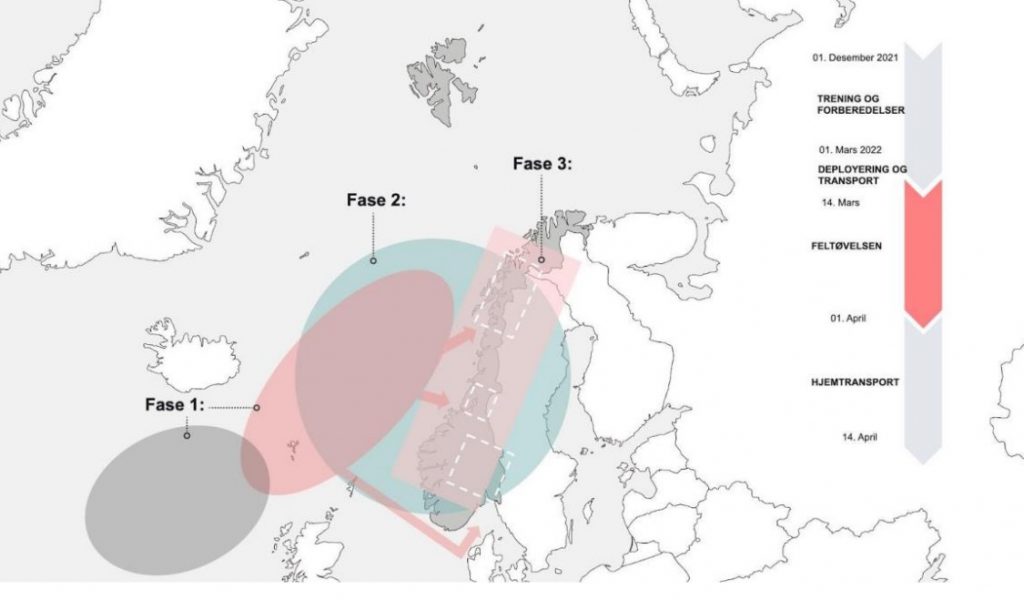
The three phases of the exercise:
Phase 1: Command of the sea (sea control) ensures that Allies are able to deploy to Norway. Sea control is ensured by the use of naval and air forces.
Phase 2: Air operations to ensure allied deployment. Norwegian troops secure important hubs for reception, and the Norwegian total defence prepares for the receiving allied troops and materiel.
Phase 3: Allied amphibious and land operations. These operations are carried out with the support of air and naval forces.
The carrier based F-35B Lightnings and ASW Merlin HM2s are key to sea control - that is why they are there.
The UK’s largest warship has left Portsmouth to lead a NATO task force to the Arctic for the biggest exercises in Norway for 30 years.
Aircraft carrier HMS Prince of Wales deploys in her role as NATO’s command ship to Exercise Cold Response, the large-scale Norwegian-led exercises which will see 35,000 troops from 28 nations operate together in the harshest environment.
Prince of Wales is responsible for leading NATO’s Maritime High Readiness Force – an international task group formed to deal with major global events – and deploys for the first time in that role to Cold Response.
Aboard the carrier are the most senior sea-going staff in the Royal Navy – Commander UK Strike Force, headed by Rear Admiral Mike Utley, who will lead a sizeable task force as part of a galvanized NATO effort for peace and stability in Europe.
Rear Admiral Utley said: “NATO is the cornerstone of the UK defence and our commitment to the alliance is absolute.
“It is a privilege to be the UK Maritime Component Commander as we participate in this Norwegian-led exercise.”
Prince of Wales will be at the head of a powerful maritime task force, which, alongside aircraft and land forces – including Royal Marines Commandos – will show how a unified multilateral force would defend Norway and Europe’s northern flank from a modern adversary.
Then, despite having learnt to use phrases like "defence of the task group", the author of that article then describes all the other task group assets as a ring of steel to defend the carrier, instead of being to achieve sea control and then moving towards the amphibious landing areas. For crying out loud!
Exercise Cold Response 22 Fact Sheet - Norwegian Armed Forces
The three phases of the exercise:
Phase 1: Command of the sea (sea control) ensures that Allies are able to deploy to Norway. Sea control is ensured by the use of naval and air forces.
Phase 2: Air operations to ensure allied deployment. Norwegian troops secure important hubs for reception, and the Norwegian total defence prepares for the receiving allied troops and materiel.
Phase 3: Allied amphibious and land operations. These operations are carried out with the support of air and naval forces.
The carrier based F-35B Lightnings and ASW Merlin HM2s are key to sea control - that is why they are there.
Joined: May 2003
Posts: 3,081
Likes: 252
From: London/Oxford/New York
HMS Prince of Wales departs Portsmouth to lead NATO task force in the Arctic - Royal Navy
The UK’s largest warship has left Portsmouth to lead a NATO task force to the Arctic for the biggest exercises in Norway for 30 years.
Aircraft carrier HMS Prince of Wales deploys in her role as NATO’s command ship to Exercise Cold Response, the large-scale Norwegian-led exercises which will see 35,000 troops from 28 nations operate together in the harshest environment.
Prince of Wales is responsible for leading NATO’s Maritime High Readiness Force – an international task group formed to deal with major global events – and deploys for the first time in that role to Cold Response.
Aboard the carrier are the most senior sea-going staff in the Royal Navy – Commander UK Strike Force, headed by Rear Admiral Mike Utley, who will lead a sizeable task force as part of a galvanized NATO effort for peace and stability in Europe.
Rear Admiral Utley said: “NATO is the cornerstone of the UK defence and our commitment to the alliance is absolute.
“It is a privilege to be the UK Maritime Component Commander as we participate in this Norwegian-led exercise.”
Prince of Wales will be at the head of a powerful maritime task force, which, alongside aircraft and land forces – including Royal Marines Commandos – will show how a unified multilateral force would defend Norway and Europe’s northern flank from a modern adversary.
Then, despite having learnt to use phrases like "defence of the task group", the author of that article then describes all the other task group assets as a ring of steel to defend the carrier, instead of being to achieve sea control and then moving towards the amphibious landing areas. For crying out loud!
Exercise Cold Response 22 Fact Sheet - Norwegian Armed Forces
The three phases of the exercise:
Phase 1: Command of the sea (sea control) ensures that Allies are able to deploy to Norway. Sea control is ensured by the use of naval and air forces.
Phase 2: Air operations to ensure allied deployment. Norwegian troops secure important hubs for reception, and the Norwegian total defence prepares for the receiving allied troops and materiel.
Phase 3: Allied amphibious and land operations. These operations are carried out with the support of air and naval forces.
The carrier based F-35B Lightnings and ASW Merlin HM2s are key to sea control - that is why they are there.
The UK’s largest warship has left Portsmouth to lead a NATO task force to the Arctic for the biggest exercises in Norway for 30 years.
Aircraft carrier HMS Prince of Wales deploys in her role as NATO’s command ship to Exercise Cold Response, the large-scale Norwegian-led exercises which will see 35,000 troops from 28 nations operate together in the harshest environment.
Prince of Wales is responsible for leading NATO’s Maritime High Readiness Force – an international task group formed to deal with major global events – and deploys for the first time in that role to Cold Response.
Aboard the carrier are the most senior sea-going staff in the Royal Navy – Commander UK Strike Force, headed by Rear Admiral Mike Utley, who will lead a sizeable task force as part of a galvanized NATO effort for peace and stability in Europe.
Rear Admiral Utley said: “NATO is the cornerstone of the UK defence and our commitment to the alliance is absolute.
“It is a privilege to be the UK Maritime Component Commander as we participate in this Norwegian-led exercise.”
Prince of Wales will be at the head of a powerful maritime task force, which, alongside aircraft and land forces – including Royal Marines Commandos – will show how a unified multilateral force would defend Norway and Europe’s northern flank from a modern adversary.
Then, despite having learnt to use phrases like "defence of the task group", the author of that article then describes all the other task group assets as a ring of steel to defend the carrier, instead of being to achieve sea control and then moving towards the amphibious landing areas. For crying out loud!
Exercise Cold Response 22 Fact Sheet - Norwegian Armed Forces
The three phases of the exercise:
Phase 1: Command of the sea (sea control) ensures that Allies are able to deploy to Norway. Sea control is ensured by the use of naval and air forces.
Phase 2: Air operations to ensure allied deployment. Norwegian troops secure important hubs for reception, and the Norwegian total defence prepares for the receiving allied troops and materiel.
Phase 3: Allied amphibious and land operations. These operations are carried out with the support of air and naval forces.
The carrier based F-35B Lightnings and ASW Merlin HM2s are key to sea control - that is why they are there.
But they're not, are they? They are back at their main bases and the carrier is a glorified and very expensive communications hub!


Joined: Sep 2015
Aviation Qualifications: PPL
Posts: 663
Likes: 398
From: London