


Ethiopian airliner down in Africa


Joined: Dec 2010
Posts: 910
Likes: 47
From: Perth, WESTERN AUSTRALIA
Have they considered that they may have a backlash from the flying public to contend with?
How can they make such a prediction anyway unless the ET incident has been properly investigated and a cause found that excludes MCAS?
And if it excludes MCAS, then what about the alternate cause of that incident?
And now loop back to the "flying public".

Pegase Driver

Joined: May 1997
Aviation Qualifications: ATCO
Posts: 4,447
Likes: 1,153
From: Europe
From Boeing statement
So Lion air only. But the ET aftermath is not yet be known, so until it is made known to certification authorities and then unless it shows the exact same issue as Lion air , I do not think independent authorities like EASA or Canada are going to lift the ban..
Soon we'll release a software update and related pilot training for the 737 MAX that will address concerns discovered in the aftermath of the Lion Air Flight 610 accident.

Joined: Nov 2007
Posts: 2
Likes: 0
From: dublin
On previous models opposing stab movement with yoke automatically jammed the stab and stopped it moving. Consider... Much more dangerous than MACS is a fault called runaway stabiliser where the STAB runs out of control until it hits the stops and we all say the Lord’s Prayer and goodbye.Except that this is not what happens. Pilot sees /senses/feels/ hears (it’s loud) stab runaway and counteracts initially with control yoke , THUS STOPPING THE STAB , MOVING. Then , applies opposite stab trim , and finally if none of this succeeds, STAB OFF switches. And from years of watching pilots do this NNP procedure they usually get it stopped PDQ. And if it runs a long way out of trim, they trim it back manually. It’s never been a problem. Are you now saying that the trim was permitted due to a tech issue to run so far forward nose down as to result in a vertical dive - AND THERE WAS NOTHING WE COULD DO ABOUT IT? That’s what I’m getting from a lot of this feedback. Have I misunderstood. Because I’ve heard nothing from any source so far to suggest that this plane was unfliable.
Talk tomorrow. It’s late here.
Yanrair
Talk tomorrow. It’s late here.
Yanrair

Joined: Feb 2009
Posts: 379
Likes: 0
From: Seattle
On previous models opposing stab movement with yoke automatically jammed the stab and stopped it moving. Consider... Much more dangerous than MACS is a fault called runaway stabiliser where the STAB runs out of control until it hits the stops and we all say the Lord’s Prayer and goodbye.Except that this is not what happens. Pilot sees /senses/feels/ hears (it’s loud) stab runaway and counteracts initially with control yoke , THUS STOPPING THE STAB , MOVING. Then , applies opposite stab trim , and finally if none of this succeeds, STAB OFF switches. And from years of watching pilots do this NNP procedure they usually get it stopped PDQ. And if it runs a long way out of trim, they trim it back manually. It’s never been a problem. Are you now saying that the trim was permitted due to a tech issue to run so far forward nose down as to result in a vertical dive - AND THERE WAS NOTHING WE COULD DO ABOUT IT? That’s what I’m getting from a lot of this feedback. Have I misunderstood. Because I’ve heard nothing from any source so far to suggest that this plane was unfliable.
Talk tomorrow. It’s late here.
Yanrair
Talk tomorrow. It’s late here.
Yanrair
Timeliness of stab cutout shutdown of misbehaving MCAS is not as critical as long as the crew continues to oppose it via pilot trim inputs to keep close to pitch trim while diagnosis of need for stab cutout switch activation is made. Lion Air pilot on accident flight was able to manage pitch control for many minutes in presence of MCAS responding to errant AOA with repeated airplane nose down trim commands that had to be walked back to trim via thumb switch commands. It was only after control was transferred to the right seat and the F/O failed to provide sufficient airplane nose up trim to fully counter each MCAS increment of airplane nose down trim that the stabilizer move progressively more airplane nose down to the point where full aft column was not sufficient to keep the nose up. As has been noted in earlier posts, increasing airspeed once in the dive made the situation worse as elevator authority was reduced due to actuation blowback.
Psychophysiological entity

Joined: Jun 2001
Aviation Qualifications: ATPL
Posts: 3,383
Likes: 169
From: Walton on the Naze Essex.
yanrair
Perhaps not so dangerous, since it is a well practised memory item and should be contained in a moment. What is proving to be the real danger is the timing of the symptoms. With the added problems of other chaotic items, the MCAS's progress is insidious - "proceeding in a gradual, subtle way, but with very harmful effects".
Just the word for this situation.
.
.
"... Much more dangerous than MACS is a fault called runaway stabiliser where the STAB runs out of control until it hits the stops and we all say the Lord’s Prayer and goodbye . . ."
Just the word for this situation.
.
.
Last edited by Loose rivets; 20th March 2019 at 00:29.
Joined: Nov 2015
Posts: 289
Likes: 0
From: Paisley, Florida USA
The 737 stabilizer trim wheel (actually two, one on each side of the aislestand with mechanical connection between) is a basic part of all 737 flight decks. As it is mechanically linked to the stabilizer jack screw nut, it moves to reflect any motion of the jack screw nut. Any extension or retraction of the jack screw requires that the jack screw nut rotate thus will be observable on the flight deck in the form or trim wheel rotation. The flight deck also has a readout showing the position of the horizontal stabilizer.
I tried to attach, for comment, a diagram of the 737 NG trim system I had found on line, but was unable to do so, and when I attempted to post a link to the diagram I was informed that I don't yet have the required 10 posts to allow me to post links. Anyway, the name of the site with the diagram is "Satcom Guru".
Joined: Jul 2010
Aviation Qualifications: ATPL
Posts: 1,775
Likes: 277
From: Asia
The whole process of certifying the Max will be gone through with a fine tooth comb by government experts. Senior people are going to be appearing before committees and grilled under oath, a whole can of worms is going to be opened up. Lawyers, investigative journalists and top experts in various fields are going to be running at full speed.
The American system is unmatched when it comes to digging up the real story and laying it out in public.
The American system is unmatched when it comes to digging up the real story and laying it out in public.

Joined: Apr 2015
Aviation Qualifications: Spotter
Posts: 1,130
Likes: 429
From: Under the radar, over the rainbow
The whole process of certifying the Max will be gone through with a fine tooth comb by government experts. Senior people are going to be appearing before committees and grilled under oath, a whole can of worms is going to be opened up. Lawyers, investigative journalists and top experts in various fields are going to be running at full speed.
The American system is unmatched when it comes to digging up the real story and laying it out in public.
The American system is unmatched when it comes to digging up the real story and laying it out in public.
Among any number of other issues, it seems likely that the insurance carriers that issue the policies required under 14 CFR 205 are paying close attention and communicating forcefully with the airlines.
Joined: Mar 2019
Posts: 5
Likes: 0
From: PA
Bloomberg reports that dead-heading pilot on penultimate Lion Air flight diagnosed the problem:
BREAKING: An off-duty pilot who happened to be riding in the cockpit saved a diving Boeing 737 Max 8. The next day, the same Lion Air jet crashed into the Java Sea, killing all 189 aboard
BREAKING: An off-duty pilot who happened to be riding in the cockpit saved a diving Boeing 737 Max 8. The next day, the same Lion Air jet crashed into the Java Sea, killing all 189 aboard
As the Lion Air crew fought to control their diving Boeing Co. 737 Max 8, they got help from an unexpected source: an off-duty pilot who happened to be riding in the cockpit.
That extra pilot, who was seated in the cockpit jumpseat, correctly diagnosed the problem and told the crew how to disable a malfunctioning flight-control system and save the plane, according to two people familiar with Indonesia’s investigation. The next day, under command of a different crew facing what investigators said was an identical malfunction, the jetliner crashed into the Java Sea killing all 189 aboard.
That extra pilot, who was seated in the cockpit jumpseat, correctly diagnosed the problem and told the crew how to disable a malfunctioning flight-control system and save the plane, according to two people familiar with Indonesia’s investigation. The next day, under command of a different crew facing what investigators said was an identical malfunction, the jetliner crashed into the Java Sea killing all 189 aboard.
Joined: Feb 2009
Posts: 379
Likes: 0
From: Seattle
I may be "picking nits" here, but my (limited) understanding of the 737 NG trim system is that the manual trim wheels are mechanically connected to the jack screw gearbox which rotates the jackscrew, resulting in linear (vertical in this case) movement of the jack screw nut. I guess it could be said that the trim wheels are linked to the jack screw nut, but that link is via the jackscrew itself (that's sorta nit-picking on my part right there). Anyway, my understanding (again limited) of the process is that the jack screw nut is attached to the structure of the horizontal stabilizer resulting in up/down movement of the stabilizer leading edge. Am I correct in my understanding that an electric motor(s) can drive the jackscrew gearbox via yoke-mounted trim switches?
I tried to attach, for comment, a diagram of the 737 NG trim system I had found on line, but was unable to do so, and when I attempted to post a link to the diagram I was informed that I don't yet have the required 10 posts to allow me to post links. Anyway, the name of the site with the diagram is "Satcom Guru".
I tried to attach, for comment, a diagram of the 737 NG trim system I had found on line, but was unable to do so, and when I attempted to post a link to the diagram I was informed that I don't yet have the required 10 posts to allow me to post links. Anyway, the name of the site with the diagram is "Satcom Guru".
Joined: Jun 2001
Posts: 5,896
Likes: 1
From: Rockytop, Tennessee, USA
A Bloomberg article credits a jumpseat rider with saving the plane on the Lion air flight prior to the JT610 accident.
Pilot Who Hitched a Ride Saved Lion Air 737 Day Before Deadly Crash
By Alan Levin and Harry Suhartono
March 19, 2019, 7:33 PM EDT
As the Lion Air crew fought to control their diving Boeing Co. 737 Max 8, they got help from an unexpected source: an off-duty pilot who happened to be riding in the cockpit.
That extra pilot, who was seated in the cockpit jumpseat, correctly diagnosed the problem and told the crew how to disable a malfunctioning flight-control system and save the plane, according to two people familiar with Indonesia’s investigation.
The next day, under command of a different crew facing what investigators said was an identical malfunction, the jetliner crashed into the Java Sea killing all 189 aboard.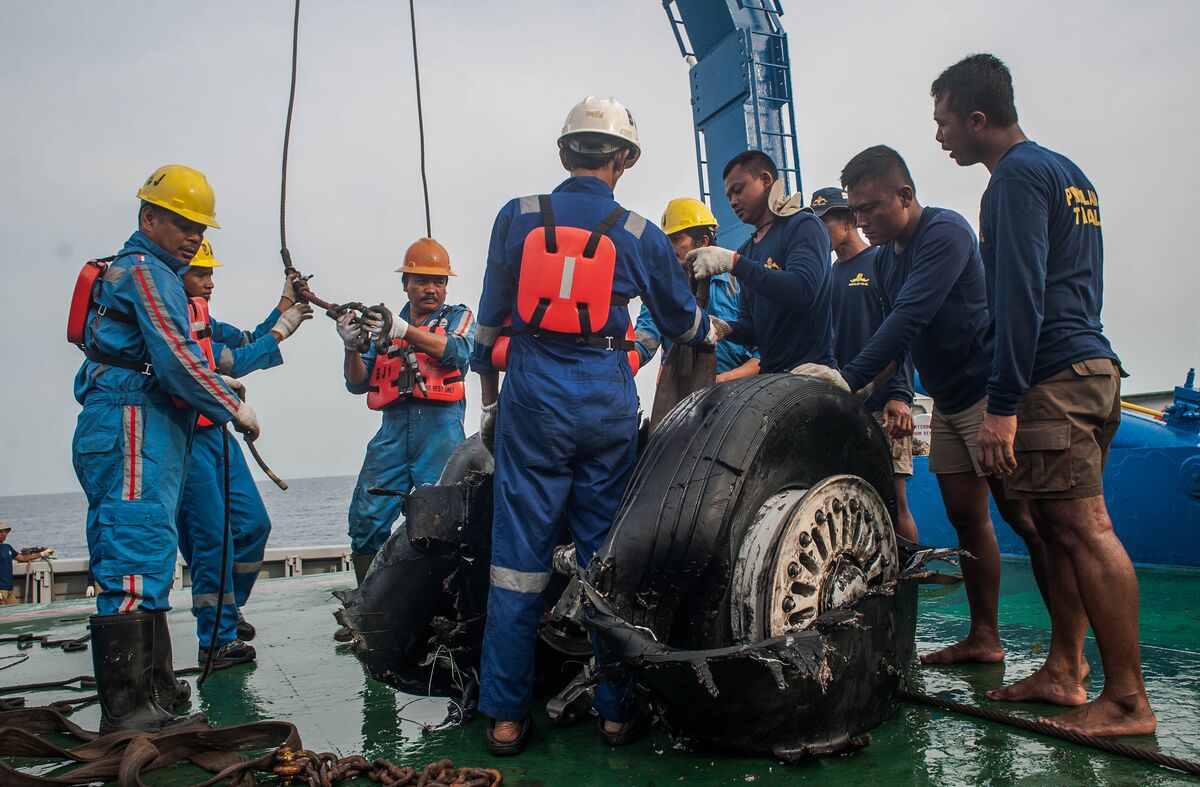 Rescuers recover the wheels of flight JT610 on Nov. 4.
Photographer: Fauzy Chaniago/EPA-EFE
The previously undisclosed detail on the earlier Lion Air flight represents a new clue in the mystery of how some 737 Max pilots faced with the malfunction have been able to avert disaster while the others lost control of their planes and crashed. The presence of a third pilot in the cockpit wasn’t contained in Indonesia’s National Transportation Safety Committee’s Nov. 28 report on the crash and hasn’t previously been reported.
The so-called dead-head pilot on the earlier flight from Bali to Jakarta told the crew to cut power to the motor driving the nose down, according to the people familiar, part of a checklist that all pilots are required to memorize.
“All the data and information that we have on the flight and the aircraft have been submitted to the Indonesian NTSC. We can’t provide additional comment at this stage due the ongoing investigation on the accident,” Lion Air spokesman Danang Prihantoro said by phone.
The Indonesia safety committee report said the plane had had multiple failures on previous flights and hadn’t been properly repaired.
Representatives for Boeing and the Indonesian safety committee declined to comment on the earlier flight.
The safety system, designed to keep planes from climbing too steeply and stalling, has come under scrutiny by investigators of the crash as well as a subsequent one less than five months later in Ethiopia. A malfunctioning sensor is believed to have tricked the Lion Air plane’s computers into thinking it needed to automatically bring the nose down to avoid a stall.
Boeing’s 737 Max was grounded March 13 by U.S. regulators after similarities to the Oct. 29 Lion Air crash emerged in the investigation of the March 10 crash of Ethiopian Airlines Flight 302. In the wake of the two accidents, questions have emerged about how Boeing’s design of the new 737 model were approved. The Transportation Department’s inspector general is conducting a review of how the plane was certified to fly and a grand jury under the U.S. Justice Department is also seeking records in a possible criminal probe of the plane’s certification.
The FAA last week said it planned to mandate changes in the system to make it less likely to activate when there is no emergency. The agency and Boeing said they are also going to require additional training and references to it in flight manuals.
“We will fully cooperate in the review in the Department of Transportation’s audit,” Boeing spokesman Charles Bickers said in an email. The company has declined to comment on the criminal probe.
Earlier: Boeing-FAA Scrutiny Is Stepped Up as U.S. Reviews Max’s Approval
After the Lion Air crash, two U.S. pilots’ unions said the potential risks of the system, known as the Maneuvering Characteristics Augmentation System, or MCAS, hadn’t been sufficiently spelled out in their manuals or training. None of the documentation for the Max aircraft included an explanation, the union leaders said.
“We don’t like that we weren’t notified,’’ Jon Weaks, president of the Southwest Airlines Pilots Association, said in November. “It makes us question, ‘Is that everything, guys?’ I would hope there are no more surprises out there.’’
The Allied Pilots Association union at American Airlines Group Inc. also said details about the system weren’t included in the documentation about the plane.
Following the Lion Air crash, the FAA required Boeing to notify airlines about the system and Boeing sent a bulletin to all customers flying the Max reminding them how to disable it in an emergency.
Authorities have released few details about Ethiopian Airlines Flight 302 other than it flew a “very similar” track as the Lion Air planes and then dove sharply into the ground. There have been no reports of maintenance issues with the Ethiopian Airlines plane before its crash.
If the same issue is also found to have helped bring down Ethiopian Airlines Flight 302, one of the most vexing questions crash investigators and aviation safety consultants are asking is why the pilots on that flight didn’t perform the checklist that disables the system.
“After this horrific Lion Air accident, you’d think that everyone flying this airplane would know that’s how you turn this off,” said Steve Wallace, the former director of the U.S. Federal Aviation Administration’s accident investigation branch.
The combination of factors required to bring down a plane in these circumstances suggests other issues may also have occurred in the Ethiopia crash, said Jeffrey Guzzetti, who also directed accident investigations at FAA and is now a consultant.
“It’s simply implausible that this MCAS deficiency by itself can down a modern jetliner with a trained crew,” Guzzetti said.
MCAS is driven by a single sensor near the nose that measures the so-called angle of attack, or whether air is flowing parallel to the length of the fuselage or at an angle. On the Lion Air flights, the angle-of-attack sensor had failed and was sending erroneous readings indicating the plane’s nose was pointed dangerously upward.
By Alan Levin and Harry Suhartono
March 19, 2019, 7:33 PM EDT
As the Lion Air crew fought to control their diving Boeing Co. 737 Max 8, they got help from an unexpected source: an off-duty pilot who happened to be riding in the cockpit.
That extra pilot, who was seated in the cockpit jumpseat, correctly diagnosed the problem and told the crew how to disable a malfunctioning flight-control system and save the plane, according to two people familiar with Indonesia’s investigation.
The next day, under command of a different crew facing what investigators said was an identical malfunction, the jetliner crashed into the Java Sea killing all 189 aboard.
Photographer: Fauzy Chaniago/EPA-EFE
The previously undisclosed detail on the earlier Lion Air flight represents a new clue in the mystery of how some 737 Max pilots faced with the malfunction have been able to avert disaster while the others lost control of their planes and crashed. The presence of a third pilot in the cockpit wasn’t contained in Indonesia’s National Transportation Safety Committee’s Nov. 28 report on the crash and hasn’t previously been reported.
The so-called dead-head pilot on the earlier flight from Bali to Jakarta told the crew to cut power to the motor driving the nose down, according to the people familiar, part of a checklist that all pilots are required to memorize.
“All the data and information that we have on the flight and the aircraft have been submitted to the Indonesian NTSC. We can’t provide additional comment at this stage due the ongoing investigation on the accident,” Lion Air spokesman Danang Prihantoro said by phone.
The Indonesia safety committee report said the plane had had multiple failures on previous flights and hadn’t been properly repaired.
Representatives for Boeing and the Indonesian safety committee declined to comment on the earlier flight.
The safety system, designed to keep planes from climbing too steeply and stalling, has come under scrutiny by investigators of the crash as well as a subsequent one less than five months later in Ethiopia. A malfunctioning sensor is believed to have tricked the Lion Air plane’s computers into thinking it needed to automatically bring the nose down to avoid a stall.
Boeing’s 737 Max was grounded March 13 by U.S. regulators after similarities to the Oct. 29 Lion Air crash emerged in the investigation of the March 10 crash of Ethiopian Airlines Flight 302. In the wake of the two accidents, questions have emerged about how Boeing’s design of the new 737 model were approved. The Transportation Department’s inspector general is conducting a review of how the plane was certified to fly and a grand jury under the U.S. Justice Department is also seeking records in a possible criminal probe of the plane’s certification.
The FAA last week said it planned to mandate changes in the system to make it less likely to activate when there is no emergency. The agency and Boeing said they are also going to require additional training and references to it in flight manuals.
“We will fully cooperate in the review in the Department of Transportation’s audit,” Boeing spokesman Charles Bickers said in an email. The company has declined to comment on the criminal probe.
Earlier: Boeing-FAA Scrutiny Is Stepped Up as U.S. Reviews Max’s Approval
After the Lion Air crash, two U.S. pilots’ unions said the potential risks of the system, known as the Maneuvering Characteristics Augmentation System, or MCAS, hadn’t been sufficiently spelled out in their manuals or training. None of the documentation for the Max aircraft included an explanation, the union leaders said.
“We don’t like that we weren’t notified,’’ Jon Weaks, president of the Southwest Airlines Pilots Association, said in November. “It makes us question, ‘Is that everything, guys?’ I would hope there are no more surprises out there.’’
The Allied Pilots Association union at American Airlines Group Inc. also said details about the system weren’t included in the documentation about the plane.
Following the Lion Air crash, the FAA required Boeing to notify airlines about the system and Boeing sent a bulletin to all customers flying the Max reminding them how to disable it in an emergency.
Authorities have released few details about Ethiopian Airlines Flight 302 other than it flew a “very similar” track as the Lion Air planes and then dove sharply into the ground. There have been no reports of maintenance issues with the Ethiopian Airlines plane before its crash.
If the same issue is also found to have helped bring down Ethiopian Airlines Flight 302, one of the most vexing questions crash investigators and aviation safety consultants are asking is why the pilots on that flight didn’t perform the checklist that disables the system.
“After this horrific Lion Air accident, you’d think that everyone flying this airplane would know that’s how you turn this off,” said Steve Wallace, the former director of the U.S. Federal Aviation Administration’s accident investigation branch.
The combination of factors required to bring down a plane in these circumstances suggests other issues may also have occurred in the Ethiopia crash, said Jeffrey Guzzetti, who also directed accident investigations at FAA and is now a consultant.
“It’s simply implausible that this MCAS deficiency by itself can down a modern jetliner with a trained crew,” Guzzetti said.
MCAS is driven by a single sensor near the nose that measures the so-called angle of attack, or whether air is flowing parallel to the length of the fuselage or at an angle. On the Lion Air flights, the angle-of-attack sensor had failed and was sending erroneous readings indicating the plane’s nose was pointed dangerously upward.
Joined: Jun 2009
Posts: 594
Likes: 72
From: VA, USA
Soon we'll release a software update and related pilot training for the 737 MAX that will address concerns discovered in the aftermath of the Lion Air Flight 610 accident.
-GY
Joined: Nov 2018
Posts: 20
Likes: 0
From: Jakarta
https://www.google.co.id/amp/s/www.g...ada-senin-pagi
[UPDATE]
It was batik air pilot who riding along JT043
https://www.straitstimes.com/asia/se...search-for-fix
Last edited by Realbabilu; 20th March 2019 at 08:28.
Joined: Nov 2010
Posts: 206
Likes: 91
From: Canada
This make sense since there are news report said pax saw the pilot (may jump seat driver)came out to get a big book from his luggage on pax compartments at jt043
https://www.google.co.id/amp/s/www.g...ada-senin-pagi
Joined: Nov 2018
Posts: 20
Likes: 0
From: Jakarta
at 28 November 2018, knkt said this plane jt610 is not airworthy to flight.
https://www.bbc.com/indonesia/media-46375781
at 29 November 2018, lion air dissagre of knkt press release regarding airworthiness jt610, and will sue.
https://www.bbc.com/indonesia/indonesia-46357109
at 29 November 2018, knkt revise the press release that airplane jt610 was airworthy.
https://www.bbc.com/indonesia/indonesia-46382531
So ? It is airworthy to you ?
Joined: Jul 2008
Posts: 61
Likes: 0
From: Dubai
I may be "picking nits" here, but my (limited) understanding of the 737 NG trim system is that the manual trim wheels are mechanically connected to the jack screw gearbox which rotates the jackscrew, resulting in linear (vertical in this case) movement of the jack screw nut. I guess it could be said that the trim wheels are linked to the jack screw nut, but that link is via the jackscrew itself (that's sorta nit-picking on my part right there). Anyway, my understanding (again limited) of the process is that the jack screw nut is attached to the structure of the horizontal stabilizer resulting in up/down movement of the stabilizer leading edge. Am I correct in my understanding that an electric motor(s) can drive the jackscrew gearbox via yoke-mounted trim switches?
I tried to attach, for comment, a diagram of the 737 NG trim system I had found on line, but was unable to do so, and when I attempted to post a link to the diagram I was informed that I don't yet have the required 10 posts to allow me to post links. Anyway, the name of the site with the diagram is "Satcom Guru".
I tried to attach, for comment, a diagram of the 737 NG trim system I had found on line, but was unable to do so, and when I attempted to post a link to the diagram I was informed that I don't yet have the required 10 posts to allow me to post links. Anyway, the name of the site with the diagram is "Satcom Guru".
Joined: Jan 2008
Posts: 16
Likes: 0
From: Singapore
'Safety is at the core of who we are at Boeing, and ensuring safe and reliable travel on our airplanes is an enduring value and our absolute commitment to everyone.'
and
'Our entire team is devoted to the quality and safety of the aircraft we design, produce and support. I've dedicated my entire career to Boeing, working shoulder to shoulder with our amazing people and customers for more than three decades, and I personally share their deep sense of commitment.'
Why are corporate types incapable of issuing straightforward statements of fact without slathering them with corporate BS and cliché? It means nothing, it adds nothing. Of course they want safe and reliable transport, if only for financial reasons. Of course they want quality and safety. Are the people and customers 'amazing'? Not really.
and
'Our entire team is devoted to the quality and safety of the aircraft we design, produce and support. I've dedicated my entire career to Boeing, working shoulder to shoulder with our amazing people and customers for more than three decades, and I personally share their deep sense of commitment.'
Why are corporate types incapable of issuing straightforward statements of fact without slathering them with corporate BS and cliché? It means nothing, it adds nothing. Of course they want safe and reliable transport, if only for financial reasons. Of course they want quality and safety. Are the people and customers 'amazing'? Not really.
Joined: Oct 2017
Posts: 143
Likes: 0
From: Vienna
Joined: Jan 2008
Posts: 94
Likes: 0
From: Irvine, CA
A Message from Boeing CEO Dennis Muilenburg
To airlines, passengers and the aviation community:
We know lives depend on the work we do, and our teams embrace that responsibility with a deep sense of commitment every day. Our purpose at Boeing is to bring family, friends and loved ones together with our commercial airplanes—safely. The tragic losses of Ethiopian Airlines Flight 302 and Lion Air Flight 610 affect us all, uniting people and nations in shared grief for all those in mourning. Our hearts are heavy, and we continue to extend our deepest sympathies to the loved ones of the passengers and crew on board.
Safety is at the core of who we are at Boeing, and ensuring safe and reliable travel on our airplanes is an enduring value and our absolute commitment to everyone. This overarching[!!!] focus on safety spans and binds together our entire global aerospace industry and communities. We're united with our airline customers, international regulators and government authorities in our efforts to support the most recent investigation, understand the facts of what happened and help prevent future tragedies. Based on facts from the Lion Air Flight 610 accident and emerging data as it becomes available from the Ethiopian Airlines Flight 302 accident, we're taking actions to fully ensure the safety of the 737 MAX. We also understand and regret the challenges for our customers and the flying public caused by the fleet's grounding.
...
Our mission is to connect people and nations, protect freedom, explore our world and the vastness of space, and inspire the next generation of aerospace dreamers and doers—and we'll fulfill that mission only by upholding and living our values. That's what safety means to us. Together, we'll keep working to earn and keep the trust people have placed in Boeing.
 Dennis Muilenburg
Chairman, President and CEO
The Boeing Company
To airlines, passengers and the aviation community:
We know lives depend on the work we do, and our teams embrace that responsibility with a deep sense of commitment every day. Our purpose at Boeing is to bring family, friends and loved ones together with our commercial airplanes—safely. The tragic losses of Ethiopian Airlines Flight 302 and Lion Air Flight 610 affect us all, uniting people and nations in shared grief for all those in mourning. Our hearts are heavy, and we continue to extend our deepest sympathies to the loved ones of the passengers and crew on board.
Safety is at the core of who we are at Boeing, and ensuring safe and reliable travel on our airplanes is an enduring value and our absolute commitment to everyone. This overarching[!!!] focus on safety spans and binds together our entire global aerospace industry and communities. We're united with our airline customers, international regulators and government authorities in our efforts to support the most recent investigation, understand the facts of what happened and help prevent future tragedies. Based on facts from the Lion Air Flight 610 accident and emerging data as it becomes available from the Ethiopian Airlines Flight 302 accident, we're taking actions to fully ensure the safety of the 737 MAX. We also understand and regret the challenges for our customers and the flying public caused by the fleet's grounding.
...
Our mission is to connect people and nations, protect freedom, explore our world and the vastness of space, and inspire the next generation of aerospace dreamers and doers—and we'll fulfill that mission only by upholding and living our values. That's what safety means to us. Together, we'll keep working to earn and keep the trust people have placed in Boeing.
Dennis MuilenburgChairman, President and CEO
The Boeing Company
Last edited by Interflug; 20th March 2019 at 08:02.