


Helicopter Accident Isle of Wight


Joined: Mar 2019
Posts: 76
Likes: 13
From: Manchester
I suspect that is a down side of the flight school.... We do training every year for stuck left, stuck right, loss of thrust etc, none of which require autorotation.
As most know, (I have written an account on Pprune somewhere), I had stuck left pedal in an Astar with 6 passengers many years ago---landed it safely, no damage.
As most know, (I have written an account on Pprune somewhere), I had stuck left pedal in an Astar with 6 passengers many years ago---landed it safely, no damage.
I assume the change of CofG will be massive


Joined: Jul 2013
Posts: 842
Likes: 104
From: Kiwiland
There have been several catastrophic failures recently leading to loss of life. Have ballistic chutes ever been looked at as a last ditch survival mechanism for helos?
It has also been reported that families of those lost are crowd funding to pay for their repatriation. Would a helicopter flight be considered high risk? Would standard holiday insurance not pay out?
It has also been reported that families of those lost are crowd funding to pay for their repatriation. Would a helicopter flight be considered high risk? Would standard holiday insurance not pay out?

Joined: Jan 2019
Aviation Qualifications: LAME
Posts: 804
Likes: 645
From: Cumbria
Above the rotor disc there is only the rotor head. Size and weight may be problematic.
Below the rotor disc; it needs to deploy through the disc. Unless you're going to somehow jettison the blades, you're looking at scenarios where premature operation of the ballistic system will result in mutual destruction of both the rotor and ballistic systems.


Joined: Sep 2003
Posts: 2,081
Likes: 189
From: Redding CA, or on a fire somewhere

Joined: Jul 1999
Posts: 3,931
Likes: 142
From: Warrington, UK
When you live in the UK and holiday in the UK, you don't generally take out holiday insurance. I never have.

Joined: Jun 2002
Aviation Qualifications: PPL
Posts: 5,100
Likes: 321
From: east ESSEX
Here`s one I `prepared 60 yrs ago;one t/r blade `let go`,followed a millisecond later by the rest and t/r g/box;about 50 lbs x30 ft moved the Cof G to somewhere in the nose,needing cyclic on the back stop...almost..shut it down,pointing at a hilltop-hole in the jungle ,landed near top but on a 30* upslope,burst a mainwheel tyre,which stopped it rolling back!


Paxing All Over The World

Joined: May 2001
Posts: 10,842
Likes: 328
From: Hertfordshire, UK.
Amateur observation: Could the tail rotor have been lost at impact? It is suggested in this thread:
Could the 'bounce' as it hit the deck have caused a whiplash of the tail boom, so that the weight of the rotor and gearbox caused it to fracture?
... but massive vertical crushing.


Joined: Nov 2003
Posts: 1,937
Likes: 28
From: UK/OZ
Before the forced mandate for improved fuel cells in the r44 an impact such as this without an ensuing fire was rare. Survivors of such impacts rarer still.
In this case there are three fatalities and one survivor and we can reflect on continuing to improve the odds of occupant survivability in light aircraft, as best we can.
Absence of fire and a sole survivor does help a coroner determine the precise cause of death so over time I wonder if there is any more we can learn.
Having studied over 100 helicopter accidents I am aware that a spin from low altitude and impact without a subsequent fire, is often fatal even in an aircraft with a more elaborate impact absorbing seats such as an EC 130.
The investigation of the EC 130 accident in Rotterdam June 2010 is authoritative; from a 220ft hover the vertical impact speed was 31kph based on video of the accident.
There was one survivor.
I wonder if semi disposable flight helmets of a kind worn by skateboarders can play a role in walk up joy rides in GA?
I note middle airbags are now in use in between front seats of cars, presumably their introduction is based on data that head impacts made between passengers can and should be mitigated.
Maybe a cheap helmet can perform a similar role in GA?
In this case there are three fatalities and one survivor and we can reflect on continuing to improve the odds of occupant survivability in light aircraft, as best we can.
Absence of fire and a sole survivor does help a coroner determine the precise cause of death so over time I wonder if there is any more we can learn.
Having studied over 100 helicopter accidents I am aware that a spin from low altitude and impact without a subsequent fire, is often fatal even in an aircraft with a more elaborate impact absorbing seats such as an EC 130.
The investigation of the EC 130 accident in Rotterdam June 2010 is authoritative; from a 220ft hover the vertical impact speed was 31kph based on video of the accident.
There was one survivor.
I wonder if semi disposable flight helmets of a kind worn by skateboarders can play a role in walk up joy rides in GA?
I note middle airbags are now in use in between front seats of cars, presumably their introduction is based on data that head impacts made between passengers can and should be mitigated.
Maybe a cheap helmet can perform a similar role in GA?
Joined: Jul 2014
Posts: 446
Likes: 100
From: South East Asia
Reading a few extract of similar accident reports, the massive vertical energy of the crash results principally in broken back injuries and nervous system damage as a consequence.
As a passenger, I would take an energy absorbing seat and a 4 point harness with the center buckle set tight just below the chest, rather than a helmet.
I often wondered how to improve ones chance of survival, in preparation for such event, my conclusion was set your back as firmly as possible against the back of the seat, Vertebral compression is a better outcome.
 . Not something that the Chetwynd sessions would have prepared you for !
Joined: Jan 2012
Posts: 75
Likes: 3
From: Blackbushe City Limits
I live on the IoW and used to fly the exact same type and even colour. I'm struggling to imagine what might have occurred in straight and level flight to have caused this. Clipper II doesn't have carb heat. Experienced and presumably competent pilot. I cycled through Sandown airfield on 27th July and noticed what I believe to be that aircraft operating what appeared to be pleasure flights. Some ground crew with tabards and a small shelter for pax to check in by. I recall thinking I wouldn't want to be doing pleasure flights with an R44. The outfit I trained with, and did some ground crew work with for pleasure & VVIP flights at events, used jet/long box presumably because had more power available for when you don't know what pax weight you'll be loading up with next. But presumably this is a red herring as in this case the aircraft took off OK and was in the straight and level for a while. As for it being a flying lesson as reported by some of the media, is that credible or some kind of marketing gimmick? Only once I was some way into my PPL(H) training did I have someone in the back, which was normally a fellow student.
All very sad, RIP to the three that perished and I wish a speedy and full recovery to the fourth.
All very sad, RIP to the three that perished and I wish a speedy and full recovery to the fourth.
Joined: Oct 1999
Aviation Qualifications: ATPL
Posts: 7,373
Likes: 931
From: Den Haag
that aircraft operating what appeared to be pleasure flights. Some ground crew with tabards and a small shelter for pax to check in by
As for it being a flying lesson as reported by some of the media, is that credible or some kind of marketing gimmick?


Joined: Nov 1999
Aviation Qualifications: ATPL
Posts: 3,144
Likes: 741
From: UK
Just for info, and not wishing to be insensitive; could a helicopter pilot explain how a main rotor blade in flight could pitch low enough or deflect low enough to chop the tail boom. Are there not physical stops to prevent it ?
And secondly, what does the helicopter pilot have to do, and what options are there to control the 'craft after loss of a tail rotor or tail rotor thrust ?
This is not intended to criticise anybody at all; it's merely for my technical understanding, (for this fixed wing pilot).
And secondly, what does the helicopter pilot have to do, and what options are there to control the 'craft after loss of a tail rotor or tail rotor thrust ?
This is not intended to criticise anybody at all; it's merely for my technical understanding, (for this fixed wing pilot).

Guest
Joined: Jul 2017
Posts: 840
Likes: 236
I think carrying passengers in the back of a trial lesson (or any lesson) has been a bit of a grey area of contention for a while now. Some say it's ok if the passengers are "interested" in their PPL, or they are swapping round and all having a go up front on the controls.
Some operators use this grey area to do what is effectively "pleasure flying", but under the guise of flight instruction.
If rear seat passengers were sold a "sightseeing" style flight, then an it should be an AOC flight
Would inadvertent float deployment cause such an accident? I am not sure. It would certainly be a suprise and could result in an abrupt cyclic input, and hence tail chop.
for ref:
Passenger in training flight
Conducting a trial lesson with passengers in the back?
Passengers while instructing
Some operators use this grey area to do what is effectively "pleasure flying", but under the guise of flight instruction.
If rear seat passengers were sold a "sightseeing" style flight, then an it should be an AOC flight
Would inadvertent float deployment cause such an accident? I am not sure. It would certainly be a suprise and could result in an abrupt cyclic input, and hence tail chop.
for ref:
Passenger in training flight
Conducting a trial lesson with passengers in the back?
Passengers while instructing
Joined: Jun 2003
Aviation Qualifications: CPL
Posts: 15
Likes: 7
From: UK
- commercial air transport of passengers
- public transport of passengers
- flying training in aircraft above a specified weight
Joined: Oct 1999
Aviation Qualifications: ATPL
Posts: 7,373
Likes: 931
From: Den Haag
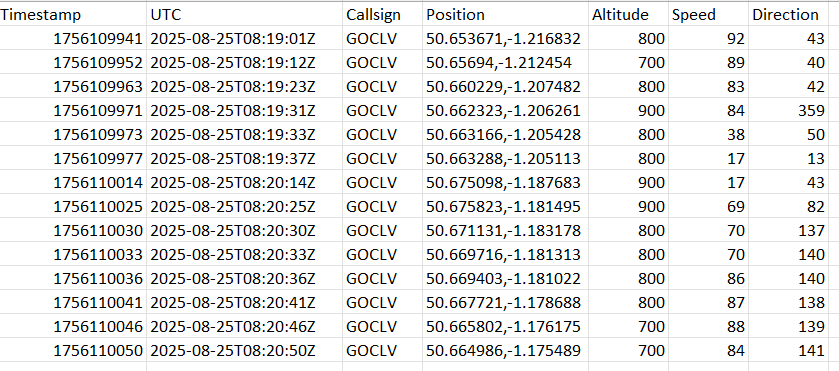
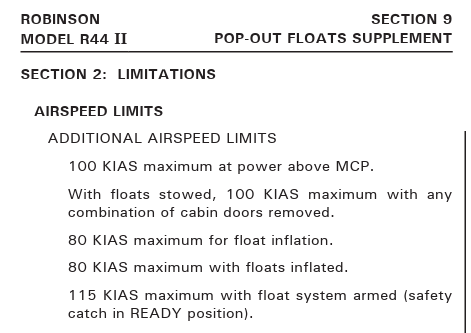
Interesting to see this Note in the POH:
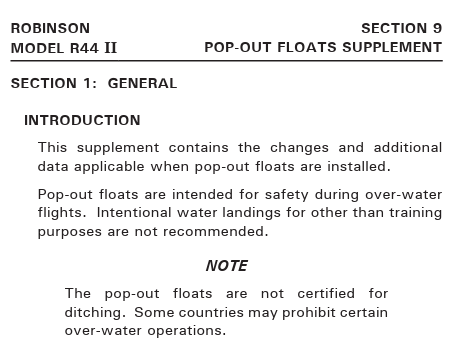
It begs the question - what are they for, if not ditching????
Guest
Joined: Jul 2017
Posts: 840
Likes: 236
- Flying Training:
Aerodromes that facilitate flying training for pilot qualifications in aircraft exceeding a specific weight (e.g., 2,730kg for aeroplanes) are also required to be licensed.
R44 MTOW is 2400 lbs (ie 1088 kg)