


AUKUS


Joined: Jul 2015
Posts: 300
Likes: 93
From: Lagrangian point 2
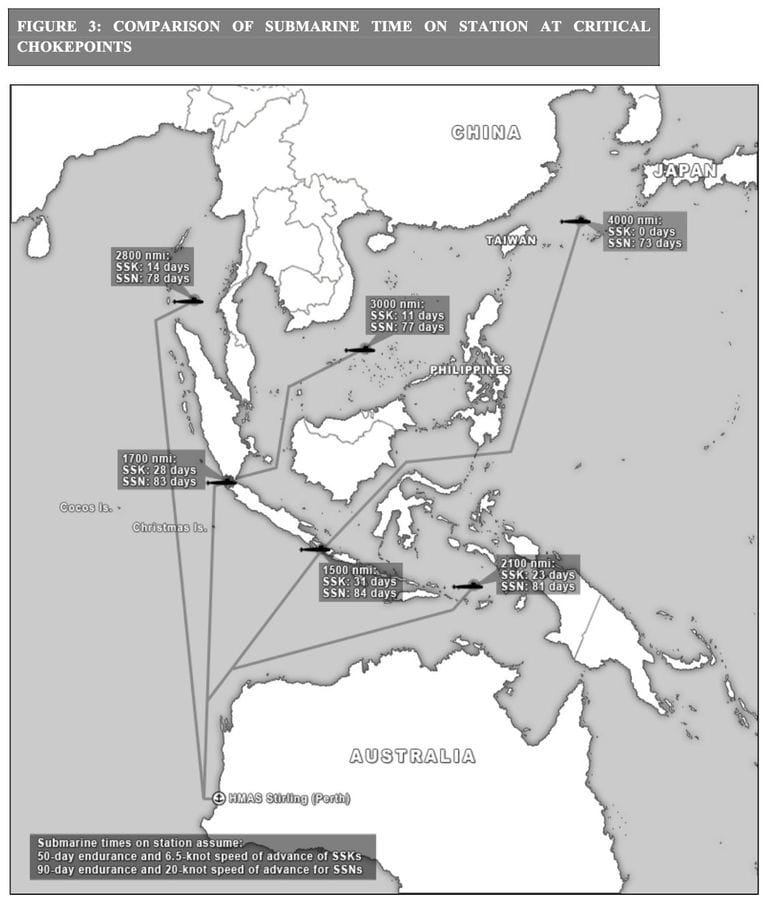
Yes. That graphic certainly explains some of the capability increase.
Can anyone explain why the proposed number to be purchased is at least 8 and not at least 9? I thought there was a long-standing ‘rule of three’ with naval hardware (one available/on station for every three due transit/maintenance/etc).
Surely pushing for at least 9 is a small extra price to pay for an even greater amount of available hulls at any one time? Or does 8 provide for something I don’t know about?


Joined: Jun 2001
Aviation Qualifications: ATPL
Posts: 1,898
Likes: 17
From: South Pole
Can anyone explain why the proposed number to be purchased is at least 8 and not at least 9? I thought there was a long-standing ‘rule of three’ with naval hardware (one available/on station for every three due transit/maintenance/etc).
Surely pushing for at least 9 is a small extra price to pay for an even greater amount of available hulls at any one time? Or does 8 provide for something I don’t know about?
Surely pushing for at least 9 is a small extra price to pay for an even greater amount of available hulls at any one time? Or does 8 provide for something I don’t know about?
There have been a number of statements where they talk about a “minimum of 8” SSN’s to be built in Australia, so they are leaving the option open for additional submarines if the political situation warrants it.


Joined: Apr 2011
Posts: 1,618
Likes: 205
From: aus
Joined: Jun 2001
Aviation Qualifications: ATPL
Posts: 1,898
Likes: 17
From: South Pole
If the US was to begin submarine operations out of Australia, the joint operations would create a case for a resupply/rearming facility to be built at Exmouth (near Learmonth RAAF Base) as this would reduce transit times and get these vessels back on station faster. There is deep water just to the West so it’s more suitable than Darwin. Also, the relative isolation of that area would mean the activities at that facility would not be subject to many prying eyes.
____________________________________________________________
This is a more comprehensive map showing RAN submarine operating areas than the one I previously posted.

Last edited by Going Boeing; 13th January 2022 at 23:15.


Joined: Oct 2018
Aviation Qualifications: PPL
Posts: 12,245
Likes: 1,657
From: Ferrara
"The waters around the Port of Darwin (Arafura Sea) are shallow and are not suitable for submarine operations. Also, the Northern coastline of Australia experience very large tidal changes which involve different docking requirements. Cyclones also present another issue."
You're also a very long way from significant technical resources and staff
You're also a very long way from significant technical resources and staff

Joined: May 2011
Posts: 1,358
Likes: 3
From: NEW YORK
"The waters around the Port of Darwin (Arafura Sea) are shallow and are not suitable for submarine operations. Also, the Northern coastline of Australia experience very large tidal changes which involve different docking requirements. Cyclones also present another issue."
You're also a very long way from significant technical resources and staff
You're also a very long way from significant technical resources and staff
Have to say, from a national policy perspective, it sure would make sense to have Perth as a West coast counterpart to all the current East coast infrastructure..
Joined: Jun 2002
Aviation Qualifications: ATPL
Posts: 2,238
Likes: 218
From: Eden Valley
Exmouth was used by the US Navy as a submarine base in WW2 as their Fleet submarines escaped from Manila Bay. It was considered too remote with a lack of infrastructure and had been bombed by the Japanese. Fremantle then became their base for conducting operations through the Indonesian archipelagic choke points and further afield. Incidentally, the USN used submarine tenders in Exmouth initially- are the relevant to the future of the RAN?
Battles of the last Pacific War seem ever so relevant today as the CCP’s influence creeps south. The last of GB’s theatre maps lacks East Coast weight? Considering the Coral Sea and vital lines of communication to the West Coast of the USA.
Battles of the last Pacific War seem ever so relevant today as the CCP’s influence creeps south. The last of GB’s theatre maps lacks East Coast weight? Considering the Coral Sea and vital lines of communication to the West Coast of the USA.
Joined: Mar 2016
Posts: 209
Likes: 10
From: Gafa
Thread Starter
Ecce Homo! Loquitur...
Joined: Jul 2000
Aviation Qualifications: Spotter
Posts: 24,642
Likes: 7,342
From: Peripatetic
Incidentally, the USN used submarine tenders in Exmouth initially- are the relevant to the future of the RAN?
Joined: Jun 2001
Aviation Qualifications: ATPL
Posts: 1,898
Likes: 17
From: South Pole
The USN has two 1970’s era submarine tenders forward based in Guam and which are due to be replaced in the mid-late 2020’s. It would be interesting to see if it was feasible to static base them near Learmonth/Exmouth in a cyclone protective harbour. It would be a quick way of providing this capability until more permanent facilities can be constructed.
https://www.navalnews.com/naval-news...-replacements/
https://www.navalnews.com/naval-news...-replacements/
Last edited by Going Boeing; 15th January 2022 at 20:33.
Joined: Oct 2018
Aviation Qualifications: PPL
Posts: 12,245
Likes: 1,657
From: Ferrara
"Is Perth any better in those respects?"
Its the sort of backup available on things like electronics companies, machine shops and the availability of skilled people - you're far better off for resources in a city of over 2 million than in one of less than 150,000. Tenders would work I guess but that's another layer of people and expense
Its the sort of backup available on things like electronics companies, machine shops and the availability of skilled people - you're far better off for resources in a city of over 2 million than in one of less than 150,000. Tenders would work I guess but that's another layer of people and expense
Joined: Apr 2011
Posts: 1,618
Likes: 205
From: aus
Joined: Jun 2001
Aviation Qualifications: ATPL
Posts: 1,898
Likes: 17
From: South Pole
In deep water, the submarine can change depth to sit just above or below temperature inversions to reduce the chances of detection from noise produced by the boat. In shallow water, the submarine captain has fewer evasion choices so enemy ASW assets (including submarines) can focus on the waters around the harbour to pick off submarines entering or leaving.
Joined: Jul 2013
Posts: 391
Likes: 105
From: Not a Pilot
Trump defence spokesperson questions AUKUS. Claims people in the military and conservative politicians don't want to share the technology.
https://www.skynews.com.au/opinion/c...017b9fe9da228b
https://www.skynews.com.au/opinion/c...017b9fe9da228b
Joined: Oct 2004
Posts: 82
Likes: 3
From: UK
As Rattman said, it’s the depth of water around the harbour that is important.
In deep water, the submarine can change depth to sit just above or below temperature inversions to reduce the chances of detection from noise produced by the boat. In shallow water, the submarine captain has fewer evasion choices so enemy ASW assets (including submarines) can focus on the waters around the harbour to pick off submarines entering or leaving.
In deep water, the submarine can change depth to sit just above or below temperature inversions to reduce the chances of detection from noise produced by the boat. In shallow water, the submarine captain has fewer evasion choices so enemy ASW assets (including submarines) can focus on the waters around the harbour to pick off submarines entering or leaving.
The advantage of being close to deeper water is speed of deployment.
A SSN can trundle about the depths at sustained speed. But there are are operational consrtaints. It needs a specific range of depth to do that speedy trundling safely in peacetime with a decent amount of water above and decent amount below.
So if you sit your SSN harbour facility somewhere where there are 100s of km of shallow waters to transit then getting the boats in and out means a slower transit time - if you lose a couple of days or more getting out and the same again getting back then that reduces time on station and adds to your lifetime costs.(Losing 4 days on 90 day patrol is 5% over the lifetime). If you end up doing much of that transit on the surface then you're visible and vulnerable.
Joined: Apr 2011
Posts: 1,618
Likes: 205
From: aus
and there might only be a limited amount of routes out
Its why australia doesn't base any real surface combatants inside the barrier reef. Theres only limited routes through the reef and its easy to block these with mines or other forces
Its why australia doesn't base any real surface combatants inside the barrier reef. Theres only limited routes through the reef and its easy to block these with mines or other forces