


Future Carrier (Including Costs)


Joined: Dec 2001
Aviation Qualifications: Military
Posts: 2,965
Likes: 484
From: The Roman Empire
No doubt the greatest moment of the Royal Navy in living memory was the Falklands conflict - which had nothing to do with a "threat to NATO".
Since 1982, rightly or wrongly, the British Army has committed significant number of troops to combat operations in Kuwait, Iraq and Afghanistan. Again not NATO operations.
British armed forces have historically, again one can argue rightly or wrongly, been repeatedly committed to operations that have little or nothing to do with NATO. They are an instrument of Britain foreign policy, and provide the politicians with options.
While a debate of the various size of Navy, Army, Airforce assets in a limited funding scenario is valid, this being pprunemil, I can alas see such a discussion rapidly descending into a p***ing contest where people argue for their "favoured" service.
And no, I 'm not ex Army.
Since 1982, rightly or wrongly, the British Army has committed significant number of troops to combat operations in Kuwait, Iraq and Afghanistan. Again not NATO operations.
British armed forces have historically, again one can argue rightly or wrongly, been repeatedly committed to operations that have little or nothing to do with NATO. They are an instrument of Britain foreign policy, and provide the politicians with options.
While a debate of the various size of Navy, Army, Airforce assets in a limited funding scenario is valid, this being pprunemil, I can alas see such a discussion rapidly descending into a p***ing contest where people argue for their "favoured" service.
And no, I 'm not ex Army.


Joined: Oct 2018
Aviation Qualifications: PPL
Posts: 12,213
Likes: 1,648
From: Ferrara
"To do what exactly? The land threat to NATO is on the Finnish, Norwegian, Estonian, Latvian, Lithuanian, Polish Turkish and then arguably Romanian, Bulgarian, Greek, German, Czech, Slovakian, Swedish borders."
that's what we thought in both 1914 & 1939 - the French would handle the Germans - bad call.................. the RN did nothing to stop the German Army overrunning most of NW Europe
that's what we thought in both 1914 & 1939 - the French would handle the Germans - bad call.................. the RN did nothing to stop the German Army overrunning most of NW Europe
Joined: Apr 2006
Posts: 807
Likes: 425
From: Portsmouth
"To do what exactly? The land threat to NATO is on the Finnish, Norwegian, Estonian, Latvian, Lithuanian, Polish Turkish and then arguably Romanian, Bulgarian, Greek, German, Czech, Slovakian, Swedish borders."
that's what we thought in both 1914 & 1939 - the French would handle the Germans - bad call.................. the RN did nothing to stop the German Army overrunning most of NW Europe
that's what we thought in both 1914 & 1939 - the French would handle the Germans - bad call.................. the RN did nothing to stop the German Army overrunning most of NW Europe

Thread Starter
Joined: Feb 2002
Posts: 2,967
Likes: 100
From: Devon
Branch Fanatic
your support for the RN and amazing detailed knowledge is well respected ( my original posting from Valley was to Buccs ,probably on Ark Royal ,until it was cancelled when Denis Healey withdrew his support for carriers back in the 60s )
BUT there is a current debate going on in the States over the viability of carriers in the future and we do seem to be devoid of essential items / manpower for the realistic defence of the UK so it is reasonable to continue the debate over where to best spend the money.
A big reason to keep the carriers of course is the vast amount of money already spent.
your support for the RN and amazing detailed knowledge is well respected ( my original posting from Valley was to Buccs ,probably on Ark Royal ,until it was cancelled when Denis Healey withdrew his support for carriers back in the 60s )
BUT there is a current debate going on in the States over the viability of carriers in the future and we do seem to be devoid of essential items / manpower for the realistic defence of the UK so it is reasonable to continue the debate over where to best spend the money.
A big reason to keep the carriers of course is the vast amount of money already spent.
The debate over the viability of carriers has probably changed since the advent of AIM-174 long range AAM (and it can kill pretty much everything else apart from a submerged submarine) several weeks ago, and recent events have proved the anti ship missiles are not the undefeatable killer some people think they are. You could ask the question is the force more able with or without a carrier to:
a. Detect and engage enemy aircraft armed with anti ship missiles, that can be fired well beyond the limited radar horizon of surface radars?
b. Maintain a constant CAP several hundred miles or more from the nearest friendly airbase, without needing large numbers of fights and tankers?
c. Maintain constant ASW helicopter operations without coordination, communications, or logistics/support difficulties?
A carrier is not an end in itself, it is merely a means to an end. It's a means of projecting air power. An on task carrier group, fully equipped, fully supported, is a useful, albeit very expensive, asset to have. But we don't have that.
We have two carriers, making availability uncertain. They also seem to have reliability issues - and please don't tell me they're teething troubles given how long they've been in the water.
They don't have an adequate air group. We don't have a credible AEW capacity. We are short of F-35s, and they are a joint, not RN only, asset (A debate I won't get into here). The F-35s we do have are no doubt double, triple or quadruple hatred, and as the primary air asset in a high threat environment, may be required elsewhere. Their V/STOL capability would also enable them to operate from remote and/or austere LAND locations. We are short of ASW helicopter airframes, in terms of a carrier based ASW hunting group. Stripping training units to equip a carrier air group for a two week exercise is not the same as being able to run sustained combat operations.
We are short of frigates, destroyers and SSNs to protect the carrier itself - and don't tell me other NATO countries will provide them.
We are massively short of support units to keep a carrier group on station, replenishing fuel, ordnance, etc.
We seem to have adopted the approach of buying the carriers and then hoping we can find everything else needed to make them viable downstream.
So, while I'm not necessarily advocating scrapping the carriers, I do feel it's a discussion worth having. The current make do and mend situation is neither one thing or the other, and I don't think it's kidding (deterring) anyone, except maybe a few UK politicians.
We have two carriers, making availability uncertain. They also seem to have reliability issues - and please don't tell me they're teething troubles given how long they've been in the water.
They don't have an adequate air group. We don't have a credible AEW capacity. We are short of F-35s, and they are a joint, not RN only, asset (A debate I won't get into here). The F-35s we do have are no doubt double, triple or quadruple hatred, and as the primary air asset in a high threat environment, may be required elsewhere. Their V/STOL capability would also enable them to operate from remote and/or austere LAND locations. We are short of ASW helicopter airframes, in terms of a carrier based ASW hunting group. Stripping training units to equip a carrier air group for a two week exercise is not the same as being able to run sustained combat operations.
We are short of frigates, destroyers and SSNs to protect the carrier itself - and don't tell me other NATO countries will provide them.
We are massively short of support units to keep a carrier group on station, replenishing fuel, ordnance, etc.
We seem to have adopted the approach of buying the carriers and then hoping we can find everything else needed to make them viable downstream.
So, while I'm not necessarily advocating scrapping the carriers, I do feel it's a discussion worth having. The current make do and mend situation is neither one thing or the other, and I don't think it's kidding (deterring) anyone, except maybe a few UK politicians.
You can blame much of that on politicians who did not see the need for ASW or other maritime (or air) capabilities - not the way that frigate numbers were cut by Hoon, Type 45 orders were cut from first twelve to eight - and then ships seven and eight never materialised, then we had more cuts under CMD/Fox (CMD wanted to cut even more - and would have done so without the carriers), and then ships have been prematurely retired in the hope that there replacements are not delayed, despite not having been ordered yet. Much of this comes down to a lack of people - in 2015 the RN and RAF both expected an uplift of about 1500 bodies each, but Cameron did not want to upset Tory backbenchers who worried about their old regiments.
Like when the contract to upgrade the Merlin HM1 to HM2 was placed, only thirty out of forty odd aircraft got the upgrade. A perceived lack of submarine threat was used as justification - and you may remember many on here insisting that they should all be axed as everything would be land centric in future. Unfortunately the spare airframes were butchered for parts to marinise the Jungly Merlin, however their are plans to augment them with sonobouy dropping UAVs. There is also the fact that modern towed array sonars allow long range submarine detection and more efficient use of airborne assets.
In 2021 the Merlin force put seven aboard HMS Queen Elizabeth for the CSG 21 deployment (which CO 820 said allowed for constant ASW, plus there were others aboard HMS Prince of Wales for trials, and others aboard frigates or ashore for NATO/national tasking. Earlier this year nine deployed for Steadfast Defender 2024. No enough, but not zero.
You might also note that the acute threat is in the NATO theatre, where task groups are multinational by design, and would be if we did have more warships of our own. Carrier groups in the Middle East often have a multinational flavour, and there is current an American Amphibious Ready Group with an RN Type 45 as its sole escort.
If a likely task might be to protect maritime reinforcements and amphibious forces to Norway, you could ask the question is the force more able with or without a carrier to:
a. Detect and engage enemy aircraft armed with anti ship missiles, that can be fired well beyond the limited radar horizon of surface radars?
b. Maintain a constant CAP several hundred miles or more from the nearest friendly airbase, without needing large numbers of fights and tankers?
c. Maintain constant ASW helicopter operations without coordination, communications, or logistics/support difficulties?
Some of us consider that there is such a thing as seapower - and the carrier is vital for that, which is why it exists. As far as I know the plan is to always have one at R2 readiness. Also the issue with the shafts has been dealt with now - in both of them.
No doubt the greatest moment of the Royal Navy in living memory was the Falklands conflict - which had nothing to do with a "threat to NATO".
Since 1982, rightly or wrongly, the British Army has committed significant number of troops to combat operations in Kuwait, Iraq and Afghanistan. Again not NATO operations.
British armed forces have historically, again one can argue rightly or wrongly, been repeatedly committed to operations that have little or nothing to do with NATO. They are an instrument of Britain foreign policy, and provide the politicians with options.
While a debate of the various size of Navy, Army, Airforce assets in a limited funding scenario is valid, this being pprunemil, I can alas see such a discussion rapidly descending into a p***ing contest where people argue for their "favoured" service.
And no, I 'm not ex Army.
Since 1982, rightly or wrongly, the British Army has committed significant number of troops to combat operations in Kuwait, Iraq and Afghanistan. Again not NATO operations.
British armed forces have historically, again one can argue rightly or wrongly, been repeatedly committed to operations that have little or nothing to do with NATO. They are an instrument of Britain foreign policy, and provide the politicians with options.
While a debate of the various size of Navy, Army, Airforce assets in a limited funding scenario is valid, this being pprunemil, I can alas see such a discussion rapidly descending into a p***ing contest where people argue for their "favoured" service.
And no, I 'm not ex Army.
Nothing to do with NATO perhaps - but the Falklands presented a scenario which was not a million miles from that likely to be encountered in the Northern Flank. As far as I know Kuwait, Iraq, and Afghanistan were all coalition operations.
What is your point?
"To do what exactly? The land threat to NATO is on the Finnish, Norwegian, Estonian, Latvian, Lithuanian, Polish Turkish and then arguably Romanian, Bulgarian, Greek, German, Czech, Slovakian, Swedish borders."
that's what we thought in both 1914 & 1939 - the French would handle the Germans - bad call.................. the RN did nothing to stop the German Army overrunning most of NW Europe
that's what we thought in both 1914 & 1939 - the French would handle the Germans - bad call.................. the RN did nothing to stop the German Army overrunning most of NW Europe
I seem to recall that a large British force was sent to France - and was defeated and had evacuated by sea. They could not be put ashore in mainland Europe again until control of the Atlantic had been secured and vast amounts of material and American and Canadian troops transported over the Atlantic. This graph may interest you:
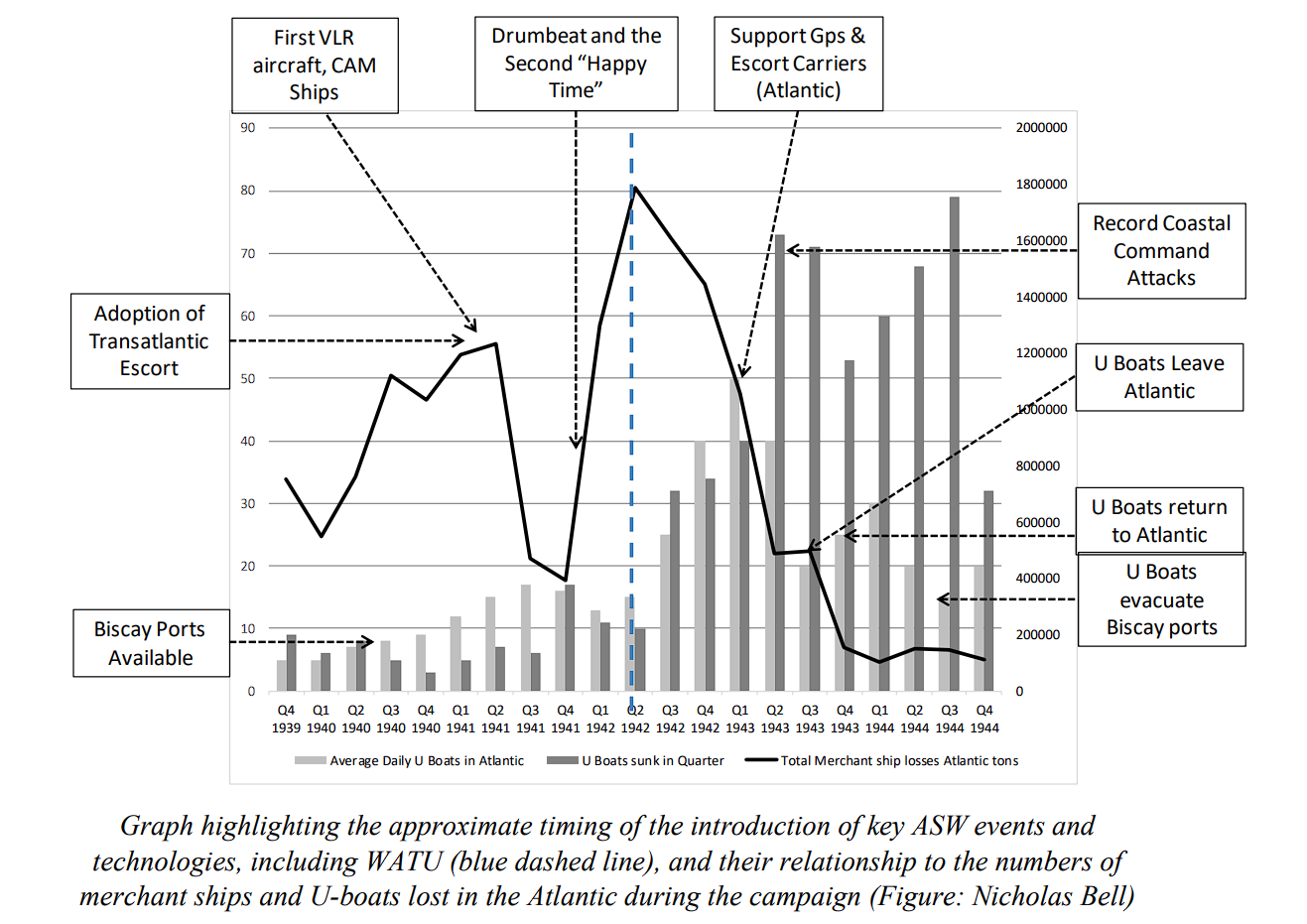
From Paul Strong's piece on the Western Approaches Tactical Unit
Ecce Homo! Loquitur...
Joined: Jul 2000
Aviation Qualifications: Spotter
Posts: 24,510
Likes: 7,255
From: Peripatetic
https://archive.ph/2024.07.19-172627...ding-6f8dm66gm
Boss steps down as Harland & Wolff seeks emergency funding
John Wood takes ‘leave of absence’ after new government declines to guarantee loan
The struggling Belfast-based shipbuilder Harland & Wolff has overhauled its board, fast-tracked emergency talks with its main lender and appointed Rothschild as an adviser after the government rejected a £200 million loan guarantee.
Amid mounting concern over the future of the company and its 1,500 workforce in the UK, it said the Department for Business and Trade had notified it that the government would not sign off on the financial support, which the company had been anticipating for more than a year…..
Boss steps down as Harland & Wolff seeks emergency funding
John Wood takes ‘leave of absence’ after new government declines to guarantee loan
The struggling Belfast-based shipbuilder Harland & Wolff has overhauled its board, fast-tracked emergency talks with its main lender and appointed Rothschild as an adviser after the government rejected a £200 million loan guarantee.
Amid mounting concern over the future of the company and its 1,500 workforce in the UK, it said the Department for Business and Trade had notified it that the government would not sign off on the financial support, which the company had been anticipating for more than a year…..
Joined: Oct 2018
Aviation Qualifications: PPL
Posts: 12,213
Likes: 1,648
From: Ferrara
"The debate over the viability of carriers has probably changed since the advent of AIM-174 long range AAM (and it can kill pretty much everything else apart from a submerged submarine) several weeks ago, and recent events have proved the anti ship missiles are not the undefeatable killer some people think they are."
I can remember people said the same thing about Sea Wolf when it was introduced
I can remember people said the same thing about Sea Wolf when it was introduced
Joined: Oct 2018
Aviation Qualifications: PPL
Posts: 12,213
Likes: 1,648
From: Ferrara
Max Hastings in today's "Times" - I'm not quite sure who would buy them - maybe the USMC
Finally, even with the fair wind blowing for the new British government, there is our own politics. If the Robertson review makes radical proposals, how far can these be implemented in the face of domestic pressures?
For instance: the two giant aircraft-carriers that our admirals insisted upon, and which Gordon Brown commissioned to provide employment in Scottish Labour constituencies, have proved an embarrassment. The misbegotten “Pacific tilt” in the 2019 defence review was conceived simply to justify these behemoths. We cannot afford a credible force of F-35s to fly off them. Manning has proved a nightmare. The ships are often broken. At a time when we need a larger fleet of smaller vessels, they consume a giant share of the Navy’s budget. We would be better off without them.
But does Starmer have the bottle to sell the carriers, which would prompt jingo outrage? I doubt it. Moreover, when Labour is seeking to market defence spending as an engine for growth, will it recognise that not only is our procurement system broken, but our domestic weapons manufacturers, notably BAE, have a lamentable record, especially as warship builders?
Finally, even with the fair wind blowing for the new British government, there is our own politics. If the Robertson review makes radical proposals, how far can these be implemented in the face of domestic pressures?
For instance: the two giant aircraft-carriers that our admirals insisted upon, and which Gordon Brown commissioned to provide employment in Scottish Labour constituencies, have proved an embarrassment. The misbegotten “Pacific tilt” in the 2019 defence review was conceived simply to justify these behemoths. We cannot afford a credible force of F-35s to fly off them. Manning has proved a nightmare. The ships are often broken. At a time when we need a larger fleet of smaller vessels, they consume a giant share of the Navy’s budget. We would be better off without them.
But does Starmer have the bottle to sell the carriers, which would prompt jingo outrage? I doubt it. Moreover, when Labour is seeking to market defence spending as an engine for growth, will it recognise that not only is our procurement system broken, but our domestic weapons manufacturers, notably BAE, have a lamentable record, especially as warship builders?
Joined: Oct 2018
Aviation Qualifications: PPL
Posts: 12,213
Likes: 1,648
From: Ferrara
I tend to agree he thinks he knows everything
but it's also a full page in one of the UK's most influential newspapers - and he has had to get his copy from somewhere or someone
but it's also a full page in one of the UK's most influential newspapers - and he has had to get his copy from somewhere or someone
Ecce Homo! Loquitur...
Joined: Jul 2000
Aviation Qualifications: Spotter
Posts: 24,510
Likes: 7,255
From: Peripatetic
Joined: Jan 2008
Aviation Qualifications: SLF
Posts: 1,017
Likes: 1,065
From: Australia
Thread Starter
Joined: Feb 2002
Posts: 2,967
Likes: 100
From: Devon
"The debate over the viability of carriers has probably changed since the advent of AIM-174 long range AAM (and it can kill pretty much everything else apart from a submerged submarine) several weeks ago, and recent events have proved the anti ship missiles are not the undefeatable killer some people think they are."
I can remember people said the same thing about Sea Wolf when it was introduced
I can remember people said the same thing about Sea Wolf when it was introduced
Sea Wolf was never anything other than a point defence system. It could provide extended point defence if in close proximity to another ship, but it was always intended to be part of a layered defence starting with fighters, medium range SAMs (Sea Dart in the RN's case), and then Sea Wolf and decoys/close range guns.
This 1977 training film explains it perfectly: PRINCIPLES OF ANTI AIR WARFARE (IWM Collections)
The AIM-174B will give the US Navy a weapon with a far greater range than AMRAAM. Meteor will provide provide a long range capability for the UK F-35B Lightning. In the words of the film: Use your defensive capability - fast.
Max Hastings in today's "Times" - I'm not quite sure who would buy them - maybe the USMC
Finally, even with the fair wind blowing for the new British government, there is our own politics. If the Robertson review makes radical proposals, how far can these be implemented in the face of domestic pressures?
For instance: the two giant aircraft-carriers that our admirals insisted upon, and which Gordon Brown commissioned to provide employment in Scottish Labour constituencies, have proved an embarrassment. The misbegotten “Pacific tilt” in the 2019 defence review was conceived simply to justify these behemoths. We cannot afford a credible force of F-35s to fly off them. Manning has proved a nightmare. The ships are often broken. At a time when we need a larger fleet of smaller vessels, they consume a giant share of the Navy’s budget. We would be better off without them.
But does Starmer have the bottle to sell the carriers, which would prompt jingo outrage? I doubt it. Moreover, when Labour is seeking to market defence spending as an engine for growth, will it recognise that not only is our procurement system broken, but our domestic weapons manufacturers, notably BAE, have a lamentable record, especially as warship builders?
Finally, even with the fair wind blowing for the new British government, there is our own politics. If the Robertson review makes radical proposals, how far can these be implemented in the face of domestic pressures?
For instance: the two giant aircraft-carriers that our admirals insisted upon, and which Gordon Brown commissioned to provide employment in Scottish Labour constituencies, have proved an embarrassment. The misbegotten “Pacific tilt” in the 2019 defence review was conceived simply to justify these behemoths. We cannot afford a credible force of F-35s to fly off them. Manning has proved a nightmare. The ships are often broken. At a time when we need a larger fleet of smaller vessels, they consume a giant share of the Navy’s budget. We would be better off without them.
But does Starmer have the bottle to sell the carriers, which would prompt jingo outrage? I doubt it. Moreover, when Labour is seeking to market defence spending as an engine for growth, will it recognise that not only is our procurement system broken, but our domestic weapons manufacturers, notably BAE, have a lamentable record, especially as warship builders?
What a load of crap!
Admirals insisted upon? Presumably he means Admirals that were running the Royal Navy at a time when carriers were at the heart of ongoing operation in the Adriatic or the Persian/Arabian Gulf, had held commands during the 1980s when carriers were at the heart of NATO's naval capability, and many had experienced combat in the Falklands?
Scottish constituencies? I am sure that most of the hull blocks were built in non Scottish yards, and the equipment that went inside the hull came from all over the UK.
Pacific Tilt? NATO first remains the centre of our policy, and we have committed the carrier capability to NATO.
Cannot afford a credible force...? What does he mean by 'credible' and why can we not afford it?
Manning a nightmare? I seem to recall Hastings as being one of the people who convinced fellow evidence averse ex public schoolboy Cameron to deny the RN a personnel uplift in 2015.
Need a larger fleet of smaller vessels: Again - what does that mean? I recall that a few years ago he was arguing that expensive destroyers and frigates were no longer needed as air and submarine threats were a thing of the past, just as he argued that Typhoon should be scrapped (without replacement) as the fighter was a relic of the past in the age of the drone.
Can he answer this question - if the task is to protect maritime reinforcements and amphibious forces, is the force more able with or without a carrier to:
a. Detect and engage enemy aircraft armed with anti ship missiles that can be fired well beyond the limited radar horizon of surface radars?
b. Maintain a constant CAP several hundred miles or more from the nearest friendly airbase, without needing large numbers of fighters and tankers?
c. Maintain constant ASW helicopter operations without coordination, communications, or logistics/support difficulties?
Can he disprove the following?
The carrier puts fighters in close proximity to the assets or area to be defended without needing an excessive number of aircraft, and Geography, Mathematics, and Physics show that attacking aircraft carrying anti ship missiles are best dealt with using fighters to kill the archers, not the arrows. Airborne radar can see far beyond the radar horizon of shipborne ones and can detect low altitude targets at range, and fighters provide the means for interception and visual identification beyond the horizon, and engagement far beyond the range of shipborne missile systems. Constant ASW helicopter operations are best supported by a large deck with multiple helicopters, as collocating them simplifies coordination, communications, and maintenance and support.
From the conclusions of the discussion about the role of the carrier in sea control - on another site.
Some people have noted that Hastings is a somewhat unreliable military historian who seems to dislike out own forces compared to those of the Wehrmacht. His contemporary writings tend to be biased towards the Army, which makes me wonder why he does not raise the issues of things like Ajax?
Perhaps the problem is that the education system of the day meant that he probably did not Maths or Science after the age of fourteen, so he may have little understanding of speed/time/distance relationships, the relationship between system range and defended area, radio/radar basics, the trade off between sensor range and resolution, probability...etc.
Joined: Oct 2018
Aviation Qualifications: PPL
Posts: 12,213
Likes: 1,648
From: Ferrara
"Cannot afford a credible force...? What does he mean by 'credible' and why can we not afford it?"
have you missed all the economic projections WEBF? We're in deep hole - something has to give. Quite a few commentators see the Army as being the major beneficiary of any increase/alignment of spending because that's what they see is needed in Europe. They see that carriers (or even navies) are irrelevant on the ground in Ukraine and it's another Ukraine that worries them most.
As for Hastings - I feel he's pretty full of his self -importance but he is read and recognised by a very large number of people. He has influence - doesn't matter if you like it or not. And someone is feeding him a story for sure. My concern is that we'll get another exercise in stretching the UK's armed forces thinner and thinner again without anyone doing something about investment (which desperately needs to increase) and a cut in some missions - we can't continue to do everything we currently claim to do
have you missed all the economic projections WEBF? We're in deep hole - something has to give. Quite a few commentators see the Army as being the major beneficiary of any increase/alignment of spending because that's what they see is needed in Europe. They see that carriers (or even navies) are irrelevant on the ground in Ukraine and it's another Ukraine that worries them most.
As for Hastings - I feel he's pretty full of his self -importance but he is read and recognised by a very large number of people. He has influence - doesn't matter if you like it or not. And someone is feeding him a story for sure. My concern is that we'll get another exercise in stretching the UK's armed forces thinner and thinner again without anyone doing something about investment (which desperately needs to increase) and a cut in some missions - we can't continue to do everything we currently claim to do
Joined: Dec 2001
Posts: 1,471
Likes: 844
From: Here 'n' there!
But the real test is what the punter down the pub thinks, not WEBF. A few "elder statesmen" down my local "understand" as they were involved in Aden, the Cod Wars, NI, the Falklands and the middle/end of the Cold War, mainly through National Service. I catch the tail end of that demographic myself tho as ex-full time RN ('78 - '07). But many now have their own problems associated with old age........
The fact is that, today, ninety-five percent of those in the pub have never served in the Forces, some may vaguely recall a family member serving way-back-when, some are even vaguely aware of some of the recent wars (Gulf, Afghanistan etc) but, tbh, they know virtually zero and care even less! But, trust me, they are fully aware of NHS waiting lists, cost-of-living inflation, the state of the roads and other such matters. WRT the Armed Forces, if you mention them, they just smile and change the conversation back to whatever the next local topic is - "Anyone know what's happening to the Solar panel farm on Bert's land?"! You mention "conscription" or "National Service" and they look at you as if you've just landed from the planet Zog!!!!
The answer as to why we cannot afford the funding (and that is it's own topic for Economists to debate!) it is simple - the electorate (based on my Local!) wouldn't allow it! The real need for an Armed Forces has effectively been bred out of the UK population. Well, that's my view anyway...........!
Joined: Oct 2018
Aviation Qualifications: PPL
Posts: 12,213
Likes: 1,648
From: Ferrara
Sadly I think H'nH has hit the nail very firmly on the head. 
If there IS a direct , actual threat they'll move - as we did in the Falklands and Kuwait to some extent - but otherwise it's personal concerns first - around my watering hole its "the kids earn a £100 k a year and can't afford a house", Doctors appointments (lack of), operations (delays thereto), anti-social behaviour (lots of), lack of police doing anything..................
If there IS a direct , actual threat they'll move - as we did in the Falklands and Kuwait to some extent - but otherwise it's personal concerns first - around my watering hole its "the kids earn a £100 k a year and can't afford a house", Doctors appointments (lack of), operations (delays thereto), anti-social behaviour (lots of), lack of police doing anything..................
Joined: Dec 2001
Posts: 1,471
Likes: 844
From: Here 'n' there!
The last briefing on UK Defence Spending (Commons Library Research Briefing, 3 May 2024, p.10) had "[Defence spending] will reach the 2.5% target by 2030" (well, the "can" has a fair way down the road to travel then!) and that various think tanks like RUSI suggest it will "..... require cuts to other areas of public spending or tax rises." to achieve. The bods in my Local won't like that! And, when I joined up (78) spend was 4% GDP not 2.5%.
What a shame Political "Snake Oil" isn't actually legal tender.....! We'd all be rich, rich, rich!!!!!!!!
Anyway, I'm drifting this thread into the existing "UK SDR 2020" thread so I'll apologise unreservedly to the Mods and make no further observations! Back to the Carriers ...... wherever they are!

Joined: Apr 2020
Posts: 1,978
Likes: 376
From: Hampshire
42% of those asked were in favour, considerably more than those required to elect a government with a massive majority. 22% were against. Haven't got access to the figures at present but there was still a substantial plurality in favour even if it meant reduced spending in other areas.