


Future Carrier (Including Costs)


Joined: Sep 2010
Posts: 2,107
Likes: 288
From: Nevada, USA


Joined: Apr 2006
Posts: 809
Likes: 428
From: Portsmouth

Joined: May 2009
Posts: 1,909
Likes: 129
From: Here
Joined: Apr 2010
Aviation Qualifications: Military (Retired)
Posts: 958
Likes: 1,239
From: Herefordshire

Ecce Homo! Loquitur...

Joined: Jul 2000
Aviation Qualifications: Spotter
Posts: 24,550
Likes: 7,281
From: Peripatetic
So, with the government being told it shouldn’t financially support the yard, which otherwise could go bankrupt; the option of the planned £1.6B RN order going to the yard in Spain, which is already building many of the sections - the unions vote to go on strike because they want to keep getting overtime on Fridays instead of working a 5 day week…..
https://archive.ph/2024.06.11-150306...-work-fridays/
Titanic shipyard staff to strike after being asked to work on Fridays
https://archive.ph/2024.06.11-150306...-work-fridays/
Titanic shipyard staff to strike after being asked to work on Fridays
Joined: Jan 2008
Aviation Qualifications: SLF
Posts: 1,022
Likes: 1,066
From: Australia
So, with the government being told it shouldn’t financially support the yard, which otherwise could go bankrupt; the option of the planned £1.6B RN order going to the yard in Spain, which is already building many of the sections - the unions vote to go on strike because they want to keep getting overtime on Fridays instead of working a 5 day week…..
https://archive.ph/2024.06.11-150306...-work-fridays/
Titanic shipyard staff to strike after being asked to work on Fridays
https://archive.ph/2024.06.11-150306...-work-fridays/
Titanic shipyard staff to strike after being asked to work on Fridays
From the FT:
Harland & Wolff in pay talks with unions after workers vote to strike
Harland & Wolff was in talks with unions on Tuesday after workers voted to strike in a pay dispute that risks paralysing the Belfast shipbuilder behind the Titanic, just as it prepares to take on a crucial UK defence contract. The walkout threat added to the woes of the lossmaking company, which has faced weeks of uncertainty over a £200mn government loan guarantee, without which chief executive John Wood has said it will be forced to “change strategy”. Unions and management met on Tuesday in the hope that a long overdue pay deal could be struck, according to one person with knowledge of Monday’s strike ballot. Another person familiar with the process said H&W had put forward an offer and that negotiations were continuing. Union leaders say the last pay deal expired in December and there has been no agreement on a new one, which would have to be backdated to January. H&W and the GMB and Unite unions had no immediate comment. Wood told the Financial Times on a visit to the Belfast yard last week that he remained hopeful of clinching the export development guarantee before the July 4 general election, despite splits among ministers last month. “The brutal reality is that, without Harland & Wolff . . . the UK can’t deliver its commitment to defence,” he said in an interview.
Wood said the company, which has three other operations in Britain, was “a strategic asset for whichever political parties form the next government”. But he rejected the idea that the guarantee was needed to secure funding for pay rises as H&W faces a looming debt repayment. The Belfast yard, which has not built a ship for two decades, is being revitalised by a £1.6bn Royal Navy contract, which it won in 2022 as part of a consortium led by Spain’s Navantia. It expects to cut steel in July 2025 and to complete the first ship in June 2029. Wood said the Aim-listed company was “pushing” the government to “get on with” granting the guarantee to give certainty to the business. H&W is hiring apprentices and preparing for the three-ship naval contract by expanding its fabrication yard into an automated facility that it says will make it the most advanced UK shipyard, well placed to win future contracts. “All the commercial banks are lined up ready and waiting to go and I see no reason why a decision can’t be made fairly soon,” Wood said. H&W has scotched talk that failure to secure the guarantee, under discussion for two years, would be the death knell for the 163-year-old company. Wood bought it out of administration in 2019, but it faces a repayment in December on a $100mn loan from Riverstone Credit Partners in New York. Neither party would say how much is due.
H&W’s auditors last year warned of “material uncertainty” unless the shipbuilder could source fresh financing and win extra work. MPs have questioned using taxpayers’ money to guarantee lending given its financial position. Wood said he remained “fairly optimistic” but that if the guarantee was not granted, “what you have to do is change your strategy and instead of the growth projection you want for export projects you have to look at what you can do for the various funding lines”. In December, H&W said it had “sufficient funds” to meet its working capital needs “until the new loan facility is completed”. But its shares, trading on Tuesday around 10p, remain roughly a quarter of their level when UK energy firm InfraStrata, led by Wood, bought the company for £6mn. H&W’s most recent annual accounts, to the end of 2022, showed revenues of £27mn but losses of £70mn. Net debt stood at £82.5mn, in part thanks to high interest payments on the Riverstone debt. “We do have a year-end deadline for the debt repayment, but you know, everything’s negotiable. If we aren’t there by then [December], then we have to go and renegotiate, but I hope we are there by then,” Wood said.
Wood said the company, which has three other operations in Britain, was “a strategic asset for whichever political parties form the next government”. But he rejected the idea that the guarantee was needed to secure funding for pay rises as H&W faces a looming debt repayment. The Belfast yard, which has not built a ship for two decades, is being revitalised by a £1.6bn Royal Navy contract, which it won in 2022 as part of a consortium led by Spain’s Navantia. It expects to cut steel in July 2025 and to complete the first ship in June 2029. Wood said the Aim-listed company was “pushing” the government to “get on with” granting the guarantee to give certainty to the business. H&W is hiring apprentices and preparing for the three-ship naval contract by expanding its fabrication yard into an automated facility that it says will make it the most advanced UK shipyard, well placed to win future contracts. “All the commercial banks are lined up ready and waiting to go and I see no reason why a decision can’t be made fairly soon,” Wood said. H&W has scotched talk that failure to secure the guarantee, under discussion for two years, would be the death knell for the 163-year-old company. Wood bought it out of administration in 2019, but it faces a repayment in December on a $100mn loan from Riverstone Credit Partners in New York. Neither party would say how much is due.
H&W’s auditors last year warned of “material uncertainty” unless the shipbuilder could source fresh financing and win extra work. MPs have questioned using taxpayers’ money to guarantee lending given its financial position. Wood said he remained “fairly optimistic” but that if the guarantee was not granted, “what you have to do is change your strategy and instead of the growth projection you want for export projects you have to look at what you can do for the various funding lines”. In December, H&W said it had “sufficient funds” to meet its working capital needs “until the new loan facility is completed”. But its shares, trading on Tuesday around 10p, remain roughly a quarter of their level when UK energy firm InfraStrata, led by Wood, bought the company for £6mn. H&W’s most recent annual accounts, to the end of 2022, showed revenues of £27mn but losses of £70mn. Net debt stood at £82.5mn, in part thanks to high interest payments on the Riverstone debt. “We do have a year-end deadline for the debt repayment, but you know, everything’s negotiable. If we aren’t there by then [December], then we have to go and renegotiate, but I hope we are there by then,” Wood said.

Ecce Homo! Loquitur...
Joined: Jul 2000
Aviation Qualifications: Spotter
Posts: 24,550
Likes: 7,281
From: Peripatetic
I don’t think that makes things sound better, rather it makes things even worse.
Company is in a bad way, reliant on the government guarantee which they have been advised they can’t give under the rules, and add the unions on top.
I suppose they can hope the next government will bend the rules, but I doubt defence will be high on their list of priorities.
Company is in a bad way, reliant on the government guarantee which they have been advised they can’t give under the rules, and add the unions on top.
I suppose they can hope the next government will bend the rules, but I doubt defence will be high on their list of priorities.
Joined: Jan 2008
Aviation Qualifications: SLF
Posts: 1,022
Likes: 1,066
From: Australia
I don’t think that makes things sound better, rather it makes things even worse.
Company is in a bad way, reliant on the government guarantee which they have been advised they can’t give under the rules, and add the unions on top.
I suppose they can hope the next government will bend the rules, but I doubt defence will be high on their list of priorities.
Company is in a bad way, reliant on the government guarantee which they have been advised they can’t give under the rules, and add the unions on top.
I suppose they can hope the next government will bend the rules, but I doubt defence will be high on their list of priorities.
H&W is probably a case in point. I don't think the union negotiations are the worst of their problems.
Thread Starter
Joined: Feb 2002
Posts: 2,968
Likes: 102
From: Devon
If I may be forgiven for quoting myself and snipping my previous post, so as to concentrate on ASW:
According to the UK Defence Journal - the RN is looking into a long range shipborne ASW weapon.
Royal Navy seeks Long Range Anti-sub Weapon for Type 26
The Ministry of Defence has issued a pre-procurement notice seeking information from industry regarding a future Long Range Anti-Submarine Warfare (ASW) Weapon (LRAW).
Specifically, the Royal Navy is seeking solutions for a Long Range Anti-Submarine Warfare weapon that can deploy Lightweight Torpedoes from Mk41 Vertical Launch System-fitted Type 26 Frigates...
Some may think that this weapon would remove the need for helicopters - but it does not. The frigate can detect submarines as long range with low frequency towed array sonar, but without sufficient accuracy do direct a torpedo attack, which is why the ASW frigate is team with dipping sonar equipped helicopters who can pinpoint the target. I remember an old (and mostly out of date when I got it from the careers office) booklet about RN Engineer Officers that featured stories from several ME Officers, a pair of WE Officers, and a couple of AE Officers - all back in the late 1970s I think. One of the WE Officers was telling a tale of a test firing of Ikara- and the diagram showed the target submarine being located by a Sea King in the dip. The diagram was meant to be of a typical Ikara engagement. This was before the days of the long range sonar with the usual trade off between range and resolution.
Here is a far more recent story: Aircraft Carriers Underpin Royal Navy Plans To Use UAS To Help Build Maritime Mass - Naval News
Constant ASW helicopter operations are best supported by a large deck with multiple helicopters, as collocating them simplifies coordination, communications, and maintenance and support. Physics also shows that modern long range sonars fitted to ASW warships need to be used in conjunction with dipping sonar to achieve their potential - andvice versa. As with all such detection systems (radar/sonar/optical) there is trade off between range and resolution. The long range sonar provides long range detection, and the dipping sonar provides pinpoint accuracy.
- a fixed-wing UAS to replace the carrier-borne, Merlin helicopter-based Crowsnest airborne early warning (AEW) system, which is due to retire at the end of the decade
Constant ASW helicopter operations are best supported by a large deck with multiple helicopters, as collocating them simplifies coordination, communications, and maintenance and support. Physics also shows that modern long range sonars fitted to ASW warships need to be used in conjunction with dipping sonar to achieve their potential - andvice versa. As with all such detection systems (radar/sonar/optical) there is trade off between range and resolution. The long range sonar provides long range detection, and the dipping sonar provides pinpoint accuracy.
According to the UK Defence Journal - the RN is looking into a long range shipborne ASW weapon.
Royal Navy seeks Long Range Anti-sub Weapon for Type 26
The Ministry of Defence has issued a pre-procurement notice seeking information from industry regarding a future Long Range Anti-Submarine Warfare (ASW) Weapon (LRAW).
Specifically, the Royal Navy is seeking solutions for a Long Range Anti-Submarine Warfare weapon that can deploy Lightweight Torpedoes from Mk41 Vertical Launch System-fitted Type 26 Frigates...
Some may think that this weapon would remove the need for helicopters - but it does not. The frigate can detect submarines as long range with low frequency towed array sonar, but without sufficient accuracy do direct a torpedo attack, which is why the ASW frigate is team with dipping sonar equipped helicopters who can pinpoint the target. I remember an old (and mostly out of date when I got it from the careers office) booklet about RN Engineer Officers that featured stories from several ME Officers, a pair of WE Officers, and a couple of AE Officers - all back in the late 1970s I think. One of the WE Officers was telling a tale of a test firing of Ikara- and the diagram showed the target submarine being located by a Sea King in the dip. The diagram was meant to be of a typical Ikara engagement. This was before the days of the long range sonar with the usual trade off between range and resolution.
Last edited by WE Branch Fanatic; 19th June 2024 at 11:02.
Ecce Homo! Loquitur...
Joined: Jul 2000
Aviation Qualifications: Spotter
Posts: 24,550
Likes: 7,281
From: Peripatetic
Reference the above.
Since it's everyone's favorite question: the RFI specifically calls for the vertical launch booster part, excluding the torpedo. Putting a "UK LightWeight torpedo" onto the booster is the whole idea. Given timeframes, the evolved, next Mod of StingRay is presumably the main idea.
Since it's everyone's favorite question: the RFI specifically calls for the vertical launch booster part, excluding the torpedo. Putting a "UK LightWeight torpedo" onto the booster is the whole idea. Given timeframes, the evolved, next Mod of StingRay is presumably the main idea.

Joined: Apr 2020
Posts: 1,980
Likes: 376
From: Hampshire
Unless I am being completely thick (always possible), they seem to be looking for something capable of hitting a submerged target beyond the range of its current or future heavyweight torpedoes. Assuming an entry point fairly close to the target, they are therefore looking at a c.35Nmi + range, so something exceeding three times the range of the Mk41 VLS launched RUM-139 VL-ASROC (or for those of us of a certain age, that of Ikara) or more than one and a half times that of the Japanese Type 07 Vertical Launch Anti-Submarine Rocket (also Mk41 VLS launchable).
(My emphasis)
The LRAW concept provides an extended range delivery means for a Lightweight Torpedo (LWT) or Very Light Weight (VLWT) Torpedo effector against submarine contacts, cued by organic or third-party sensor detection. Engagement ranges are to comfortably overmatch those of current and forecast threat Heavy Weight Torpedoes.
The solution requires an interchangeable, stand-off, quick-reaction, all-weather ASW weapon delivery capability that enables a UK LWT to reach a water-entry point for a targeted submarine from any Mk41 VLS-fitted platform. LRAW will need to integrate with RN Combat or Sonar Systems and must be ‘Secure by Design’.
The solution requires an interchangeable, stand-off, quick-reaction, all-weather ASW weapon delivery capability that enables a UK LWT to reach a water-entry point for a targeted submarine from any Mk41 VLS-fitted platform. LRAW will need to integrate with RN Combat or Sonar Systems and must be ‘Secure by Design’.
Thread Starter
Joined: Feb 2002
Posts: 2,968
Likes: 102
From: Devon
Unless I am being completely thick (always possible), they seem to be looking for something capable of hitting a submerged target beyond the range of its current or future heavyweight torpedoes. Assuming an entry point fairly close to the target, they are therefore looking at a c.35Nmi + range, so something exceeding three times the range of the Mk41 VLS launched RUM-139 VL-ASROC (or for those of us of a certain age, that of Ikara) or more than one and a half times that of the Japanese Type 07 Vertical Launch Anti-Submarine Rocket (also Mk41 VLS launchable).
(My emphasis)
(My emphasis)
Indeed - but you do have to wonder why bother? The aforementioned RN careers publication featured a draw on an Ikara firing with a Sea King dipping. A bit of research suggests that Ikara could be fed updates in flight - presumably after the firing ship received updates for the Pinger? This shows that the torpedo had to be released very near the target - just as if a helicopter had delivered it. Which begs the question of why not drop the torpedo from the helicopter - either the Pinger or something like a Wildcat acting as a Pony? The Royal Navy pioneered the use of helicopters for ASW, the first operational ASW sorties by a shipborne helicopter taking place towards the end of the Second World War, and the torpedo carrying Wasp was the response to the increasing range of submarine launched torpedoes. These were always meant to be teamed up with carrier based ASW helicopters with dipping sonar - a major part of the RN carrier role since 1960.
Not so many years ago I saw an Ikara on display at HMS Collingwood, and when I mentioned this to two old and bold ASW types they both agreed that better and faster helicopters, such as the Lynx which replaced the Wasp, was a better solution.
Today the Type 23s updated with 2087 can detect the submarine at long range (the Type 26 will inherit 2087) but because of the range you need something else (typically a Merlin HM2 with dipping sonar) to pinpoint the submarine and attack, so I see little value in a weapon that will still need the Merlin (or MPA) to pinpoint the submarine, and tie up the finite number of VLS cells in the process.
On an ASW theme - the Russians have been making a show of exercises in the Barents Sea that involve firing submarine launched cruise missiles against targets representing NATO amphibious forces.Not only is the submarine launched cruise missile a weapon of sea denial (not sea control), but the firings have taken place in waters close to Russia, with Russian fighters aircraft nearby. The submarine firing anti ship cruise missiles in the Norwegian Sea, GIUK gap, or beyond would face huge problems:
1. NATO tracks all Russian submarines.
2. NATO has strong ASW forces - including shipborne (including carrierborne) ASW helicopters that act on conjunction with surface warships with long range sonar and coordinated with NATO submarines and MPA.
3. Any attempt to use aircraft against helicopters or MPA will result in a quick response from the carrier's jets.
4. As submarines have limited means to detect targets at long range, the cruise missiles will depend on targeting platforms - possibly aircraft. In the Cold War dealing with Bears performing this role was a job for carrier based aircraft, and the primary role for the Royal Navy's Sea Harrier. It was the need for ASW helicopters operations around the the clock, and to deal with the Bears doing reconnaissance and targeting, that kept the Royal Navy in the carrier game and led to the Invincible class CVS/Sea King/Sea Harrier combination.
5. Back in the 1970s it was expected that the fighters (certainly the USN F-14 Tomcat, less so the Sea Harrier FRS1 with only Sidewinder) would be able to splashed missiles. Not so long ago a USN F/A-18E/F Super Hornet proved this in the Red Sea, and an Israeli F-35I did so not too long before that. The increased missile load and sensor capabilities of today's aircraft means they can counter a salvo of missiles.
6. A submarine cannot control the airspace, and therefore a group of submarines cannot perform a sea control role in the same way as a carrier group.
7. It is interesting that the quoted Russian news article referred to a target simulating a detachment of landing ships of a mock enemy. This actually reminds us of the need for sea control, and the need for carriers to protect amphibious forces.

Joined: Oct 2018
Aviation Qualifications: PPL
Posts: 12,223
Likes: 1,649
From: Ferrara
"A submarine cannot control the airspace, and therefore a group of submarines cannot perform a sea control role in the same way as a carrier group."
they're likely to last a lot longer tho'
they're likely to last a lot longer tho'
Ecce Homo! Loquitur...
Joined: Jul 2000
Aviation Qualifications: Spotter
Posts: 24,550
Likes: 7,281
From: Peripatetic
https://ukdefencejournal.org.uk/brit...s-says-report/
Britain needs Arsenal Ships says report
A report advocates for the Royal Navy to embrace the concept of the ‘arsenal ship’, a vessel capable of firing huge volumes of missiles.According to ‘A More Lethal Royal Navy: Sharpening Britain’s Naval Power‘ by William Freer and Dr. Emma Salisbury, it is time for the UK to accelerate its exploration of this concept.
“The arsenal ship, the idea of a platform which carries a large number of missiles and little else, has been around for some time but is now starting to make real progress,” the report states.
The US Navy’s exploration of Large Unmanned Surface Vessels (LUSVs) and Large Optionally Crewed Surface Vessels (LOSVs) is proof of this progress.
After years of experimentation, the US plans to order up to nine LUSVs/LOSVs between 2025 and 2028, each expected to cost approximately $250 million (£195 million). These vessels will displace around 1,800-2,000 tonnes and carry 16-32 Vertical Launch System (VLS) cells.
The Australian Navy, following its 2024 Surface Fleet Review, also plans to procure up to six LOSVs based on US designs.
The theory behind these vessels is to “provide a greater number of missiles and distribute these missiles across more platforms, minimising the consequences of losing one to enemy action. They will be semi-autonomous, with instructions and sensor capabilities coming either from motherships or ashore,” the report elaborates.
The primary advantage of arsenal ships lies in their ability to disperse a large number of missiles across multiple platforms, reducing the risk associated with the loss of a single vessel to enemy action and enhancing fleet survivability. These semi-autonomous vessels, controlled by motherships or shore-based facilities, add flexibility.
However, “arsenal ships are not without limitation,” the report cautions. “First and foremost, they would lose the flexibility which naval platforms bring. A Type 31 frigate may be more expensive, but it can undertake a much wider range of missions due to the larger crew.”
Additionally, these vessels depend on external communications for autonomous operations, making them vulnerable to electronic warfare (EW) threats, as “these signals can be interfered with.”
Another significant concern is the potential for mission creep during procurement.
“There could be an urge to push for the vessel to have its own point defences, then its own radar to detect threats and act more autonomously – all of which would require it to be larger. This process could go on until the design has simply become an optionally-crewed frigate,” the report warns.
To address these challenges, the report recommends that the UK accelerate its exploration of the arsenal ship concept by procuring a single LOSV as soon as feasible.
“This could be based on the proven River class OPV hull (stripped of everything apart from minimal crew quarters and packed with VLS), to act as a testbed platform. This will allow for the Royal Navy to evaluate the utility of arsenal ships. If the extra VLS capacity is evaluated to be more beneficial than the loss of flexibility, the Royal Navy can acquire more – potentially multiplying the effort by following the Australian approach and replicating the US design.”
The strategic context driving this recommendation is clear. The report underscores that the UK, as a maritime nation, faces growing threats at sea, including Russia’s naval modernisation and China’s substantial naval expansion.
To counter these threats and achieve its strategic objectives in the Euro-Atlantic and Indo-Pacific regions, the Royal Navy must enhance its lethality, survivability, and operational mass.
Investing in arsenal ships is presented as a cost-effective means to increase missile capacity and distribute firepower across more platforms. This approach, combined with other strategic investments such as additional F35B Lightning II combat aircraft, improved carrier defences, and accelerated destroyer and submarine programmes, could significantly boost the Royal Navy’s combat flexibility.
Britain needs Arsenal Ships says report
A report advocates for the Royal Navy to embrace the concept of the ‘arsenal ship’, a vessel capable of firing huge volumes of missiles.According to ‘A More Lethal Royal Navy: Sharpening Britain’s Naval Power‘ by William Freer and Dr. Emma Salisbury, it is time for the UK to accelerate its exploration of this concept.
“The arsenal ship, the idea of a platform which carries a large number of missiles and little else, has been around for some time but is now starting to make real progress,” the report states.
The US Navy’s exploration of Large Unmanned Surface Vessels (LUSVs) and Large Optionally Crewed Surface Vessels (LOSVs) is proof of this progress.
After years of experimentation, the US plans to order up to nine LUSVs/LOSVs between 2025 and 2028, each expected to cost approximately $250 million (£195 million). These vessels will displace around 1,800-2,000 tonnes and carry 16-32 Vertical Launch System (VLS) cells.
The Australian Navy, following its 2024 Surface Fleet Review, also plans to procure up to six LOSVs based on US designs.
The theory behind these vessels is to “provide a greater number of missiles and distribute these missiles across more platforms, minimising the consequences of losing one to enemy action. They will be semi-autonomous, with instructions and sensor capabilities coming either from motherships or ashore,” the report elaborates.
The primary advantage of arsenal ships lies in their ability to disperse a large number of missiles across multiple platforms, reducing the risk associated with the loss of a single vessel to enemy action and enhancing fleet survivability. These semi-autonomous vessels, controlled by motherships or shore-based facilities, add flexibility.
However, “arsenal ships are not without limitation,” the report cautions. “First and foremost, they would lose the flexibility which naval platforms bring. A Type 31 frigate may be more expensive, but it can undertake a much wider range of missions due to the larger crew.”
Additionally, these vessels depend on external communications for autonomous operations, making them vulnerable to electronic warfare (EW) threats, as “these signals can be interfered with.”
Another significant concern is the potential for mission creep during procurement.
“There could be an urge to push for the vessel to have its own point defences, then its own radar to detect threats and act more autonomously – all of which would require it to be larger. This process could go on until the design has simply become an optionally-crewed frigate,” the report warns.
To address these challenges, the report recommends that the UK accelerate its exploration of the arsenal ship concept by procuring a single LOSV as soon as feasible.
“This could be based on the proven River class OPV hull (stripped of everything apart from minimal crew quarters and packed with VLS), to act as a testbed platform. This will allow for the Royal Navy to evaluate the utility of arsenal ships. If the extra VLS capacity is evaluated to be more beneficial than the loss of flexibility, the Royal Navy can acquire more – potentially multiplying the effort by following the Australian approach and replicating the US design.”
The strategic context driving this recommendation is clear. The report underscores that the UK, as a maritime nation, faces growing threats at sea, including Russia’s naval modernisation and China’s substantial naval expansion.
To counter these threats and achieve its strategic objectives in the Euro-Atlantic and Indo-Pacific regions, the Royal Navy must enhance its lethality, survivability, and operational mass.
Investing in arsenal ships is presented as a cost-effective means to increase missile capacity and distribute firepower across more platforms. This approach, combined with other strategic investments such as additional F35B Lightning II combat aircraft, improved carrier defences, and accelerated destroyer and submarine programmes, could significantly boost the Royal Navy’s combat flexibility.
Joined: Apr 2011
Posts: 1,617
Likes: 205
From: aus
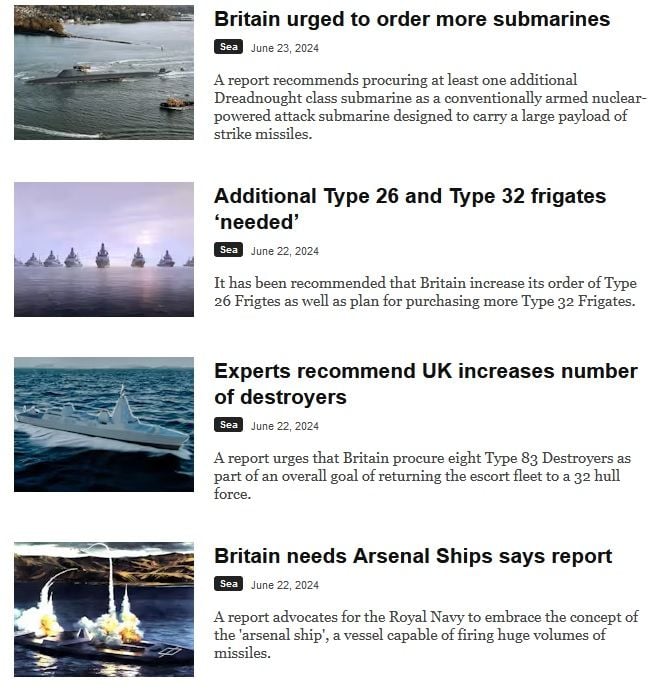
Same reports coming out today more submarines (SSGN) and more type 26's. Lots or more but no actual where is the money and crew coming from
Joined: Dec 2001
Aviation Qualifications: Military
Posts: 2,968
Likes: 485
From: The Roman Empire
rattman,
With regard to where crews will come from, I believe the plan is to build ships with a crew of 50, rather than 150 (exact numbers may be incorrect, but the principle is the point). So there is a requirement for less personnel, or the same number can crew more ships.
No doubt someone with more knowledge will be along soon to give a more detailed/accurate answer.
As for where the money comes from...
With regard to where crews will come from, I believe the plan is to build ships with a crew of 50, rather than 150 (exact numbers may be incorrect, but the principle is the point). So there is a requirement for less personnel, or the same number can crew more ships.
No doubt someone with more knowledge will be along soon to give a more detailed/accurate answer.
As for where the money comes from...