Originally Posted by
mahogany bob
Branch Fanatic
your support for the RN and amazing detailed knowledge is well respected ( my original posting from Valley was to Buccs ,probably on Ark Royal ,until it was cancelled when Denis Healey withdrew his support for carriers back in the 60s )
BUT there is a current debate going on in the States over the viability of carriers in the future and we do seem to be devoid of essential items / manpower for the realistic defence of the UK so it is reasonable to continue the debate over where to best spend the money.
A big reason to keep the carriers of course is the vast amount of money already spent.
The debate over the viability of carriers has probably changed since the advent of AIM-174 long range AAM (and it can kill pretty much everything else apart from a submerged submarine) several weeks ago, and recent events have proved the anti ship missiles are not the undefeatable killer some people think they are.
You could ask the question is the force more able with or without a carrier to:
a. Detect and engage enemy aircraft armed with anti ship missiles, that can be fired well beyond the limited radar horizon of surface radars?
b. Maintain a constant CAP several hundred miles or more from the nearest friendly airbase, without needing large numbers of fights and tankers?
c. Maintain constant ASW helicopter operations without coordination, communications, or logistics/support difficulties?
Originally Posted by
Biggus
A carrier is not an end in itself, it is merely a means to an end. It's a means of projecting air power. An on task carrier group, fully equipped, fully supported, is a useful, albeit very expensive, asset to have. But we don't have that.
We have two carriers, making availability uncertain. They also seem to have reliability issues - and please don't tell me they're teething troubles given how long they've been in the water.
They don't have an adequate air group. We don't have a credible AEW capacity. We are short of F-35s, and they are a joint, not RN only, asset (A debate I won't get into here). The F-35s we do have are no doubt double, triple or quadruple hatred, and as the primary air asset in a high threat environment, may be required elsewhere. Their V/STOL capability would also enable them to operate from remote and/or austere LAND locations. We are short of ASW helicopter airframes, in terms of a carrier based ASW hunting group. Stripping training units to equip a carrier air group for a two week exercise is not the same as being able to run sustained combat operations.
We are short of frigates, destroyers and SSNs to protect the carrier itself - and don't tell me other NATO countries will provide them.
We are massively short of support units to keep a carrier group on station, replenishing fuel, ordnance, etc.
We seem to have adopted the approach of buying the carriers and then hoping we can find everything else needed to make them viable downstream.
So, while I'm not necessarily advocating scrapping the carriers, I do feel it's a discussion worth having. The current make do and mend situation is neither one thing or the other, and I don't think it's kidding (deterring) anyone, except maybe a few UK politicians.
You can blame much of that on politicians who did not see the need for ASW or other maritime (or air) capabilities - not the way that frigate numbers were cut by Hoon, Type 45 orders were cut from first twelve to eight - and then ships seven and eight never materialised, then we had more cuts under CMD/Fox (CMD wanted to cut even more - and would have done so without the carriers), and then ships have been prematurely retired in the hope that there replacements are not delayed, despite not having been ordered yet. Much of this comes down to a lack of people - in 2015 the RN and RAF both expected an uplift of about 1500 bodies each, but Cameron did not want to upset Tory backbenchers who worried about their old regiments.
Like when the contract to upgrade the Merlin HM1 to HM2 was placed, only thirty out of forty odd aircraft got the upgrade. A perceived lack of submarine threat was used as justification - and you may remember many on here insisting that they should all be axed as everything would be land centric in future. Unfortunately the spare airframes were butchered for parts to marinise the Jungly Merlin, however their are plans to augment them with sonobouy dropping UAVs. There is also the fact that modern towed array sonars allow long range submarine detection and more efficient use of airborne assets.
In 2021 the Merlin force put seven aboard HMS
Queen Elizabeth for the CSG 21 deployment (which CO 820 said allowed for constant ASW, plus there were others aboard HMS
Prince of Wales for trials, and others aboard frigates or ashore for NATO/national tasking. Earlier this year nine deployed for
Steadfast Defender 2024. No enough, but not zero.
You might also note that the acute threat is in the NATO theatre, where task groups are multinational by design, and would be if we did have more warships of our own. Carrier groups in the Middle East often have a multinational flavour, and there is current an American Amphibious Ready Group with an RN Type 45 as its sole escort.
If a likely task might be to protect maritime reinforcements and amphibious forces to Norway, you could ask the question is the force more able with or without a carrier to:
a. Detect and engage enemy aircraft armed with anti ship missiles, that can be fired well beyond the limited radar horizon of surface radars?
b. Maintain a constant CAP several hundred miles or more from the nearest friendly airbase, without needing large numbers of fights and tankers?
c. Maintain constant ASW helicopter operations without coordination, communications, or logistics/support difficulties?
Some of us consider that there is such a thing as
seapower - and the carrier is vital for that, which is why it exists. As far as I know the plan is to always have one at R2 readiness. Also the issue with the shafts has been dealt with now - in both of them.
Originally Posted by
Biggus
No doubt the greatest moment of the Royal Navy in living memory was the Falklands conflict - which had nothing to do with a "threat to NATO".
Since 1982, rightly or wrongly, the British Army has committed significant number of troops to combat operations in Kuwait, Iraq and Afghanistan. Again not NATO operations.
British armed forces have historically, again one can argue rightly or wrongly, been repeatedly committed to operations that have little or nothing to do with NATO. They are an instrument of Britain foreign policy, and provide the politicians with options.
While a debate of the various size of Navy, Army, Airforce assets in a limited funding scenario is valid, this being pprunemil, I can alas see such a discussion rapidly descending into a p***ing contest where people argue for their "favoured" service.
And no, I 'm not ex Army.
Nothing to do with NATO perhaps - but the Falklands presented a scenario which was not a million miles from that likely to be encountered in the Northern Flank. As far as I know Kuwait, Iraq, and Afghanistan were all coalition operations.
What is your point?
Originally Posted by
Asturias56
"To do what exactly? The land threat to NATO is on the Finnish, Norwegian, Estonian, Latvian, Lithuanian, Polish Turkish and then arguably Romanian, Bulgarian, Greek, German, Czech, Slovakian, Swedish borders."
that's what we thought in both 1914 & 1939 - the French would handle the Germans - bad call.................. the RN did nothing to stop the German Army overrunning most of NW Europe
I seem to recall that a large British force was sent to France - and was defeated and had evacuated by sea. They could not be put ashore in mainland Europe again until control of the Atlantic had been secured and vast amounts of material and American and Canadian troops transported over the Atlantic. This graph may interest you:
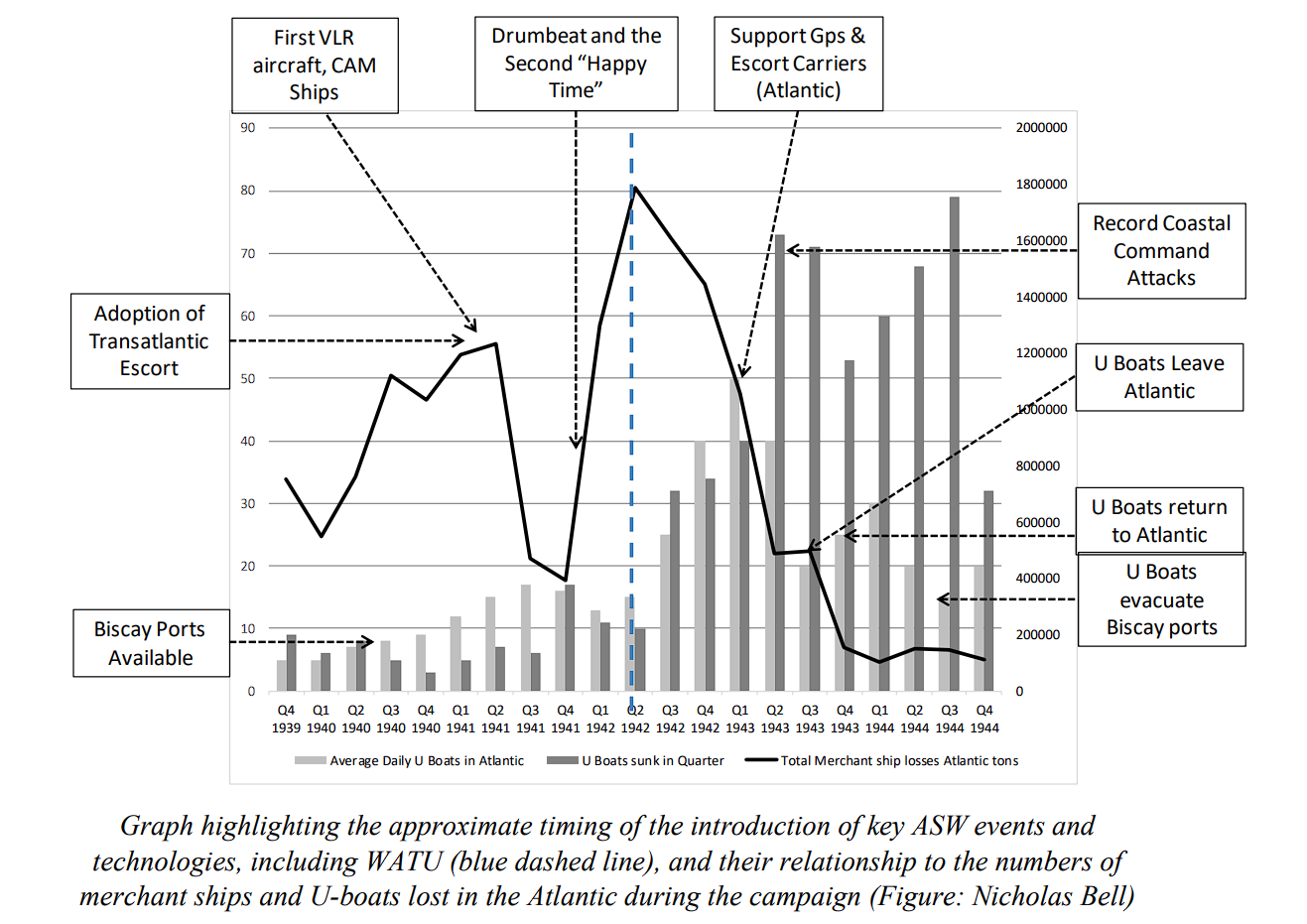
From
Paul Strong's piece on the Western Approaches Tactical Unit