


Future Carrier (Including Costs)


Joined: Mar 2005
Posts: 1,125
Likes: 144
From: MARS
Quote:
Originally Posted by Thud_and_Blunder
Re the Chinook - a quick off-thread question: what are the requirements for lashing a heli on-deck prior to offloading pax?
I ask because - after the farce where an inexperienced-on-type Sqn Ldr tried lifting the back end of Invincible when he 'forgot' to do the after-landing checks prior to waving in the lashing party (AFCS - 'OFF') - we would have a non-stop badgering from FLYCO on every arrival about checks. I understand their point, as it was only the quick thinking of the No.1 crewman that saved at least one life. As for the now-potentially-damaged Chinook: where would you choose to divert if you were 12nm or so away from West Freugh? That's right - a farmer's field in N Ireland... couldn't make it up.
Back in the day, fhe basic principle was that nothing happenened the requisite number of nylon lashings had been fitted. Pilot and Marshaller/FDO would signal prior agreement to the lashing numbers moving in, the idea being that the pilot would have the aircraft in a state to be lashed down. Once lashed, Mum is then free to manoeuvre. The the FDO or marshaller might initiate pax off load by requesting in move of a guide or signal agreement to the pilot request for persons to transit under the disc from the a/c. Both pilot approval/ assent and marshaller/FDO approval assent were needed before movement.
N
Originally Posted by Thud_and_Blunder
Re the Chinook - a quick off-thread question: what are the requirements for lashing a heli on-deck prior to offloading pax?
I ask because - after the farce where an inexperienced-on-type Sqn Ldr tried lifting the back end of Invincible when he 'forgot' to do the after-landing checks prior to waving in the lashing party (AFCS - 'OFF') - we would have a non-stop badgering from FLYCO on every arrival about checks. I understand their point, as it was only the quick thinking of the No.1 crewman that saved at least one life. As for the now-potentially-damaged Chinook: where would you choose to divert if you were 12nm or so away from West Freugh? That's right - a farmer's field in N Ireland... couldn't make it up.
Back in the day, fhe basic principle was that nothing happenened the requisite number of nylon lashings had been fitted. Pilot and Marshaller/FDO would signal prior agreement to the lashing numbers moving in, the idea being that the pilot would have the aircraft in a state to be lashed down. Once lashed, Mum is then free to manoeuvre. The the FDO or marshaller might initiate pax off load by requesting in move of a guide or signal agreement to the pilot request for persons to transit under the disc from the a/c. Both pilot approval/ assent and marshaller/FDO approval assent were needed before movement.
N


Joined: Jun 2006
Aviation Qualifications: ATP+Mil
Posts: 957
Likes: 786
From: 350/3 Compton
Re the Chinook - a quick off-thread question: what are the requirements for lashing a heli on-deck prior to offloading pax?
I ask because - after the farce where an inexperienced-on-type Sqn Ldr tried lifting the back end of Invincible when he 'forgot' to do the after-landing checks prior to waving in the lashing party (AFCS - 'OFF') - we would have a non-stop badgering from FLYCO on every arrival about checks. I understand their point, as it was only the quick thinking of the No.1 crewman that saved at least one life. As for the now-potentially-damaged Chinook: where would you choose to divert if you were 12nm or so away from West Freugh? That's right - a farmer's field in N Ireland... couldn't make it up.
I ask because - after the farce where an inexperienced-on-type Sqn Ldr tried lifting the back end of Invincible when he 'forgot' to do the after-landing checks prior to waving in the lashing party (AFCS - 'OFF') - we would have a non-stop badgering from FLYCO on every arrival about checks. I understand their point, as it was only the quick thinking of the No.1 crewman that saved at least one life. As for the now-potentially-damaged Chinook: where would you choose to divert if you were 12nm or so away from West Freugh? That's right - a farmer's field in N Ireland... couldn't make it up.
Mog
Joined: Mar 2005
Posts: 1,125
Likes: 144
From: MARS
Same exercise that a pair of Buccs dumped fuel all over the deck while aircraft were burning and turning. Lots of chockheads running around waving their arms. Cdr Air just calmly said ‘pah, if they were F1-11s they could have lit it as well’
or was that you or Soapy I heard Mog?
or was that you or Soapy I heard Mog?
Thread Starter
Joined: Feb 2002
Posts: 2,967
Likes: 100
From: Devon
Air Defence and ASW are on the menu:
Just for fun:
When you can measure what you are speaking about, and express it in numbers, you know something about it, when you cannot express it in numbers, your knowledge is of a meagre and unsatisfactory kind; it may be the beginning of knowledge, but you have scarcely, in your thoughts advanced to the stage of science - Lord Kelvin
For as long as there have been carrier related discussions on various forums, people have claimed that because a maritime task group can be supported by long range aircraft such AWACS and MPA types, and tankers, then the same must be true for fighters, and that there is no advantage to having aircraft close to the shore for dealing with land targets. Ongoing operations in the Red Sea suggest otherwise.
Before he went off piste and became unaware of the value of low observerability and advanced avionics, and the advances made in V/STOL aircraft propulsion and controls, Sharkey Ward often made sense. In Sea Harrier Over The Falklands he says that when he was in a MOD job post Falklands, he pointed out that:
To put fighter cover over the fleet at just a few hundred miles would take up all the tanker resources of the RAF and most of the fighters.
He does not develop this argument further. He does not say exactly what he means - the same level of cover as provided by multiple US carriers each with two Squadrons of Tomcats? Despite being a fairly numerate Engineering student when I first purchased and read his book, I have never tried to do the speed/time/distance calculations - until just over a week ago.
Scenario
Vlad The Invader and his henchmen are on the rampage. Eastern Europe, and the Baltic States are in his sights as she seeks to recreate the Russian (ie pre Soviet) empire. He also plans to attack Norway to seize airfields and ports with access to the Norwegian Sea and Atlantic beyond. LANDCOM has asked SACEUR to request transatlantic reinforcement, and protecting the crisis response shipping falls to MARCOM. MARCOM also has maritime logistics within European waters to protect, as well as the option of using amphibious forces. Moscow makes noises about NATO reinforcements being a threat to peace and threatens to sink them. Although the Russian surface fleet is in a sorry state, it does possess surface combatants with long range missiles. A more serious threat is posted by the Northern Fleet's submarine force and Russia bombers, coming around the North Cape and losing of multiple anti ship missiles. A number of vessels that are part of the Crisis Response Shipping are in the Norwegian Sea, approximately half way between the UK and Norway. Fifty nautical miles to the South there is one of our carriers.
Assumptions
I am assuming that the airfields in the UK and Norway are both 300nm away, that land and carrier jets both have three hour endurance, that they both transit at a speed of 600kt, and that technical issues occur at a rate proportional to the time in the air. The planned CAP station is 50nm ahead of the ships loaded with reinforcements.
No CAP
Without a CAP and incoming raid will have to be dealt with by either jets on deck alert or ones scrambled from ashore. Assuming an average 600kt transit the deck alert jets will be on station in ten minutes, but the land based ones will take thirty.
24 hour CAP
Carrier launched:
Transit takes 10 min THEN 2 hours 40 min (160 min) on station before return to the carrier
In 24 hour (1440) min: 1440/160 sortie pairs needed for CAP
= 9 sorties pairs
= 18 sorties
If there are eight jets embarked, then that is 18/8 sorties per jet per aircraft
= 2.35 sorties per day for each jet – achievable
7.05 hours airborne per jet every day
Land based 300nm away
Transit takes 30 mins, as does return, leaving 120 min on station
1440/120 = 12 sortie pairs
= 24 sorties
If squadron of eight aircraft then 3 sorties per day for each jet = 9 hours airborne
If the shipping to be protected moves and is now 400nm away
Transit takes 40 min, as does return, leaving 100 min on station
1440/100 = 14.4 sortie pairs per day
=28.8 sorties
28.8/8 = 3.6 sorties per jet every day = 10.8 hours hours airborne
If the shipping to be protected moves again and is now 500nm away
Transit now takes 50 mins – so time on CAP now 80 min
1440/80 = 18 sortie pairs needed
= 36 sorties
36/8 = 4.5 sorties per jet per day = 13.5 hours airborne
If the shipping moves again and is now 600nm away
60 min on station
1440/60 = 24 sortie pairs
=48 sorties
=6 sorties per aircraft per day = 18 hours airborne!
If we assume that the aircraft cannot do this, and assume that two hours maintenance are needed for every flight however, then each jet can only fly for 8 hours per day - 480 mins. Are more jets needed?
No of aircraft needed = no of sorties x sortie time/Max flying time per aircraft
In our case N = S180/480, which can be simplified to N = 0.375 S
Using the figures from above:
Carrier 100nm from CAP station: N = 6.75(round up to 7 aircraft)
Land based 300nm from CAP station: N = 9 aircraft
Land based 400nm from CAP station: N = 10.8 (round up to 11 aircraft)
Land based 500nm from CAP station: N = 13.5 (round up to 14 aircraft)
Land based 600nm from CAP station: N = 18 aircraft
Conclusions
1. The value of having your air defence aircraft near, as part of the force, is clearly demonstrable. Apart from question of a single CAP or a pair of aircraft on alert, there is the issue of what if you need additional aircraft to deal with mass attacks.
2. Even a small carrier, or a larger carrier with a small number of fixed wing aircraft, can play an important and potentially war winning air defence/AAW role.
3. A larger carrier and/or larger number of jets allows you to do far more than a single CAP at 100nm.
Just for fun:
When you can measure what you are speaking about, and express it in numbers, you know something about it, when you cannot express it in numbers, your knowledge is of a meagre and unsatisfactory kind; it may be the beginning of knowledge, but you have scarcely, in your thoughts advanced to the stage of science - Lord Kelvin
For as long as there have been carrier related discussions on various forums, people have claimed that because a maritime task group can be supported by long range aircraft such AWACS and MPA types, and tankers, then the same must be true for fighters, and that there is no advantage to having aircraft close to the shore for dealing with land targets. Ongoing operations in the Red Sea suggest otherwise.
Before he went off piste and became unaware of the value of low observerability and advanced avionics, and the advances made in V/STOL aircraft propulsion and controls, Sharkey Ward often made sense. In Sea Harrier Over The Falklands he says that when he was in a MOD job post Falklands, he pointed out that:
To put fighter cover over the fleet at just a few hundred miles would take up all the tanker resources of the RAF and most of the fighters.
He does not develop this argument further. He does not say exactly what he means - the same level of cover as provided by multiple US carriers each with two Squadrons of Tomcats? Despite being a fairly numerate Engineering student when I first purchased and read his book, I have never tried to do the speed/time/distance calculations - until just over a week ago.
Scenario
Vlad The Invader and his henchmen are on the rampage. Eastern Europe, and the Baltic States are in his sights as she seeks to recreate the Russian (ie pre Soviet) empire. He also plans to attack Norway to seize airfields and ports with access to the Norwegian Sea and Atlantic beyond. LANDCOM has asked SACEUR to request transatlantic reinforcement, and protecting the crisis response shipping falls to MARCOM. MARCOM also has maritime logistics within European waters to protect, as well as the option of using amphibious forces. Moscow makes noises about NATO reinforcements being a threat to peace and threatens to sink them. Although the Russian surface fleet is in a sorry state, it does possess surface combatants with long range missiles. A more serious threat is posted by the Northern Fleet's submarine force and Russia bombers, coming around the North Cape and losing of multiple anti ship missiles. A number of vessels that are part of the Crisis Response Shipping are in the Norwegian Sea, approximately half way between the UK and Norway. Fifty nautical miles to the South there is one of our carriers.
Assumptions
I am assuming that the airfields in the UK and Norway are both 300nm away, that land and carrier jets both have three hour endurance, that they both transit at a speed of 600kt, and that technical issues occur at a rate proportional to the time in the air. The planned CAP station is 50nm ahead of the ships loaded with reinforcements.
No CAP
Without a CAP and incoming raid will have to be dealt with by either jets on deck alert or ones scrambled from ashore. Assuming an average 600kt transit the deck alert jets will be on station in ten minutes, but the land based ones will take thirty.
24 hour CAP
Carrier launched:
Transit takes 10 min THEN 2 hours 40 min (160 min) on station before return to the carrier
In 24 hour (1440) min: 1440/160 sortie pairs needed for CAP
= 9 sorties pairs
= 18 sorties
If there are eight jets embarked, then that is 18/8 sorties per jet per aircraft
= 2.35 sorties per day for each jet – achievable
7.05 hours airborne per jet every day
Land based 300nm away
Transit takes 30 mins, as does return, leaving 120 min on station
1440/120 = 12 sortie pairs
= 24 sorties
If squadron of eight aircraft then 3 sorties per day for each jet = 9 hours airborne
If the shipping to be protected moves and is now 400nm away
Transit takes 40 min, as does return, leaving 100 min on station
1440/100 = 14.4 sortie pairs per day
=28.8 sorties
28.8/8 = 3.6 sorties per jet every day = 10.8 hours hours airborne
If the shipping to be protected moves again and is now 500nm away
Transit now takes 50 mins – so time on CAP now 80 min
1440/80 = 18 sortie pairs needed
= 36 sorties
36/8 = 4.5 sorties per jet per day = 13.5 hours airborne
If the shipping moves again and is now 600nm away
60 min on station
1440/60 = 24 sortie pairs
=48 sorties
=6 sorties per aircraft per day = 18 hours airborne!
If we assume that the aircraft cannot do this, and assume that two hours maintenance are needed for every flight however, then each jet can only fly for 8 hours per day - 480 mins. Are more jets needed?
No of aircraft needed = no of sorties x sortie time/Max flying time per aircraft
In our case N = S180/480, which can be simplified to N = 0.375 S
Using the figures from above:
Carrier 100nm from CAP station: N = 6.75(round up to 7 aircraft)
Land based 300nm from CAP station: N = 9 aircraft
Land based 400nm from CAP station: N = 10.8 (round up to 11 aircraft)
Land based 500nm from CAP station: N = 13.5 (round up to 14 aircraft)
Land based 600nm from CAP station: N = 18 aircraft
Conclusions
1. The value of having your air defence aircraft near, as part of the force, is clearly demonstrable. Apart from question of a single CAP or a pair of aircraft on alert, there is the issue of what if you need additional aircraft to deal with mass attacks.
2. Even a small carrier, or a larger carrier with a small number of fixed wing aircraft, can play an important and potentially war winning air defence/AAW role.
3. A larger carrier and/or larger number of jets allows you to do far more than a single CAP at 100nm.


Joined: Jan 2008
Aviation Qualifications: Military
Posts: 3,346
Likes: 2,119
From: Glorious Devon
Would the availability of spares and repair capability also not have a bearing? Can a carrier based force achieve the same levels of serviceability as a land based force?
Joined: Oct 2018
Aviation Qualifications: PPL
Posts: 12,213
Likes: 1,648
From: Ferrara
It's the availability of jets that would worry me -https://www.defenceeye.co.uk/2024/01/12/delivery-delays-hit-britains-f-35-build-up/
Just looking at WEBF's numbers how long can they keep up 2+ sorties a day on all 8 aircraft?. Plus, of course , they can't do anything else - flying CAP is it. You're going to need quite a few more aircraft for strike or to reinforce the CAP if things suddenly turn hot.
We need a lot more aircraft and we need them delivered quickly - not dribs and drabs
Just looking at WEBF's numbers how long can they keep up 2+ sorties a day on all 8 aircraft?. Plus, of course , they can't do anything else - flying CAP is it. You're going to need quite a few more aircraft for strike or to reinforce the CAP if things suddenly turn hot.
We need a lot more aircraft and we need them delivered quickly - not dribs and drabs
Ecce Homo! Loquitur...
Joined: Jul 2000
Aviation Qualifications: Spotter
Posts: 24,510
Likes: 7,255
From: Peripatetic
HMS Damond embarking replacement Sea Viper missiles in Gibraltar this morning ahead of returning to the Red Sea soon.
Gibraltar once again demonstrating its value as a forward support base.
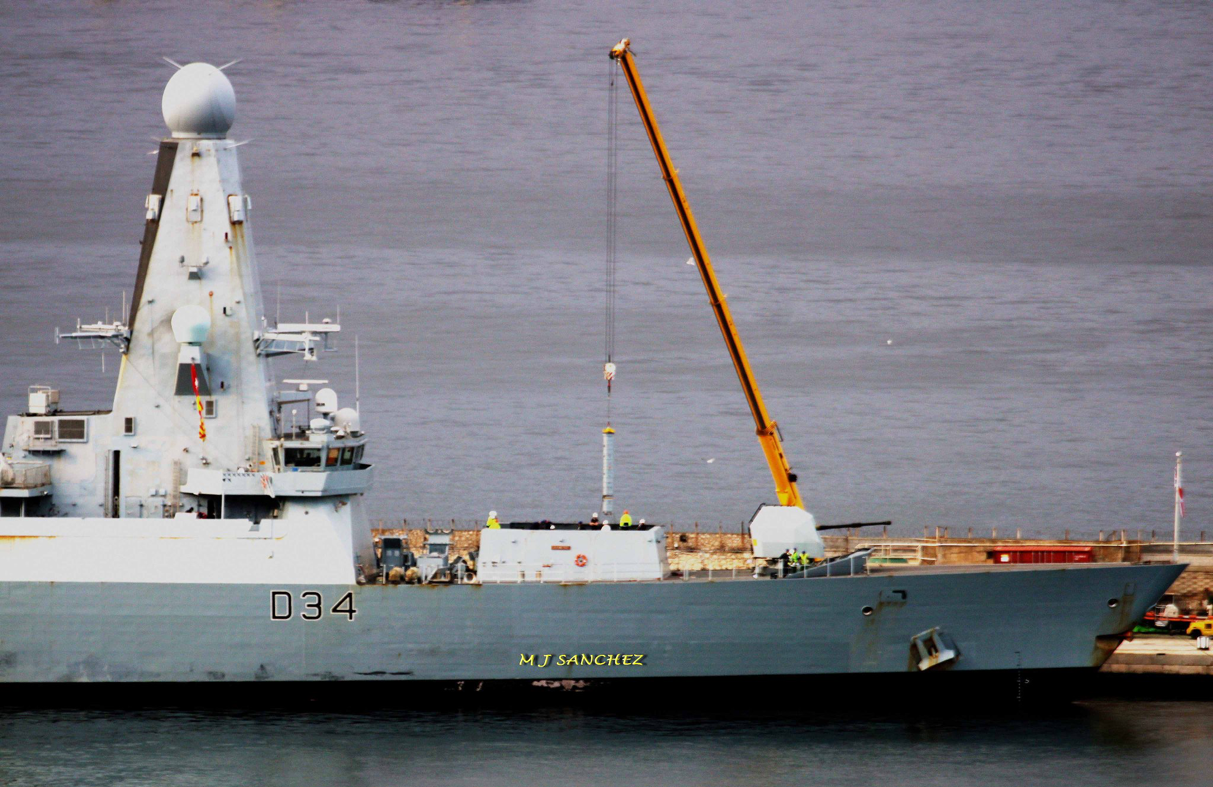
Gibraltar once again demonstrating its value as a forward support base.

Joined: Oct 2018
Aviation Qualifications: PPL
Posts: 12,213
Likes: 1,648
From: Ferrara
Forward Supply Base?
Its 3600 km from the nearest point on the Red Sea - AND you have to go through a canal........
Helsinki or Lagos are closer..................
Its 3600 km from the nearest point on the Red Sea - AND you have to go through a canal........
Helsinki or Lagos are closer..................
Joined: Sep 2004
Posts: 2,130
Likes: 326
From: Royal Berkshire

I make it about 11,000km from Red Sea area to Helsinki by ship.....and that invloves passing Gib on the way.

Joined: Oct 2018
Aviation Qualifications: PPL
Posts: 12,213
Likes: 1,648
From: Ferrara
Joined: Apr 2008
Posts: 216
Likes: 54
From: Somerset
Ecce Homo! Loquitur...
Joined: Jul 2000
Aviation Qualifications: Spotter
Posts: 24,510
Likes: 7,255
From: Peripatetic
https://ukdefencejournal.org.uk/mod-...or-mothballed/
MOD confirm assault ships not to be ‘scrapped or mothballed’
Despite previous speculation that HMS Albion and HMS Bulwark could be scrapped or mothballed, the Ministry of Defence has confirmed they’ll remain ins ervice.The information came to light in response to a Written Parliamentary Question.
Julian Lewis Chair, Intelligence and Security Committee of Parliament, asked:
“To ask the Secretary of State for Defence, with reference to his oral reply of 19 February 2024 to the Rt hon Member for New Forest East on HMS Albion and HMS Bulwark, Official Report, column 458, whether his assurance that one of those ships will always be being made ready to sail means that neither will be mothballed.”
James Cartlidge, The Minister of State, Ministry of Defence, responded:
“I can confirm that neither HMS ALBION nor HMS BULWARK will be scrapped or mothballed before their planned out of service dates in 2033 and 2034 respectively. As has been the case since 2010, one Landing Platform Dock ship will be held in extended readiness such that she will be capable of being regenerated if we have strategic notice that she will be needed.
As such, HMS ALBION will take HMS BULWARK’s place in extended readiness. While you would not expect me to reveal the fine detail of readiness forecasts for security reasons, I can confirm HMS BULWARK will be regenerated from extended readiness and maintained so that she can be ready to deliver defence outputs if required.”
MOD confirm assault ships not to be ‘scrapped or mothballed’
Despite previous speculation that HMS Albion and HMS Bulwark could be scrapped or mothballed, the Ministry of Defence has confirmed they’ll remain ins ervice.The information came to light in response to a Written Parliamentary Question.
Julian Lewis Chair, Intelligence and Security Committee of Parliament, asked:
“To ask the Secretary of State for Defence, with reference to his oral reply of 19 February 2024 to the Rt hon Member for New Forest East on HMS Albion and HMS Bulwark, Official Report, column 458, whether his assurance that one of those ships will always be being made ready to sail means that neither will be mothballed.”
James Cartlidge, The Minister of State, Ministry of Defence, responded:
“I can confirm that neither HMS ALBION nor HMS BULWARK will be scrapped or mothballed before their planned out of service dates in 2033 and 2034 respectively. As has been the case since 2010, one Landing Platform Dock ship will be held in extended readiness such that she will be capable of being regenerated if we have strategic notice that she will be needed.
As such, HMS ALBION will take HMS BULWARK’s place in extended readiness. While you would not expect me to reveal the fine detail of readiness forecasts for security reasons, I can confirm HMS BULWARK will be regenerated from extended readiness and maintained so that she can be ready to deliver defence outputs if required.”
Joined: May 2003
Posts: 3,081
Likes: 252
From: London/Oxford/New York
Whereas mothballed is exactly that, mothballed!
A huge difference.
Joined: Dec 2001
Aviation Qualifications: Military
Posts: 2,965
Likes: 484
From: The Roman Empire
Thank you....
However, I expect the "small permanent crew" allocated will be VERY small, and the people identified to bring it back to fully crewed will no doubt already be doing vital jobs in a service that is "underpersonned"...
However, I expect the "small permanent crew" allocated will be VERY small, and the people identified to bring it back to fully crewed will no doubt already be doing vital jobs in a service that is "underpersonned"...
Ecce Homo! Loquitur...
Joined: Jul 2000
Aviation Qualifications: Spotter
Posts: 24,510
Likes: 7,255
From: Peripatetic
Must have run out of pianos…..
NEW: Aircraft carrier USS John F. Kennedy (CVN-79) is catapulting objects into the James River in Virginia to test its plane launching capabilities.
The footage was recently released by Huntington Ingalls Industries (HII), a ship building company.
The Kennedy features an electromagnetic aircraft launch system (EMALS) which makes it just the 2nd US aircraft carrier to have this advanced system.
The vehicles it launched in testing reached speeds of 150mph and experts estimate it will be able to launch jets at speeds of 240mph.
The Kennedy was launched in 2019 and has a price tag of $11.3 billion.
NEW: Aircraft carrier USS John F. Kennedy (CVN-79) is catapulting objects into the James River in Virginia to test its plane launching capabilities.
The footage was recently released by Huntington Ingalls Industries (HII), a ship building company.
The Kennedy features an electromagnetic aircraft launch system (EMALS) which makes it just the 2nd US aircraft carrier to have this advanced system.
The vehicles it launched in testing reached speeds of 150mph and experts estimate it will be able to launch jets at speeds of 240mph.
The Kennedy was launched in 2019 and has a price tag of $11.3 billion.