


Future Carrier (Including Costs)


Joined: Oct 2018
Aviation Qualifications: PPL
Posts: 12,223
Likes: 1,649
From: Ferrara
IIRC the armed services have often had recruitment issues over the past 30 years - the Army in particular has been reducing regiments etc for ages - and having to recruit in Fiji etc.
Whilst NAB and I do not agree about the UK Carriers I think we do agree that procurement and long term planning for the RN has been ... less than optimum....
The politicians seem unable to grasp the need for long term planning and commitments - a steady run-down of shipbuilding (what a brilliant idea it was to close Portsmouth for example - not!), stop start replacement programmes, general underfunding - it's been going on for decades now. It's not good.
Whilst NAB and I do not agree about the UK Carriers I think we do agree that procurement and long term planning for the RN has been ... less than optimum....
The politicians seem unable to grasp the need for long term planning and commitments - a steady run-down of shipbuilding (what a brilliant idea it was to close Portsmouth for example - not!), stop start replacement programmes, general underfunding - it's been going on for decades now. It's not good.


Joined: Apr 2006
Posts: 809
Likes: 428
From: Portsmouth
The politicians seem unable to grasp the need for long term planning and commitments - a steady run-down of shipbuilding (what a brilliant idea it was to close Portsmouth for example - not!), stop start replacement programmes, general underfunding - it's been going on for decades now. It's not good.
The biggest issue in MoD appears to be the belief that RDEL funding is a "bad thing" and cannot possibly ever be permanently increased. Because RDEL pays for people, this is what restricts numbers of people, their wages, their day to day op costs, supporting contracts for logistics and all the other things that make the entity as a whole work. That includes funding the procurement and in-service support staff to actually allow enough of them to conduct their activities in an efficient, sensible manner.
Fix that - and its primarily an accounting and subsequently communications piece - and you go a long way to fixing some of the more intractable problems.
Joined: Oct 2018
Aviation Qualifications: PPL
Posts: 12,223
Likes: 1,649
From: Ferrara
"That includes funding the procurement and in-service support staff to actually allow enough of them to conduct their activities in an efficient, sensible manner."
Agreed - but reading Citadel of Waste (see the thread) makes you despair
Agreed - but reading Citadel of Waste (see the thread) makes you despair
Ecce Homo! Loquitur...
Joined: Jul 2000
Aviation Qualifications: Spotter
Posts: 24,550
Likes: 7,281
From: Peripatetic
Unprecedented:
RN is appealing to the retired community via LinkedIn for a new Rear Admiral - Director of Submarines.
No suitable internal candidate to replace two-star @RAdmSAsquith
https://archive.is/2024.01.05-143432...ting-l6sc8wm2z
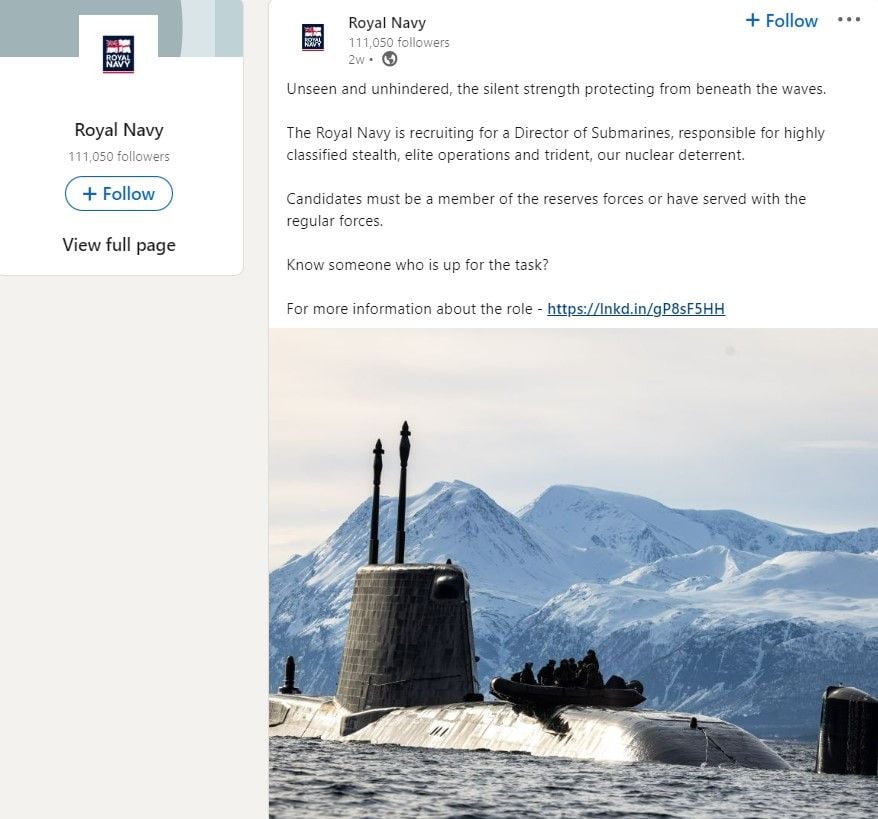
RN is appealing to the retired community via LinkedIn for a new Rear Admiral - Director of Submarines.
No suitable internal candidate to replace two-star @RAdmSAsquith
https://archive.is/2024.01.05-143432...ting-l6sc8wm2z
Ecce Homo! Loquitur...
Joined: Jul 2000
Aviation Qualifications: Spotter
Posts: 24,550
Likes: 7,281
From: Peripatetic
And the other boot drops….
https://www.thetimes.co.uk/news/uk/r...sels-2s2r3mbfs
Mothballing assault ships ‘will spell the end of Royal Marines
’Two amphibious assault ships are to be mothballed under government plans to make up for a severe sailor shortage in what critics have described as “the beginning of the end for the Royal Marines”.
Grant Shapps, the defence secretary, has put forward proposals to retire HMS Albion and HMS Bulwark from active service, The Times can reveal.
The move would free more than 200 sailors to crew new ships. But a source familiar with the plans said it would weaken the elite force by taking away one of its central purposes — storming beaches from the sea. “It would be the beginning of the end for the Royal Marines,” they said.
The manpower crisis is deemed so acute across the navy that the Ministry of Defence is also planning to decommission two older vessels, HMS Westminster and HMS Argyll, as soon as this year. The crews of all four ships would be sent to work across the new fleet of Type 26 frigates as they come into service.
It is understood that the Royal Navy has been pushing for the vessels to be scrapped and Royal Marine numbers to be slashed for years to spare other assets but Ben Wallace, the former defence secretary, repeatedly refused.
He told senior naval chiefs that the sailors could be found from within the existing service, as thousands are currently in shore-based roles.
A senior naval source said the final plans for the amphibious assault ships were on the desk of Rishi Sunak, the prime minister, who is expected to give them the go-ahead. An MoD source said that no decision had been made, adding: “If a decision is made on them, they would remain in a state of extended readiness.”….
By mothballing HMS Albion and HMS Bulwark, up to 250 sailors will be released to man the new frigates, of which there will eventually be eight. They will be the navy’s most advanced submarine-hunting warships to date….
HMS Bulwark and HMS Albion’s role is to “deliver the punch of the Royal Marines ashore by air and by sea, with boats from the landing dock in the belly of the ship and by assault helicopter from the two-spot flight deck”, according to the navy.
The ships had been expected to remain in service until the early 2030s, with HMS Bulwark recently given an expensive refit. A naval source said they would be “kept in the cupboard” to be “dusted off” if needed.
https://www.thetimes.co.uk/news/uk/r...sels-2s2r3mbfs
Mothballing assault ships ‘will spell the end of Royal Marines
’Two amphibious assault ships are to be mothballed under government plans to make up for a severe sailor shortage in what critics have described as “the beginning of the end for the Royal Marines”.
Grant Shapps, the defence secretary, has put forward proposals to retire HMS Albion and HMS Bulwark from active service, The Times can reveal.
The move would free more than 200 sailors to crew new ships. But a source familiar with the plans said it would weaken the elite force by taking away one of its central purposes — storming beaches from the sea. “It would be the beginning of the end for the Royal Marines,” they said.
The manpower crisis is deemed so acute across the navy that the Ministry of Defence is also planning to decommission two older vessels, HMS Westminster and HMS Argyll, as soon as this year. The crews of all four ships would be sent to work across the new fleet of Type 26 frigates as they come into service.
It is understood that the Royal Navy has been pushing for the vessels to be scrapped and Royal Marine numbers to be slashed for years to spare other assets but Ben Wallace, the former defence secretary, repeatedly refused.
He told senior naval chiefs that the sailors could be found from within the existing service, as thousands are currently in shore-based roles.
A senior naval source said the final plans for the amphibious assault ships were on the desk of Rishi Sunak, the prime minister, who is expected to give them the go-ahead. An MoD source said that no decision had been made, adding: “If a decision is made on them, they would remain in a state of extended readiness.”….
By mothballing HMS Albion and HMS Bulwark, up to 250 sailors will be released to man the new frigates, of which there will eventually be eight. They will be the navy’s most advanced submarine-hunting warships to date….
HMS Bulwark and HMS Albion’s role is to “deliver the punch of the Royal Marines ashore by air and by sea, with boats from the landing dock in the belly of the ship and by assault helicopter from the two-spot flight deck”, according to the navy.
The ships had been expected to remain in service until the early 2030s, with HMS Bulwark recently given an expensive refit. A naval source said they would be “kept in the cupboard” to be “dusted off” if needed.
Ecce Homo! Loquitur...
Joined: Jul 2000
Aviation Qualifications: Spotter
Posts: 24,550
Likes: 7,281
From: Peripatetic
Telegraph (@SheridanDani) and Times (@larisamlbrown) have reported that the Royal Navy is planning to scrap or pay off 2 x Type 23 and both LPDs
Pinstripedline analysis asks if this is a pragmatic reality check or more bad news for the Royal Navy?
http://tinyurl.com/26sra849
Pinstripedline analysis asks if this is a pragmatic reality check or more bad news for the Royal Navy?
http://tinyurl.com/26sra849
Ecce Homo! Loquitur...
Joined: Jul 2000
Aviation Qualifications: Spotter
Posts: 24,550
Likes: 7,281
From: Peripatetic
Indirectly related - is this something we are now doing right?
http://tinyurl.com/2p92n2mh
Revitalizing US Navy Shipbuilding
The US Navy's ship program is sick, but the fixes aren't rocket science.
http://tinyurl.com/2p92n2mh
Revitalizing US Navy Shipbuilding
The US Navy's ship program is sick, but the fixes aren't rocket science.
Joined: Apr 2006
Posts: 809
Likes: 428
From: Portsmouth
That article is full of inappropriate or inaccurate deductions and examples. There are some truths in it, but by accident rather than a well thought-out argument.
It also cites the US "Navy Matters" website which is run by someone who appears never to have set foot on an active warship, but believes everything the internet says.
It also cites the US "Navy Matters" website which is run by someone who appears never to have set foot on an active warship, but believes everything the internet says.

Joined: Apr 2020
Posts: 1,980
Likes: 376
From: Hampshire
Somewhat adrift for the discussion as I have been trying to calm down but here are my increasingly random thoughts. You never know, Shapps may have been reroled be for he can do any of this, although I suspect it's HMT driven.
HMS Argyll is a GP T23 so her replacement will be a T31 - Venturer will be afloat within 6 months and due to commission by the end of next year; Babcock aim to deliver all 5 by the end of 2028. On the ASW side last I heard is that Glasgow is due to commission around the end of 2026 with Cardiff and Belfast following at approximately 18 month intervals accelerating to a year for the 5 batch II vessels. Given the 53 months it took to refit the Iron Duck, even if they restarted Westminster's refit she might not be ready for a pre-FOST work up before Glasgow.
As to Nelson's frigates, he wanted them for the Georgian equivalent of ISTAR, communications, and taking damaged ships of the line under tow. These are no longer the roles of minor warships.
The recruitment and retention problems aren't news the numbers have been under the required level for years, plus the Andrew has had a perpetual struggle with aircrew numbers, and as I think I posted before, the nature of the submarine service means it is struggling even more. I increasingly wonder if the small crews of modern warships have negative psychological and morale effects lacking the support of a larger naval community. If one looks at FFs Leander v T23, DDs T42 v T45, and LPDs Fearless v Albion the crews of the current generation are roughly 1/2 to 2/3 but the ships are much more capable. A QEC fishhead crew is roughly the same as an Invincible. In the capability gap area the crew (excl air group and Royals) of Ocean was 1/3 that of the Rusty B. We have single escorts playing the role of a cruiser at the height of pax-Brittanica, granted in the case of a T45 displacing much the same as a WW2 heavy cruiser but with a crew 1/3 the size and limited ASuW armament (indeed the same crew numbers as a Modified Black Swan sloop). In peace the cruiser would carried the implicit message Nemo me impune lacessit threatening the revenge of a battle fleet somewhere over the horizon, I don't think such fear is generated by our scattered escorts. In the days of the steam navy ships with such small crews would have been part of a deployed squadron with a depot ship or alongside a stone frigate and as such part of a larger naval community. I also wonder if the RN's much lauded recruitment adds have been counterproductive. In a climate of employment levels that are nearly at the highest level since records began, young people have been sold unrealistic expectations of the financial benefits of a university education which has lost its rarity value, and the technically literate people the RN and RAF are among those who assume they deserve starting salaries well in excess of the median for the whole working population, there is a need to identify USPs beyond fitness, waving firearms, and runs ashore and 'made in the Royal Navy'.
It should be remembered that one of the reasons there were a number of ships new enough to be worth reactiving from the Standby Squadron in 1982, was the extreme manpower crisis in the the late '70s and early '80s this lead to the earlier than planned retirement of a number of ships especially crew hungry ones like Blake and Tiger.
To me the fleet has for the last half-century has effectively been equipped as a green-water navy but given an intermittent and increasingly frequent blue-water tasking. The pocket carriers of the QE Class are to me sized for an LHA role but as N_a_B has previously reminded us we don't have the nuclear engineers to properly support the SSBN and much shrunken SSN fleets. A fact coupled with all flavours of HMGs's perpetual penny pinching prevented the UK having the CATOBAR CVNs that a Strike Carrier capability really requires and the necessary escort numbers to provide adequate 360° ASW, ASuW and AAW screens. Escort vessels should be, in the last resort, present in sufficient numbers to be able to be sacrificed to support the major assets, the problem is until the QECs arrived the Navy had gone through two generations with virtually no major units. Escorts have become bloated in size, cost and roles such that they can be barely afforded and certainly not sacrificed and cannot replaced until they are worn out long passed their initially planned OSDs. Nor do we maintain the capacity to replace them temporarily with inactive but reasonably modern ships (which admitedly brings problems - though the batch one Rivers returned to service and that was thought impossible by some.)
The beginning of the end for the Royals was the loss of Four One in 1981* as was demonstrated the following year when 3 Cdo Bde had to borrow two pongo battalions to stage an operation How they've lasted another forty years is nothing short of a miracle. Four Two has now been emasculated and with Four Three is now performing the Naval equivalent of the Rocks' Force Protection role. (*possibly even the disbanding of the 'real' Four Three on 1968)
I struggle to understand the purpose of FCF and LRG. An LPD plus a Bay LSD were the original theoretical minimum amphibious vessels composing an LRG (with a T45 and a logistics ship) but with the forward deployment of two and only one active and possibly soon no LPDs how does the concept work? I suppose one could argue a Bay is a hybrid LPD/LSL but there are only three and one of them is effectively the 9 MCMS depot ship at HMS Jufair. So what happens when one is in refit and the RFA is struggling even more than the RN to recruit and retain to provide crews. Beyond flag waving, I honestly can't see what the actual pupose of a rotating forward based single company of Royals, with elements supporting arms, is even with their wizzy new toys and new doctrines. I am sure Vlad the bad and his generals don't see them making a threatening contribution to the defence of NATO's northern flank. It strikes me that FCF is to deliver a 'special forces light' tripwire company expecting support to be delivered as effectively and rapidly as to 6th Airborne in Operation Varsity but will be lucky to get it as slowly and ineffectively as Op Garden supplied it to the 1st Airborne participants in Op Market. The old error of only preparing to fight the last war applies; it suits the purposes of politicians and to some extent (V)VSOs to convince themselves, despite their statements to the contrary, the UK will only ever be involved in low intensity, highly asymmetric conflicts.
In my fantasy fleet an LRG would consist of a USS Bougainville equivalent LHA with flights of F-35Bs, AH-64Es, H-47ERs (the "Honestly Mr Congressman, it's not an FMS MH-47G " version), Merlin HM2 (ASW & ASAC) a mix of Wildcat AH1 and HMA2s (Martlet/Sea Venom/Stingray equipped), and variously roled UAV, UUV and USVs. It would carry a full commando with support elements. It would be supported by an LSD(A), an FSS, two AAW and two ASW escorts. I had better put down the gin and sober up.
HMS Argyll is a GP T23 so her replacement will be a T31 - Venturer will be afloat within 6 months and due to commission by the end of next year; Babcock aim to deliver all 5 by the end of 2028. On the ASW side last I heard is that Glasgow is due to commission around the end of 2026 with Cardiff and Belfast following at approximately 18 month intervals accelerating to a year for the 5 batch II vessels. Given the 53 months it took to refit the Iron Duck, even if they restarted Westminster's refit she might not be ready for a pre-FOST work up before Glasgow.
As to Nelson's frigates, he wanted them for the Georgian equivalent of ISTAR, communications, and taking damaged ships of the line under tow. These are no longer the roles of minor warships.
The recruitment and retention problems aren't news the numbers have been under the required level for years, plus the Andrew has had a perpetual struggle with aircrew numbers, and as I think I posted before, the nature of the submarine service means it is struggling even more. I increasingly wonder if the small crews of modern warships have negative psychological and morale effects lacking the support of a larger naval community. If one looks at FFs Leander v T23, DDs T42 v T45, and LPDs Fearless v Albion the crews of the current generation are roughly 1/2 to 2/3 but the ships are much more capable. A QEC fishhead crew is roughly the same as an Invincible. In the capability gap area the crew (excl air group and Royals) of Ocean was 1/3 that of the Rusty B. We have single escorts playing the role of a cruiser at the height of pax-Brittanica, granted in the case of a T45 displacing much the same as a WW2 heavy cruiser but with a crew 1/3 the size and limited ASuW armament (indeed the same crew numbers as a Modified Black Swan sloop). In peace the cruiser would carried the implicit message Nemo me impune lacessit threatening the revenge of a battle fleet somewhere over the horizon, I don't think such fear is generated by our scattered escorts. In the days of the steam navy ships with such small crews would have been part of a deployed squadron with a depot ship or alongside a stone frigate and as such part of a larger naval community. I also wonder if the RN's much lauded recruitment adds have been counterproductive. In a climate of employment levels that are nearly at the highest level since records began, young people have been sold unrealistic expectations of the financial benefits of a university education which has lost its rarity value, and the technically literate people the RN and RAF are among those who assume they deserve starting salaries well in excess of the median for the whole working population, there is a need to identify USPs beyond fitness, waving firearms, and runs ashore and 'made in the Royal Navy'.
It should be remembered that one of the reasons there were a number of ships new enough to be worth reactiving from the Standby Squadron in 1982, was the extreme manpower crisis in the the late '70s and early '80s this lead to the earlier than planned retirement of a number of ships especially crew hungry ones like Blake and Tiger.
To me the fleet has for the last half-century has effectively been equipped as a green-water navy but given an intermittent and increasingly frequent blue-water tasking. The pocket carriers of the QE Class are to me sized for an LHA role but as N_a_B has previously reminded us we don't have the nuclear engineers to properly support the SSBN and much shrunken SSN fleets. A fact coupled with all flavours of HMGs's perpetual penny pinching prevented the UK having the CATOBAR CVNs that a Strike Carrier capability really requires and the necessary escort numbers to provide adequate 360° ASW, ASuW and AAW screens. Escort vessels should be, in the last resort, present in sufficient numbers to be able to be sacrificed to support the major assets, the problem is until the QECs arrived the Navy had gone through two generations with virtually no major units. Escorts have become bloated in size, cost and roles such that they can be barely afforded and certainly not sacrificed and cannot replaced until they are worn out long passed their initially planned OSDs. Nor do we maintain the capacity to replace them temporarily with inactive but reasonably modern ships (which admitedly brings problems - though the batch one Rivers returned to service and that was thought impossible by some.)
The beginning of the end for the Royals was the loss of Four One in 1981* as was demonstrated the following year when 3 Cdo Bde had to borrow two pongo battalions to stage an operation How they've lasted another forty years is nothing short of a miracle. Four Two has now been emasculated and with Four Three is now performing the Naval equivalent of the Rocks' Force Protection role. (*possibly even the disbanding of the 'real' Four Three on 1968)
I struggle to understand the purpose of FCF and LRG. An LPD plus a Bay LSD were the original theoretical minimum amphibious vessels composing an LRG (with a T45 and a logistics ship) but with the forward deployment of two and only one active and possibly soon no LPDs how does the concept work? I suppose one could argue a Bay is a hybrid LPD/LSL but there are only three and one of them is effectively the 9 MCMS depot ship at HMS Jufair. So what happens when one is in refit and the RFA is struggling even more than the RN to recruit and retain to provide crews. Beyond flag waving, I honestly can't see what the actual pupose of a rotating forward based single company of Royals, with elements supporting arms, is even with their wizzy new toys and new doctrines. I am sure Vlad the bad and his generals don't see them making a threatening contribution to the defence of NATO's northern flank. It strikes me that FCF is to deliver a 'special forces light' tripwire company expecting support to be delivered as effectively and rapidly as to 6th Airborne in Operation Varsity but will be lucky to get it as slowly and ineffectively as Op Garden supplied it to the 1st Airborne participants in Op Market. The old error of only preparing to fight the last war applies; it suits the purposes of politicians and to some extent (V)VSOs to convince themselves, despite their statements to the contrary, the UK will only ever be involved in low intensity, highly asymmetric conflicts.
In my fantasy fleet an LRG would consist of a USS Bougainville equivalent LHA with flights of F-35Bs, AH-64Es, H-47ERs (the "Honestly Mr Congressman, it's not an FMS MH-47G " version), Merlin HM2 (ASW & ASAC) a mix of Wildcat AH1 and HMA2s (Martlet/Sea Venom/Stingray equipped), and variously roled UAV, UUV and USVs. It would carry a full commando with support elements. It would be supported by an LSD(A), an FSS, two AAW and two ASW escorts. I had better put down the gin and sober up.
Joined: Oct 2018
Aviation Qualifications: PPL
Posts: 12,223
Likes: 1,649
From: Ferrara
"Escorts have become bloated in size, cost and roles such that they can be barely afforded and certainly not sacrificed and cannot replaced until they are worn out long passed their initially planned OSD"
I was re-reading Freidmanns "British Destroyers" which details all the ins and outs of post war design drivers - it's a 2006 book and its still the same issues. When you can't afford a large fleet you finish up loading the ships you have (or are designing) with more and more roles and they get bigger and bigger. Plus the changes in accommodation, electronics etc lead to bigger vessels
I was re-reading Freidmanns "British Destroyers" which details all the ins and outs of post war design drivers - it's a 2006 book and its still the same issues. When you can't afford a large fleet you finish up loading the ships you have (or are designing) with more and more roles and they get bigger and bigger. Plus the changes in accommodation, electronics etc lead to bigger vessels
Joined: Apr 2006
Posts: 809
Likes: 428
From: Portsmouth
"Escorts have become bloated in size, cost and roles such that they can be barely afforded and certainly not sacrificed and cannot replaced until they are worn out long passed their initially planned OSD"<br /><br />I was re-reading Freidmanns "British Destroyers" which details all the ins and outs of post war design drivers - it's a 2006 book and its still the same issues. When you can't afford a large fleet you finish up loading the ships you have (or are designing) with more and more roles and they get bigger and bigger. Plus the changes in accommodation, electronics etc lead to bigger vessels
The differences when actually aboard are significant. You walk down a T42 passageway and it's tiny. Walk down a T23 and its noticeably more spacious. Walk down the main drag on a T45 and it's huge. Remember that a T45 is a single role ship as well.
Cost does not directly scale with size, it's more complicated than that (although the MoD cost models still use that relationship). Build time also has an effect, which again is not directly scalable with size. T45 - comparable in size to T26 - built in two yards took (broadly) a couple of years less than T26 will do to build in one.
Joined: Apr 2020
Posts: 1,980
Likes: 376
From: Hampshire
I admit I should have used a less negative word than bloated. I would much prefer serving in the working and living environment of a 45, poor ergonomics wasn't confined to the previous generation of escorts, my recollection is that the fighting and driving areas of the Invincibles were 'deceptively spacious'. My point was I would like to see research conducted into the psychological effects of smaller crew in larger ships especially on long single vessel deployments and if this is affecting retention. T45 is clearly a quantum leap in AAW capability, it can carry twice (planned to become three times) as many AAMs as a 42, has bigger and better aviation facilities and can an act as a flagship Its range is 75% greater than a 42. However, it was designed before the age of the drone swarm and I understand its Mk 8 gun can't engage aerial targets due to software limitations (the recent press coverage of Diamond suggest she used he guns - I assume this was point defence against a threat to the ship?). This means it currently has to use its main weapon system to protect other vessels from drone attack - an expensive option. May main concern is the lack of decent ASW sensors and weapons fit if they are being used on single ship deployment rather than in concert with an ASW frigate; IMO this can only become more important with the likely growth in the use of heavyweight UUVs. I don't see politicians understanding these bigger ships are single role, though may be the fact that Diamond and Richmond are both being deployed means the light is trickling through.
The real issue for maintaining adequate escort numbers is the aforementioned warship cost inflation, using 11/2023 pounds, a 45 cost more that four times as much as the last 42 and nearly eight times as much as the last County - which is probably a fairer comparison as it had flag facilities (granted coupled with a virtually useless primary weapon system.)
HMS Antrim <220m Nov2023 GBP
HMS Edinburgh <400m Nov2023 GBP
Type 45 average c.1,750m Nov2023 GBP
(for comparison a QE CV would be 4,600m in Nov2023 GBP)
Hoewvwer, for another metric, the cost per ton, of the T45 was about the same as a T42 batch 3 but more than double that of a County (2009 GBPs)
I was interested in the views of Tom Sharpe in one of his recent comment articles in the Telegraph (urgh) - he was CO of HMS St Albans 2010-2012 and held three other commands in a 27 year career. He was appointed OBE for his role in saving HMS Endurance from sinking.
The real issue for maintaining adequate escort numbers is the aforementioned warship cost inflation, using 11/2023 pounds, a 45 cost more that four times as much as the last 42 and nearly eight times as much as the last County - which is probably a fairer comparison as it had flag facilities (granted coupled with a virtually useless primary weapon system.)
HMS Antrim <220m Nov2023 GBP
HMS Edinburgh <400m Nov2023 GBP
Type 45 average c.1,750m Nov2023 GBP
(for comparison a QE CV would be 4,600m in Nov2023 GBP)
Hoewvwer, for another metric, the cost per ton, of the T45 was about the same as a T42 batch 3 but more than double that of a County (2009 GBPs)
I was interested in the views of Tom Sharpe in one of his recent comment articles in the Telegraph (urgh) - he was CO of HMS St Albans 2010-2012 and held three other commands in a 27 year career. He was appointed OBE for his role in saving HMS Endurance from sinking.
...the Royal Navy and Royal Fleet Auxiliary are critically short of people with ships unable to go to sea as a result. Admiral level positions are being recruited on LinkedIn and the Royal Marines are fighting for their existence yet again – despite the fact that they don’t suffer nearly as badly from recruiting problems as most. This reflects a global maritime recruitment shortage (of about 9 per cent), inefficient and wasteful recruitment processes and an inability to convert those that do make it through the door onto the trained strength and then keep them there.Improving the offer would help to solve this wicked problem, but that involves more money so won’t happen. The raft of other solutions to the recruitment and retention problem is huge but one that must always be considered is sending ships on real operations. Army friends – I do have some – have told me about the effect that active land warfare had on infantry recruitment. I guarantee no one is resigning from HMS Diamond’s ship’s company just now: she is up threat and doing exactly the job she was built for and her people trained for. HMS Richmond is heading out to join her. She too has the tools for the task, with her new Sea Ceptor missiles and new, upgraded propulsion and power units. The RN can still put effective warships to sea when it has to.
This makes the decision not to send HMS Queen Elizabeth even more frustrating – if the carrier was to deploy on a punchy operation such as restoring freedom of navigation in the Red Sea this would be recruitment and retention positive. As it is, we are sending the escort group, without its carrier!
This makes the decision not to send HMS Queen Elizabeth even more frustrating – if the carrier was to deploy on a punchy operation such as restoring freedom of navigation in the Red Sea this would be recruitment and retention positive. As it is, we are sending the escort group, without its carrier!
Defence will always compete unfavourably with other government priorities until it’s too late, that is the historical precedent with which we must live. Thus, it is not entirely fair to blame the current predicament on this current government. That there is an obvious surge in global insecurity, some of which is affecting the UK, and all we get is a vague promise of an increase in defence spending ‘when economic conditions allow’ is annoying and short-sighted but not unprecedented.
There are many channels into the decision makers in Downing Street to at least attempt to address this but the one way that is guaranteed not to help is overt or subtle interservice tribalism from inside or outside the services.
There are many channels into the decision makers in Downing Street to at least attempt to address this but the one way that is guaranteed not to help is overt or subtle interservice tribalism from inside or outside the services.
Last edited by SLXOwft; 11th January 2024 at 18:24.
Thread Starter
Joined: Feb 2002
Posts: 2,968
Likes: 102
From: Devon
We seem to be living in incredible times - deploying extra frigates to the Middle East while talking of cutting numbers, talking of mothballing the LPDs and letting talk of losing the amphibious capability get out of hand, and as always the carriers get the blame. I have heard a suggestion that the leaks were 'pitch rolling' - whatever that means...
Firstly - personnel numbers. Thanks to Capita the services have a problem getting interested applicants to the point of actually joining. In addition, some of you may remember that in 2015 the RN expected a personnel uplift of 1500 people (as did the RAF). A great deal of work had been put into coming up with these figures and what to do with the extra people, but Cameron lacked the backbone to stand up to backbenchers when he made a promise about 'troop numbers' whilst not increasing the number (on paper - which included personnel who did not actually exist) of overall personnel in HM Forces.
I do not welcome his return to front line politics.
Secondly - have a look at this Telegraph article partly quoted above: Aircraft carriers are not a problem. Inter-service tribalism is
The title says it all really. The backbenchers thought of their old regiments...
Thirdly - frigates. Cutting numbers even further years before the replacements are ready makes no sense, as we are deploying more of them in the Middle East and on NATO tasking.
HMS Richmond heads to Gulf to support Diamond and Lancaster safeguard shipping - Royal Navy
Royal Navy warship HMS Richmond is Gulf-bound to support the international effort protecting shipping.
The frigate will stand in for HMS Diamond and HMS Lancaster when either vessel needs to break off patrols for re-supply or maintenance.
Diamond is assigned to a newly-established international security mission, Operation Prosperity Guardian which was inaugurated last month following a series of drone and missile attacks threatening shipping passing through the Red Sea.
Meanwhile frigate HMS Lancaster is on a long-term mission in the Middle East, largely focused on the Indian Ocean and Arabian Sea, hunting down drug smugglers and arms traffickers, while providing a reassurance presence to lawful seafarers.
In announcing Richmond’s deployment – the ship made a low-key departure from Plymouth on Friday, waved off by a small number of family and friends – Defence Secretary Grant Shapps told fellow MPs that there had been a fivefold increase in attacks against merchant shipping in the past month.
When she arrives in the region in a few weeks, Richmond will, Mr Shapps said “provide resilience to the UK’s presence in the Gulf”.
If necessary, the frigate will use her Sea Ceptor anti-missile system to protect herself and merchant vessels, as well as providing the wider assurance of the presence of a warship.
She heads for the Middle East having only returned to Devonport shortly before Christmas on another short-notice mission, helping to protect undersea infrastructure in the Baltic in support of regional allies...
A great time to be talking about cuts!
Fourthly: Bootnecks and amphibious capabilities. This was on the RN website yesterday:
Another year at the sharp end: Royal Marines in 2023 - Royal Navy
Looking north to the Arctic Circle and Baltic, Commandos carried out their annual winter deployment in Norway to keep themselves razor sharp for combat in the extreme cold – honing skills in survival, the ability move across the snow and ice and, finally, fight alongside allies in one of the world’s most unforgiving environments.
Following this up, Royal Marines headed to the Baltic Sea to take part in Sweden’s largest military drills in 25 years before heading to Estonia for Baltops – the largest annual NATO training in the region.
Commandos returned to the Baltic this month, taking part in Finland’s first major military drills as a NATO member and mastering the complex coastline near to capital Helsinki.
There remains ongoing operations in the Mediterranean, while 45 Commando have just completed Exercise Green Dagger – which saw the Arbroath-based unit work in the High Sierras in California to conduct high altitude and advanced mountain training.
At home in the UK, Royal Marines spent more than six months training nearly 1,000 Ukrainian counterparts in the art of commando raiding and complex amphibious operations.
Specialist instructors from across the UK Commando Force passed on invaluable expertise and knowledge in how to plan and carry out raids using small boats by day and night.
“Whether at sea or on land, in training or on operations, the Royal Marines have truly embodied the Defence purpose of protect the nation and help it prosper – and I am immensely proud of all you have achieved,” added General Jenkins.
“Behind every Marine is a network of support and strength, and I’d like to share my heartfelt gratitude for the sacrifices made by those who stand by our side and allow us to focus and succeed on operations.
“To them, I send my deepest gratitude and admiration for the part they play in protecting our Nation.
“As we look ahead to our 360th year, 2024 promises to be no less exciting.
“While it’s impossible to predict exactly where the Royal Marines will find themselves, rest assured, the warfighting Commando Force and expertise of the Royal Marines will be in high demand!”
---
In Den Helder, the two NATO and Joint Expeditionary Force allies shared plans on ships to carry the vehicles, boats, aircraft, and weaponry of highly-trained marines – and, vitally, land them ashore wherever they’re needed...
Fifthly: We got too accustomed to peaceful seas - Freight Waves
It’s somewhat ahistorical that the world’s oceans have been relatively painless to navigate in the second half of the 20th century, permitting trade to flow around the world. That was not the case for much of human history. “Pirates, predatory states, and the fleets of great powers did as they pleased,” wrote Jerry Hendrix, senior fellow at the Sagamore Institute, in The Atlantic last year. “The current reality, which dates only to the end of World War II, makes possible the commercial shipping that handles more than 80% of all global trade by volume — oil and natural gas, grain and raw ores, manufactured goods of every kind.”
Such peace can no longer be assumed. It’s unclear whether ongoing diversions from the Suez Canal will become the norm going forward, but it’s clear that things are shifting — and it’s not in the favor of frictionless trade or a U.S. hegemony.
“It was almost like you had a conveyor belt from the shoe factory in Bangladesh to the shop in Chicago,” said Simon Sundboell, founder and CEO of Copenhagen-based maritime intelligence company eeSea. “That’s just not happening anymore. You’re in a world that’s going increasingly from American-controlled unipolar to multipolar globally. You’re going to have a much more fraught supply chain, and every BCO [beneficial cargo owner], importer, exporter, and logistics provider is going to have to deal with that going forward. The Houthis are just one step in that.”
Firstly - personnel numbers. Thanks to Capita the services have a problem getting interested applicants to the point of actually joining. In addition, some of you may remember that in 2015 the RN expected a personnel uplift of 1500 people (as did the RAF). A great deal of work had been put into coming up with these figures and what to do with the extra people, but Cameron lacked the backbone to stand up to backbenchers when he made a promise about 'troop numbers' whilst not increasing the number (on paper - which included personnel who did not actually exist) of overall personnel in HM Forces.
I do not welcome his return to front line politics.
Secondly - have a look at this Telegraph article partly quoted above: Aircraft carriers are not a problem. Inter-service tribalism is
The title says it all really. The backbenchers thought of their old regiments...
Thirdly - frigates. Cutting numbers even further years before the replacements are ready makes no sense, as we are deploying more of them in the Middle East and on NATO tasking.
HMS Richmond heads to Gulf to support Diamond and Lancaster safeguard shipping - Royal Navy
Royal Navy warship HMS Richmond is Gulf-bound to support the international effort protecting shipping.
The frigate will stand in for HMS Diamond and HMS Lancaster when either vessel needs to break off patrols for re-supply or maintenance.
Diamond is assigned to a newly-established international security mission, Operation Prosperity Guardian which was inaugurated last month following a series of drone and missile attacks threatening shipping passing through the Red Sea.
Meanwhile frigate HMS Lancaster is on a long-term mission in the Middle East, largely focused on the Indian Ocean and Arabian Sea, hunting down drug smugglers and arms traffickers, while providing a reassurance presence to lawful seafarers.
In announcing Richmond’s deployment – the ship made a low-key departure from Plymouth on Friday, waved off by a small number of family and friends – Defence Secretary Grant Shapps told fellow MPs that there had been a fivefold increase in attacks against merchant shipping in the past month.
When she arrives in the region in a few weeks, Richmond will, Mr Shapps said “provide resilience to the UK’s presence in the Gulf”.
If necessary, the frigate will use her Sea Ceptor anti-missile system to protect herself and merchant vessels, as well as providing the wider assurance of the presence of a warship.
She heads for the Middle East having only returned to Devonport shortly before Christmas on another short-notice mission, helping to protect undersea infrastructure in the Baltic in support of regional allies...
A great time to be talking about cuts!
Fourthly: Bootnecks and amphibious capabilities. This was on the RN website yesterday:
Another year at the sharp end: Royal Marines in 2023 - Royal Navy
Looking north to the Arctic Circle and Baltic, Commandos carried out their annual winter deployment in Norway to keep themselves razor sharp for combat in the extreme cold – honing skills in survival, the ability move across the snow and ice and, finally, fight alongside allies in one of the world’s most unforgiving environments.
Following this up, Royal Marines headed to the Baltic Sea to take part in Sweden’s largest military drills in 25 years before heading to Estonia for Baltops – the largest annual NATO training in the region.
Commandos returned to the Baltic this month, taking part in Finland’s first major military drills as a NATO member and mastering the complex coastline near to capital Helsinki.
There remains ongoing operations in the Mediterranean, while 45 Commando have just completed Exercise Green Dagger – which saw the Arbroath-based unit work in the High Sierras in California to conduct high altitude and advanced mountain training.
At home in the UK, Royal Marines spent more than six months training nearly 1,000 Ukrainian counterparts in the art of commando raiding and complex amphibious operations.
Specialist instructors from across the UK Commando Force passed on invaluable expertise and knowledge in how to plan and carry out raids using small boats by day and night.
“Whether at sea or on land, in training or on operations, the Royal Marines have truly embodied the Defence purpose of protect the nation and help it prosper – and I am immensely proud of all you have achieved,” added General Jenkins.
“Behind every Marine is a network of support and strength, and I’d like to share my heartfelt gratitude for the sacrifices made by those who stand by our side and allow us to focus and succeed on operations.
“To them, I send my deepest gratitude and admiration for the part they play in protecting our Nation.
“As we look ahead to our 360th year, 2024 promises to be no less exciting.
“While it’s impossible to predict exactly where the Royal Marines will find themselves, rest assured, the warfighting Commando Force and expertise of the Royal Marines will be in high demand!”
---
In Den Helder, the two NATO and Joint Expeditionary Force allies shared plans on ships to carry the vehicles, boats, aircraft, and weaponry of highly-trained marines – and, vitally, land them ashore wherever they’re needed...
Fifthly: We got too accustomed to peaceful seas - Freight Waves
It’s somewhat ahistorical that the world’s oceans have been relatively painless to navigate in the second half of the 20th century, permitting trade to flow around the world. That was not the case for much of human history. “Pirates, predatory states, and the fleets of great powers did as they pleased,” wrote Jerry Hendrix, senior fellow at the Sagamore Institute, in The Atlantic last year. “The current reality, which dates only to the end of World War II, makes possible the commercial shipping that handles more than 80% of all global trade by volume — oil and natural gas, grain and raw ores, manufactured goods of every kind.”
Such peace can no longer be assumed. It’s unclear whether ongoing diversions from the Suez Canal will become the norm going forward, but it’s clear that things are shifting — and it’s not in the favor of frictionless trade or a U.S. hegemony.
“It was almost like you had a conveyor belt from the shoe factory in Bangladesh to the shop in Chicago,” said Simon Sundboell, founder and CEO of Copenhagen-based maritime intelligence company eeSea. “That’s just not happening anymore. You’re in a world that’s going increasingly from American-controlled unipolar to multipolar globally. You’re going to have a much more fraught supply chain, and every BCO [beneficial cargo owner], importer, exporter, and logistics provider is going to have to deal with that going forward. The Houthis are just one step in that.”
Joined: Dec 2020
Aviation Qualifications: Non-Aircrew
Posts: 1,572
Likes: 1,384
From: Over the rainbow
Can someone explain why our carrier is in Portsmouth and we are flying Typhoons out of Cyprus?
I would have thought Yemen would be a great proving ground?
I would have thought Yemen would be a great proving ground?
Joined: Apr 2006
Posts: 809
Likes: 428
From: Portsmouth
You don't need F35 to operate over Houthi territory, so you're not really proving anything as yet. Now - if this goes on for any extended period, then a UK CSG taking a turn on-station to free up the USN to move closer to the Gulf might be a useful option.
Joined: Apr 2016
Posts: 9
Likes: 8
From: Mexico
I think Tom Sharpe has made some excellent points. The key is that whilst the quality of HM Forces is still very high, the quantity is well, well below that required to defend the UK s interests. Even more than that, from a numbers point of view [both personnel and numbers of a/c, ships, weapons and ammunition], the UK is barely in a position to defend itself. Reminiscent of the 1930s..................
If you want to live in a free democracy, you have to be prepared to invest in a military able to defend it. The alternative is horrendous.
If you want to live in a free democracy, you have to be prepared to invest in a military able to defend it. The alternative is horrendous.

Joined: Aug 2010
Posts: 897
Likes: 140
From: Frensham
Because there is already a US carrier in-theatre with more than enough aboard to give the Houthi a malleting. Our participation in the operation is primarily symbolic at this point and more efficiently done - at this scale - from Akrotiri than by sailing the CSG and disrupting the on-going build up of the Lightning force.
You don't need F35 to operate over Houthi territory, so you're not really proving anything as yet. Now - if this goes on for any extended period, then a UK CSG taking a turn on-station to free up the USN to move closer to the Gulf might be a useful option.
You don't need F35 to operate over Houthi territory, so you're not really proving anything as yet. Now - if this goes on for any extended period, then a UK CSG taking a turn on-station to free up the USN to move closer to the Gulf might be a useful option.
Thread Starter
Joined: Feb 2002
Posts: 2,968
Likes: 102
From: Devon
Perhaps some of you missed this press release from the Prime Minister's Office - 13 Oct 23:
The carrier group, including HMS Queen Elizabeth, will return early next year to lead the UK’s contribution to the first phase of NATO’s most ambitious military drill since the Cold War, Exercise Steadfast Defender.
The operation will span almost six months and see 16,000 UK soldiers deploy to Estonia and Norway...
The Houthis are not at the top of our list of threats. The Russians are, and contributing to NATO fits in with constraining Vlad - see the explanations of CONSTRAIN in the Maritime Operating Concept. The 2021 defence paper, written nearly a year before the invasion of Ukraine, correctly recognised the threat posed by an aggressive Russia and prioritised NATO and the Euro-Atlantic.
I see that a Telegraph writer is claiming that we are not sending a carrier to the Red Sea due to a lack of personnel. I wonder how they managed to find enough people for the CSG23 and WESTLANT23 deployments, and where have all these sailors gone since then?
Sad to see such an esteemed paper go downhill.
The carrier group, including HMS Queen Elizabeth, will return early next year to lead the UK’s contribution to the first phase of NATO’s most ambitious military drill since the Cold War, Exercise Steadfast Defender.
The operation will span almost six months and see 16,000 UK soldiers deploy to Estonia and Norway...
The Houthis are not at the top of our list of threats. The Russians are, and contributing to NATO fits in with constraining Vlad - see the explanations of CONSTRAIN in the Maritime Operating Concept. The 2021 defence paper, written nearly a year before the invasion of Ukraine, correctly recognised the threat posed by an aggressive Russia and prioritised NATO and the Euro-Atlantic.
I see that a Telegraph writer is claiming that we are not sending a carrier to the Red Sea due to a lack of personnel. I wonder how they managed to find enough people for the CSG23 and WESTLANT23 deployments, and where have all these sailors gone since then?
Sad to see such an esteemed paper go downhill.