


AA5342 Down DCA


Joined: Jul 2013
Aviation Qualifications: Non-Aircrew
Posts: 1,391
Likes: 678
From: Within AM radio broadcast range of downtown Chicago
No, I think the US Army policies with regard to ADS-B will be found to be irrelevant to this accident. Brigadier General Matthew Braman is correct in that the US Army, and other government agencies with policing, security and counter intelligence responsibilities do not want their aircraft tracked on FR24 and the like. The MOU is key and may not see the light of day in the public domain. National Security will trump (sorry) other considerations, even safety, especially with so many high profile score buildings adjacent to DCA.
1) Regarding ADSB-Out being turned off, what is the reason there was such emphasis placed on this at the recent Congressional hearing (and just scoring media points per usual in Committee hearings doesn't qualify as a "reason" in this context). Is the reason that there are objections to running the kinds of tests in question (per the R&N thread) in or near DCA airspace? Is it valid to say there is no connection to the chain of causes-and-effects which led to the midair collision on Janaury 29 (but if there is, what is that connection, specifically)? Is the reason some connection with the occurence of TA's and RA's on TCAS as documented by NTSB? (although other posts on the R&N thread indicate that ADSB-out isn't connected to TCAS advisories . . . that is, if I understood those other posts). Or something else? I'm dismissing the mere fact that FR24 doesn't provide information to enthusiasts as the reason for such emphasis in the hearing.
2) If the Army operates certain "missions" with ADSB-Out turned off, and it conducts these operations based on national security concerns, my initial thought about this practice is, . . . . . . . hey, isn't there a discretionary function involved in deciding what avionics (or electronics system if this isn't within the technical definition and scope of "avionics") to operate based on national security concerns? So the Senator declaring that there is "no justification" seems to deliberately overlook the existence in the Federal Tort Claims Act of the exception. (I realize there has not been, to my knowledge at least, any lawsuits filed yet. But they're certainly going to happen.)
Of course, this all said, the indictment of the structure and operation of the portion of the NAS in which DCA is situated might (as suggested previosly) itself be adjudged inconsistent and non-compliant with basic standards of aviation safety. The only not-crazy-sounding justification for that state of affairs would seem to be "but we have to move traffic in volume." As a legal wrangle over whether that obvious judgment of a "policy" nature is or is not a proper basis for keeping federal immunity in place in a particular matter . . . I am quite skeptical such a legal wrangle would ever make it as far as an actual courtroom proceeding. But will Congress not try to manuever itself into the issue for all the usual reasons - some people want actually to address the problem constructively, some just want to please their donors, and some just follow the crowd, or so it always appears.
3) Something about discovery in civil litigation was underscored by the exchange in the video clip: there's an Army memo, dated Aug. 9, 2024 as referenced by Sen. Cruz, about operating in the NAS with ADSB-Out turned off. And the Army so far declines to turn it over to the Committee. (Applying the rough equivalent of a pre-snap read by a QB, the manner in which the Army witness replied to Sen. Cruz's questions gave the impression that the Army and DoD will strongly resist the memo in question becoming public.)
[Okay, I'll refrain from speculating how much fun it would be to decide which officer or officers would be presented as the Person(s) Most Knowledgeable about the matters discussed in this memo (on the Army side, receiving the Rule 30(b)(6) deposition notice), or similarly, how much fun would be had by counsel describing the "subject matter(s)" which must be specifically iterated in a Rule 30(b)(6) deposition notice (on the plaintiffs' side).]
4. I'm very determinedly hoping this won't be read or even misinterpreted as an offensive point. In the YT video produced by "Mover" in which he interviewed a former Army helicopter aviator (post 1228), it was possible to draw the impression that Army helicopter pilots operating in the airspace in which DCA is situated have a certain attitude toward FAA ATC. That is, the Army operates - one could get the impression - in its own "airspace system" and deals with FAA ATC only as much and only as quickly as necessary. Listening to the pertient Jan. 29 ATC R/T, and knowing the visual difficulties presented by the basic facts of nighttime in that specific area of the DCA airspace, plus NVGs, an observer could get the impression that the Army aviator handling the R/T was doing so in a perfunctory manner on Jan. 29.
To explain further, upthread (in post 1261) in the context of a Mover/Gonky YT video (post 1228) someone much more knowledgeable than myself observed that the way in which the Army pilot interviewed in the video described communications with FAA ATCOs in DCA airspace was as if Army chopper pilots view FAA ATCOs somewhat as a nuisance. Far be it from me to fault any pilot over any practice or custom in anything, including comms with ATCOs. But faulting any pilot is not the point. The point is that in that YT video, as related that other poster, --
"it was suggested that it’s perfectly OK to second guess what ATC might have said to you, reply to that, and then if no correction is forthcoming you can comply with your guess. As others have pointed out implicitly, that works if there’s only one error involved, but here there were three: an untrue statement, leading to a wrongly issued clearance, and a missing read back."
It is known that ADSB-Out is not active on the Army and other certain missions in the relevant airspace. Is there also a pattern or practice of operating with a mindset that FAA ATC is a necessary nuisance, to be indulged but not focused upon as closely as other airspace users? If any reader asserts this question accuses the Army pilots or any one of them in the helicopter on January 29 of negligence - that would be incorrect. The way in which the airspace had been designed, managed and operated handed those pilots a pre-determined normalization of complacency - so it appears, does it not?. They operated their flight within the system they had been given, which does not constitute negligence. The designers, managers, and operators of that system . . . well, it will be for the courts to sort out whether the exception to the removal of federal immunity to tort claims applies to those systemic level actions, or not. If it were not for the existence of the discretionary function exception, I personally believe the race to the courthouse would already have been a feeding frenzy worthy of the most biting negative stereotypes about lawyers.
Speaking of immunities, wasn't it generally believed that the airspace within the NAS, and especially airspace in which major airports in the United States are situated, was immune to midair collisions, in general and not only collisions sudden, without actionable warning, and with at most two or three seconds' knowledge of impending death and disaster? Mere SLF/attorney as I am, I had believed that. It follows, but only under that mindset, that what occurred was obviously negligence, and even gross negligence. The point is, expect the lawsuits to be, in a word, consistent with the ugliness one feels seeing the wreckage pulled from the Potomac, or reading about the backgrounds of 67 people. Or both.


Joined: Dec 2002
Aviation Qualifications: ATP+Mil
Posts: 3,985
Likes: 568
From: Where the Quaboag River flows, USA
If the US Army has to keep its flights on published routes in the nation’s capital “secret” and turn off ADS-B (not saying ADS-B would have saved the day here); we’ve already lost the “war”. There’s simply no need for this training—in a national emergency where continuation of government mission is necessary—there won’t be any civilian traffic at DCA. We’re talking 9/11 or nuclear war, not “do you I need to get to the Pentagon for PowerPoint briefing now, CWO”.
Joined: May 2024
Aviation Qualifications: CPL
Posts: 379
Likes: 36
From: Kaupuala
If the US Army has to keep its flights on published routes in the nation’s capital “secret” and turn off ADS-B (not saying ADS-B would have saved the day here); we’ve already lost the “war”. There’s simply no need for this training—in a national emergency where continuation of government mission is necessary—there won’t be any civilian traffic at DCA. We’re talking 9/11 or nuclear war, not “do you I need to get to the Pentagon for PowerPoint briefing now, CWO”.
Joined: Oct 2019
Aviation Qualifications: Non-Aircrew
Posts: 1,704
Likes: 1,085
From: USA
Keeping each flight anonymous as possible means it will be difficult to pick off a particular General or other leader, but it's a target rich environment and picking off even one, with no one high ranking aboard is enough to send a message. While I get that being sneaky lowers the odds, they are not reduced to zero as long as there is a common hub and a few narrow courses. Like, if someone managed to smuggle an anti-helicopter missile into the area, they wouldn't need ADS-B to tell them "that's an Army helicopter."
Instead of the unavoidable chance of getting shot down there is the continuous risk of mid-air collision.
Of the two ends of these conflicting requirements, I don't see that the DoD will want to budge, and I don't see a safe resolution that works without ADS-B and other broadcasts.
At the least, in a national emergency, there would be no need to follow the defined helicopter corridors. The Georgetown residents can file their noise complaints if they want to.
Instead of the unavoidable chance of getting shot down there is the continuous risk of mid-air collision.
Of the two ends of these conflicting requirements, I don't see that the DoD will want to budge, and I don't see a safe resolution that works without ADS-B and other broadcasts.
At the least, in a national emergency, there would be no need to follow the defined helicopter corridors. The Georgetown residents can file their noise complaints if they want to.
Joined: Jan 2008
Aviation Qualifications: SLF
Posts: 1,028
Likes: 1,071
From: Australia
I'm applying SLF/attorney license here (hey, there's poetic license, so why not?) of repeating - with some editing - a post I placed on the R&N thread about testing at DCA.
<snip>
It is known that ADSB-Out is not active on the Army and other certain missions in the relevant airspace. Is there also a pattern or practice of operating with a mindset that FAA ATC is a necessary nuisance, to be indulged but not focused upon as closely as other airspace users? If any reader asserts this question accuses the Army pilots or any one of them in the helicopter on January 29 of negligence - that would be incorrect. The way in which the airspace had been designed, managed and operated handed those pilots a pre-determined normalization of complacency - so it appears, does it not?. They operated their flight within the system they had been given, which does not constitute negligence. The designers, managers, and operators of that system . . . well, it will be for the courts to sort out whether the exception to the removal of federal immunity to tort claims applies to those systemic level actions, or not. If it were not for the existence of the discretionary function exception, I personally believe the race to the courthouse would already have been a feeding frenzy worthy of the most biting negative stereotypes about lawyers.
<snip>
<snip>
It is known that ADSB-Out is not active on the Army and other certain missions in the relevant airspace. Is there also a pattern or practice of operating with a mindset that FAA ATC is a necessary nuisance, to be indulged but not focused upon as closely as other airspace users? If any reader asserts this question accuses the Army pilots or any one of them in the helicopter on January 29 of negligence - that would be incorrect. The way in which the airspace had been designed, managed and operated handed those pilots a pre-determined normalization of complacency - so it appears, does it not?. They operated their flight within the system they had been given, which does not constitute negligence. The designers, managers, and operators of that system . . . well, it will be for the courts to sort out whether the exception to the removal of federal immunity to tort claims applies to those systemic level actions, or not. If it were not for the existence of the discretionary function exception, I personally believe the race to the courthouse would already have been a feeding frenzy worthy of the most biting negative stereotypes about lawyers.
<snip>
There were other holes in the cheese, so the pilot was working in a compromised environment.
I'm just an SLF, so no domain expertise at all.
Last edited by artee; 30th March 2025 at 03:00. Reason: Typo
Joined: Jul 2013
Aviation Qualifications: Non-Aircrew
Posts: 1,391
Likes: 678
From: Within AM radio broadcast range of downtown Chicago
..... However... from my (simplistic) viewpoint, the helo pilot explicitly requested visual separation. That's explicitly requesting the right? responsiibilty? to keep themselves separated from other traffic. This they failed to do. Surely that is negligence.
There were other holes in the cheese, so the pilot was working in a compromised environment.
I'm just an SLF, so no domain expertice at all.
There were other holes in the cheese, so the pilot was working in a compromised environment.
I'm just an SLF, so no domain expertice at all.
This is not a reason either to dismiss, or to claim decisivenesss of, any particular legal reasoning here. It is instead recognition that reasoning which points to the request for visual separation and then the failure to maintain it as the basic cause of the accident will produce a very unpleasant legal case. Think of the Army units assigned to this sort of duty, how they are trained to treat "continuity of governement" and transport of highly important (presumably) officials as a kind of higher calling - at least that's the impression given by several statements or articles. And one set of their fellow servicemembers are put in the position of being blamed, and not present even to try to explain what happened. And that's in addition to usual strident reluctance to assign responsibility to aviators in situations where things go wrong.
Over the past several days, it has become clearer that the airspace environment was indeed so compromised that, as SLF/attorney without technical expertise or even knowledge about airspace design, management and operation, it would be best to stop trying to refine an understanding of the causes and effects and instead leave the puzzle-solving aside until the NTSB report is completed and released. That said, the way Sen. Cruz pressed witnesses last week suggests that waiting for the report will be a difficult task.
I appreciate any and every acknowledgement of efforts to make positive contributions to this forum - thank you for your post!
As other posts have admitted I am biased against assigning responsibility in situations such as this one to any aviator. There additionally may be a somewhat unique factor in this case too (involving some personal history about Army aviation maintenance training circa 1975, enlistment as an alternative to dead-end mindless jobs, and studying German in high school and for a couple of semesters in college so that if I ever went to Germany in the Army . . . ).

Joined: Dec 2008
Posts: 2,838
Likes: 215
From: SA
In recent investigations ATSB (Australia) has been pushing the merits of ADSB-IN. NTSB's (and ATSB's) remit is rather broad and can be used to push a particular agenda.
FAA (and CASA) can mandate ADSB-IN in all powered aircraft, and the US (and AU) Governments could easily fund the fitment from the Government coffers. Every billionaire in the Forbes Top 200 Richest People in America could easily afford to fund ADSB fitment. Would certainly improve their Philanthropy scores.
Be interesting to see whether PSA Airlines tick the ADSB-IN option with their next fleet order, or retrofit their fleet with ADSB-IN.
Last edited by sunnySA; 30th March 2025 at 04:08. Reason: typo
Joined: Oct 2019
Aviation Qualifications: Non-Aircrew
Posts: 1,704
Likes: 1,085
From: USA
It's a general comment about dark operations when dark doesn't help as much as it would at first appear.
I agree with the rest and don't understand** the constant foot dragging by the FAA about ADS-B.
**Disclaimer: I do understand it because the FAA is under control of the Congress and the lobbyists for the aviation industry seem to have made it clear that a mandate for ADS-B will be resisted by a bunch of people who don't want to spend money on what they feel is unnecessary. Instead they go after the ones with a weak lobby, the hobby drones, to have useless short-range position transmitters that don't improve safety, but do increase cost. I also think there is some sort of cover-up in that ADS-B doesn't have enough bandwidth for the full integration such as placing transmitters on known fixed obstacles, like radio towers, and the predicted commercial drone traffic. So the FAA is stuck. Have it as a nice extra, but if they push too much and the flaws become obvious. To fix that likely requires some give from the FCC of spectrum, but the FCC has been selling prime spectrum to private industry and have lobbyists chewing on the FCC who would not give up a slice for the common good.
I agree with the rest and don't understand** the constant foot dragging by the FAA about ADS-B.
**Disclaimer: I do understand it because the FAA is under control of the Congress and the lobbyists for the aviation industry seem to have made it clear that a mandate for ADS-B will be resisted by a bunch of people who don't want to spend money on what they feel is unnecessary. Instead they go after the ones with a weak lobby, the hobby drones, to have useless short-range position transmitters that don't improve safety, but do increase cost. I also think there is some sort of cover-up in that ADS-B doesn't have enough bandwidth for the full integration such as placing transmitters on known fixed obstacles, like radio towers, and the predicted commercial drone traffic. So the FAA is stuck. Have it as a nice extra, but if they push too much and the flaws become obvious. To fix that likely requires some give from the FCC of spectrum, but the FCC has been selling prime spectrum to private industry and have lobbyists chewing on the FCC who would not give up a slice for the common good.
Joined: Oct 2004
Posts: 118
Likes: 53
From: NY - USA
Not sure that I'm following this focus on ADSB. Unless the PSA CRJ had ADSB-IN, then the absence of ADSB-OUT in the Army helicopter is irrelevant to the accident.
In recent investigations ATSB (Australia) has been pushing the merits of ADSB-IN. NTSB's (and ATSB's) remit is rather broad and can be used to push a particular agenda.
FAA (and CASA) can mandate ADSB-IN in all powered aircraft, and the US (and AU) Governments could easily fund the fitment from the Government coffers. Every billionaire in the Forbes Top 200 Richest People in America could easily afford to fund ADSB fitment. Would certainly improve their Philanthropy scores.
Be interesting to see whether PSA Airlines tick the ADSB-IN option with their next fleet order, or retrofit their fleet with ADSB-IN.
In recent investigations ATSB (Australia) has been pushing the merits of ADSB-IN. NTSB's (and ATSB's) remit is rather broad and can be used to push a particular agenda.
FAA (and CASA) can mandate ADSB-IN in all powered aircraft, and the US (and AU) Governments could easily fund the fitment from the Government coffers. Every billionaire in the Forbes Top 200 Richest People in America could easily afford to fund ADSB fitment. Would certainly improve their Philanthropy scores.
Be interesting to see whether PSA Airlines tick the ADSB-IN option with their next fleet order, or retrofit their fleet with ADSB-IN.
Adding the mandated ADSB-OUT capability to the Proline 4 was a simpler exercise as it mainly required upgrading the TDR-94 transponders and making use of already-available ARINC-429 data from the Air Data Computers, AHRS/IRS and GPS

Joined: Dec 2002
Aviation Qualifications: ATP+Mil
Posts: 3,985
Likes: 568
From: Where the Quaboag River flows, USA
We didn’t have ADS-IN in the Global with Fusion cockpits. I’ll ask if the newer ones have it.
EDIT: Yes,they do now
EDIT: Yes,they do now
Last edited by galaxy flyer; 30th March 2025 at 17:00.
Pegase Driver

Joined: May 1997
Aviation Qualifications: ATCO
Posts: 4,456
Likes: 1,168
From: Europe
I feel like this ADS-B discussion at political level is just a diversion , either they have been badly briefed by their staff , or they have and are deliberately chosen to raise this in public to shift the blame game somewhere else.
Because , even if the helo had ADSB out and the CRJ an "in " receiver and a CDTI display , what would have happened then ? . The crew would have spotted the Helo, maybe asked ATC what was that , and the reply of the controller would have been something like : " it is a military helicopter on route 4 , has you in sight , passing behind ." and then would you , flying the CRJ , take evasive action or go around after hearing that ? No .
.
The primary cause of this collision is airspace design and normalization of deviance over the years. I hope the judges will see that when the trial comes. We should leave the military crew and their grieving families out of this.
Because , even if the helo had ADSB out and the CRJ an "in " receiver and a CDTI display , what would have happened then ? . The crew would have spotted the Helo, maybe asked ATC what was that , and the reply of the controller would have been something like : " it is a military helicopter on route 4 , has you in sight , passing behind ." and then would you , flying the CRJ , take evasive action or go around after hearing that ? No .
.
The primary cause of this collision is airspace design and normalization of deviance over the years. I hope the judges will see that when the trial comes. We should leave the military crew and their grieving families out of this.

Joined: Oct 2019
Posts: 19
Likes: 8
From: New Jersey
According to post 1346 the accident helicopter was higher and to the west of the position of the typical helicopter flying that route. Was this a slight error that in this case was fatal?
Joined: Dec 2014
Aviation Qualifications: Non-Aircrew
Posts: 581
Likes: 51
From: Schiphol
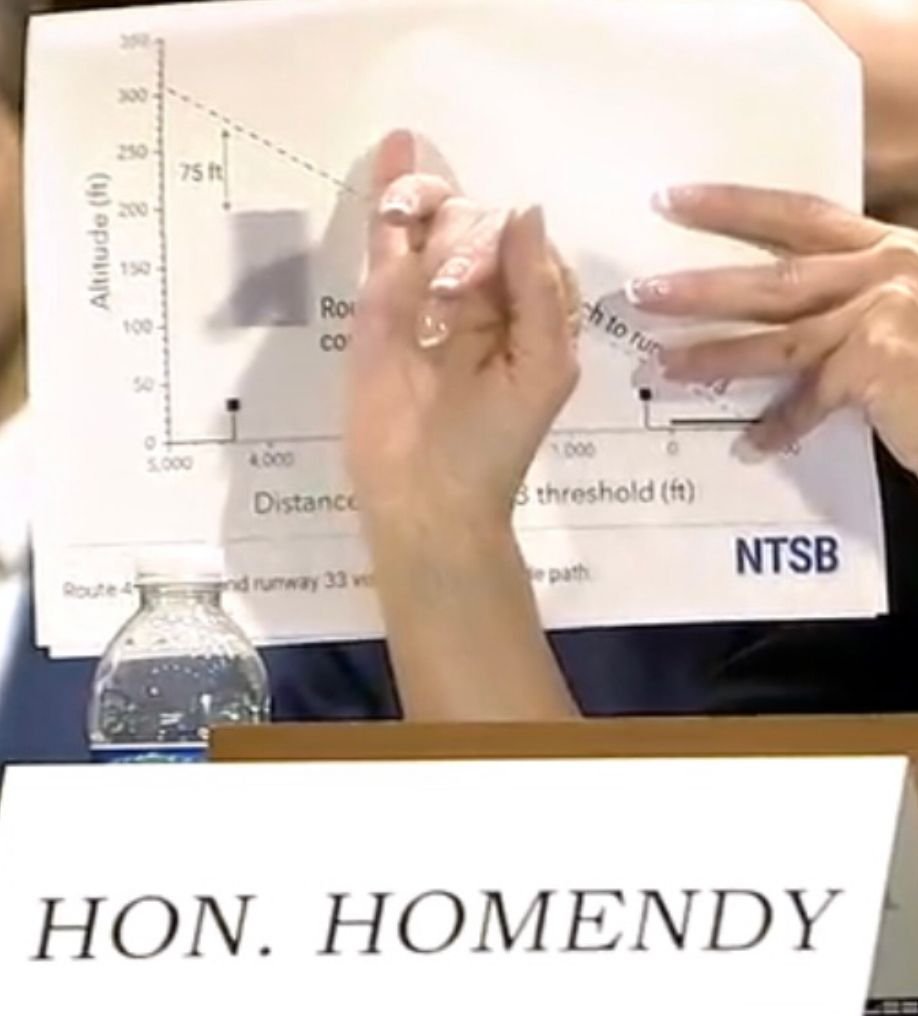
The altitude is still uncertain because of difference between jet and heli values and destruction of the heli altimeter. So work on that is continuing with a focus on other sources.
But note the 75 ft separation is a maximum. So if the heli was at 200ft then it was on the glide slope.
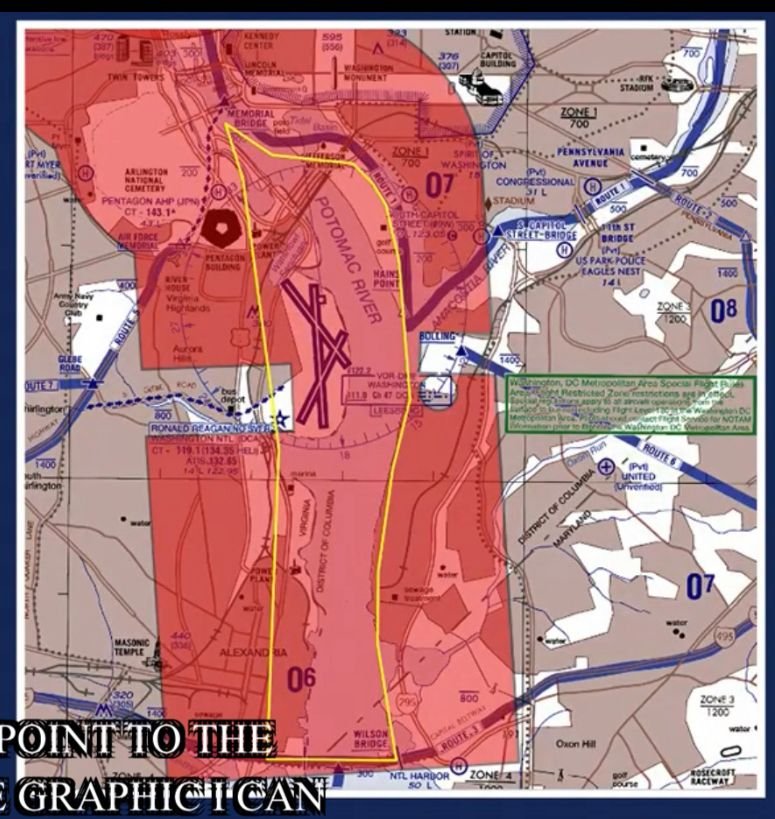
Another interesting point is that mixed heli and fixed wing is forbidden in the yellow zone (permanently), and ADSB mandatory in the red zone. With routes 4 and 6 cut.
See post below
Last edited by A0283; 30th March 2025 at 20:25.
Joined: Sep 2008
Aviation Qualifications: ATPL
Posts: 3,435
Likes: 1,202
From: 41S174E
even if the helo had ADSB out and the CRJ an "in " receiver and a CDTI display , what would have happened then ? . The crew would have spotted the Helo, maybe asked ATC what was that , and the reply of the controller would have been something like : " it is a military helicopter on route 4 , has you in sight , passing behind ." and then would you , flying the CRJ , take evasive action or go around after hearing that ? No .
.
The primary cause of this collision is airspace design and normalization of deviance over the years.
.
The primary cause of this collision is airspace design and normalization of deviance over the years.
Some people are making out that if the Helicopter had ADSB-out switched on/ activated, then this would never have happened.
Someone correct me if I am wrong but if the Blackhawk has ADSB-out switched on then nothing changes for the CRJ on that night. The TCAS behaves the same, there is no display of the Blackhawk on the CRJ’s Nav display…..nothing changes. The CRJ crew are still conducting an approach that requires a lot of fast mental processing close to the ground, at night onto a short runway while ensuring checklists/configuration etc is correct. ie they have a high workload. During this high workload phase, ‘the system’ has seen fit to allow a single Human ( the helicopter Captain) to be responsible for the separation of the two aircraft visually, at night, in a busy environment while conducting a check, on NVG’s.
Is it likey that a single Human, with the sole responsibility, will make a mistake? It’s not just likely, it’s inevitable, regardless of how sharp and well trained they are, if you run the program long enough their vision, or their SA will fail them and we get what we got here.
The system should never have devolved to the point where one person accepted the responsibility for visual sep 6nm away, at night, in a busy traffic environment while dealing with their own high workload.
The Blackhawk crew had a high workload, the CRJ crew had a high workload, the ATC had a high workload, there was no fat left in the system. Humans make mistakes and any good system will be tolerant of those mistakes.
The system was not tolerant of a mistake, ergo, the system is at fault.
Joined: Dec 2014
Aviation Qualifications: Non-Aircrew
Posts: 581
Likes: 51
From: Schiphol
Another interesting point is that mixed heli and fixed wing is forbidden in the yellow zone (permanently), and ADSB mandatory in the red zone. With routes 4 and 6 cut.
another item in the testimony was that generally 100% army helicopters flew there with ADSB set to OFF.
and that the accident heli might have put their ADSB to ON, but that the FAA had not received ADSB data from this heli in 730 days.
on ADSB there also was a difference between the Mike and Lima models,
NTSB chair indicated there was a lot more factual information. I wonder if the pull from Congress will lead to a change in the normal process, and release more factual information (with an appropriate disclaimer).
another item in the testimony was that generally 100% army helicopters flew there with ADSB set to OFF.
and that the accident heli might have put their ADSB to ON, but that the FAA had not received ADSB data from this heli in 730 days.
on ADSB there also was a difference between the Mike and Lima models,
NTSB chair indicated there was a lot more factual information. I wonder if the pull from Congress will lead to a change in the normal process, and release more factual information (with an appropriate disclaimer).
Joined: Oct 2019
Aviation Qualifications: Non-Aircrew
Posts: 1,704
Likes: 1,085
From: USA
Recognizing that if the only change was ADS-B Out on the helicopter would not have changed things, the use case proposed by the FAA and shown in their promotional materials in support of ADS-B is a helicopter flying in crowded airspace with a display of nearby ADS-B Out traffic. With only half the system installed, it's not going to work.
This is from 7 years ago:
This is from 7 years ago:
Joined: Jul 2013
Aviation Qualifications: Non-Aircrew
Posts: 1,391
Likes: 678
From: Within AM radio broadcast range of downtown Chicago
The header to this forum says "Accidents and Close Calls Discussion on accidents, close calls, and other unplanned aviation events, so we can learn from them, and be better pilots ourselves." I don't think a bias against assigning any responsibility for accidents to the pilots involved is helpful in using accidents to become better pilots. Sometimes many other parts of the system will fail but the pilot will still have a final opportunity to save the day. Or not.
According to post 1346 the accident helicopter was higher and to the west of the position of the typical helicopter flying that route. Was this a slight error that in this case was fatal?
According to post 1346 the accident helicopter was higher and to the west of the position of the typical helicopter flying that route. Was this a slight error that in this case was fatal?
But I crash this party every time I post, and so I'll let the professionals in the aviation community direct the painful vector of responsibility to aviators, where they must. As SLF/attorney I have determined it appropriate to respect the fact that the average professional pilot has already forgotten more about understanding accident causes and reasons than I will ever know. As I said, in a professional capacity, I would be working with such pro's and would "try to keep up."
Joined: Jul 2013
Aviation Qualifications: Non-Aircrew
Posts: 1,391
Likes: 678
From: Within AM radio broadcast range of downtown Chicago
ATC Watcher:
"The primary cause of this collision is airspace design and normalization of deviance over the years. I hope the judges will see that when the trial comes. We should leave the military crew and their grieving families out of this."
Which takes the pertinent legal case right back to the question whether the federal government will be protected by sovereign immunity. Sitting in, say, a conference room discussing in the abstract "airspace design" I don't think a single competent aviation attorney would not reply that design of airspace is a discretionary function (so sovereign immunity applies), and perhaps is a classic illustration of such discretion exercised functionally. Normalization of deviance is likely a closer question on the premise that it occurred through numerous small (or perceived as small at the time) changes and revisions of procedures and airspace design. But operation of the airspace when viewed in such a macro frame of reference looks pretty discretionary as a function, too.
But abstractions lost their meaning as 67 entirely blameless people lost their lives in this catastrophe. I'm not in this matter - not representing or advising anyone - but my mind can't get off outlining the attack on the discretionary function exception (to avoid doubt, I'm saying the exception needs to be argued against and shown not to apply on these facts). It is with hindsight, true, but the situation which existed in the airspace in question on the night of Wednesday 29 January broke, stomped upon, and otherwise disregarded so many basic rules of the aviation safety mindset that ....
like they say, you can take the lawyer out of litigating, but you can't take litigating out of the lawyer.
Here's a new thought. In lawsuits (another poster helpfully noted upthread) under the Federal Tort Claims Act - the statute which takes sovereign immunity away but subject to exceptions - claims for punitive damages are not allowed.
Think about that for half a minute. Just on the facts, forget the legal technicality under the FTCA, would this not FREAKING be a case warranting punitive damages against the federal government for setting the stage of this accident and then putting the players in motion? So, you're an attorney, part of the team representing any one of the families of victims of this CATASTROPHE in the middle of the air ... or some or even all, of the victims' families. What do you do?
I will be neither surprised nor shocked if the lawsuits also name American Airlines, which has no protection obviously under the FTCA. It didn't do anything wrong..... but naming the airline as a defendant gets their insurers involved, and then establishment of a fund and a process to compensate the representatives of the victims can be brought forward and conducted. Skip the courthouse except to get things started, but this matter needs a creative approach. Oh, did I mention, part of the approval for such a fund and compensation process would have to be pretty sweeping reform of how FAA does business and what business it does, and the reform plan had better be down to chapter and verse?
WR 6-3
"The primary cause of this collision is airspace design and normalization of deviance over the years. I hope the judges will see that when the trial comes. We should leave the military crew and their grieving families out of this."
Which takes the pertinent legal case right back to the question whether the federal government will be protected by sovereign immunity. Sitting in, say, a conference room discussing in the abstract "airspace design" I don't think a single competent aviation attorney would not reply that design of airspace is a discretionary function (so sovereign immunity applies), and perhaps is a classic illustration of such discretion exercised functionally. Normalization of deviance is likely a closer question on the premise that it occurred through numerous small (or perceived as small at the time) changes and revisions of procedures and airspace design. But operation of the airspace when viewed in such a macro frame of reference looks pretty discretionary as a function, too.
But abstractions lost their meaning as 67 entirely blameless people lost their lives in this catastrophe. I'm not in this matter - not representing or advising anyone - but my mind can't get off outlining the attack on the discretionary function exception (to avoid doubt, I'm saying the exception needs to be argued against and shown not to apply on these facts). It is with hindsight, true, but the situation which existed in the airspace in question on the night of Wednesday 29 January broke, stomped upon, and otherwise disregarded so many basic rules of the aviation safety mindset that ....
like they say, you can take the lawyer out of litigating, but you can't take litigating out of the lawyer.
Here's a new thought. In lawsuits (another poster helpfully noted upthread) under the Federal Tort Claims Act - the statute which takes sovereign immunity away but subject to exceptions - claims for punitive damages are not allowed.
Think about that for half a minute. Just on the facts, forget the legal technicality under the FTCA, would this not FREAKING be a case warranting punitive damages against the federal government for setting the stage of this accident and then putting the players in motion? So, you're an attorney, part of the team representing any one of the families of victims of this CATASTROPHE in the middle of the air ... or some or even all, of the victims' families. What do you do?
I will be neither surprised nor shocked if the lawsuits also name American Airlines, which has no protection obviously under the FTCA. It didn't do anything wrong..... but naming the airline as a defendant gets their insurers involved, and then establishment of a fund and a process to compensate the representatives of the victims can be brought forward and conducted. Skip the courthouse except to get things started, but this matter needs a creative approach. Oh, did I mention, part of the approval for such a fund and compensation process would have to be pretty sweeping reform of how FAA does business and what business it does, and the reform plan had better be down to chapter and verse?
WR 6-3
Joined: Nov 2020
Posts: 21
Likes: 7
From: Islands in the Stream
Refer to ATCDumbo Question 1!!
ATCWatcher Thank you…It’s like pulling teeth but we will get there eventually ….
No thanks to the NTSB for the selective choice of facts…What should I expect in a country of fake news and alternative facts?
As for your comments re if the CRJ had ADSB_IN; exactly ….welcome to my nightmare!
Shock horror The Holy Grail turned out to be the holy hand grenade!!!
Re all lawyers reading…Put that one in your pipes and smoke it!
Always look on the ….. Now what pizza to order tonight
ATCWatcher Thank you…It’s like pulling teeth but we will get there eventually ….
No thanks to the NTSB for the selective choice of facts…What should I expect in a country of fake news and alternative facts?
As for your comments re if the CRJ had ADSB_IN; exactly ….welcome to my nightmare!
Shock horror The Holy Grail turned out to be the holy hand grenade!!!
Re all lawyers reading…Put that one in your pipes and smoke it!
Always look on the ….. Now what pizza to order tonight