


AA5342 Down DCA


Joined: Dec 2010
Posts: 290
Likes: 38
From: USA
It appears from the NTSB's most recent press conference that the instruction "pass behind the CRJ" was not heard in the helo's CVR and, therefore by inference, not heard by the crew. Am I correct in assuming that there is no requirement to readback an instruction like that in the USA? ATC appeared not to expect one.
Last edited by Commando Cody; 15th February 2025 at 06:45. Reason: precision


Joined: May 2002
Posts: 327
Likes: 10
From: Kiwiland
Didn’t NTSB say today that FDR had ‘data error’ instead of altitude indicating possibility of pitot/static problem? Said they were going to try rebuilding system to test it, which won’t be easy or quick!

Joined: Dec 2020
Posts: 102
Likes: 87
From: USA
I think we're flogging a dead horse with this altitude thing, we already know that the aircraft collided from the video.
The most reliable information from the helicopter indicates they were at 278ft above the water. Likewise we're told that the CRJ was at 313ft 2 seconds before impact. The CRJ is 20ft tall, more with landing gear extended. The UH60 is 16ft tall. There is no more information to be gleaned from this.
The CRJ was a passenger jet on finals to land and there is no way on earth anything else should be on a collision track. The helicopter should never have been allowed to be that close to landing traffic, no matter what the legal and procedural niceties of ATC communication were.
And the fact that there were numerous reports of similar close calls of this kind over the previous decade or so is a damning (some might say criminal) indictment of the safety management systems of the authorities involved.
The most reliable information from the helicopter indicates they were at 278ft above the water. Likewise we're told that the CRJ was at 313ft 2 seconds before impact. The CRJ is 20ft tall, more with landing gear extended. The UH60 is 16ft tall. There is no more information to be gleaned from this.
The CRJ was a passenger jet on finals to land and there is no way on earth anything else should be on a collision track. The helicopter should never have been allowed to be that close to landing traffic, no matter what the legal and procedural niceties of ATC communication were.
And the fact that there were numerous reports of similar close calls of this kind over the previous decade or so is a damning (some might say criminal) indictment of the safety management systems of the authorities involved.
Pegase Driver

Joined: May 1997
Aviation Qualifications: ATCO
Posts: 4,448
Likes: 1,158
From: Europe
The helicopter should never have been allowed to be that close to landing traffic,
In any case the procedure us currently withdrawn until end of March and I sincerely doubt they will re-install it before the final report is out. ..
A couple of new info points the NTSB clarified : Both aircraft were on VHF , so we can drop this UHF discussion , the Blackhawk had ADS-B equipped but was not transmitting , it was check ride with NVG, and they most probably all had them on .and there was a last second evasive action attempt by the CRJ crew, which go a TA previously . On the TWR, the CAs are displayed in the BRITE even with audio on ..
For the rest we have to wait until the next NTSB briefing

Joined: Jan 2025
Aviation Qualifications: Non-Aircrew
Posts: 639
Likes: 776
From: New Zealand
One could also argue that a CRJ overflying a helicopter by 50-100 ft is going to throw a pretty bad wake turbulence into the helicopter, and the helicopter losing control and crashing seems pretty likely. Save the CRJ, sure.
Joined: Feb 2020
Posts: 8
Likes: 1
From: Thailand
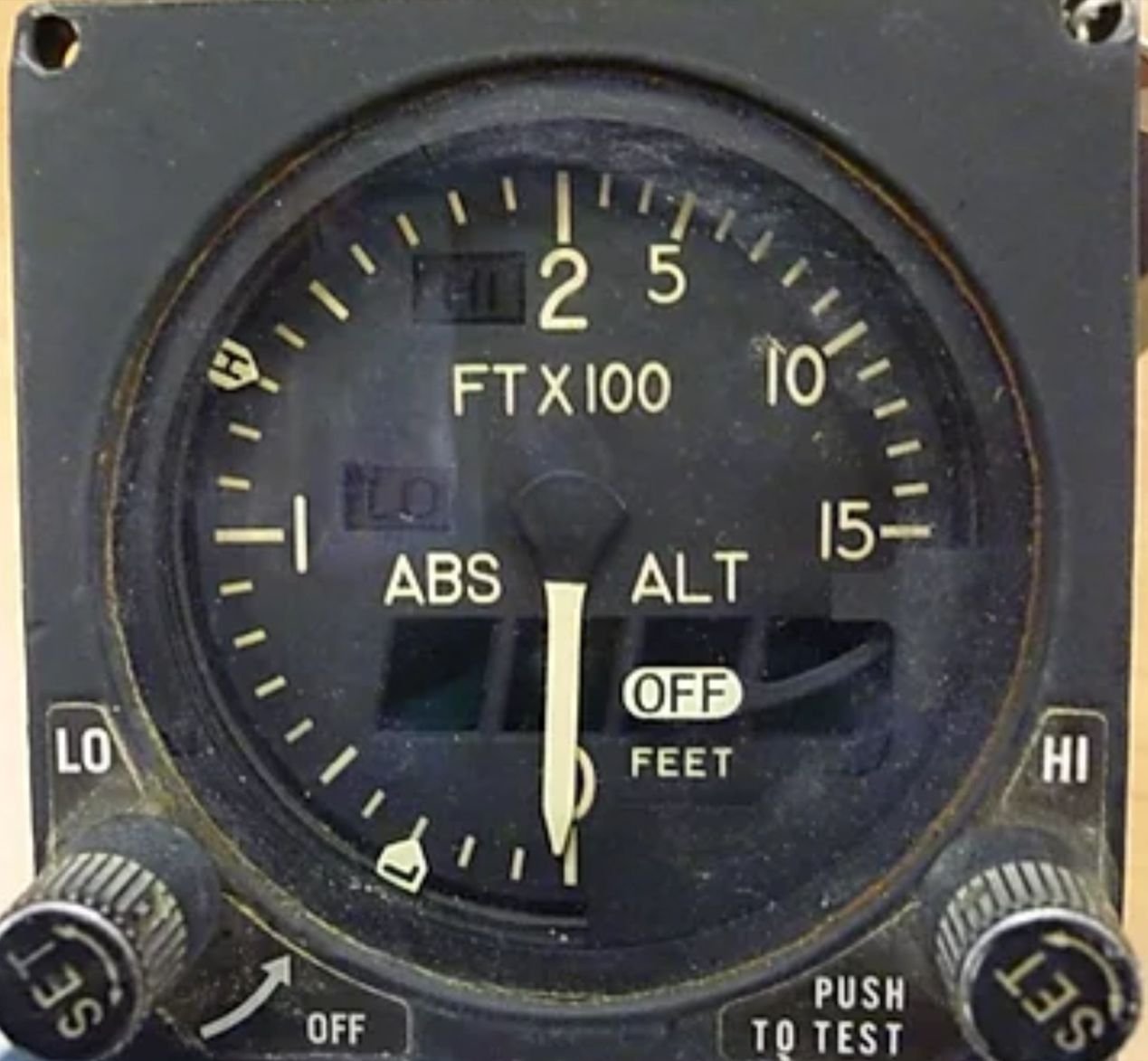
The L model radar altimeter indicators each contain a pointer that indicates altitude on a linear scale from 0 to 200 feet (10 feet per unit) and a second-linear scale from 200 to 1500 feet (100 feet per unit). In other words 300 feet could easily be misread as 210 feet for the uninitiated. Worth noting the pointer is the width between 200 feet and 300 feet. Also, was the bug in use and if so what altitude was it set to?
Disconcerting that the PAT 25 crew, about to descend and fly less than 200 feet AGL , would not have investigate the discrepancy of 100 feet between their respective altimeters...
Disconcerting that the PAT 25 crew, about to descend and fly less than 200 feet AGL , would not have investigate the discrepancy of 100 feet between their respective altimeters...
Joined: Apr 2009
Posts: 2,049
Likes: 535
From: Wherever it is this month
absolutely . the altimeter talk is just a distraction or at best contributing factor, Not the cause .. which brings us back to the safety assessment of the procedure , which the NTSB did not mention at all,, but I am sure , or at least I hope they will go into in their final report.
I sincerely hope the NTSB can avoid being distracted by the distractions of altimetry and the missing ATC words on the Blackhawk CVR.
Upthread, Luca Lion calculated the 3 degree PAPI approach path as crossing the eastern riverbank at 270ft. If that's correct, then the CRJ's 313ft radar height 2 seconds before collision puts it at least 43ft above the approach path, so the Blackhawk's radio height deviation of 78ft would have contributed only about 35ft to the erosion of any intended "procedural separation" (*) between the aircraft. Or, to put it another way, the same outcome would have resulted if the Blackhawk had been at 235ft radio and the CRJ on the glide. Height keeping of plus or minus 35ft can only be achieved by instrument flying, which is obviously not compatible with visual separation (or indeed VFR) so cannot be reasonably cited as part of a safety case for the procedure. And of course a landing aircraft could easily be below the glide. Altimetry and height keeping are not the cause of this accident.
Missing the word "circling" wouldn't have influenced the helo crew getting visual with the CRJ at the time of the trasnmission. At best, it would have given them an extra nudge that "runway 33" (which was audible) meant the CRJ would be taking an easterly flight path. Missing "pass behind" with only a few seconds to collision was irrelevant if, as seems likely, the helo crew did not see the CRJ at that point.
(*) The quotes around "procedural separation" are intended to convey a tone of disgust and sarcasm.
Last edited by Easy Street; 15th February 2025 at 09:47.
Joined: Nov 2001
Posts: 6,152
Likes: 1,264
From: Australia/India
...
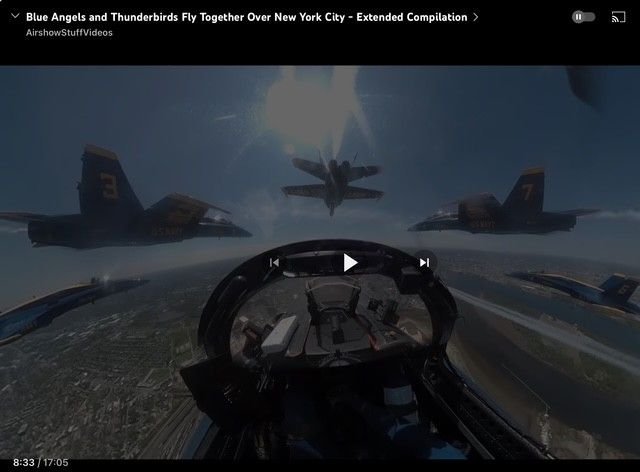
I was recently watching a video on the highlights of Oshkosh, the relevance of which will hopefully become clear shortly.
One part of the video was some POV footage from the cockpit of one of the Blue Angels. I had a 'double-take' and triple rewind to confirm what I thought I saw on the glareshield: I think I saw a piece of portable avionics that is very, very familiar to me.
Is any expert able to confirm what that white block on the glareshield is?
I've been in a discussion about the complexity of avionics upgrades to military flying machinery, the discussion precipitated by the differing terminology about "fitted with" and "equipped with" and "carried". And I suggest that even if the helo was "fitted with" an ADS system, at the altitude the aircraft were operating at the time of the collision any alerts may have been suppressed.
Joined: Jul 2016
Posts: 14
Likes: 21
From: The Hague
+1 to everything you and Wide Mouth Frog said.
I sincerely hope the NTSB can avoid being distracted by the distractions of altimetry and the missing ATC words on the Blackhawk CVR.
Upthread, Luca Lion calculated the 3 degree PAPI approach path as crossing the eastern riverbank at 270ft. If that's correct, then the CRJ's 313ft radar height 2 seconds before collision puts it at least 43ft above the approach path, so the Blackhawk's radio height deviation of 78ft would have contributed only about 35ft to the erosion of any intended "procedural separation" (*) between the aircraft. Or, to put it another way, the same outcome would have resulted if the Blackhawk had been at 235ft radio and the CRJ on the glide. Height keeping of plus or minus 35ft can only be achieved by instrument flying, which is obviously not compatible with visual separation (or indeed VFR) so cannot be reasonably cited as part of a safety case for the procedure. And of course a landing aircraft could easily be below the glide. Altimetry and height keeping are not the cause of this accident.
Missing the word "circling" wouldn't have influenced the helo crew getting visual with the CRJ at the time of the trasnmission. At best, it would have given them an extra nudge that "runway 33" (which was audible) meant the CRJ would be taking an easterly flight path. Missing "pass behind" with only a few seconds to collision was irrelevant if, as seems likely, the helo crew did not see the CRJ at that point.
(*) The quotes around "procedural separation" are intended to convey a tone of disgust and sarcasm.
I sincerely hope the NTSB can avoid being distracted by the distractions of altimetry and the missing ATC words on the Blackhawk CVR.
Upthread, Luca Lion calculated the 3 degree PAPI approach path as crossing the eastern riverbank at 270ft. If that's correct, then the CRJ's 313ft radar height 2 seconds before collision puts it at least 43ft above the approach path, so the Blackhawk's radio height deviation of 78ft would have contributed only about 35ft to the erosion of any intended "procedural separation" (*) between the aircraft. Or, to put it another way, the same outcome would have resulted if the Blackhawk had been at 235ft radio and the CRJ on the glide. Height keeping of plus or minus 35ft can only be achieved by instrument flying, which is obviously not compatible with visual separation (or indeed VFR) so cannot be reasonably cited as part of a safety case for the procedure. And of course a landing aircraft could easily be below the glide. Altimetry and height keeping are not the cause of this accident.
Missing the word "circling" wouldn't have influenced the helo crew getting visual with the CRJ at the time of the trasnmission. At best, it would have given them an extra nudge that "runway 33" (which was audible) meant the CRJ would be taking an easterly flight path. Missing "pass behind" with only a few seconds to collision was irrelevant if, as seems likely, the helo crew did not see the CRJ at that point.
(*) The quotes around "procedural separation" are intended to convey a tone of disgust and sarcasm.
Following "5*why", keep asking...
Why did the did miss part of the message
Why was the incomplete read back missed
Why does missing a few words lead to this disaster within seconds.
Does this lead an answer like: helicopter in a very busy airspace, busy controllers (insufficient time to be fully focused on full read backs) being by default too close to (and even needing to cross) the glideslope.
Joined: Oct 2004
Posts: 531
Likes: 38
From: Southern England

In the case in hand if the step on was from the helicopter then they were stepping on a transmission addressed to them which, regardless of the effect of the overstepped information they didn't receive, might indicate that communication with the Tower adjacent to a very busy airfield was not as high a priority as perhaps it should have been.
For proper radio and full duplex, the kind we all take for granted with the devices in our pockets, you probably need to wait for the digital revolution in civil aviation. The cost for poorer countries, and more significantly the large military fleets tied into expensive and slow upgrade programmes, means you will probably wait a long time.
Joined: Apr 2009
Posts: 2,049
Likes: 535
From: Wherever it is this month
Following "5*why", keep asking...
Why did the did miss part of the message
Why was the incomplete read back missed
Why does missing a few words lead to this disaster within seconds.
Does this lead an answer like: helicopter in a very busy airspace, busy controllers (insufficient time to be fully focused on full read backs) being by default too close to (and even needing to cross) the glideslope.
Why did the did miss part of the message
Why was the incomplete read back missed
Why does missing a few words lead to this disaster within seconds.
Does this lead an answer like: helicopter in a very busy airspace, busy controllers (insufficient time to be fully focused on full read backs) being by default too close to (and even needing to cross) the glideslope.
Helicopters in busy airspace are not a problem if a safe system exists for separating them from airline traffic.
There is no evidence yet of the controller having made a mistake. He was undoubtedly busy, but that was not his fault. What could be done about it? The answers to that question take us another step along the causal chain:
- The FAA could have provided more controllers. We know the helicopter controller position was unoccupied, and it's likely that closer monitoring and earlier intervention could have changed the outcome (notwithstanding point 3).
- Controller workload could have been reduced by implementing effective procedural separation. If the DCA ATC rulebook allowed this segment of Route 4 to be in simultaneous use with Runway 33 landings, then procedural separation did not exist, however much anyone thought it did. At least 1.5nm or 500ft between flight paths would be needed to meet the least restrictive FAA separation standards, and this would have forced constraints to be applied to Route 4 or Runway 33 utilisation.
- Regulations allowed the helo pilots to assume responsibility for separation. This is what happened, with the consequences which flow from the inherent difficulty of identifying and separating visually at night (especially while wearing NVG).
The authorities (by which I mean FAA and DoD) have questions to answer on all three points. Why was the helicopter controller position vacant? Did the ATC rulebook or staffing requirements rely on a false assumption that procedural separation existed? How did any such assumption remain in place after previous near misses? Is visual separation between helicopters and airline traffic a reasonable thing for regulations to permit, at night and using NVG? Ultimately it seems to have routinely been used as a release valve for the pressure building in the system due to the failure to address points 1 and 2.
Hopefully the investigation will be bold enough to ask these questions, which expand the potential scope of responsibility well beyond the individual controller and pilots.
Last edited by Easy Street; 15th February 2025 at 12:36.

Joined: Jul 2013
Aviation Qualifications: CPL
Posts: 611
Likes: 473
From: Maryland USA
Joined: Sep 2001
Aviation Qualifications: CPL
Posts: 2,783
Likes: 203
From: Toronto
I believe radalts are configured to display height above gear; so add ≈16' height of Blackhawk to 278' yielding 294'. Then there's rotor bowing, and how much higher will the tail rotor arc be at the speed the helo was flying?
Likely the Kollsman settings will be recoverable. Barometric altimeters used in VFR can be way off, but transponder calibration depends on a calibrated altimeter. The NTSB will be looking at maintenance records.
Likely the Kollsman settings will be recoverable. Barometric altimeters used in VFR can be way off, but transponder calibration depends on a calibrated altimeter. The NTSB will be looking at maintenance records.

Joined: Mar 2010
Aviation Qualifications: ATCO
Posts: 8,023
Likes: 314
From: Often in Jersey, but mainly in the past.
Whilst these are valid observations, it is also micro-managing a procedure whose altitude separation was always totally flawed. I cannot personally attribute any blame to ATC or either pilot when the scenario was so badly devised ... and that means not only the infamous Route 4 but the concept of visual separation in the dark.
It was doomed to fail, eventually, but sadly someone [other than those directly impacted] never saw it coming. THEY are the culprits.
MPN11, former Mil ATCO
It was doomed to fail, eventually, but sadly someone [other than those directly impacted] never saw it coming. THEY are the culprits.
MPN11, former Mil ATCO
Joined: Jul 2013
Aviation Qualifications: CPL
Posts: 611
Likes: 473
From: Maryland USA
Whilst these are valid observations, it is also micro-managing a procedure whose altitude separation was always totally flawed. I cannot personally attribute any blame to ATC or either pilot when the scenario was so badly devised ... and that means not only the infamous Route 4 but the concept of visual separation in the dark.
It was doomed to fail, eventually, but sadly someone [other than those directly impacted] never saw it coming. THEY are the culprits.
MPN11, former Mil ATCO
It was doomed to fail, eventually, but sadly someone [other than those directly impacted] never saw it coming. THEY are the culprits.
MPN11, former Mil ATCO
Joined: Mar 2022
Posts: 74
Likes: 39
From: Nearby
The L model radar altimeter indicators each contain a pointer that indicates altitude on a linear scale from 0 to 200 feet (10 feet per unit) and a second-linear scale from 200 to 1500 feet (100 feet per unit). In other words 300 feet could easily be misread as 210 feet for the uninitiated. Worth noting the pointer is the width between 200 feet and 300 feet. Also, was the bug in use and if so what altitude was it set to?
Disconcerting that the PAT 25 crew, about to descend and fly less than 200 feet AGL , would not have investigate the discrepancy of 100 feet between their respective altimeters...
Disconcerting that the PAT 25 crew, about to descend and fly less than 200 feet AGL , would not have investigate the discrepancy of 100 feet between their respective altimeters...
Details of instrumentation here:
https://apps.dtic.mil/sti/tr/pdf/ADA409934.pdf
Not completely obvious in the photo is the digital display of radar altitude just underneath the annotation ABS ALT. The technical manual also mentions a three digit radar altitude displayed on the HUD.
Last edited by Stagformation; 15th February 2025 at 22:01.
Joined: Nov 2001
Posts: 6,152
Likes: 1,264
From: Australia/India
As someone with an insight into the complexities of retrofitting certified avionics hardware and the associated wiring, controllers and antennae to fighter jets and other military aircraft, I would be completely unsurprised if, as seems to be evident from the video imbedded at #1112, the USA’s elite, pre-eminent military aerobatics team uses a portable ADS-B unit velcro’ed to the aircraft’s glare shield. And if it’s OK for them, I can’t see why it wouldn’t be OK for the PAT helicopters and I wouldn’t be surprised if that’s the ADS-B to which various references having been made.
I suppose the operational question is whether the aircraft on which these portable units are used are permitted to fly without them on board and working. My guess is that there will be no prohibition. They are just ‘nice to haves’ but not essential for the ops in which they engage.
And there’s a causal question anyway: Would a functioning ADS-B system – portable or otherwise - on the PAT helo have made any difference? The answer depends on the variables around the alert suppression parameters in each aircraft’s systems and the effectiveness of the format of alerts – if any – given in each cockpit.
I suppose the operational question is whether the aircraft on which these portable units are used are permitted to fly without them on board and working. My guess is that there will be no prohibition. They are just ‘nice to haves’ but not essential for the ops in which they engage.
And there’s a causal question anyway: Would a functioning ADS-B system – portable or otherwise - on the PAT helo have made any difference? The answer depends on the variables around the alert suppression parameters in each aircraft’s systems and the effectiveness of the format of alerts – if any – given in each cockpit.
Joined: Jul 2013
Aviation Qualifications: CPL
Posts: 611
Likes: 473
From: Maryland USA
As someone with an insight into the complexities of retrofitting certified avionics hardware and the associated wiring, controllers and antennae to fighter jets and other military aircraft, I would be completely unsurprised if, as seems to be evident from the video imbedded at #1112, the USA’s elite, pre-eminent military aerobatics team uses a portable ADS-B unit velcro’ed to the aircraft’s glare shield. And if it’s OK for them, I can’t see why it wouldn’t be OK for the PAT helicopters and I wouldn’t be surprised if that’s the ADS-B to which various references having been made.
I suppose the operational question is whether the aircraft on which these portable units are used are permitted to fly without them on board and working. My guess is that there will be no prohibition. They are just ‘nice to haves’ but not essential for the ops in which they engage.
And there’s a causal question anyway: Would a functioning ADS-B system – portable or otherwise - on the PAT helo have made any difference? The answer depends on the variables around the alert suppression parameters in each aircraft’s systems and the effectiveness of the format of alerts – if any – given in each cockpit.
I suppose the operational question is whether the aircraft on which these portable units are used are permitted to fly without them on board and working. My guess is that there will be no prohibition. They are just ‘nice to haves’ but not essential for the ops in which they engage.
And there’s a causal question anyway: Would a functioning ADS-B system – portable or otherwise - on the PAT helo have made any difference? The answer depends on the variables around the alert suppression parameters in each aircraft’s systems and the effectiveness of the format of alerts – if any – given in each cockpit.