


AA5342 Down DCA


Joined: May 2016
Posts: 75
Likes: 3
From: Nantes
I would like to ask if it is known number of aircraft at TWR Frequency( ies) at the moment of collision?
One ATCO, worked , at three separate frequency, three runways, 6 aircraft for arrival 01, one a/c 33, plus three helicopter, plus how many departures ( both active and approaching/crossing active runways) ?
Plus active estimate for a few aircraft more?
Ground vehicles, any?

One ATCO, worked , at three separate frequency, three runways, 6 aircraft for arrival 01, one a/c 33, plus three helicopter, plus how many departures ( both active and approaching/crossing active runways) ?
Plus active estimate for a few aircraft more?
Ground vehicles, any?


Joined: Mar 2003
Aviation Qualifications: ATPL
Posts: 2,558
Likes: 155
From: BC
Hi Bill , understood, I was a bit too harsh maybe, but I get upset to continuously read what the controller should have done. Remember he was trained like this , to follow procedures that were basically unsafe in order to move the traffic . I can say unsafe because they were removed immediately after the accident , not waiting for the NTSB to recommend it . No everyone is stupid in the FAA , they knew this route was in conflict with 33 Visual arrivals. And did not pass any safety case, but the procedure was kept , most probably due political or military pressures , relying on controllers and pilots to mitigate the risks.
Now on the Conflict alert on the BRITE display . I have no first hand info on the SOPs in DCA on how a TWR controller uses the BRITE and if STCA are even displayed . `, but if they are, seen the charts and the routes , I guess STCA alerts are very common .especially when you delegate separation and you then play with a couple of hundred feet, vertical separation Too many unnecessary alerts equals normalization of deviance, . Look at the Haneda preliminary report , same ..
Finally since you mention TCAS RAs , there is a major difference with STCA , it is not the same as a TCAS RA . With an RA , as a pilot you have to react and follow , it is mandatory , for a controller a STCA is just an alert , just like a TCAS TA , if in your judgement it will pass you will not do anything , and if you have already issued a correcting instruction ( heading, level , etc,,) or here delegate visual separation , the STCA just becomes a nuisance. .
I sincerely hope the DC Controller will not be made the scapegoat of this accident . Not so sure it will not.
Now on the Conflict alert on the BRITE display . I have no first hand info on the SOPs in DCA on how a TWR controller uses the BRITE and if STCA are even displayed . `, but if they are, seen the charts and the routes , I guess STCA alerts are very common .especially when you delegate separation and you then play with a couple of hundred feet, vertical separation Too many unnecessary alerts equals normalization of deviance, . Look at the Haneda preliminary report , same ..
Finally since you mention TCAS RAs , there is a major difference with STCA , it is not the same as a TCAS RA . With an RA , as a pilot you have to react and follow , it is mandatory , for a controller a STCA is just an alert , just like a TCAS TA , if in your judgement it will pass you will not do anything , and if you have already issued a correcting instruction ( heading, level , etc,,) or here delegate visual separation , the STCA just becomes a nuisance. .
I sincerely hope the DC Controller will not be made the scapegoat of this accident . Not so sure it will not.
Rarely does the "bad apple" theory of accident causation survive the scrutiny of a robust, honest investigation.
Last edited by Senior Pilot; 12th February 2025 at 22:14. Reason: Quote was unreadable

Joined: Mar 2015
Posts: 905
Likes: 319
From: Virginia, USA
I would like to ask if it is known number of aircraft at TWR Frequency( ies) at the moment of collision?
One ATCO, worked , at three separate frequency, three runways, 6 aircraft for arrival 01, one a/c 33, plus three helicopter, plus how many departures ( both active and approaching/crossing active runways) ?
Plus active estimate for a few aircraft more?
Ground vehicles, any?
One ATCO, worked , at three separate frequency, three runways, 6 aircraft for arrival 01, one a/c 33, plus three helicopter, plus how many departures ( both active and approaching/crossing active runways) ?
Plus active estimate for a few aircraft more?
Ground vehicles, any?
Fixed wing
AAL1630, departed 1, waiting handoff to departure
JIA5305, holding short 1, #2
DAL832, holding short 1 #3
JIA5342, cleared to land 33
AAL3130, cleared to land 1
AAL472, cleared visual 1
JIA5347, cleared visual 1, requested 33
Rotary wing
PAT25
helo, Zone 4
helo, callsign Blackjack 1, freq change approved just prior
helo, callsign Muscle 12, handed off to ADW prior
helo, request Route 3, Zone 6
helo, Zone 7
Medevac AirCare helo, proceeding to Inova Fairfax
Some of the helo’s on above list may be duplicates due to poor audio quality.
At the time of the accident, runway 4/22 was not in use.

Joined: Jul 2013
Aviation Qualifications: Non-Aircrew
Posts: 1,390
Likes: 678
From: Within AM radio broadcast range of downtown Chicago
Long version of Wall Street Journal article about changing DCA airspace use rules, from WSJ website (summary in print edition Feb. 12):
__________
Federal air-safety officials want to permanently keep helicopters away from commercial jets taking off and landing at a busy Washington, D.C., airport after the deadliest U.S. aviation accident in more than two decades.
The move, under consideration by senior Federal Aviation Administration officials, would be part of a long-term plan to improve safety at Ronald Reagan Washington National Airport, according to people familiar with the discussions.
Helicopters have been temporarily barred from flying in a corridor used by the U.S. Army Black Hawk that collided on Jan. 29 with an American Airlines regional jet, killing 67 people. The chopper routes have been used to ferry senior military officials around the region and to train for a “continuity of government” mission in the event American political leaders need rapid evacuation from Washington. Other government agencies have also used the routes.
Federal officials have said they would revisit the helicopter restrictions once the National Transportation Safety Board issues a preliminary report on the accident in the coming weeks. Preliminary indications from the probe point to multiple factors potentially contributing to the crash, including the design of the airspace, as well as actions by the helicopter pilot and air-traffic controller, according to people familiar with the investigation.
The NTSB said it would examine how far apart planes and helicopters are supposed to be while flying in the airspace.
Transportation Secretary Sean Duffy has criticized the Pentagon’s operation of helicopters near the airport. “If we have generals who are flying in helicopters for convenience through this airspace, that’s unacceptable,” he said last week. “Get in a damn Suburban and drive. You don’t need to take a helicopter.”
The Army said it would continue to comply with FAA requirements and restrictions to enhance flight safety. The service said it was reassessing its aircraft operations near the airport and that it gave priority to the safety of the public and military personnel. The current restrictions allow certain critical flights.
Duffy also suggested certain military missions can be done at a different time of night. The Jan. 29 crash occurred around 9 p.m. Eastern time.
Defense officials have assumed that the helicopter routes would be closed in the coming months amid several ongoing investigations, but have privately said that the routes should be reopened. Adjustments under consideration if routes are reopened include limiting hours for training and test missions.
Reagan’s convenient location, a few miles from Capitol Hill, has made the nearly 84-year-old airport a favorite among politicians, business executives and tourists.
Space is tight at the airport. Reagan’s longest runway, Runway 1, is the nation’s busiest, airport officials have said, and it has two smaller runways. Routes into and out of the airport are constrained by no-fly zones around sensitive government buildings.
The FAA has said it is also reviewing airspace around airports aside from Reagan that also have high volumes of helicopter and airplane traffic.
Discussions about Reagan airport have also focused on a small runway known as Runway 33, people familiar with the matter said. The American Airlines regional jet was attempting to land there when it collided with the Army helicopter. Some government and industry aviation officials believe that there isn’t a problem with planes using the runway if helicopters aren’t near the traffic lanes.
Warning signs existed for years about risks facing commercial passengers, with planes sharing the skies closely with helicopters zipping up and down the Potomac River.
The path the American Airlines regional jet took toward Runway 33 required it to turn toward the right and then bank left to line up for its landing. That route crosses over a lane for helicopters at a relatively low altitude.
There have been at least 35 events involving conflicts between helicopters and flights into and out of the airport that have been flagged since the 1980s, according to a Wall Street Journal analysis of anonymous reports to a system overseen by the National Aeronautics and Space Administration.
In one instance, in July 2018, a helicopter and small plane came within roughly 580 feet of each other while the plane was approaching Runway 33. The helicopter pilot had to maneuver to avoid the plane and questioned the air-traffic controller about it after, according to an internal FAA report on the incident viewed by the Journal.
Neither aircraft had received traffic advisories or safety alerts, the report said. The helicopter pilot reported the incident as a near midair collision. “I’m sorry for the confusion,” the controller told the helicopter pilot, according to an audio recording of air-traffic-control communications following the incident.
Nearly two weeks after the deadly crash over the Potomac, the FAA has lifted some of the constraints put on Reagan airport in the wake of the accident.
The FAA on Tuesday boosted the airport’s arrival rate from 26 to 28 aircraft an hour, after temporarily reducing it to ease the strain on controllers still dealing with the aftermath of the crash, according to an email viewed by the Journal and earlier reported by other news outlets. The current rate is still lower than the airport’s typical maximum of 32 arrivals an hour.
Reagan’s two smaller runways, which had been closed due to search and recovery efforts, have been reopened.
________
__________
Federal air-safety officials want to permanently keep helicopters away from commercial jets taking off and landing at a busy Washington, D.C., airport after the deadliest U.S. aviation accident in more than two decades.
The move, under consideration by senior Federal Aviation Administration officials, would be part of a long-term plan to improve safety at Ronald Reagan Washington National Airport, according to people familiar with the discussions.
Helicopters have been temporarily barred from flying in a corridor used by the U.S. Army Black Hawk that collided on Jan. 29 with an American Airlines regional jet, killing 67 people. The chopper routes have been used to ferry senior military officials around the region and to train for a “continuity of government” mission in the event American political leaders need rapid evacuation from Washington. Other government agencies have also used the routes.
Federal officials have said they would revisit the helicopter restrictions once the National Transportation Safety Board issues a preliminary report on the accident in the coming weeks. Preliminary indications from the probe point to multiple factors potentially contributing to the crash, including the design of the airspace, as well as actions by the helicopter pilot and air-traffic controller, according to people familiar with the investigation.
The NTSB said it would examine how far apart planes and helicopters are supposed to be while flying in the airspace.
Transportation Secretary Sean Duffy has criticized the Pentagon’s operation of helicopters near the airport. “If we have generals who are flying in helicopters for convenience through this airspace, that’s unacceptable,” he said last week. “Get in a damn Suburban and drive. You don’t need to take a helicopter.”
The Army said it would continue to comply with FAA requirements and restrictions to enhance flight safety. The service said it was reassessing its aircraft operations near the airport and that it gave priority to the safety of the public and military personnel. The current restrictions allow certain critical flights.
Duffy also suggested certain military missions can be done at a different time of night. The Jan. 29 crash occurred around 9 p.m. Eastern time.
Defense officials have assumed that the helicopter routes would be closed in the coming months amid several ongoing investigations, but have privately said that the routes should be reopened. Adjustments under consideration if routes are reopened include limiting hours for training and test missions.
Reagan’s convenient location, a few miles from Capitol Hill, has made the nearly 84-year-old airport a favorite among politicians, business executives and tourists.
Space is tight at the airport. Reagan’s longest runway, Runway 1, is the nation’s busiest, airport officials have said, and it has two smaller runways. Routes into and out of the airport are constrained by no-fly zones around sensitive government buildings.
The FAA has said it is also reviewing airspace around airports aside from Reagan that also have high volumes of helicopter and airplane traffic.
Discussions about Reagan airport have also focused on a small runway known as Runway 33, people familiar with the matter said. The American Airlines regional jet was attempting to land there when it collided with the Army helicopter. Some government and industry aviation officials believe that there isn’t a problem with planes using the runway if helicopters aren’t near the traffic lanes.
Warning signs existed for years about risks facing commercial passengers, with planes sharing the skies closely with helicopters zipping up and down the Potomac River.
The path the American Airlines regional jet took toward Runway 33 required it to turn toward the right and then bank left to line up for its landing. That route crosses over a lane for helicopters at a relatively low altitude.
There have been at least 35 events involving conflicts between helicopters and flights into and out of the airport that have been flagged since the 1980s, according to a Wall Street Journal analysis of anonymous reports to a system overseen by the National Aeronautics and Space Administration.
In one instance, in July 2018, a helicopter and small plane came within roughly 580 feet of each other while the plane was approaching Runway 33. The helicopter pilot had to maneuver to avoid the plane and questioned the air-traffic controller about it after, according to an internal FAA report on the incident viewed by the Journal.
Neither aircraft had received traffic advisories or safety alerts, the report said. The helicopter pilot reported the incident as a near midair collision. “I’m sorry for the confusion,” the controller told the helicopter pilot, according to an audio recording of air-traffic-control communications following the incident.
Nearly two weeks after the deadly crash over the Potomac, the FAA has lifted some of the constraints put on Reagan airport in the wake of the accident.
The FAA on Tuesday boosted the airport’s arrival rate from 26 to 28 aircraft an hour, after temporarily reducing it to ease the strain on controllers still dealing with the aftermath of the crash, according to an email viewed by the Journal and earlier reported by other news outlets. The current rate is still lower than the airport’s typical maximum of 32 arrivals an hour.
Reagan’s two smaller runways, which had been closed due to search and recovery efforts, have been reopened.
________
Joined: May 2005
Posts: 271
Likes: 144
From: Ontario, Canada
On the flying end, there is quite a rigid procedure to follow if a TCAS RA goes off. From posts since I see, that there seems to be one for for STCA triggers too. It seems to me that the gravity of the situation is brought faster to a pilot's attention if the Conflict warning is announced on the RT.
That is just one factor in this sad affair of course. Both TCAS and STCA are last ditch saviours but only if full attention can be paid to them.
That is just one factor in this sad affair of course. Both TCAS and STCA are last ditch saviours but only if full attention can be paid to them.
TCAS RA says that a collision is imminent (within the accuracy of the system, ie it probably means the system can’t prove the planes won’t hit).
Conflict alert is to notify the controller well in advance — maybe a few minutes for en-route. It isn’t a loss of separation, it is so they can avoid a loss of separation (3 or 5 miles for radar).
Joined: Dec 2003
Posts: 2,343
Likes: 822
From: Tring, UK
I am not a US controller but as I understand it their conflict alert is not a last minute save in the way TCAS is.
TCAS RA says that a collision is imminent (within the accuracy of the system, ie it probably means the system can’t prove the planes won’t hit).
Conflict alert is to notify the controller well in advance — maybe a few minutes for en-route. It isn’t a loss of separation, it is so they can avoid a loss of separation (3 or 5 miles for radar).
TCAS RA says that a collision is imminent (within the accuracy of the system, ie it probably means the system can’t prove the planes won’t hit).
Conflict alert is to notify the controller well in advance — maybe a few minutes for en-route. It isn’t a loss of separation, it is so they can avoid a loss of separation (3 or 5 miles for radar).
The problem with conflict alerting is that in mixed-use airspace you will get a lot of warnings; I hesitate to say false as they are defined by preset parameters that may or may not be relevant to the potential conflict. Talking to controllers in the UK, they often turn this feature (STCA) off as GA traffic happily avoiding each other by visual and/or electronic means can fill the screen with so many alerts it distracts from the main job, especially if you are not in communication with either aircraft.
I would expect, given the traffic density around DCA, that CAs are so commonplace they have become unremarkable, indeed expected. Twice the controller was told that the traffic was in sight, so in their mind they are applying visual separation (no minima, just don’t collide). The takeaway has to be that IFR/VFR separation at night by visual means is inherently risky and so a questionable pursuit.
Joined: Feb 2015
Aviation Qualifications: ATPL
Posts: 125
Likes: 246
From: The black woods
ATC Watcher, Full Wings and YRP,
Thanks for the clarification on STCA ops.
I have done a few Tower visits but the game changes over time.
In no way is an implicit criticism of the controller intended...
I'll be keen to see what recommendations might be made after the investigation.
B
Thanks for the clarification on STCA ops.
I have done a few Tower visits but the game changes over time.
In no way is an implicit criticism of the controller intended...
I'll be keen to see what recommendations might be made after the investigation.
B

Joined: Nov 2000
Aviation Qualifications: ATPL
Posts: 280
Likes: 136
From: South East
I just can’t help compare the general situation to London, where it’s again very busy airspace, and the helicopter routes generally follow the river. You have Heathrow at western end and London City at the eastern end.
ATC do a fantastic job of managing the flow, basically by issuing helicopter traffic clearance limits based on the VRPs - usually based on Thames bridges. The Eastbound clearance limit is usually the Isle of Dogs…. Before London City Tower take over to manage traffic closer to the airport. At the Western end the heli routes go nowhere near the LHR approaches due or traffic density.
ATC will not in my experience clear any helicopter traffic to visually proceed behind airline traffic based on the helicopters visual perception. Day or night. They do a great job of keeping both airline and rotary traffic advised about each other, and prioritise air ambulance and police helicopters as required. But, they keep control over the overall traffic flow and it works.
I just fail to see why the FAA couldn’t employ a similar system, where helicopter traffic is issued a clearance limit - pending a gap in traffic - either a natural one or an ATC created gap. Before being cleared to continue.
I have also been in the situation having started engines at London City and police helicopter then was tasked to something going on off the departure end of the runway. All departures and arrivals suspend. Indefinite delays. It’s part of the bigger picture. CAVOK day but no possibility of visual separation. So the London system gives priority to helicopters where appropriate. But seems infinitely safer for both airline and helicopter traffic.
ATC do a fantastic job of managing the flow, basically by issuing helicopter traffic clearance limits based on the VRPs - usually based on Thames bridges. The Eastbound clearance limit is usually the Isle of Dogs…. Before London City Tower take over to manage traffic closer to the airport. At the Western end the heli routes go nowhere near the LHR approaches due or traffic density.
ATC will not in my experience clear any helicopter traffic to visually proceed behind airline traffic based on the helicopters visual perception. Day or night. They do a great job of keeping both airline and rotary traffic advised about each other, and prioritise air ambulance and police helicopters as required. But, they keep control over the overall traffic flow and it works.
I just fail to see why the FAA couldn’t employ a similar system, where helicopter traffic is issued a clearance limit - pending a gap in traffic - either a natural one or an ATC created gap. Before being cleared to continue.
I have also been in the situation having started engines at London City and police helicopter then was tasked to something going on off the departure end of the runway. All departures and arrivals suspend. Indefinite delays. It’s part of the bigger picture. CAVOK day but no possibility of visual separation. So the London system gives priority to helicopters where appropriate. But seems infinitely safer for both airline and helicopter traffic.

Joined: May 2020
Posts: 63
Likes: 30
From: Virginia, USA
I just saw that the National Transportation Safety Board will hold a media briefing on Friday, Feb. 14 at 2 p.m. Eastern time.
FWIW, this is my take on the layout of the crash scene:
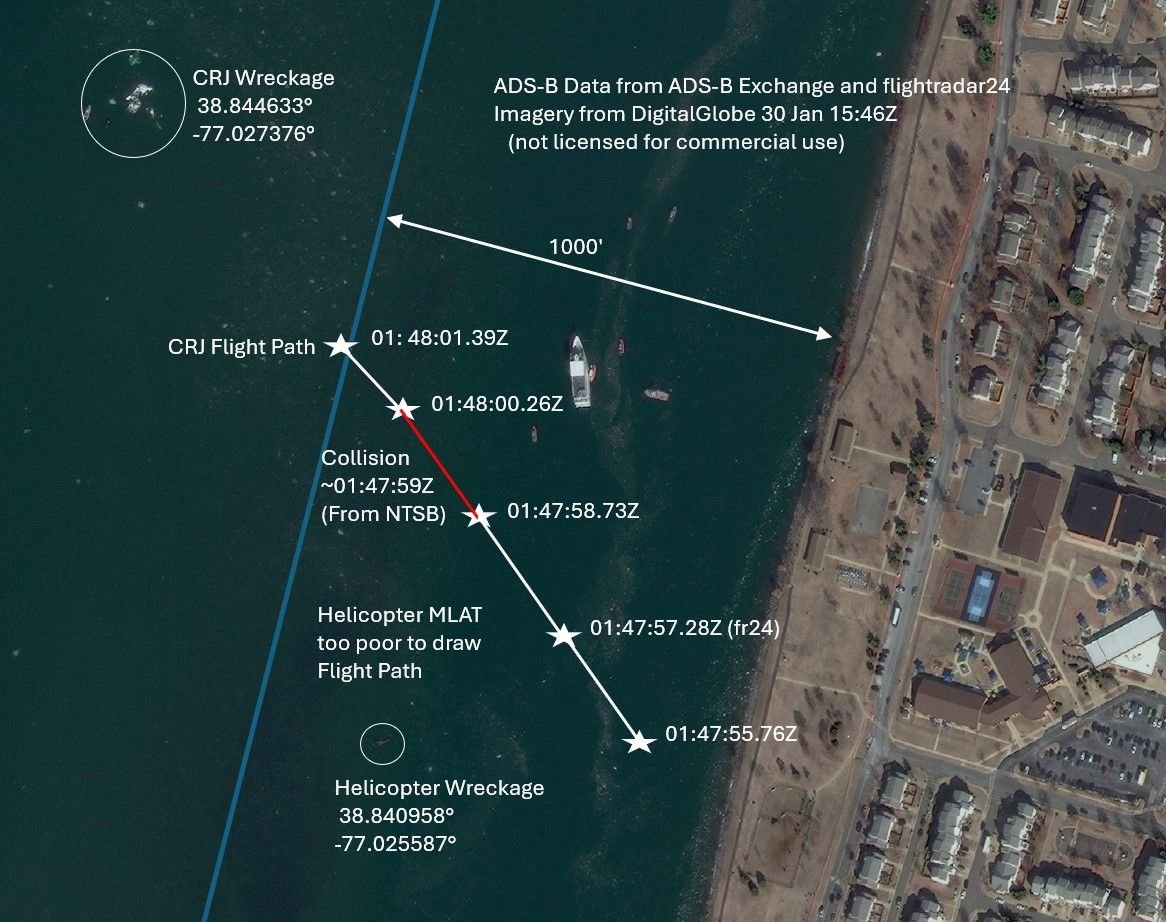
Crash Scene
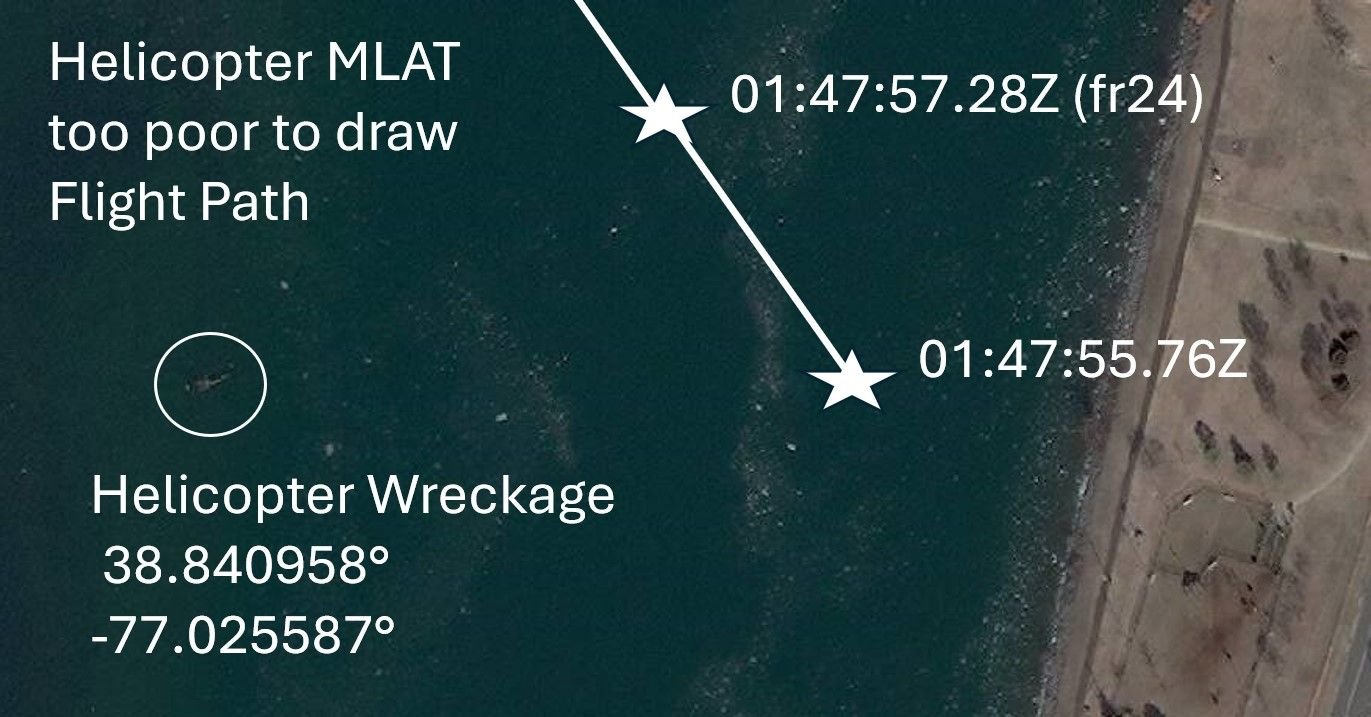
Zoom on helicopter
FWIW, this is my take on the layout of the crash scene:
Crash Scene
Zoom on helicopter
Last edited by airplanecrazy; 14th February 2025 at 06:49. Reason: Fixed pictures
Joined: May 2016
Posts: 75
Likes: 3
From: Nantes
Just heard NTSB briefing. It seems that the scapegoat will not be any of the humans involved, nor even the procedures, but the altimeter system of the black hawk (a 100 ft discrepancy) and the radio (they did not hear "circling" and "pass behind")
Joined: Apr 2009
Aviation Qualifications: Non-Aircrew
Posts: 1,581
Likes: 673
From: DM33
Landing flap, 9 deg pitch up, and full up elevator! That is what I heard NTSB report at today's briefing.
No one in the assembled press made any comment and so likely no one understood that was not normal or what it most likely indicated.
No one in the assembled press made any comment and so likely no one understood that was not normal or what it most likely indicated.

Joined: Jul 2008
Posts: 9
Likes: 0
From: bristol
deltafox44
Not at all. The briefing indicated there may be a possibility that the altimeter in the BlackHawk displayed an inaccurate altitude reading and that the discrepency was in the order of approx 100' given the height at which the collision is known to have occurred.
Briefing the RT comms, NTSB stated that a portion of the ATC instruction to the BlackHawk to 'pass behind the CRJ' was received in the Blackhawk (according to the CVR), truncated due to the BlackHawk keying the mic at the same time. Apparently, the words 'pass behind the' were missing from the BlackHawk CVR.
Not at all. The briefing indicated there may be a possibility that the altimeter in the BlackHawk displayed an inaccurate altitude reading and that the discrepency was in the order of approx 100' given the height at which the collision is known to have occurred.
Briefing the RT comms, NTSB stated that a portion of the ATC instruction to the BlackHawk to 'pass behind the CRJ' was received in the Blackhawk (according to the CVR), truncated due to the BlackHawk keying the mic at the same time. Apparently, the words 'pass behind the' were missing from the BlackHawk CVR.
Last edited by parabatix; 14th February 2025 at 19:35. Reason: 'in rely to'
Joined: Dec 2007
Posts: 952
Likes: 447
From: same planet as yours
For a couple of days now, was thinking about posting something on an "extra noise" I keep hearing in the R/T comms, when TWR gives the 'pass behind' instruction. Was wondering whether TWR's Tx wasn't stepped over by someone.
My first impression was that the extra noise came from an radio call from a turbine helicopter (given the typical background noise often heard in radio calls from turbine helicopters). And was wondering if it wasn't PAT25 that started replying to TWR's first 'in sight?' call, effectively blocking part of TWR's second call, the 'pass behind' part of the instruction.
In attached mp3 (in .zip per forum attachment requirements) around 00:05 I hear this 'extra noise'.
Edit:
well, this seems to confirm my initial impression:
Briefing the RT comms, NTSB stated that a portion of the ATC instruction to the BlackHawk to 'pass behind the CRJ' was received in the Blackhawk (according to the CVR), truncated due to the BlackHawk keying the mic at the same time. Apparently, the words 'pass behind the' were missing from the BlackHawk CVR.
Last edited by DIBO; 14th February 2025 at 20:07. Reason: last posts with NTSB info seem to confirm my suspicion


Joined: Aug 2009
Aviation Qualifications: Military
Posts: 9,337
Likes: 2,185
From: Texas
The subtext for me is that the Blackhawk crew never saw them...but there's more for the NTSB to sort out, as the lady was VERY CLEAR about.
Joined: May 2020
Posts: 63
Likes: 30
From: Virginia, USA
Here is the text of the prepared remarks from today's NTSB briefing which includes the event timeline: Prepared remarks
Joined: Dec 2020
Posts: 102
Likes: 87
From: USA
deltafox44
Not at all. The briefing indicated there may be a possibility that the altimeter in the BlackHawk displayed an inaccurate altitude reading and that the discrepency was in the order of approx 100' given the height at which the collision is known to have occurred.
Briefing the RT comms, NTSB stated that a portion of the ATC instruction to the BlackHawk to 'pass behind the CRJ' was received in the Blackhawk (according to the CVR), truncated due to the BlackHawk keying the mic at the same time. Apparently, the words 'pass behind the' were missing from the BlackHawk CVR.
Not at all. The briefing indicated there may be a possibility that the altimeter in the BlackHawk displayed an inaccurate altitude reading and that the discrepency was in the order of approx 100' given the height at which the collision is known to have occurred.
Briefing the RT comms, NTSB stated that a portion of the ATC instruction to the BlackHawk to 'pass behind the CRJ' was received in the Blackhawk (according to the CVR), truncated due to the BlackHawk keying the mic at the same time. Apparently, the words 'pass behind the' were missing from the BlackHawk CVR.
Joined: Jul 2013
Aviation Qualifications: Non-Aircrew
Posts: 1,390
Likes: 678
From: Within AM radio broadcast range of downtown Chicago
I'm not sure they did say that about the altimeter, they said that there was bad pressure altitude data recorded on the FDR. That's not the same as saying the altimeter display was wrong, although it does mean that it's going to be hard to infer what was actually displayed on the Baro Alts. I would have thought a military crew would be pretty solid on altimeter cross checks though so I think that's all a bit of a red herring. The Potomac is (give or take the tide) at sea level so I think we can be pretty confident that the RadAlt figure of 278ft is good for an altitude too.
8:43:48, pilot stated the Black Hawk was at 300 feet, the instructor pilot stated 400 feet, there is no discussion of the discrepancy; the investigation will probe this.
True, this is some minutes before the collision. But it is a discrepancy of 100 feet as referred to in the prior post.
Joined: Aug 2009
Aviation Qualifications: Military
Posts: 9,337
Likes: 2,185
From: Texas
I'm not sure they did say that about the altimeter, they said that there was bad pressure altitude data recorded on the FDR. That's not the same as saying the altimeter display was wrong, although it does mean that it's going to be hard to infer what was actually displayed on the Baro Alts. I would have thought a military crew would be pretty solid on altimeter cross checks though so I think that's all a bit of a red herring. The Potomac is (give or take the tide) at sea level so I think we can be pretty confident that the RadAlt figure of 278ft is good for an altitude too.
Joined: Dec 2002
Aviation Qualifications: ATP+Mil
Posts: 3,984
Likes: 567
From: Where the Quaboag River flows, USA
Well, 9 degrees pitch up AND full up elevator is rather different than “slight pitch up” just prior to impact, as reported earlier. That sounds like the beginning of an evasive climb