


AA5342 Down DCA

Pegase Driver

Joined: May 1997
Aviation Qualifications: ATCO
Posts: 4,448
Likes: 1,158
From: Europe
@ Fullwings :No rotary pilot I know would knowingly pass that close under/behind a jet transport as the wake could literally be the end of you at 200’AGL.
@ Lascaille : I very strongly doubt that the US govt would do a 'technically we're immune so tough luck' here. The optics would be dire.
Here if you want to learn or just refresh your memory ; https://www.latimes.com/archives/la-...%20government.
As an aside , the NTSB conclusions of that collision are interesting compared to our DCA accident : ( exactly 40 years ago !)
The NTSB determined "that the probable cause of the accident was the limitations of the air traffic control system to provide collision protection, through both air traffic control procedures and automated redundancy."In addition to the inadvertent and unauthorized entry of the PA-28 into the LA Terminal Control Area, another factor at play was the limitations of the "see and avoid" concept to ensure traffic separation.


Joined: Oct 2019
Posts: 19
Likes: 8
From: New Jersey
I think that compensation will almost certainly be made available one way or another, as to how, well, I don't know whether it really matters much. There's plenty of precedent for a 'we're not admitting fault but we're paying anyway' type of deal q.v. Iran 655
I very strongly doubt that the US govt would do a 'technically we're immune so tough luck' here. The optics would be dire.
I very strongly doubt that the US govt would do a 'technically we're immune so tough luck' here. The optics would be dire.


Joined: Aug 2009
Aviation Qualifications: Military
Posts: 9,337
Likes: 2,185
From: Texas
Joined: Oct 2019
Aviation Qualifications: Non-Aircrew
Posts: 1,698
Likes: 1,079
From: USA
If wake turbulence is to pose a problem then "go behind" is the worst place to be. OTOH, passing at right angles to the downwash means a very short exposure time and, with the wing-tip vortex one is experiencing up-and down-wash at nearly the same time at each vortex, unlike being parallel which generates roll in one direction for aircraft that are too small to intercept both at the same time. Entering one sideways sees an up-wash and then the immediate down-wash along that filament of flow with a smaller downward velocity until fully into the vortex sheet between the two vorticies; then the same on the other side when exiting. I would expect it to feel like dropping off a curb on one side and then popping up a curb on the other side with a small decrease in altitude.
I would also expect helicopter pilots would avoid doing it at all. I would not recommend testing.
I would also expect helicopter pilots would avoid doing it at all. I would not recommend testing.
Last edited by Senior Pilot; 18th February 2025 at 00:12. Reason: Leave the US Politics out of it, thanks


Joined: Feb 2009
Posts: 2,822
Likes: 109
From: Virginia
I wasn't insinuating that -- or really trying to be clever, either. I should have said this more directly, but the legal defenses that might be available with respect to the FAA's actions almost certainly won't apply to the Blackhawk crew. And the Government won't pay twice for the same accident in any event. So if the Blackhawk crew was negligent, which I have to say seems likely, the FAA's possible defenses are pretty much irrelevant.


Joined: Jul 2013
Aviation Qualifications: Non-Aircrew
Posts: 1,390
Likes: 678
From: Within AM radio broadcast range of downtown Chicago
I wasn't insinuating that -- or really trying to be clever, either. I should have said this more directly, but the legal defenses that might be available with respect to the FAA's actions almost certainly won't apply to the Blackhawk crew. And the Government won't pay twice for the same accident in any event. So if the Blackhawk crew was negligent, which I have to say seems likely, the FAA's possible defenses are pretty much irrelevant.
But, you're asserting that the Army can be sued - it's covered by the Federal Tort Claims Act, as far as I know. Which is to say it will be claimed that the Army as an organization, and perhaps the pilots, were negligent. There isn't a separate exception to the FTCA's immunity waiver for the military in general although there is an exception for combatant activities in time of war (not applicable, right?).
But not so fast. The operation of training and/or check rides for VIP transport- especially as related to continuity of government operations - carries lots of policy judgments. It could be a more intense legal fight than scoring the FAA for favoring traffic capacity over stricter safety rules. For one thing, the continuity of government stuff probably is largely meant to be kept out of the public record, making litigation involving it more challenging.
Joined: Nov 2011
Aviation Qualifications: CPL
Posts: 749
Likes: 6
From: Somewhere close to me
Playing Devil's Advocate for a moment, if the heliroutes are published for the common sense use of participants, not for the protection of air transport, and we further accept that it is not within the purview of ATC to question the discretion of willing users, I'm afraid we can only fall back on this accident being the sole responsibility of the helicopter. Which I guess is is another way of re-stating your last post.
I wouldn't put it past the FAA to pull a stunt like that, read Mary Schiavo's (ex IG of the Dept. of Transportation) book if you want to know how wily they can be. And Jennifer gave them the perfect lay up in the last briefing.
I wouldn't put it past the FAA to pull a stunt like that, read Mary Schiavo's (ex IG of the Dept. of Transportation) book if you want to know how wily they can be. And Jennifer gave them the perfect lay up in the last briefing.
It's way to easy to blame the pilots, over the years there have been incidents due to incorrect QNH settings, were both pilots and ATC have failed to catch the error, in a busy airspace with overworked ATC, late change of runway for airlines, and military helicopters using Night Vision Goggles, altimeter equipment failure/error.
Even the Max 200 ft altitude under the approach to a major US airport is an accident waiting to happen, and whoever approved this to be used during normal operations should be investigated. The CRJ was at around 325 ft on a visual/circling approach when it crashed, does anyone really think it's great airmanship to have a Black Hawk helicopter at 200 ft passing under you?
That's what made the Swiss Cheese model line up perfectly, a planned approved separation of 125 ft was the "best case" scenario.
Joined: May 2020
Aviation Qualifications: ATCO
Posts: 151
Likes: 68
From: Magrathea
But, who exactly are the “knuckleheads” ? To my mind, they are the officials who approved these routes & procedures. Would you agree ? Others (ATC & pilots) might have made contributory errors, but the situation was orchestrated by those who designed & allowed the procedures. Correct ?
Joined: Jan 2008
Aviation Qualifications: ATP+Mil
Posts: 121
Likes: 80
From: USA
But, who exactly are the “knuckleheads” ? To my mind, they are the officials who approved these routes & procedures. Would you agree ? Others (ATC & pilots) might have made contributory errors, but the situation was orchestrated by those who designed & allowed the procedures. Correct ?
How do you boil a frog? Just like this. Obe degree at a time. This is the B-17/P63 crash- dumb orchestration, no one spoke up.
Joined: Dec 2020
Posts: 102
Likes: 87
From: USA
But, who exactly are the “knuckleheads” ? To my mind, they are the officials who approved these routes & procedures. Would you agree ? Others (ATC & pilots) might have made contributory errors, but the situation was orchestrated by those who designed & allowed the procedures. Correct ?
I've asked a question over on Rotorheads to see if anyone knows the actual clearance and service given to helicopters entering the DCA Class Bravo on the 'routes', and I'm happy to repeat it here. In London it's Radar Control ie. separation provided by ATC supported by radar. That's one part of the picture. The other is this startling revelation from Jennifer Homendy that there are no lateral limits to the 'routes', so in one sense they are not really 'routes' at all just guidelines with defined altitude limits. I can't find even altitude limits on the NY and Boston charts.
In other words, the way the 'routes' are used is quite possibly defined locally by custom and practice rather than designed with safety baked in by the authority, and that may be the way the authority intended things to be. In the UK every towered field has its own safety management system, as does the CAA. If these exist here at DCA and the FAA it would be instructive to have those examined as part of the investigation, because either they are not being used, or they're being ignored. Nobody could maintain that the risks on this 'route' were As Low As Reasonably Practicable (ALARP).
Last edited by Wide Mouth Frog; 18th February 2025 at 12:16.
Joined: Aug 2009
Aviation Qualifications: Military
Posts: 9,337
Likes: 2,185
From: Texas
I should have said this more directly, but the legal defenses that might be available with respect to the FAA's actions almost certainly won't apply to the Blackhawk crew.
And the Government won't pay twice for the same accident in any event.
So if the Blackhawk crew was negligent, which I have to say seems likely, the FAA's possible defenses are pretty much irrelevant.
And the Government won't pay twice for the same accident in any event.
So if the Blackhawk crew was negligent, which I have to say seems likely, the FAA's possible defenses are pretty much irrelevant.
Joined: Feb 2025
Posts: 21
Likes: 7
From: NM
Indeed , and there is a precedent : the 1986 Cerritos collision : the NTSB found no responsibility to ATC as the pilot of the PA28 that hit the DC9 had entered Los Angeles Terminal Control Area airspace without the required clearance. However a judge found the FAA partly responsible to make sure the families of the pax , mostly Mexicans , would be compensated , as the responsible private pilot's wealth would not have been able to cover those.
Joined: Jan 2023
Posts: 344
Likes: 141
From: Puget Sound, WA
Perfectly vigilant pilots with perfect eyesight can't prevent all see-and-avoid midairs, as there are midair scenarios (like the ones mentioned) where it is literally impossible for the pilots to see the aircraft on collision course in time to avoid the collision.
Joined: Jan 2023
Posts: 344
Likes: 141
From: Puget Sound, WA
An interesting point. But, consider first how frequently on this forum posters have observed that the FAA (and Congress) have favored higher capacity of operations over stricter safety-related operational procedures. It has been noted on many threads about many incidents. So - while admitting there could be legal reasoning that has eldued me - the presence of policy judgments in the FAA situation looks pretty strong, and very likely preclusive.

Joined: Dec 2002
Aviation Qualifications: ATP+Mil
Posts: 3,984
Likes: 567
From: Where the Quaboag River flows, USA
I’m not sure about that. I went from 1950s B727 and 1960s C-5 into a Global Expess. The improvements in information processing for the crew was astounding. Then, add in SMS at the airlines, including FOQA, and it’s not an accident (pardon the pun) that safety has improved.
Joined: Nov 2005
Posts: 314
Likes: 70
From: on the way to sea
as active ATCO I can say only this (to addition to what I've already said) - I will never, ever allow any flying object to cross path of another flying object, especially when one of them is landing. This practice of my US colleagues to frequently offload separation duties to the pilots is just not acceptable. As if there is not enough incident contributing factors, they tend to add some of their own. I said (to disbelief of the attendees) at IFATCA conference just after Uberlingen - let's be honest, at the end of the day, it was ATCO who cleared both airplanes to the same level...
It may sound harsh, but after years of struggle for non-punitive environment, some have deduced this as non-punitive environment for any kind of incident (or even accident).
Back to case in DCA - to expect self separation of night VFR and IFR conducting visual approach agreed hasty and under pressure in the area where none of them is capable of sudden change of trajectory is just pouring gasoline to the fire already raging.
It may sound harsh, but after years of struggle for non-punitive environment, some have deduced this as non-punitive environment for any kind of incident (or even accident).
Back to case in DCA - to expect self separation of night VFR and IFR conducting visual approach agreed hasty and under pressure in the area where none of them is capable of sudden change of trajectory is just pouring gasoline to the fire already raging.
Joined: Jun 2008
Posts: 546
Likes: 129
From: London
Joined: May 2020
Posts: 63
Likes: 30
From: Virginia, USA
Out of curiosity, I was wondering how “out of the ordinary” the flight path was for PA25 compared to other flights along Route 4. I found 65 such flights in January (there are probably some I missed) and I plotted where they crossed the runway approach. Note that the altitude is binned in 25' chunks, so you should assume that all altitudes just above 200' were actually at 200'. For any aircraft above 200' I DID NOT try to determine if they received clearance from ATC (which is permitted), and you SHOULD NOT assume that they didn't. I also threw in a rough breakout between daylight and night for each crossing. For the two PAT flights well offshore, I did not investigate any special ATC clearances they had. I apologize in advance for any errors as it is a bit tricky to plot and measure these distances.
Added note: The chart shows only crossings collected with ADS-B. I threw out all MLAT collected crossing because of inherent inaccuracy.
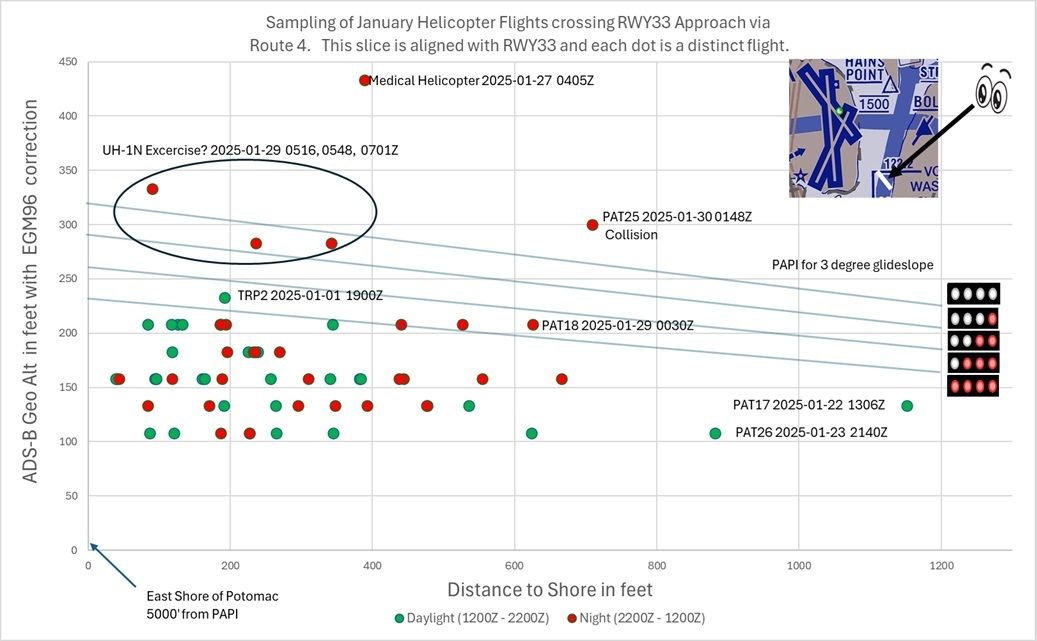
Helicopters crossing RWY 33 approach via Route 4 for January
Added note: The chart shows only crossings collected with ADS-B. I threw out all MLAT collected crossing because of inherent inaccuracy.
Helicopters crossing RWY 33 approach via Route 4 for January
Last edited by airplanecrazy; 19th February 2025 at 21:26.
Joined: Apr 2009
Posts: 2,049
Likes: 535
From: Wherever it is this month
(I've assumed that the altitude is recorded in the closest bin to the actual value. If that's not the case then the error bars would be 25 feet in one direction or the other depending on whether it rounds up or down. An ADSB geek would know. I am also itching to know whether the origin point of your glidepath lines has been adjusted to the same EGM96 height datum as the ADSB values...)