


Plane Down in Hudson River - NYC

Everything is under control.

Joined: Jul 2001
Posts: 437
Likes: 0
From: Washington, D.C.
I think what is happening is two things:
1. The name. Air BUS. A bus, get it? A type of conveyance. Boeing does not have that same ring to it. If people think of an aircraft as an Airbus, that is a great branding accomplishment. Like calling a photocopy a Xerox or a tissue Kleenex.
2. Airbus makes aircraft. Boeing is involved in aircraft, satellites, defense systems, missiles, space launch vehicles. So, I do not know what a Boeing is.
1. The name. Air BUS. A bus, get it? A type of conveyance. Boeing does not have that same ring to it. If people think of an aircraft as an Airbus, that is a great branding accomplishment. Like calling a photocopy a Xerox or a tissue Kleenex.
2. Airbus makes aircraft. Boeing is involved in aircraft, satellites, defense systems, missiles, space launch vehicles. So, I do not know what a Boeing is.


Joined: Mar 2007
Posts: 1,198
Likes: 17
From: Roguesville, cloud cuckooland
The debate over whether pilots who save an aircraft in this fashion are heroes, is a little silly in my opinion.
A hero is someone who makes a conscious choice to put someone else's life ahead of their own.
Captain Sully and his crew were put in a critical situation by fate. Through exemplary skill by the cockpit crew, both of them; and a well trained and disciplined cabin crew who had the passengers out of the aircraft in very short order, everyone did what they were trained to do and all the passengers got out alive.
Brilliant flying and decision making?-Yes.
Fantastic work by the cabin crew?-Undoubtedly.
Heroic? I think the crew themselves would deny it.
In Australia this week we had our first Victoria Cross awarded in 40 years. The recipient, time and time made himself a target for Taliban machine gunners in order to give Coalition troops time to gather wounded soldiers after an ambush. Then he sprinted 80 metres over open ground to rescue a wounded Afghan interpreter and carry him on his shoulders back to safety. That guy is a true hero because he made the conscious choice to risk his own life to save others.
Funnily enough, he even denies the hero tag as he says anyone would have done the same. I don't think so.
Nevertheless, Capt Sully and crew, I salute you all for the great credit you give to your respective professions. Well done.
A hero is someone who makes a conscious choice to put someone else's life ahead of their own.
Captain Sully and his crew were put in a critical situation by fate. Through exemplary skill by the cockpit crew, both of them; and a well trained and disciplined cabin crew who had the passengers out of the aircraft in very short order, everyone did what they were trained to do and all the passengers got out alive.
Brilliant flying and decision making?-Yes.
Fantastic work by the cabin crew?-Undoubtedly.
Heroic? I think the crew themselves would deny it.
In Australia this week we had our first Victoria Cross awarded in 40 years. The recipient, time and time made himself a target for Taliban machine gunners in order to give Coalition troops time to gather wounded soldiers after an ambush. Then he sprinted 80 metres over open ground to rescue a wounded Afghan interpreter and carry him on his shoulders back to safety. That guy is a true hero because he made the conscious choice to risk his own life to save others.
Funnily enough, he even denies the hero tag as he says anyone would have done the same. I don't think so.
Nevertheless, Capt Sully and crew, I salute you all for the great credit you give to your respective professions. Well done.
Joined: Aug 2007
Posts: 644
Likes: 0
From: Oz
This in Flightblogger...
The Airbus Ditching Button - FlightBlogger - Aviation News, Commentary and Analysis
The Airbus Ditching Button - FlightBlogger - Aviation News, Commentary and Analysis

Joined: Jul 1999
Posts: 3,040
Likes: 0
From: 58-33N. 00-18W. Peterborough UK
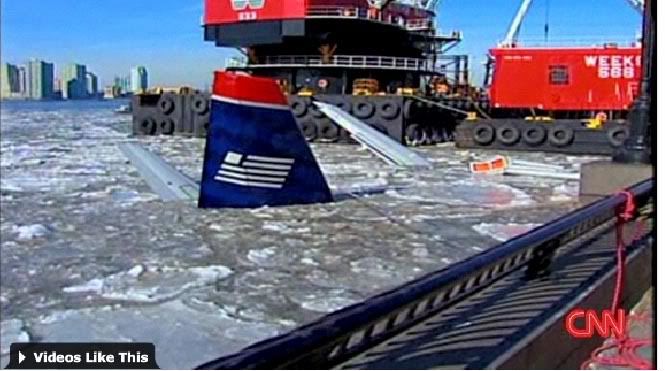
the airframe floating with a nose up attitude, the top of an engine should be as visible as the top of the wing surface

Joined: Jan 2008
Posts: 798
Likes: 0
From: The Land of Beer and Chocolate
Just a silly question.
The NTSB want to look at the engines to see the damage in regard to it being a birdstrike on each of them. That's fair enough, but would there have been any (more) damage to the engines due to the ditching? I mean, if you hit water at that sort of speed something would surely break so how would the NTSB figure out if both engines had been "goosed" when the pressure of the water has had to have broken something and also would have washed the blood and guts out?
(I'm not doubting it was a double birdstrike, I just can't figure out what the NTSB is talking about, apart from it being the usual beaurocrat talk)
The NTSB want to look at the engines to see the damage in regard to it being a birdstrike on each of them. That's fair enough, but would there have been any (more) damage to the engines due to the ditching? I mean, if you hit water at that sort of speed something would surely break so how would the NTSB figure out if both engines had been "goosed" when the pressure of the water has had to have broken something and also would have washed the blood and guts out?
(I'm not doubting it was a double birdstrike, I just can't figure out what the NTSB is talking about, apart from it being the usual beaurocrat talk)
Joined: Sep 2008
Aviation Qualifications: ATPL
Posts: 3,435
Likes: 1,201
From: 41S174E
I imagine that water impact causes one type of damage and goose imapct causes another. Is there anyone on here who can shed light on how a pro would determine the difference?
Joined: Aug 2003
Posts: 44
Likes: 0
From: Dublin
The value of finding the engines
What could the engines reveal?, a poster asks.
Well, DNA evidence could identify the species, and might even tell you the number of unfortunate birds to have been ingested. All useful information, in the wake of the second power-off (or limited power) landing of an airliner in just over two months.
Well, DNA evidence could identify the species, and might even tell you the number of unfortunate birds to have been ingested. All useful information, in the wake of the second power-off (or limited power) landing of an airliner in just over two months.
Joined: Oct 2008
Posts: 30
Likes: 0
From: USA
Well here's a scenario...one engine dies, who knows why...your flying an aircraft that is overgross..you not very high up....you panic, and firewall your last good engine, an engine that is being trend monitored, and has 30,000 hours on it...so it dies...your really low, because your doing a reduced thrust, Flex type of departure, with a lower then max climb rate...you see some bldgs...so you go for that big expanse of water...glide along over the water as long as you can, getting as slow as you can, splash, probably about about 100 kts.
So maybe they got bad fuel, maybe some fuel tank switching stupidity, starvation scenario, maybe some fuel pump thing...maybe ice in the inlets came into the engines...
I thought all the birds flew South in the middle of winter....
Double engine failure? At the same time? Anyone want to calcuate those odds, without the hand of human intervention?
Not meant to incite, but rather I am really going to be curious when the engines get pulled, and the flight data recorder info is made available...which I doubt...
So maybe they got bad fuel, maybe some fuel tank switching stupidity, starvation scenario, maybe some fuel pump thing...maybe ice in the inlets came into the engines...
I thought all the birds flew South in the middle of winter....
Double engine failure? At the same time? Anyone want to calcuate those odds, without the hand of human intervention?
Not meant to incite, but rather I am really going to be curious when the engines get pulled, and the flight data recorder info is made available...which I doubt...
Joined: Feb 2008
Posts: 83
Likes: 0
From: Hazel Grove, Stockport
A320 in Hudson River
In reply re why did the rh eng not come off, look again at the landing and see how hard the a/c veared to the left at the end of its landing run. I would have said that the LH eng was the braking force at that point with the RH Eng and wing being higher as in any hard turn and as such with not enough force on it to break the shear pins.
Lakerman
Lakerman

Joined: Feb 2005
Posts: 4,581
Likes: 0
From: flyover country USA
I imagine that water impact causes one type of damage and goose imapct causes another. Is there anyone on here who can shed light on how a pro would determine the difference?
Water ingestion at low RPM, if it causes any damage, will likely drive blades downstream into stator vanes.
Joined: Jan 2008
Posts: 798
Likes: 0
From: The Land of Beer and Chocolate
Glad Rag
As I said, it was a silly question, because my brain went "Whaaa?" at the comment from the NTSB in the news report posted earlier with the comments from the flight attendants.
Now, to the damage, if you hit water at over 100mph it's seemingly like hitting concrete. I'm guessing they hit above that speed so the pressure of the water is bound to have caused more damage to the engines. Also, the sudden flow trough the engines would probably wash any debris from the birds out. So what is there to be gained by the NTSB wanting to look at the engines when there is, no doubt, more damage caused by the ditching? They have the statements from the flight attendants saying it was a double strike, they have the captain saying the same, why not get the data recorders and look at them to show what happened (two engines going "POP" at the same time would be pretty clear)?
It just makes no sense to hold a Sword of Damacles over people when everything is pointing to it being a very unfortunate accident, as the NTSB seem to be doing.
Oh, and the fact that everyone lived is surely a reason to discuss things more, instead of being ghouls discussing dead bodies.
(PS.. Thanks to those who came out with sensible answers)
As I said, it was a silly question, because my brain went "Whaaa?" at the comment from the NTSB in the news report posted earlier with the comments from the flight attendants.
Now, to the damage, if you hit water at over 100mph it's seemingly like hitting concrete. I'm guessing they hit above that speed so the pressure of the water is bound to have caused more damage to the engines. Also, the sudden flow trough the engines would probably wash any debris from the birds out. So what is there to be gained by the NTSB wanting to look at the engines when there is, no doubt, more damage caused by the ditching? They have the statements from the flight attendants saying it was a double strike, they have the captain saying the same, why not get the data recorders and look at them to show what happened (two engines going "POP" at the same time would be pretty clear)?
It just makes no sense to hold a Sword of Damacles over people when everything is pointing to it being a very unfortunate accident, as the NTSB seem to be doing.
Oh, and the fact that everyone lived is surely a reason to discuss things more, instead of being ghouls discussing dead bodies.
(PS.. Thanks to those who came out with sensible answers)
Last edited by hellsbrink; 17th January 2009 at 22:45. Reason: Added a bit
Joined: Jan 2008
Posts: 1,275
Likes: 21
From: London
Bloomberg info
"U.S. radar data and witness accounts support early reports that bird strikes may have forced a US Airways Group Inc. plane’s “miracle on the Hudson” splashdown this week in which all 155 people on board survived.
The plane intersected “a string of primary targets” that may have been birds at an altitude of 2,900 to 3,000 feet, 90 seconds after takeoff from New York’s LaGuardia Airport, said Kitty Higgins, a National Transportation Safety Board member."
Considering the max altitude of the plane was aprox 3200 ft it therefore sounds like the power loss must have been almost immediate and almost total
The plane intersected “a string of primary targets” that may have been birds at an altitude of 2,900 to 3,000 feet, 90 seconds after takeoff from New York’s LaGuardia Airport, said Kitty Higgins, a National Transportation Safety Board member."
Considering the max altitude of the plane was aprox 3200 ft it therefore sounds like the power loss must have been almost immediate and almost total
Joined: Oct 1998
Posts: 451
Likes: 0
From: Kalgoorlie, W.A. , Australia
Aircraft appears to be breaking up, read earlier that tide had loosend the mooring ropes. A picture NY1 | 24 Hour Local News | Top Stories | Divers Search For Plane's Missing Engines In River from NY1 shows Port wing and Starboard tailplane out of the water.
Joined: Jan 2008
Posts: 798
Likes: 0
From: The Land of Beer and Chocolate
Why do you ask, OD?
As I say, I'm just thinking about things because I've seen certain things and the NTSB comment doesn't really make sense, going by the evidence, apart from it being the usual beaurocratic malebovinefaeces you can expect from official bodies until they have looked at things.
As I say, I'm just thinking about things because I've seen certain things and the NTSB comment doesn't really make sense, going by the evidence, apart from it being the usual beaurocratic malebovinefaeces you can expect from official bodies until they have looked at things.
Joined: Feb 2005
Posts: 4,581
Likes: 0
From: flyover country USA
So if one of the engines is still attached, should 'we' not ask the question . . . why?
Should it not have come off?
(as designed . . . )
Should it not have come off?
(as designed . . . )