


Training on grass


Joined: Apr 2010
Posts: 850
Likes: 0
From: USA
Thank you, Gordy! 
If grass is all you have then grass is all you have. But there's no reason to be going to grass if you have a choice. A little wear on the carbides isn't going to break anyone's bank. The old ways worked, but sometimes the new ways are an improvement. Just so long as your instructor or check pilot isn't letting you get away with improper technique, of course.
If grass is all you have then grass is all you have. But there's no reason to be going to grass if you have a choice. A little wear on the carbides isn't going to break anyone's bank. The old ways worked, but sometimes the new ways are an improvement. Just so long as your instructor or check pilot isn't letting you get away with improper technique, of course.


Joined: Sep 2018
Aviation Qualifications: CPL
Posts: 888
Likes: 65
From: California
# 2 was a checkride for CFI demonstrating a touch down auto. The examiner had a rather large stomach and the student left it too late to flare and thereby attempted an aggressive flare but ran out of cyclic as it hit the instructors belly....they hit the ground fast and the skids "dug in"...
.


Joined: Sep 2003
Posts: 2,081
Likes: 189
From: Redding CA, or on a fire somewhere
Thank you, Gordy!
If grass is all you have then grass is all you have. But there's no reason to be going to grass if you have a choice. A little wear on the carbides isn't going to break anyone's bank. The old ways worked, but sometimes the new ways are an improvement. Just so long as your instructor or check pilot isn't letting you get away with improper technique, of course.
If grass is all you have then grass is all you have. But there's no reason to be going to grass if you have a choice. A little wear on the carbides isn't going to break anyone's bank. The old ways worked, but sometimes the new ways are an improvement. Just so long as your instructor or check pilot isn't letting you get away with improper technique, of course.
Yep, unfortunately he has since passed on. This was a case of the student had learned "rote muscle movement" and did not fully comprehend the situation and adjust his technique.
The one in Pic A, had less than 25 hours on the airframe since new.........

These were the 3 airframes I showed Shawn Coyle when he visited back in 2005 right before he wrote his article on Touchdowns to hard surfaces.


Joined: Aug 2000
Posts: 2,111
Likes: 118
Hm, got home after loads of touchdown auto's to grass. Haven't bent anything. Grass is much more forgiving to land on then a hard surface. As a comparison if I asked you to jump off a 10 ft wall would you wish to land on grass or a concrete surface ?
Joined: Sep 2003
Posts: 2,081
Likes: 189
From: Redding CA, or on a fire somewhere
And yes, I too have done 100's of autos to grass, but accept that the risk is greater than to a hard surface.
Joined: Mar 2005
Aviation Qualifications: Military
Posts: 6,562
Likes: 952
From: Aus
There is absolutely nothing wrong with grass providing you have surveyed it prior to use to determine its suitability, we are talking training here, not when you've had a failure and few options. All our training was to grass and never had an issue in my seven years of military service, as said previously we used to even run on at 35 knots, no problem, because the surface was maintained. Fixed wing come to grief when landing on surfaces not suitable as well, even when they think it is - runway under repair, did you get the notam.
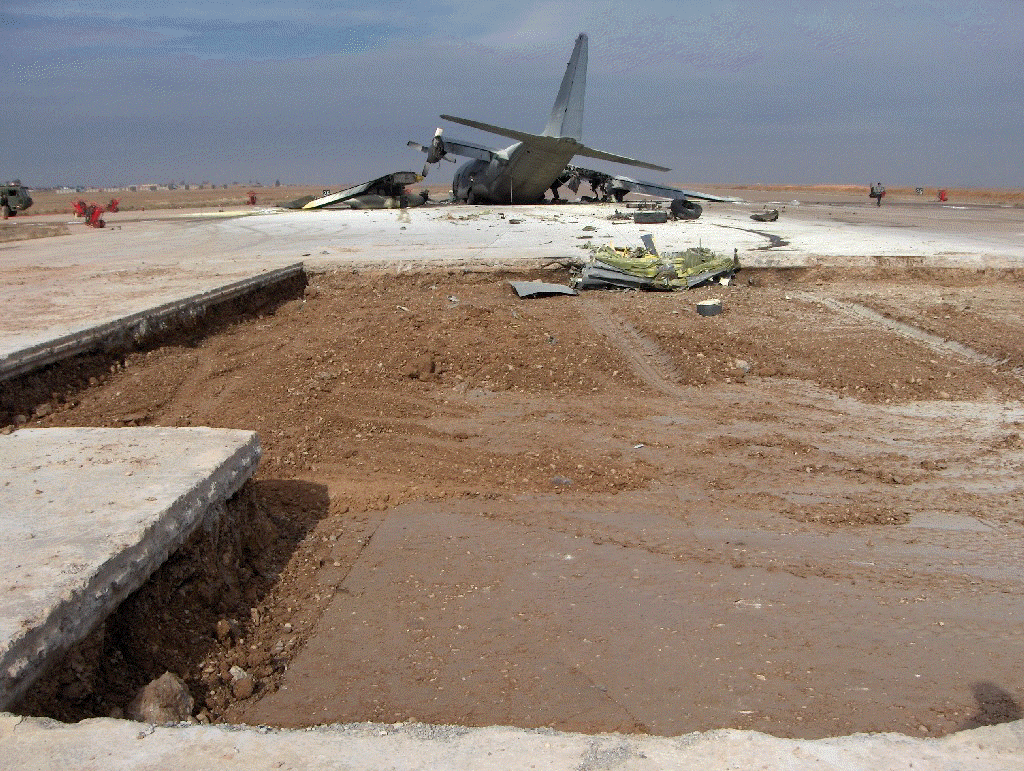
Gordy, the grass in your #1 and #2 photos would not have passed muster here as suitable for training, don't blame the grass, blame the standards of which you are willing to accept as suitable. Our system ensured a surface flat as a billiard table and the grass kept mown short.
Gordy, the grass in your #1 and #2 photos would not have passed muster here as suitable for training, don't blame the grass, blame the standards of which you are willing to accept as suitable. Our system ensured a surface flat as a billiard table and the grass kept mown short.
Joined: Sep 2003
Posts: 2,081
Likes: 189
From: Redding CA, or on a fire somewhere
Joined: Apr 2000
Aviation Qualifications: ATP+Mil
Posts: 10,959
Likes: 1,814
From: EGDC
Our system ensured a surface flat as a billiard table and the grass kept mown short.
Joined: Apr 2000
Aviation Qualifications: ATP+Mil
Posts: 10,959
Likes: 1,814
From: EGDC
#1 was a new instructor who was demonstrating having too much forward trim and allowing the helicopter to run onto the ground with forward motion...
# 2 was a checkride for CFI demonstrating a touch down auto. The examiner had a rather large stomach and the student left it too late to flare and thereby attempted an aggressive flare but ran out of cyclic as it hit the instructors belly....they hit the ground fast and the skids "dug in"...
# 3 Actually the third was a "flare" problem in that the instructor was not authorized to conduct touchdown autos and he did a "power recovery" to a hover auto and bounced forward pulling full aft cyclic---had he been to a hard surface, there is a good chance the skids would have spread a little and then skidded not compressed and then sprung up.
# 2 was a checkride for CFI demonstrating a touch down auto. The examiner had a rather large stomach and the student left it too late to flare and thereby attempted an aggressive flare but ran out of cyclic as it hit the instructors belly....they hit the ground fast and the skids "dug in"...
# 3 Actually the third was a "flare" problem in that the instructor was not authorized to conduct touchdown autos and he did a "power recovery" to a hover auto and bounced forward pulling full aft cyclic---had he been to a hard surface, there is a good chance the skids would have spread a little and then skidded not compressed and then sprung up.
#2 - did he pass his CFI ride?
#3 - not authorised for touchdown autos and couldn't even get a power recovery right!
All three instructor errors and rather confirming a dilution of quality and ability in the instructor cadre......
Joined: Sep 2003
Posts: 2,081
Likes: 189
From: Redding CA, or on a fire somewhere
Originally Posted by [email protected]
#1 - a very convincing demonstration by the instructor - too convincing
#2 - did he pass his CFI ride?
#3 - not authorised for touchdown autos and couldn't even get a power recovery right!
All three instructor errors and rather confirming a dilution of quality and ability in the instructor cadre......
#2 - did he pass his CFI ride?
#3 - not authorised for touchdown autos and couldn't even get a power recovery right!
All three instructor errors and rather confirming a dilution of quality and ability in the instructor cadre......
#1...Ironic huh....he was part of the MTP---Military Training Program, yep---former military pilots now in the civvie world teaching new military pilots...
#2... Nope he failed, was retrained and retested and I believe he passed on 2nd attempt
#3 See #1 above....I was the one who removed #3's authorization prior to this accident. He was subsequently 609'd (license revoked by the FAA and had to retest to get it back, which he never did).
Joined: Aug 2000
Posts: 2,111
Likes: 118
Gordy not a bad one really as the grass and ground absorbs some of the shock as the aircraft touches down, hence you see indents in the ground. You can't seriously lell me that landing on a hard surface has less of a shock to the aircraft ? Of course the skids splay out as this is the first " crumple zone " the manufacturer puts in to protect us. The skids still start to splay on grass, you just dont get the harder shock especially when a student gets it wrong and one has to recover it
Joined: Apr 2010
Posts: 850
Likes: 0
From: USA
Gordy not a bad one really as the grass and ground absorbs some of the shock as the aircraft touches down, hence you see indents in the ground. You can't seriously lell me that landing on a hard surface has less of a shock to the aircraft ? Of course the skids splay out as this is the first " crumple zone " the manufacturer puts in to protect us. The skids still start to splay on grass, you just dont get the harder shock especially when a student gets it wrong and one has to recover it
Also, it's worth nothing that from a vertical perspective, it's not really that the grass is absorbing impact so much as that the grass surface is providing a different character to the ground effect as you touch down. Leaving aside any differences in ground effect from soft surfaces vs. hard surfaces, given the same vertical speed at impact a soft surface will keep the skids from spaying more so than on pavement, and this will transmit a higher shock load to the airframe.
The bottom line is that hard surfaces are safer. Period. Dot. Physics and all that sort of thing. Now if you want to argue that the additional safety margin afforded by hard surfaces is inconsequential certainly you are free to do so. But as Gordy has noted, there are far more touchdown auto related accidents on soft surfaces than on hard surfaces, regardless of how many you and others have survived unscathed. If you have hard surfaces available to you why would you not avail yourself of them to gain that extra margin of safety? Your instructor should be beating you about the head and shoulders for too much forward velocity, or vertical velocity, at touchdown regardless of what surface you have chosen. So choose the one with a more homogenous surface and a lower coefficient of friction, i.e. a hard surface, just in case things go a little sideways.
Last edited by aa777888; 20th May 2021 at 12:07. Reason: Remove the evil "bubble" word and replace with "ground effect".

 Chose the runway rather than the grass, as if they had a choice, wonder what the result may have been if they came down on the grass.
Joined: Apr 2000
Aviation Qualifications: ATP+Mil
Posts: 10,959
Likes: 1,814
From: EGDC
Also, it's worth nothing that from a vertical perspective, it's not really that the grass is absorbing impact so much as that the grass surface is not allowing the bubble of air underneath the helicopter to escape so readily. So it's an air cushion effect rather than a surface cushion effect. Indeed, leaving aside the air cushion, given the same vertical speed at impact a soft surface will keep the skids from spaying more so than on pavement, and this will transmit a higher shock load to the airframe.
Keep straight, don't chase the attitude with cyclic and don't lower the lever until you have stopped during the run on and it doesn't matter what surface or pretty much what speed you land on.

Joined: Mar 2018
Posts: 2,243
Likes: 1,154
From: Central UK
Full TD autos can be conducted to grass safely but not all pilots possess the skills to do so.
Originally Posted by [email protected]
So we are back to dumbing down training...........
You are, after all, practicing for emergency landngs in fields...