


Helicopter crash New York City

Fleet Manager


Joined: Aug 2006
Aviation Qualifications: CPL
Posts: 7,081
Likes: 2,938
From: Ontario, Canada
Jeremy. this is a very qualified and experienced group, you gotta really know your stuff to make a good impression here. For myself, particularly on this forum, I often read and consider more, and post less, and only what I know first hand from having done it/lived through it!

Joined: Nov 2010
Posts: 880
Likes: 225
From: Australia
First, I assume by "tail rotor drive shaft bonds" you mean that a coupling between the tail rotor drive shaft elements failed?
The footage of the helicopter emerging from behind the building appears to me to show the fuselage yawing anticlockwise as viewed from above [update: I can now see the clockwise yaw others had indicated]. The tail boom might initially also start yawing in that direction but then seems to fold back as if resisting the sudden yaw by its own inertia and aerodynamic loads. If there was a loss of tail rotor drive, then the fuselage should start yawing clockwise viewed from above (until pilot reacts and reduces collective and power) [update: which again is the direction of yaw most posters here were seeing, and I now can as well] .
I realise different people might perceive the direction of yaw in opposite directions [update: I have changed my perception over time].
You also associate the audio sound with a tail rotor shaft thrashing around. But the frequency has been associated by others with main rotor RPM. The tail rotor and tail rotor drive RPM is much higher so I would expect a higher frequency if that was the cause of the sound?
Last edited by helispotter; 22nd April 2025 at 10:52.

Joined: Oct 1999
Aviation Qualifications: ATPL
Posts: 7,371
Likes: 926
From: Den Haag
im making a valid well educated analysis here
If you go back to basics, how many times has this happened in previous TR drive failure incidents in the past? I doubt anyone here has heard of one and, frankly, if this was the logical outcome, of a failure type that has a relatively high risk of occurring, I’m sure many here will have stopped flying sooner!

Joined: Oct 2003
Posts: 221
Likes: 2
From: Hampshire, UK
Related to the topic, I found an interesting video diary showing a brief glimpse of this kind of operation. This one follows a flight to and from Newark (it uses part of the same flightpath and you can see the now-famous NJ riverside buildings from the aerial perspective). The accident aircraft even makes a cameo. I think it might be the same operator, perhaps a sister aircraft.
Joined: Nov 2010
Posts: 880
Likes: 225
From: Australia
A partial screengrab from the NTSB B-roll video, showing the tail boom failure point. The investigator is holding a torch, the black shaft is not part of the aircraft.

The full video source is here:
https://youtu.be/_n2dJN7xemM
The full video source is here:
https://youtu.be/_n2dJN7xemM
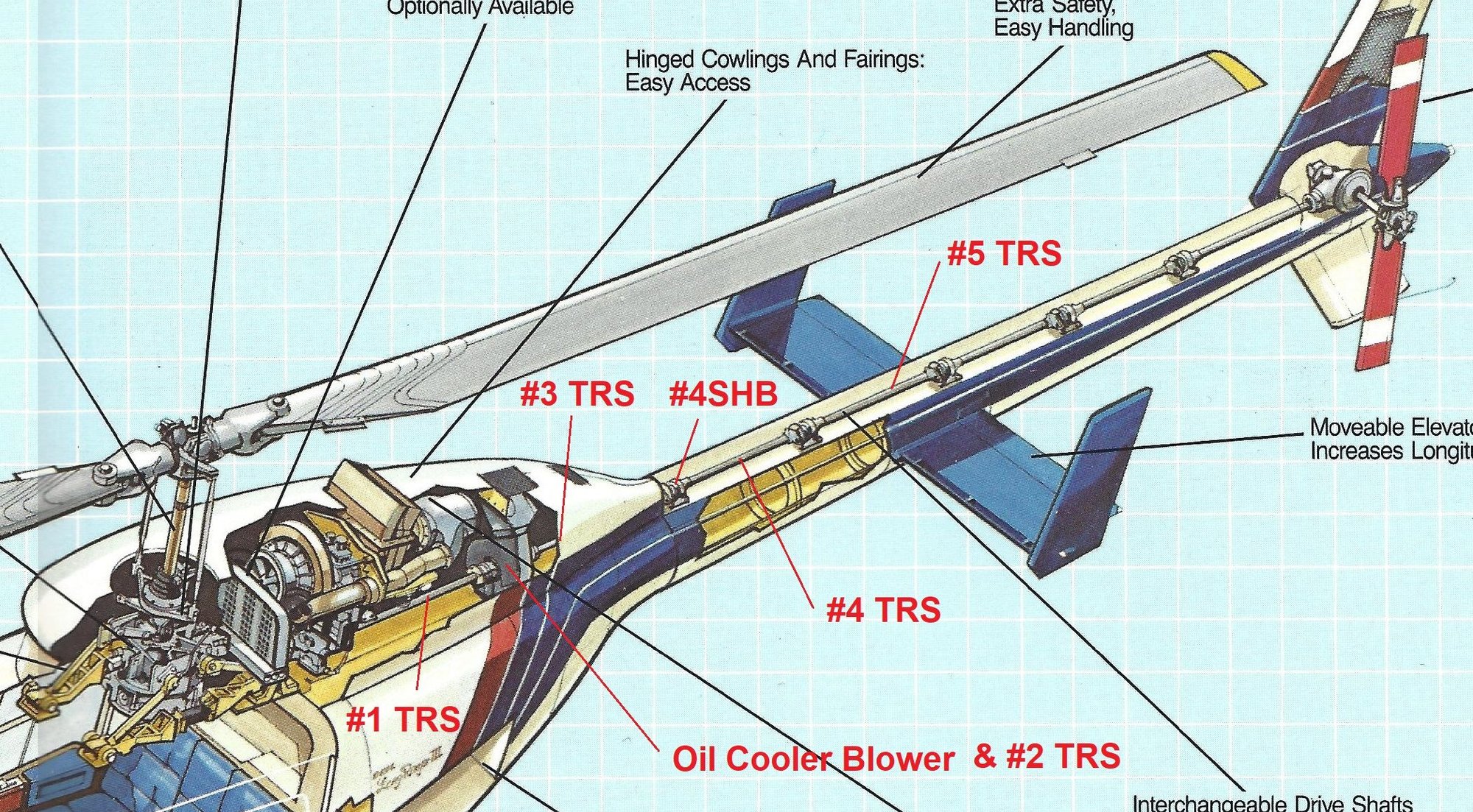
Then a few more observations about the tail rotor drive shaft as seen in the NTSB B-roll. Will start by including a layout drawing of a 206L-3 from a Bell brochure (the L-3 is presumably mostly similar to the L-4):

Next, a pair of views near the fractured tail boom but also looking forward to what I understand from Kulwin Park (#139) is the Oil Cooler Fan (dark green). A spline end of a portion of tail rotor drive shaft is visible where marked by arrows, with support bearing still intact at that location:
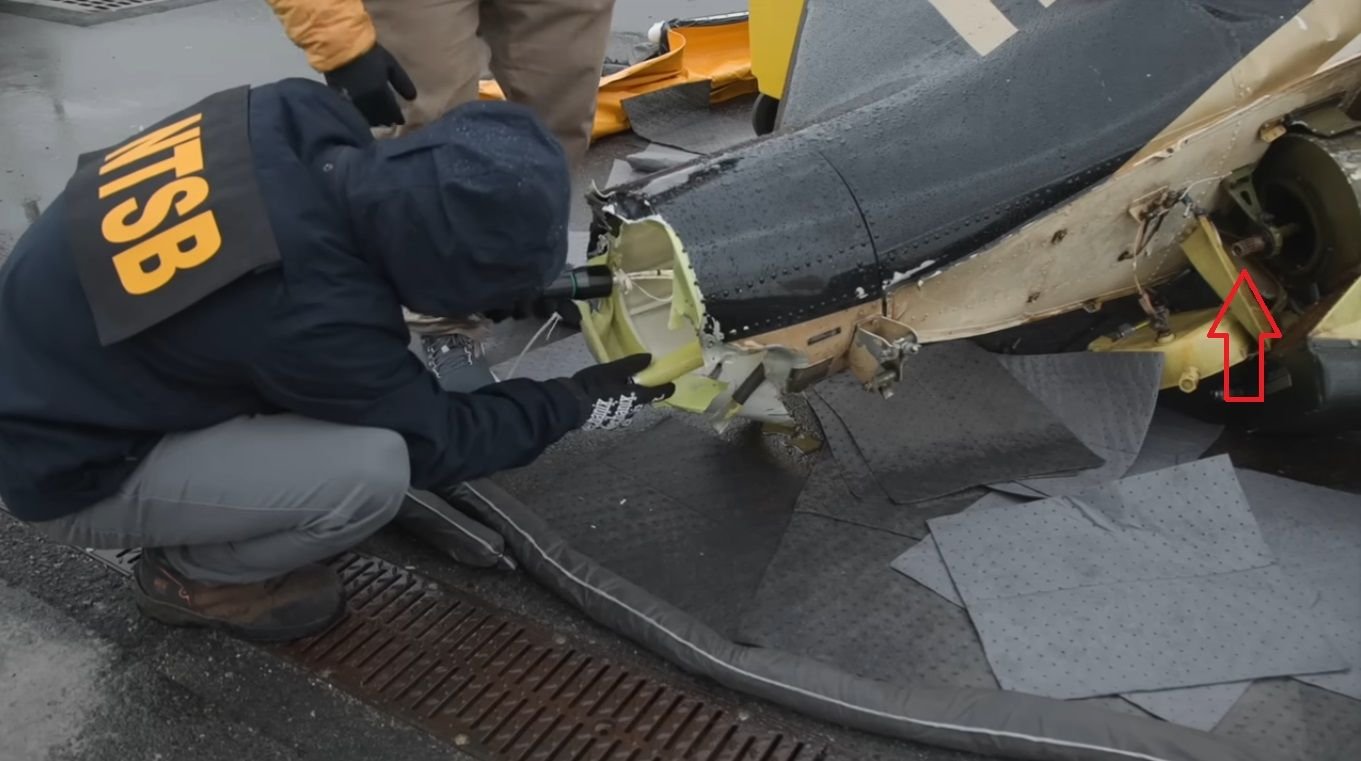
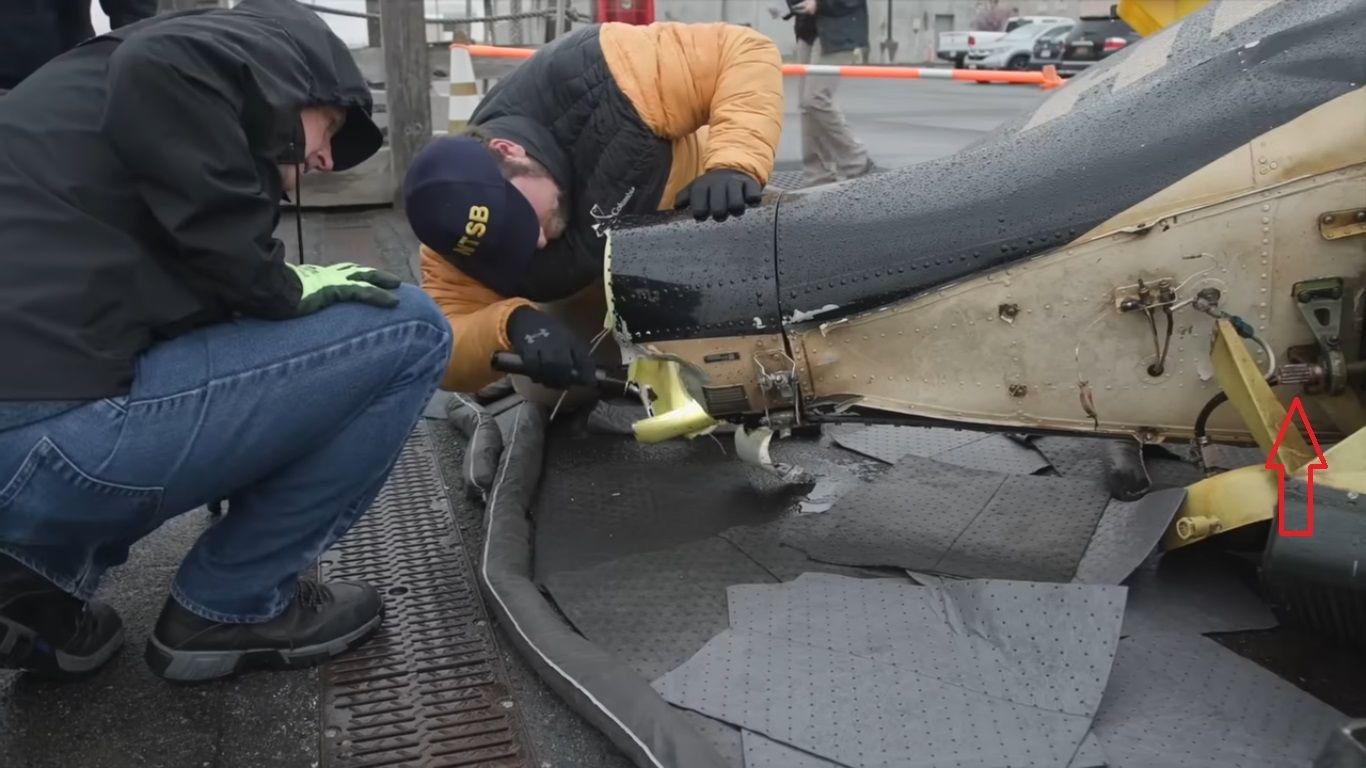
Then, as Kulwin Park noted in #139, a seemingly fractured section of tail rotor drive shaft further forward below the engine (see again arrow):

Finally, to complement the screen shot of tail boom fracture already posted by JamesT73J, another view looking from directly behind. A portion of the tail boom skin hangs out on the right side of the fracture (white being the interior colour of the tail boom at this location):

It isn't obvious to me the fracture of the tail boom is due to a drive shaft flailing about given the bearing seat near that fracture isn't massively distorted. It also doesn't seem the fracture at this location relates directly to a main rotor strike as that would likely have occurred further aft. So can anything be drawn from the remnants of the tail rotor drive? My guess is the TR drive fracture below the engine may have occurred when the fuselage impacted the water (which seemed to be mostly inverted). Drive shaft may have been pulled apart at spline aft of oil cooler fan when the tail boom folded as seen in video?
I was curious to see the animation(?) one of the investigators showed Jennifer Homendy on their laptop at 5:43+. The rotor hub looked more like a Bo105 or BK117. Gives me a sense they were trying to illustrate the way in which cyclic pitch control of blades operates rather than something specific to 206L. In turn, I am still left wondering if perhaps a pitch control link gave way? A single 'out of control' blade would certainly generate a noise consistent with 1 per rev of the main rotor system as Juan Browne is indicating in one of his video clips. Not sure what the sound of a blade driven to a large AoA might sound like* but the drag on such a blade would cause rotor to loose its RPM even with turbine still driving it. That is consistent with the frequency of the noise in the video reducing over time. But rotor drag should then have caused the fuselage to yaw clockwise which is opposite to what I perceive from the video footage.
* Audio of footage of the EC130B4 VH-XH9 landing following its collision with EC130B4 VH-XKQ on Gold Coast of Australia in 2023 revealed a distinct 'swoosh' sound, perhaps matching rotor RPM. I now suspect that was due to what the final report reveals was a partly delaminated blade on XH9.
Thread Starter

Joined: Mar 2011
Posts: 518
Likes: 50
From: London/Atlanta
Chief Bottle Washer

Joined: Sep 2000
Aviation Qualifications: ATPL
Posts: 7,252
Likes: 1,437
From: PPRuNe
Joined: Oct 2006
Aviation Qualifications: A&P
Posts: 1,346
Likes: 270
From: USA
No. Blade is a different operator than the accident aircraft.
Yes. The larger diameter one is to the elevator.
Yes. But in general the L-4 has a different MR/TR drive system and higher gross weight.
Yes. But its technically called the oil cooler blower. The splines are part of the blower which is also called the #2 TR shaft.
That is the #1 TR driveshaft and it appears to be sheared near the middle of the shaft. Given the engine was torn loose seems plausible it would break there since the blower is still intact which would be where that #1 shaft connected to.
Except if the aft end of the #4 TR shaft came lose or failed it would have hit the t/boom in the area of where the t/boom tore off. Plus the remains of the #4 shaft hangar bearing can still be seen in its deformed mount on the forward edge of the installed t/boom portion.
The #3 TR shaft only slides onto the aft blower splines as does the #1 TR shaft at the fwd blower splines. The aft end of the #3 shaft would bolt to the #4 shaft at the distorted hangar bearing mount.
I think a good question would be what caused the #4 hangar bearing to fail and where are the #3, #4, #5 TR shafts?
Will start by including a layout drawing of a 206L-3 from a Bell brochure (the L-3 is presumably mostly similar to the L-4):
Next, a pair of views near the fractured tail boom but also looking forward to what I understand from Kulwin Park (#139) is the Oil Cooler Fan (dark green). A spline end of a portion of tail rotor drive shaft is visible where marked by arrows, with support bearing still intact at that location:
a seemingly fractured section of tail rotor drive shaft further forward below the engine (see again arrow):
It isn't obvious to me the fracture of the tail boom is due to a drive shaft flailing about given the bearing seat near that fracture isn't massively distorted.
Drive shaft may have been pulled apart at spline aft of oil cooler fan when the tail boom folded as seen in video?
I think a good question would be what caused the #4 hangar bearing to fail and where are the #3, #4, #5 TR shafts?
Joined: Jul 2002
Posts: 221
Likes: 18
From: Somewhere, Over the Rainbow
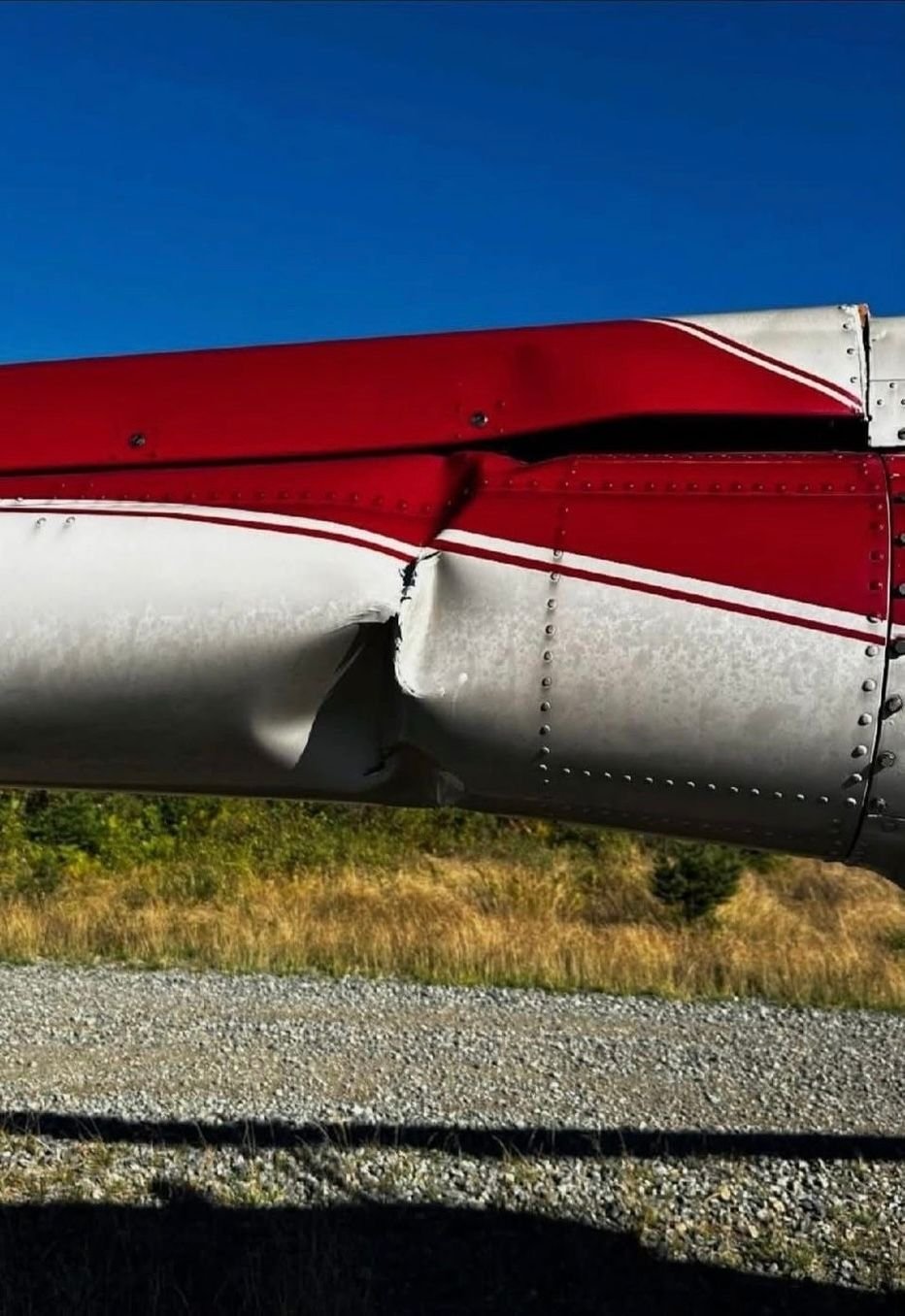
This is the tailboom of a Long Ranger that suspectedly got into the Van Horn bounce. The pilot was extremely lucky to get it on the ground and it all happened within seconds. The landing was not hard at all.
Eerily similar damage wouldn’t y’all say?
Last edited by Senior Pilot; 21st April 2025 at 03:29. Reason: Crop photo

Joined: Oct 2009
Posts: 47
Likes: 24
From: New York
Blade does not own any helicopters. They use various New York operators, New York Heli being one of them. They usually took care of the shorter airport transfers around the city in their 206s. So yes, that would be the same aircraft.
Joined: Oct 2006
Aviation Qualifications: A&P
Posts: 1,346
Likes: 270
From: USA
Interesting. Was told Blade quit using them after the last CH 11 filing. Thanks.
Joined: Oct 2003
Posts: 221
Likes: 2
From: Hampshire, UK
Blimey. That's very similar, innit.
Last edited by Senior Pilot; 21st April 2025 at 03:28. Reason: Edit quote
Joined: Aug 2009
Aviation Qualifications: Military
Posts: 9,328
Likes: 2,175
From: Texas

Joined: Jan 2020
Posts: 25
Likes: 1
From: California
Something I noticed tonight as I was reading through, that I hadn't noticed before in the pictures. The very straight line of the break on the left side of the tail, compared to the more can opener style of damage to the bottom and right side.
Would a crack lead to such a straight break?
I wouldnt think a crack would propogate in such a straight line, but a straight line in a crash where everything else looks like a beer can seems odd to me.
If my blade directions are right, if something,(crack, harmonics like the picture above, FOD denting the tailboom?) caused the tail to weaken, the tail rotor would fold the tail to the right like the accident sequence?
Would a crack lead to such a straight break?
I wouldnt think a crack would propogate in such a straight line, but a straight line in a crash where everything else looks like a beer can seems odd to me.
If my blade directions are right, if something,(crack, harmonics like the picture above, FOD denting the tailboom?) caused the tail to weaken, the tail rotor would fold the tail to the right like the accident sequence?
Joined: Nov 2010
Posts: 880
Likes: 225
From: Australia
Thanks wrench1 (#332) for explaining tail rotor drive components and their arrangement. On the basis the L-3 drawing remains representative of an L-4 in terms of overall layout, I added abbreviated labels pointing towards the items you described (hopefully correctly).
As with TwinHueyMan (#333) and JamesT73J, I certainly see the similarities between both tail boom failures, only that one managed to "hang on".
Returning to post #259 by SansAnhedral where the missing tip of one rotor blade was sketched onto the photo of the recovered rotor, I was wondering if there was any evidence of that part already being missing off the main rotor on its way down. If you view from 0:46 in the following clip, you could certainly convince youself a portion was already missing in the air:
To illustrate, a screen shot from that video:

So question then is whether the missing 'tip' was the 'first' failure (causing substantial unbalance in rotor with 1 per rev vibration), or did the tip only fail after striking tail boom due to a substantial rotor 'hop' or deflection or as tail boom parted? In post #329 Bell_ringer reports seeing the tail boom passing through main rotors, but on the videos I have come across, the helicopter is too grainy to make out much at that point. Is there a clearer clip somewhere zoomed into the helicopter?
As with TwinHueyMan (#333) and JamesT73J, I certainly see the similarities between both tail boom failures, only that one managed to "hang on".
Returning to post #259 by SansAnhedral where the missing tip of one rotor blade was sketched onto the photo of the recovered rotor, I was wondering if there was any evidence of that part already being missing off the main rotor on its way down. If you view from 0:46 in the following clip, you could certainly convince youself a portion was already missing in the air:
So question then is whether the missing 'tip' was the 'first' failure (causing substantial unbalance in rotor with 1 per rev vibration), or did the tip only fail after striking tail boom due to a substantial rotor 'hop' or deflection or as tail boom parted? In post #329 Bell_ringer reports seeing the tail boom passing through main rotors, but on the videos I have come across, the helicopter is too grainy to make out much at that point. Is there a clearer clip somewhere zoomed into the helicopter?
Last edited by helispotter; 21st April 2025 at 07:00.


Joined: Feb 2006
Posts: 1,067
Likes: 40
From: On the big blue planet