Originally Posted by
JamesT73J
A partial screengrab from the NTSB B-roll video, showing the tail boom failure point. The investigator is holding a torch, the black shaft is not part of the aircraft.

The full video source is here:
https://youtu.be/_n2dJN7xemM
First of all, is it fair to assume the two broken tubes emerging from within the tail boom are the tail rotor pitch control and the elevator control links?
Then a few more observations about the tail rotor drive shaft as seen in the NTSB B-roll. Will start by including a layout drawing of a 206L-3 from a Bell brochure (the L-3 is presumably mostly similar to the L-4):

Next, a pair of views near the fractured tail boom but also looking forward to what I understand from Kulwin Park (#139) is the Oil Cooler Fan (dark green). A spline end of a portion of tail rotor drive shaft is visible where marked by arrows, with support bearing still intact at that location:
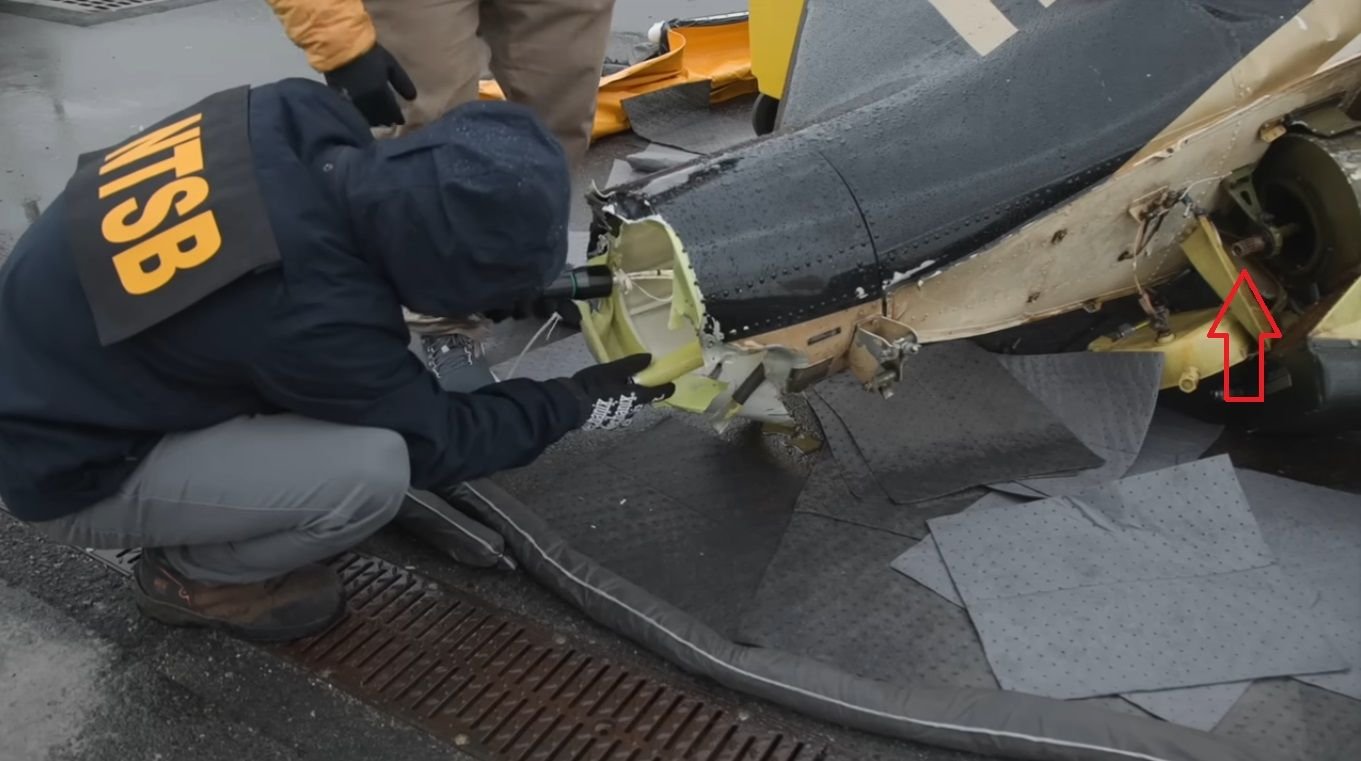
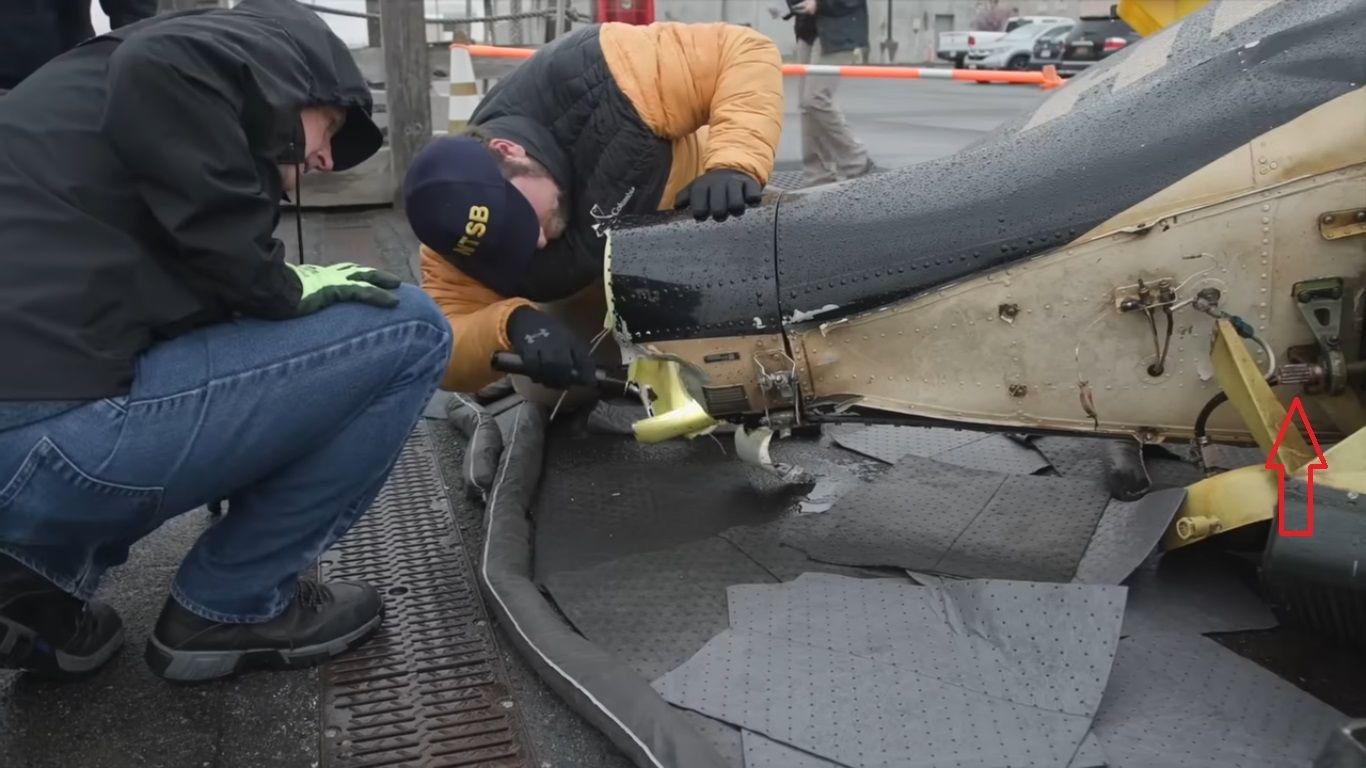
Then, as Kulwin Park noted in #139, a seemingly fractured section of tail rotor drive shaft further forward below the engine (see again arrow):

Finally, to complement the screen shot of tail boom fracture already posted by JamesT73J, another view looking from directly behind. A portion of the tail boom skin hangs out on the right side of the fracture (white being the interior colour of the tail boom at this location):

It isn't obvious to me the fracture of the tail boom is due to a drive shaft flailing about given the bearing seat near that fracture isn't massively distorted. It also doesn't seem the fracture at this location relates directly to a main rotor strike as that would likely have occurred further aft. So can anything be drawn from the remnants of the tail rotor drive? My guess is the TR drive fracture below the engine may have occurred when the fuselage impacted the water (which seemed to be mostly inverted). Drive shaft may have been pulled apart at spline aft of oil cooler fan when the tail boom folded as seen in video?
I was curious to see the animation(?) one of the investigators showed Jennifer Homendy on their laptop at 5:43+. The rotor hub looked more like a Bo105 or BK117. Gives me a sense they were trying to illustrate the way in which cyclic pitch control of blades operates rather than something specific to 206L. In turn, I am still left wondering if perhaps a pitch control link gave way? A single 'out of control' blade would certainly generate a noise consistent with 1 per rev of the main rotor system as Juan Browne is indicating in one of his video clips. Not sure what the sound of a blade driven to a large AoA might sound like* but the drag on such a blade would cause rotor to loose its RPM even with turbine still driving it. That is consistent with the frequency of the noise in the video reducing over time. But rotor drag should then have caused the fuselage to yaw clockwise which is opposite to what I perceive from the video footage.
* Audio of footage of the EC130B4 VH-XH9 landing following its collision with EC130B4 VH-XKQ on Gold Coast of Australia in 2023 revealed a distinct 'swoosh' sound, perhaps matching rotor RPM. I now suspect that was due to what the final report reveals was a partly delaminated blade on XH9.