


AA5342 Down DCA

Joined: Dec 2002
Posts: 2,776
Likes: 352
From: UK
Even the best
makobob … "we need to hire pilots and air-traffic controllers based on merit and experience"
'Even the best pilots can make the worst mistakes' James Reason
The point is that accidents involve many converging, often unforeseen factors in situations not envisaged by risk assessment.
'Even the best pilots can make the worst mistakes' James Reason
The point is that accidents involve many converging, often unforeseen factors in situations not envisaged by risk assessment.
Last edited by safetypee; 2nd February 2025 at 22:09.

Joined: Nov 2000
Posts: 142
Likes: 47
From: Montgomery, NY, USA
Regarding the collision of American Eagle JIA342 and Army Blackhawk PAT25, I lay the blame squarely on the shoulders of both the FAA and the United States Army Aviation Branch. If the NTSB in any way blame the pilots in the incident, they are not doing their job. Let’s look at all of the holes in this swiss cheese:
1. In an effort to maximize commercial air traffic in and out of DCA, the FAA has created the “deviate to RWY 33 procedure” for air traffic in-bound to RWY 01. This requires a right-hand turn from the RWY 01 approach followed by an immediate hard left-hand turn to line up on RWY 33. FAA criteria for a stabilized approach states that you have to be stable at 500 feet AGL on final in VMC or perform an immediate go-around. But on this particular approach, you will be at or below 400 feet AGL as you come out of the left turn to final. So the FAA has granted an exception to the “stabilized requirements” at DCA to allow for this maneuver. This allows ATC to shorten the distance between arriving and departing aircraft that are utilizing conflicting RWYs. The FAA in essence violates its own safety standards on stabilized approaches for the sake of expediency.
2. The FAA creates the Route 1/4 helicopter route through the DCA airspace as a VFR route with constantly changing altitude requirements. The lowest limit is at 200 ft MSL through the area east of DCA. Any pilot will tell you that flying that low over water at night is a best a tense experience. Try not to break that limit flying at night while also trying to communicate with ATC and simultaneously searching for possible conflicting aircraft.
3. The United States Army Aviation Branch deems it acceptable to allow training missions for Army Reserve pilots with limited flying experience to fly these helicopter routes through this complex and extremely active airspace. Compounding this, training flights at night using night-vision goggles are deemed “safe” in spite of the fact that using said goggles severely limits peripheral vision and makes it difficult if not impossible to perceive any color other than green and white. Picking out particular lights against the background of urban lighting is challenging, as is depth perception. Scanning key cockpit instruments is also made more difficult, making it challenging to accurately maintain altitude. Add to that workload the need to be in constant communication with ATC as well as monitoring all other comms traffic not directed to you but necessary in order to maintain good situational awareness. Given the density of commercial air traffic on this route, common sense would dictate that this route be flown by only the most experienced pilots and only when absolutely necessary. Reasonable logic would understand that conducting training missions should not be using final approach areas with heavy commercial traffic.
4. The Army crew on PAT25 are flying a mission they have been ordered to fly, at night and using night vision goggles. Although they may feel it is difficult and may be anxious about it, their command structure has determined that it is an appropriate training procedure and as such must meet minimum safety requirements. They do not have the authority to question the mission or the orders to fly it.
5. JIA342 is on approach for RWY 01, but is asked at the last minute by ATC to deviate to RWY 33, requiring the “circle to land” maneuver. Therefore, they are now on approach different from what they briefed for.
6. Any aircraft following the “circle to land” approach to RWY 33 will most likely have both pilots focused on RWY 33 as they come out of the left turn to final, especially if it was a last-minute request by ATC. In this case they will be looking to make sure that AA1630, which has just been given clearance to depart from RWY 01, is clear of the intersection with RWY 33 as they complete their final approach, and be ready for a go-around if it is not. In addition, this left bank makes it extremely difficult for the first officer to see any conflicting traffic coming towards them from the 1 to 2 o’clock position, as that traffic will probably be below the right window level. For the pilot, who is on the left side of the cockpit, visibility of such conflicting traffic will be nearly impossible.
7. For whatever reason, ATC is working with “split frequencies while controlling this airspace, so that although the controller hears both the aircraft on approach and the helo traffic south-bound on “Route 1”, the pilots of those respective aircraft only hear information directed at them. Thus they are not aware of all that is going on around them, and as such their situational awareness is limited by factors outside of their control.
8. ATC informs PAT25 of the conflicting aircraft on approach for RWY 33 at 1200 feet MSL, but at the time, PAT25 is heading almost due east towards the Jefferson Memorial on Helo Route 4 while JIA342 (the CRJ) is executing its right turn departing from the RWY 01 approach and is now heading in a northeast direction as it prepares to make a hard left onto the RWY 33 short final approach. From their respective positions, PAT25 in all likelihood sees the landing lights of AA3130 which is trailing JIA342 and whose landing lights are pointed almost directly in his direction, and mistakenly identifies it as the aircraft approaching RWY 33. At no time does it appear that ATC notifies JIA342 of the conflicting helo traffic. They are most likely focused on their approach to RWY 33, which was just handed to them.
9. As JIA342 rolls out of its left hand turn to final on RWY 33, completing the deviation they were just handed and had not briefed for, it is now approaching the 9-11 o’clock position of PAT25. Since the pilot of PAT25 is on the right-hand side of the Blackhawk, visibility of the CRJ may be limited. Both pilots of PAT25 are now most likely visibly fixated on passing to the rear of AA3130, which is in their 1-3 O’clock position, and which is the conflicting aircraft they perceive as the one ATC initially warned them about.
10. ATC, now receiving a conflicting aircraft warning, asks PAT25 if they have JIA342 in sight. In the absence of any obvious difference from the first mid-identification of the conflicting traffic, confirmation bias raises its ugly head. The voice response from the training pilot is calm and confident in stating that they do have it in sight and claim visual separation, probably proving once again that he mistakenly has AA3130 in sight slightly to his right directly in front of him and more than a mile away. Both pilots are totally unaware of JIA342 which is now arriving in front of them from their left.
11. The collision occurs.
In my humble opinion, the crews of both aircraft involved were set up by both the FAA and the Army Department of Aviation through a series of poorly based decisions which focused on expediency and departed from any appropriate utilization of a rational use of risk assessment. Consider the following:
1. Approval of the circling to RWY 33 maneuver which violates normal stabilized approach standards.
2. The establishment of a series of complex VFR helicopter track complex and heavily restricted air space as well as through final approach paths.
3. A 200 foot maximum altitude requirement over water and required even at night, which may result in a less than 200 foot vertical separation between aircraft on approach to RWY 33 and those traveling on Helo Route 1/4.
4. The decision to conduct military training missions in this complex and busy airspace with an abundance of commercial passenger traffic either arriving to or departing from DCA.
5. The use of split frequencies by the FAA which negatively impacts the situational awareness of all of the pilots in the airspace.
6. The use of night vision goggles to place even more limitations on the pilots.
Granted, all pilots involved may not have had the thousands of hours senior commercial and military pilot possess. But even the most senior individuals when placed in the task saturated environments these two crews faced would have at the very least felt their “pucker factor” increase through this. And there is probably an equal chance that the lack of common sense and appropriate safety design exhibited by the controlling entities would have resulted in a similar outcome. The odds were significantly stacked against these two flight crews, and unfortunately, against the passengers and flight attendants as well. If ever there were an example of an accident waiting to happen, this is it.
1. In an effort to maximize commercial air traffic in and out of DCA, the FAA has created the “deviate to RWY 33 procedure” for air traffic in-bound to RWY 01. This requires a right-hand turn from the RWY 01 approach followed by an immediate hard left-hand turn to line up on RWY 33. FAA criteria for a stabilized approach states that you have to be stable at 500 feet AGL on final in VMC or perform an immediate go-around. But on this particular approach, you will be at or below 400 feet AGL as you come out of the left turn to final. So the FAA has granted an exception to the “stabilized requirements” at DCA to allow for this maneuver. This allows ATC to shorten the distance between arriving and departing aircraft that are utilizing conflicting RWYs. The FAA in essence violates its own safety standards on stabilized approaches for the sake of expediency.
2. The FAA creates the Route 1/4 helicopter route through the DCA airspace as a VFR route with constantly changing altitude requirements. The lowest limit is at 200 ft MSL through the area east of DCA. Any pilot will tell you that flying that low over water at night is a best a tense experience. Try not to break that limit flying at night while also trying to communicate with ATC and simultaneously searching for possible conflicting aircraft.
3. The United States Army Aviation Branch deems it acceptable to allow training missions for Army Reserve pilots with limited flying experience to fly these helicopter routes through this complex and extremely active airspace. Compounding this, training flights at night using night-vision goggles are deemed “safe” in spite of the fact that using said goggles severely limits peripheral vision and makes it difficult if not impossible to perceive any color other than green and white. Picking out particular lights against the background of urban lighting is challenging, as is depth perception. Scanning key cockpit instruments is also made more difficult, making it challenging to accurately maintain altitude. Add to that workload the need to be in constant communication with ATC as well as monitoring all other comms traffic not directed to you but necessary in order to maintain good situational awareness. Given the density of commercial air traffic on this route, common sense would dictate that this route be flown by only the most experienced pilots and only when absolutely necessary. Reasonable logic would understand that conducting training missions should not be using final approach areas with heavy commercial traffic.
4. The Army crew on PAT25 are flying a mission they have been ordered to fly, at night and using night vision goggles. Although they may feel it is difficult and may be anxious about it, their command structure has determined that it is an appropriate training procedure and as such must meet minimum safety requirements. They do not have the authority to question the mission or the orders to fly it.
5. JIA342 is on approach for RWY 01, but is asked at the last minute by ATC to deviate to RWY 33, requiring the “circle to land” maneuver. Therefore, they are now on approach different from what they briefed for.
6. Any aircraft following the “circle to land” approach to RWY 33 will most likely have both pilots focused on RWY 33 as they come out of the left turn to final, especially if it was a last-minute request by ATC. In this case they will be looking to make sure that AA1630, which has just been given clearance to depart from RWY 01, is clear of the intersection with RWY 33 as they complete their final approach, and be ready for a go-around if it is not. In addition, this left bank makes it extremely difficult for the first officer to see any conflicting traffic coming towards them from the 1 to 2 o’clock position, as that traffic will probably be below the right window level. For the pilot, who is on the left side of the cockpit, visibility of such conflicting traffic will be nearly impossible.
7. For whatever reason, ATC is working with “split frequencies while controlling this airspace, so that although the controller hears both the aircraft on approach and the helo traffic south-bound on “Route 1”, the pilots of those respective aircraft only hear information directed at them. Thus they are not aware of all that is going on around them, and as such their situational awareness is limited by factors outside of their control.
8. ATC informs PAT25 of the conflicting aircraft on approach for RWY 33 at 1200 feet MSL, but at the time, PAT25 is heading almost due east towards the Jefferson Memorial on Helo Route 4 while JIA342 (the CRJ) is executing its right turn departing from the RWY 01 approach and is now heading in a northeast direction as it prepares to make a hard left onto the RWY 33 short final approach. From their respective positions, PAT25 in all likelihood sees the landing lights of AA3130 which is trailing JIA342 and whose landing lights are pointed almost directly in his direction, and mistakenly identifies it as the aircraft approaching RWY 33. At no time does it appear that ATC notifies JIA342 of the conflicting helo traffic. They are most likely focused on their approach to RWY 33, which was just handed to them.
9. As JIA342 rolls out of its left hand turn to final on RWY 33, completing the deviation they were just handed and had not briefed for, it is now approaching the 9-11 o’clock position of PAT25. Since the pilot of PAT25 is on the right-hand side of the Blackhawk, visibility of the CRJ may be limited. Both pilots of PAT25 are now most likely visibly fixated on passing to the rear of AA3130, which is in their 1-3 O’clock position, and which is the conflicting aircraft they perceive as the one ATC initially warned them about.
10. ATC, now receiving a conflicting aircraft warning, asks PAT25 if they have JIA342 in sight. In the absence of any obvious difference from the first mid-identification of the conflicting traffic, confirmation bias raises its ugly head. The voice response from the training pilot is calm and confident in stating that they do have it in sight and claim visual separation, probably proving once again that he mistakenly has AA3130 in sight slightly to his right directly in front of him and more than a mile away. Both pilots are totally unaware of JIA342 which is now arriving in front of them from their left.
11. The collision occurs.
In my humble opinion, the crews of both aircraft involved were set up by both the FAA and the Army Department of Aviation through a series of poorly based decisions which focused on expediency and departed from any appropriate utilization of a rational use of risk assessment. Consider the following:
1. Approval of the circling to RWY 33 maneuver which violates normal stabilized approach standards.
2. The establishment of a series of complex VFR helicopter track complex and heavily restricted air space as well as through final approach paths.
3. A 200 foot maximum altitude requirement over water and required even at night, which may result in a less than 200 foot vertical separation between aircraft on approach to RWY 33 and those traveling on Helo Route 1/4.
4. The decision to conduct military training missions in this complex and busy airspace with an abundance of commercial passenger traffic either arriving to or departing from DCA.
5. The use of split frequencies by the FAA which negatively impacts the situational awareness of all of the pilots in the airspace.
6. The use of night vision goggles to place even more limitations on the pilots.
Granted, all pilots involved may not have had the thousands of hours senior commercial and military pilot possess. But even the most senior individuals when placed in the task saturated environments these two crews faced would have at the very least felt their “pucker factor” increase through this. And there is probably an equal chance that the lack of common sense and appropriate safety design exhibited by the controlling entities would have resulted in a similar outcome. The odds were significantly stacked against these two flight crews, and unfortunately, against the passengers and flight attendants as well. If ever there were an example of an accident waiting to happen, this is it.


Joined: Mar 2015
Aviation Qualifications: PPL
Posts: 249
Likes: 26
From: UK
In the end, the chain of events were allowed to happen as did this horrible accident that took the lives of sixty-seven beautiful souls. The President is totally correct in that we need to hire pilots and air-traffic controllers based on merit and experience, nothing else!
"The helicopter was going straight at the airplane for an extended period of time. It is a CLEAR NIGHT, the lights on the plane were blazing, why didn’t the helicopter go up or down, or turn,"
As for recruitment of new people, decode this and following remarks
As part of the hiring freeze, no federal civilian position that was vacant at noon on January 20 would be filled, and no new positions would be created unless required by law or under the president's orders. Trump's order does not apply to military personnel or positions related to immigration enforcement, national security, or public safety.
It is unclear whether the freeze prevents the FAA from hiring new air traffic controllers or if these roles fall under public safety professionals.
https://www.newsweek.com/donald-trum...-crash-2023348
Other articles say that air traffic controllers were amongst FAA staff who received offers to resign with 8 months pay
Subsequently there may have been some later official sourced remarks that they are not eligible for the offer, but not necessarily also clarification whether they have been told this
https://abcnews.go.com/US/wireStory/air-traffic-controllers-initially-offered-buyouts-told-leaving-118330627
Last edited by aox; 2nd February 2025 at 22:40.
Joined: Apr 2015
Posts: 10
Likes: 28
From: Nevada, USA
What I can say about Mike is: he puts his name and his face and his reputation out there in public to have open discussions about flight safety, and in the context of this totally preventable collision, it would be beneficial to all if every expert here and elsewhere on the interwebs participated in a similarly open and public debate in relation to this incident. If you disagree with him, message him and invite a public debate.
I've lurked and read this forum for a long time. Decades? I can't even remember how long. Much as I enjoy reading it when a major incident occurs, it frustrates me to no end how it is filled with so many examples of institutional inertia, acquiescence to mind-numbingly antiquated regulations, ridiculous politics, and endless excuses, all of which inhibit the progress of technology and safety...not to segue into a rant but the most obvious example being, and which 99% of the non-flying public would agree with, that there is almost zero reason at this point to not have cameras in the cockpit and perhaps even live transmission of video and/or audio feeds on every commercial aircraft at this point – the power and data/bandwidth requirements being miniscule relative to the benefits, at this point it is simply absurd that such features do not exist; the Jeju incident's loss of CVR data being the best recent example of what a hindrance to technological progress aviation regulations have become, when for a few dollars a consumer can own a tiny little dashcam that records stunning 4K video and broadcast quality audio in near total darkness with 100mph wind noise running on a small and safe lithium batteries trickle charged from a 5 watt power supply for days on end, which can be broadcast via wifi link to Starlink-satellite based internet across the entire planet. We live in the Space Age, but the data storage and recovery procedures for commercial aircraft still hearkens back to WW2...
That rant aside, as the videos posted above by others demonstrate:
- A Blackhawk can in fact stop on a dime (so whatever you're suggesting Mike Blackstone was wrong about, it certainly wasn't that).
- Obviously that shouldn't be the plan, but it still a legitimate question to ask, in the context of an emergency, and when every other safety precaution has already failed, why couldn't it be done? Other poster's rationalize: at the low altitude, there's nowhere to go. The videos demonstrate otherwise. You can stop a Blackhawk 50 feet above the ground in seconds. If deviating in any direction is a risk, why didn't ATC just say "PAT25 slow to stop and hover!" – as a Very. Last. Resort?
- I don't understand how we can have a system of "Air Traffic Control" that defers its control to aircraft at night around a busy airport with intersecting approaches. It's nonsensical. I honestly didn't know it was a thing. I thought all major airports had flight paths that kept inbound and outbound aircraft in separate non-conflicting lanes at all times. Obviously, I'm extremely naive. From my perspective, it seems as though the professionals involved are allowed no intuition to deviate when the procedures clearly compromise safety? Apparently they're all reduced to being bots who can only read checklists? If that's the case, then why not run the whole system on "AI"? I know I'm being spicy by saying that, given all the pilots on this forum who harp on about how stupid AI is (true for the moment, but not for much longer, rest assured), yet many consider it perfectly reasonable for ATC procedures being to read out the type of aircraft to a pilot who is flying in total darkness in order to fulfill delegation of its responsibility to control air traffic, as if that procedure actually helps? Are we through the looking glass? It doesn't take a three year NTSB investigation to infer how stupid that is. Yet some defend it. Why?
Joined: Jul 2011
Posts: 2,449
Likes: 92
From: BFE
and from island air photo :
Spot on, but there is no EU or EASA IFR there are IFR rules and agreed global aviation standards ,Period What is ( or should I say was ) done in DC , or in SFO or with LAHSO, etc are all deviations to allow more traffic outside of the rules. Expedition taking over our good old "safety first" mantra .
Now , is delegating visual separation to an Helicopter ,at night ,( with pilots wearing NGV ) on an aircraft cleared off the ILS doing a circle visual NPA at 500 ft with 4 eyes most probably locked on the PAPI something safe ? with a 150- Ft margin of error designed on the chart ? But it is how the system was built and local controllers trained on doing this , since years. Normalization of Deviance.
I wish good luck to the NTSB and the FAA is trying to reverse this .
Spot on, but there is no EU or EASA IFR there are IFR rules and agreed global aviation standards ,Period What is ( or should I say was ) done in DC , or in SFO or with LAHSO, etc are all deviations to allow more traffic outside of the rules. Expedition taking over our good old "safety first" mantra .
Now , is delegating visual separation to an Helicopter ,at night ,( with pilots wearing NGV ) on an aircraft cleared off the ILS doing a circle visual NPA at 500 ft with 4 eyes most probably locked on the PAPI something safe ? with a 150- Ft margin of error designed on the chart ? But it is how the system was built and local controllers trained on doing this , since years. Normalization of Deviance.
I wish good luck to the NTSB and the FAA is trying to reverse this .
The “single point of failure” thing has been around forever. Reminds me of when ATC decided it was OK to start using land and hold short procedures at major air carrier airports. My airline immediately put out ALL CAPS memo that we were not to accept LAHSO clearance under any circumstances. It wasn’t long after that I was operating into BOS landing 27, when controller says “______ 123 you are cleared to land 27, ________ XYZ will be landing 22L and holding short of your runway.” I politely said we can’t accept that clearance. Controller got PO’ed a bit and wanted to debate it, but in the end he removed the LAHSO clearance from the other aircraft/cancelled our landing clearance/told us to continue then subsequently cleared us to land after the other aircraft landed. The gist of all that is that ATC was miffed because everybody else was going along with their questionable tactics until I came along. In my mind it was clear: technically we would not have been accepting a land and hold short clearance, but we would all be cemetery dead if the other guy screwed up. We would be “dead right.”
Over the course of the next few weeks/months I queried every check airman/chief pilot I came across and got differing opinions from nearly every one. The majority of them leaned towards the “ it’s ok you are not landing/holding short,” idea. When I would point out the “dead right” concept they would just look at me like I was speaking Mandarin Chinese.
It seems like most pilots (myself included) have a can do attitude and are willing to help ATC out whenever they can so long as it’s “legal.”
There was an old captain I flew with years ago that said “We get paid the big bucks to say no.”

Joined: Apr 2009
Posts: 2,049
Likes: 535
From: Wherever it is this month
Thanks to DIBO and galaxy flyer for posting the weathers. I should have thought to go and look at ASN!
My marked up version of the radar plot now shows the heading of PAT25 at the first and penultimate sweep, based on the ground track as measured directly from the plot and assuming that the wind is at the non-gust value from the METAR observation taken just 4 minutes later (making this a reasonable minimum drift). It also shows the 40 degree field of view of the AN/AVS-9 NVG, drawn assuming both pilots are looking directly ahead along aircraft centreline.
The take-away is that with these assumptions, the CRJ starts on the extreme left hand edge of the NVG field of view and then moves just out of it. The PAT25 pilots would only see the CRJ in NVG if they turned their heads left of aircraft centreline to search for it. Since they thought they had visual contact, presumably with AAL3130, they would have no reason to do so.
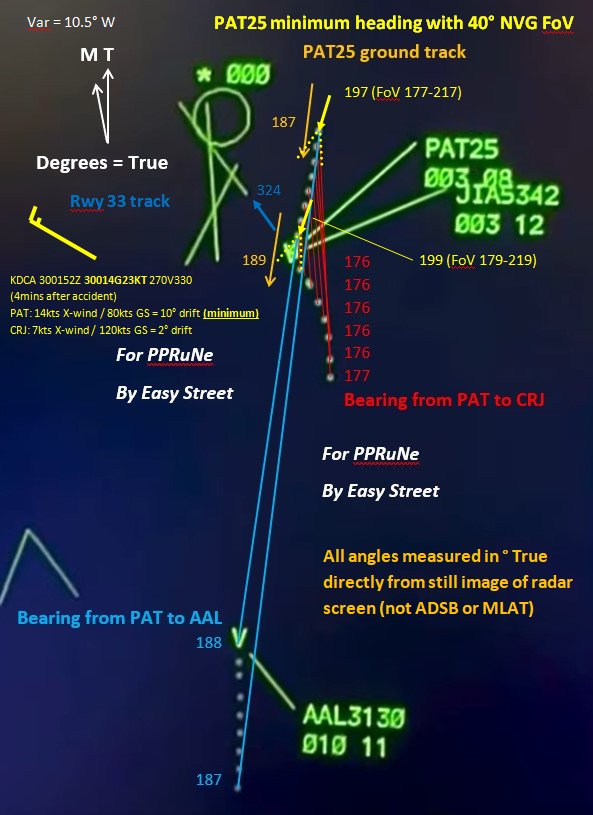
My marked up version of the radar plot now shows the heading of PAT25 at the first and penultimate sweep, based on the ground track as measured directly from the plot and assuming that the wind is at the non-gust value from the METAR observation taken just 4 minutes later (making this a reasonable minimum drift). It also shows the 40 degree field of view of the AN/AVS-9 NVG, drawn assuming both pilots are looking directly ahead along aircraft centreline.
The take-away is that with these assumptions, the CRJ starts on the extreme left hand edge of the NVG field of view and then moves just out of it. The PAT25 pilots would only see the CRJ in NVG if they turned their heads left of aircraft centreline to search for it. Since they thought they had visual contact, presumably with AAL3130, they would have no reason to do so.
Chief Bottle Washer


Joined: Sep 2000
Aviation Qualifications: ATPL
Posts: 7,280
Likes: 1,442
From: PPRuNe
That rant aside, as the videos posted above by others demonstrate:
- A Blackhawk can in fact stop on a dime (so whatever you're suggesting Mike Blackstone was wrong about, it certainly wasn't that).
- Obviously that shouldn't be the plan, but it still a legitimate question to ask, in the context of an emergency, and when every other safety precaution has already failed, why couldn't it be done? Other poster's rationalize: at the low altitude, there's nowhere to go. The videos demonstrate otherwise. You can stop a Blackhawk 50 feet above the ground in seconds. If deviating in any direction is a risk, why didn't ATC just say "PAT25 slow to stop and hover!" – as a Very. Last. Resort?
- A Blackhawk can in fact stop on a dime (so whatever you're suggesting Mike Blackstone was wrong about, it certainly wasn't that).
- Obviously that shouldn't be the plan, but it still a legitimate question to ask, in the context of an emergency, and when every other safety precaution has already failed, why couldn't it be done? Other poster's rationalize: at the low altitude, there's nowhere to go. The videos demonstrate otherwise. You can stop a Blackhawk 50 feet above the ground in seconds. If deviating in any direction is a risk, why didn't ATC just say "PAT25 slow to stop and hover!" – as a Very. Last. Resort?
My experience? 15,000 hours rotary with at least 4-5,000 hours below 200', 1,500 night hours, Mil/Civil mix of mediums (21,000lb) down to horrid little clockwork toys.
No further online discussion from me, but it would be interesting to know your pilot qualifications to post here with such assumed authority, please?

Joined: Dec 2002
Aviation Qualifications: ATP+Mil
Posts: 3,984
Likes: 568
From: Where the Quaboag River flows, USA
I’ve used ogimet for years, good source for historical Met data. The one I posted was taken as a result of the accident. Much less wind than the earlier reports.
Joined: May 2005
Posts: 271
Likes: 145
From: Ontario, Canada
And in fact he did speak up, asked the helo to confirm in sight. Obviously he saw it was close and wanted to check.
Unfortunately he didn’t quite say enough. If he’d said “traffic is 1/2 mile” and the helo was looking at something 2 miles away, they might have twigged to it. Maybe.
Joined: May 2005
Posts: 271
Likes: 145
From: Ontario, Canada
Good post: just because you found some data doesn’t mean you understand it.
Joined: May 2005
Posts: 271
Likes: 145
From: Ontario, Canada
Instead of no RA below 500ft (or whatever the floor is), how about telling one conflict to climb and the other one to ‘not climb’? ‘Not climb’ could then be understood (and trained) to mean ‘descend a little, terrain/aircraft/wx permitting or fly level’. Lots of ifs and buts, spurious warnings, limitations for when 3 or more conflicts, TCAS vs. GPWS considerations etc. but perhaps worth a thought.
Instructing a climb could be useless or dangerous. Instructing no climb, same thing.
Engineering safety systems is not simple. You adjust one case, it can worsen another case.
Joined: Mar 2005
Posts: 1,290
Likes: 289
From: Poplar Grove, IL, USA
Mid-Air Collision - US Military Blackhawk & Regional Jet
That's private pilot stuff. I'd question anything he has to say.

Joined: Jan 2025
Posts: 3
Likes: 2
From: Perth
Tangent - wreckage of helicopter
A tangent on the location of the helicopter wreckage that appears somewhat intact. There is one photo I can find by Getty but it isn't verified and has the Washington monument in the background with the helicopter in the water appearing to be infront of WM - obviously edited and incorrect location.
In the security footage of the crash - I can't post link but google 'security footage shows new angles of D.C crash NBC' and the NBC video should show. In this video the NBC commentator says the helicopter can be seen after the crash and explosion. It appears intact and one piece unlike the aircraft. The helicopter shape seems to move North of the crash location and is not captured falling into the water unlike the plane. It looks to fall or disappear into the land mass. I have looked on maps and north of the crash site vicinity, there are no rivers or bodies of water behind a land mass or beyond river.
I am confused by this video. Is anyone able to shed light on what I am seeing. Thankyou. I realise you want to focus on the crash and cause and errors of pilots and systems. Remembering that you base all of this on the facts and data presented. I am analysing the facts and data presented. Thankyou.
I am not drawing conclusions or making a statement of fact or politics about the above. Merely wanting a second opinion and set of eyes as what I am seeing is a helicopter, after the crash, relatively intact moving/falling/travelling away from the river.
In the security footage of the crash - I can't post link but google 'security footage shows new angles of D.C crash NBC' and the NBC video should show. In this video the NBC commentator says the helicopter can be seen after the crash and explosion. It appears intact and one piece unlike the aircraft. The helicopter shape seems to move North of the crash location and is not captured falling into the water unlike the plane. It looks to fall or disappear into the land mass. I have looked on maps and north of the crash site vicinity, there are no rivers or bodies of water behind a land mass or beyond river.
I am confused by this video. Is anyone able to shed light on what I am seeing. Thankyou. I realise you want to focus on the crash and cause and errors of pilots and systems. Remembering that you base all of this on the facts and data presented. I am analysing the facts and data presented. Thankyou.
I am not drawing conclusions or making a statement of fact or politics about the above. Merely wanting a second opinion and set of eyes as what I am seeing is a helicopter, after the crash, relatively intact moving/falling/travelling away from the river.
Joined: Aug 1999
Aviation Qualifications: ATP+Mil
Posts: 4,411
Likes: 83
From: Gold Coast, Australia
In the security footage of the crash - I can't post link but google 'security footage shows new angles of D.C crash NBC' and the NBC video should show. In this video the NBC commentator says the helicopter can be seen after the crash and explosion. It appears intact and one piece unlike the aircraft. The helicopter shape seems to move North of the crash location and is not captured falling into the water unlike the plane. It looks to fall or disappear into the land mass. I have looked on maps and north of the crash site vicinity, there are no rivers or bodies of water behind a land mass or beyond river.
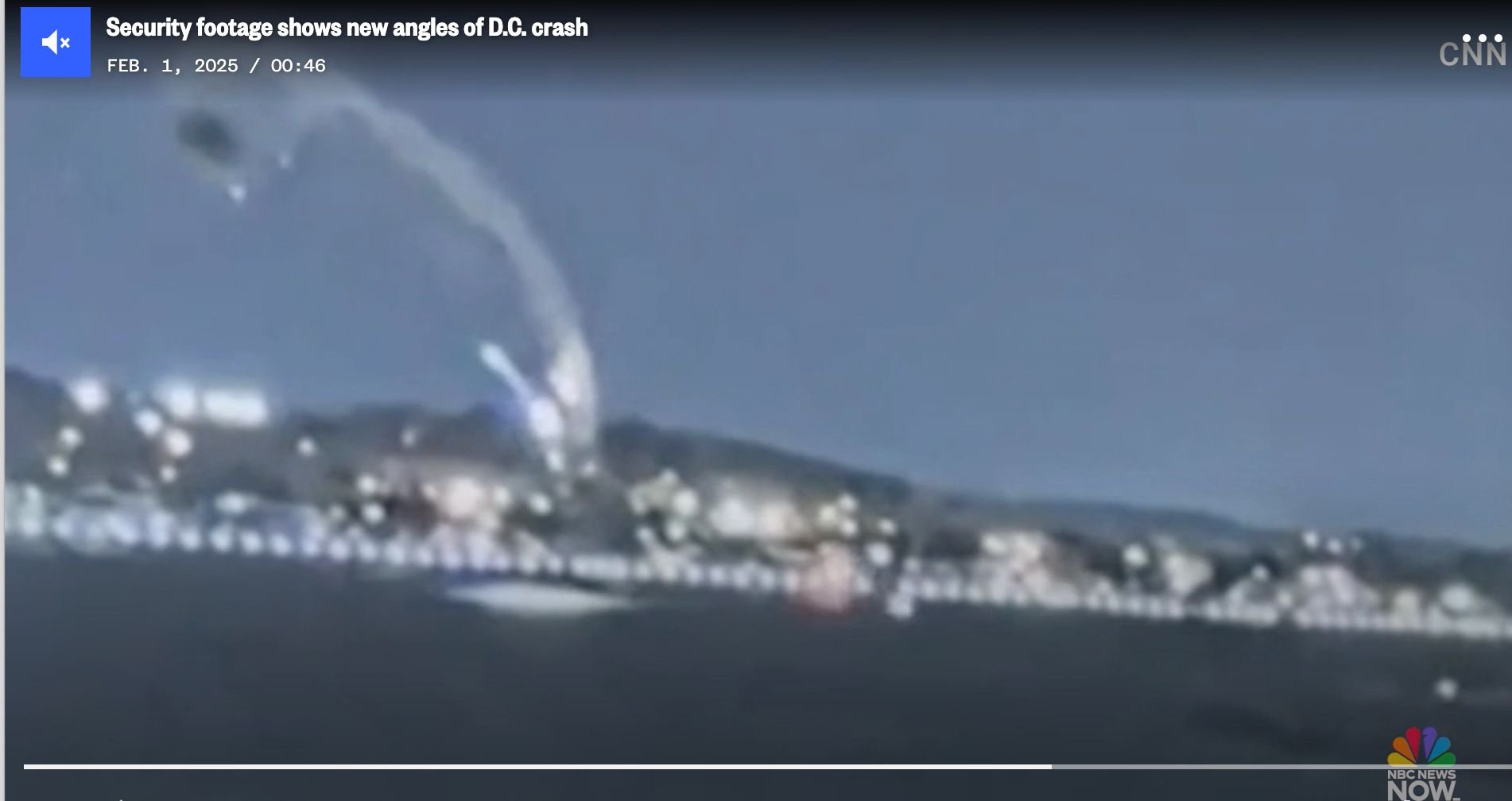
It's at about 31 seconds into this video
Joined: Dec 2003
Posts: 2,348
Likes: 839
From: Tring, UK
The helicopter pilots were a qualified instructor pilot with 7 years experience and a pilot under check who graduated in the top 20% of her class. The CRJ pilots were quite experienced for an regional crew. Nothing to suggest the controller did not maintain the standards required of an air traffic controller.
These were 5 aviation professionals who had gotten their roles through hard work and perseverance (like all aviation professionals) and fell victim to the circumstances they found themselves in that night.
These were 5 aviation professionals who had gotten their roles through hard work and perseverance (like all aviation professionals) and fell victim to the circumstances they found themselves in that night.
Speaking to some of my colleagues who have used NVGs operationally, they say they do reduce your field-of-view and flatten depth perception - one said he had mistaken a star for another aircraft for a while; it was only further away than he thought by a factor of ten trillion...
Joined: Jan 2008
Aviation Qualifications: SLF
Posts: 1,028
Likes: 1,071
From: Australia
The amazing thing is that there wasn’t an accident like this every month at DCA with the procedures and environment as they were. I suspect that there have been a lot of close calls and they’ll find a filing cabinet worth of reports but likely not much was done. If you continuously set up a dangerous scenario that in the end relies for safety on a procedure that is known to be unreliable (visual ID at night in a city environment), then statistics eventually intervene. This has likely been mitigated over the years by awareness, training, professionalism and sheer will to survive but when you are dealt the perfect bad hand and the last of the barriers to MAC fail, this is the result. Another factor pointed out recently is the “mission” status of military flights: someone with more gold on their uniform and a bigger hat than you has said to go and do this task with that equipment, so you do it.
Speaking to some of my colleagues who have used NVGs operationally, they say they do reduce your field-of-view and flatten depth perception - one said he had mistaken a star for another aircraft for a while; it was only further away than he thought by a factor of ten trillion...
Speaking to some of my colleagues who have used NVGs operationally, they say they do reduce your field-of-view and flatten depth perception - one said he had mistaken a star for another aircraft for a while; it was only further away than he thought by a factor of ten trillion...
What's wrong with this picture?
Last edited by artee; 3rd February 2025 at 09:37. Reason: Corrected wording.
Joined: Jun 2008
Posts: 547
Likes: 134
From: London
Can we please get away from the idea that there is a direct equivalence between the hours flown by military pilots and those flown in commercial air transport types?