


A Sukhoi superjet 100 is missing

Join Date: Nov 2004
Location: Perth - Western Australia
Age: 75
Posts: 1,805
Likes: 0
Received 0 Likes
on
0 Posts
Razoray - The photos circulating are definitely of an earlier flight, but the pax list of the Sukhoi shows that out of the 45 deceased pax, 11 were hosties employed by Sky Aviation, plus another two executives of the same company.
That's a big hole in anyones company or organisation.
Latest List Shows 45 People Aboard Crashed Sukhoi Jet | The Jakarta Globe
One can speculate extensively on what caused the accident, but the entire scenario effectively screams poor flight planning (we're only going for a quick joyflight!); quite possibly inadequate pre-flight briefing; and a substantial degree of complacency on the part of the pilots.
These were old, bold pilots, and they paid the ultimate price.
That's a big hole in anyones company or organisation.
Latest List Shows 45 People Aboard Crashed Sukhoi Jet | The Jakarta Globe
One can speculate extensively on what caused the accident, but the entire scenario effectively screams poor flight planning (we're only going for a quick joyflight!); quite possibly inadequate pre-flight briefing; and a substantial degree of complacency on the part of the pilots.
These were old, bold pilots, and they paid the ultimate price.

Join Date: Aug 2008
Location: Germany
Posts: 37
Likes: 0
Received 0 Likes
on
0 Posts
Does it seem a bit strange that both black boxes weren't found fairly quickly once the SAR forces were on the spot?
Only deployable Flightrecorders (which are mainly used in military aircraft/helicopter installtions) have ETL's installed which transmit their position (or the position of deployment) on 406 MHz to the satellite for locating the black boxes).
Last edited by flighttest-engineer; 18th May 2012 at 13:21. Reason: quote added
Psychophysiological entity
the Radar signal should have been re-aquired again on the western and northern side of the mountain,
Interesting point, but I guess the radar operator would only have got primary for a while, and that may well have been very weak even at that range.
Anyone know how long it takes for secondary display to kick back in.
(They do have secondary, don't they?)
Psychophysiological entity
Turning? Not a chance. When I GooEarth the eastern end of the Inn valley, it looks huge, but turning in it with a full load of pax is a very different story.
I wrote this in a style appropriate for Jet Blast, but I promise you, it was a very accurate description of events on that day.
http://www.pprune.org/jet-blast/3520...ml#post4548355
I remember one of my old skippers - wartime experience and all that - saying if he was confronted with a vertical wall of granite, he soar. "what else could you do?"
One may well ask, though an aircraft with proper controls might well be rolled off the top of a loop, but try persuading a computer that it's a good idea.
I wrote this in a style appropriate for Jet Blast, but I promise you, it was a very accurate description of events on that day.
http://www.pprune.org/jet-blast/3520...ml#post4548355
I remember one of my old skippers - wartime experience and all that - saying if he was confronted with a vertical wall of granite, he soar. "what else could you do?"
One may well ask, though an aircraft with proper controls might well be rolled off the top of a loop, but try persuading a computer that it's a good idea.
Join Date: Dec 2010
Location: S 51 N
Age: 84
Posts: 196
Likes: 0
Received 0 Likes
on
0 Posts
Radar signal
If they have Secondary it comes up imediately that the two antennas are in line of vision again, provided transponder is working.
A primary target, I agree , might have been more difficult to re-aquire, not that it wouldn´t show as fast, but because of the obviously present clouds. If these had enough water or ice it will cover the Radar return at least to a very large amount.
A primary target, I agree , might have been more difficult to re-aquire, not that it wouldn´t show as fast, but because of the obviously present clouds. If these had enough water or ice it will cover the Radar return at least to a very large amount.
Pegase Driver
Join Date: May 1997
Location: Europe
Age: 74
Posts: 3,692
Likes: 0
Received 0 Likes
on
0 Posts
henra
Yes and not only one , there are all the technical failures possibilities , the human interferences ones , etc..
That is why it is better to wait for the CVR that will give some clues ( or perhaps not)
However in this case, in the meantime the media propaganda is likely to be in full gear: the Indonesians to prove that they did not do anything wrong, the Russians that the aircraft was not at fault and is safe to buy. So caution on what you read on the media.
loose rivets :
"Radar operators " are called Air traffic controllers today. They issue instructions if you are in IFR to keep you clear of other aircrfat and terrain.
In this case ,the R/T exchange reported in the media ( if they are correct ) would indicate that the aircraft flew VFR . If this is confirmed , then the controllers are releived from their responsibility of separate for terrain ( read flying below MSA ) and depending on the class of airspace you are in they do not have to monitor the flight on radar anymore. If you subsequently crash, of course we can find your track on the video recording, but while you crash no-one is likely to be looking at you on radar.
( excatly what happenned on the 2 recent crashs in Nepal by the way)
For your info in the XXI st century,in civilian ATC , Primary radar is the exception, SSR secondary the norm .. Return depends on Antenna rotation and availibility or not of a multiple radar tracking system , ,but to give you an idea, anything between 3 and 10 seconds.
.
Did I overlook any other option?
That is why it is better to wait for the CVR that will give some clues ( or perhaps not)
However in this case, in the meantime the media propaganda is likely to be in full gear: the Indonesians to prove that they did not do anything wrong, the Russians that the aircraft was not at fault and is safe to buy. So caution on what you read on the media.
loose rivets :
I guess the radar operator would only have got primary for a while, and that may well have been very weak even at that range.
Anyone know how long it takes for secondary display to kick back in.
(They do have secondary, don't they?
Anyone know how long it takes for secondary display to kick back in.
(They do have secondary, don't they?
In this case ,the R/T exchange reported in the media ( if they are correct ) would indicate that the aircraft flew VFR . If this is confirmed , then the controllers are releived from their responsibility of separate for terrain ( read flying below MSA ) and depending on the class of airspace you are in they do not have to monitor the flight on radar anymore. If you subsequently crash, of course we can find your track on the video recording, but while you crash no-one is likely to be looking at you on radar.
( excatly what happenned on the 2 recent crashs in Nepal by the way)
For your info in the XXI st century,in civilian ATC , Primary radar is the exception, SSR secondary the norm .. Return depends on Antenna rotation and availibility or not of a multiple radar tracking system , ,but to give you an idea, anything between 3 and 10 seconds.
.
Psychophysiological entity
Ooooo, sēmantikós! Sorrreeeee.
There was an element of sarcasm in the 'they do have secondary . . .' but I don't really want to get into the relative qualities of various countries radar. Though in my day, it could be chalk and cheese.
There was an element of sarcasm in the 'they do have secondary . . .' but I don't really want to get into the relative qualities of various countries radar. Though in my day, it could be chalk and cheese.
Last edited by Loose rivets; 17th May 2012 at 20:12.
Join Date: Dec 2010
Location: S 51 N
Age: 84
Posts: 196
Likes: 0
Received 0 Likes
on
0 Posts
really sorry !!
Uuuuh, Ouch,
that is the last I wanted to say. Intention was to say, if at that special moment Secondary was available . . . .
Sorry, and please no hard feelings !!
that is the last I wanted to say. Intention was to say, if at that special moment Secondary was available . . . .
Sorry, and please no hard feelings !!
Guest
Join Date: Apr 2009
Location: On the Beach
Posts: 3,336
Likes: 0
Received 0 Likes
on
0 Posts
Loose rivits:
I wrote this in a style appropriate for Jet Blast, but I promise you, it was a very accurate description of events on that day.
I remember one of my old skippers - wartime experience and all that - saying if he was confronted with a vertical wall of granite, he soar. "what else could you do?"
One may well ask, though an aircraft with proper controls might well be rolled off the top of a loop, but try persuading a computer that it's a good idea.
LOWI is tame these days for those with the equipment and training:
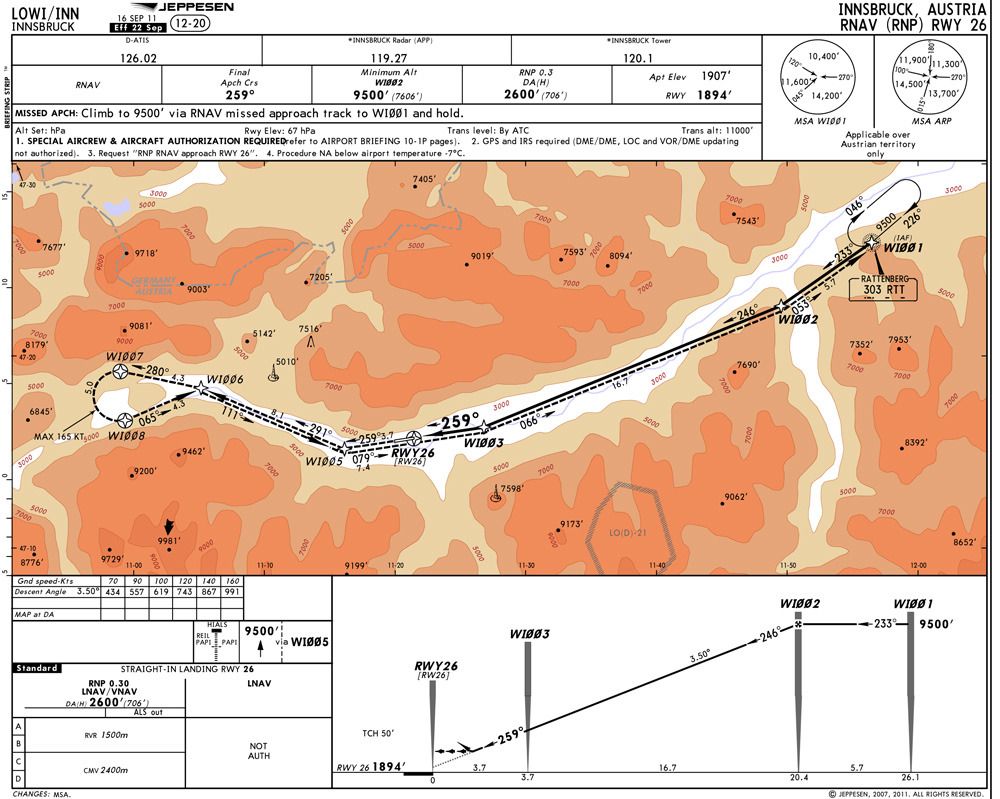
Turning? Not a chance. When I GooEarth the eastern end of the Inn valley, it looks huge, but turning in it with a full load of pax is a very different story.
I wrote this in a style appropriate for Jet Blast, but I promise you, it was a very accurate description of events on that day.
I remember one of my old skippers - wartime experience and all that - saying if he was confronted with a vertical wall of granite, he soar. "what else could you do?"
One may well ask, though an aircraft with proper controls might well be rolled off the top of a loop, but try persuading a computer that it's a good idea.
Join Date: Jul 2007
Location: Germany
Posts: 556
Likes: 0
Received 0 Likes
on
0 Posts
Flight simulator flyby of suspected crash location
I made two flybys in the X-Plane flight simulator in an airplane of similar performance to give you an idea of the terrain of the probable crash location.
This is in no way intended to be representative of the actual flight path, only to give a rough idea of what the terrain is like, to the extent of X-Plane 10's global scenery resolution.
Part 1: coming in from the north
Part 2: coming in from the south
(The actual simulator ride is much smoother, but the video was recorded at lower framerate.)
If and when flight data recorder data will be published I will probably make an animation of the actual flight path.
This is in no way intended to be representative of the actual flight path, only to give a rough idea of what the terrain is like, to the extent of X-Plane 10's global scenery resolution.
Part 1: coming in from the north
Part 2: coming in from the south
(The actual simulator ride is much smoother, but the video was recorded at lower framerate.)
If and when flight data recorder data will be published I will probably make an animation of the actual flight path.
Last edited by bsieker; 18th May 2012 at 07:37.
Join Date: Jan 2008
Location: Atlanta, GA, USA
Posts: 349
Likes: 0
Received 0 Likes
on
0 Posts
bsieker, you video shows clearly that this is not a valley, but an amphitheater, as is typical of stratocone volcanoes, e.g. Mt. St. Helens, that blow their stacks.
Guest
Join Date: Apr 2009
Location: On the Beach
Posts: 3,336
Likes: 0
Received 0 Likes
on
0 Posts
deSitter:
Mt. St. Helens blew its top as well as becoming an amphitheater. Seattle Center was able to lower its minimum instrument altitude by 1,800 feet over that area after the eruption.
Mt. St. Helens blew its top as well as becoming an amphitheater. Seattle Center was able to lower its minimum instrument altitude by 1,800 feet over that area after the eruption.
Last edited by aterpster; 18th May 2012 at 01:09.
Psychophysiological entity
The rise within the 'valley' is substantial.
One half-mile stretch shortly before the crash site gives an increased elevation of 1,000' Quite a climb rate.
One half-mile stretch shortly before the crash site gives an increased elevation of 1,000' Quite a climb rate.

Join Date: Dec 2000
Location: Desert Rat
Age: 53
Posts: 675
Likes: 0
Received 0 Likes
on
0 Posts
It makes it even more evident by looking at those two video clips that the pilots should have not been there... Hindsight is always 20/20. And why they have been there might never come out. We have lost a lot of friends...
We have lost a lot of friends...
Join Date: Jul 2007
Location: the City by the Bay
Posts: 547
Likes: 0
Received 0 Likes
on
0 Posts
Maybe test pilots should not fly these sales exhibition flights in future. They should be done by a separate team of flyers who are ex Airline pilots who fly these flights like it was a scheduled flight. Maybe just take off and circle two times and / or maybe one low (ish) but not super low like the CX one, fly by and land. Demo over.
Even thrill seekers should stay minimum 1000feet above highest terrain of the flight path .
Even thrill seekers should stay minimum 1000feet above highest terrain of the flight path .
Besides that I was rather looking for scenarios not so much individual influencing factors like which instrument did show what. There will be lots of nitty gritty things having contributed to the accident, but I'm rather trying to think about probable overall scenarios.
Yes, someone entering the cockpit distracting the crew is a very plausible contributing factor.
Technical Issues: probably much less likely apart from things like T2CAS bing inactive or some such.
The overriding question remains: What made them be there in the first place and made them not initiate a max climb immediately after entering the canyon?
Didn't they see it at all?
Didn't they identify it as a canyon and taking it for the outside flange of that mountain range ?
Did they see it and think they could fly through it?
Did they fly through it deliberately and knowingly, just barely missing the side exit e.g. due to reduced visibility?
I hope my intention is clearer now?!