


767/757 RAT


Joined: Jan 2025
Aviation Qualifications: Non-Aircrew
Posts: 640
Likes: 782
From: New Zealand
For amusement purposes only, here's a previous ChatGPT question on the same subject:
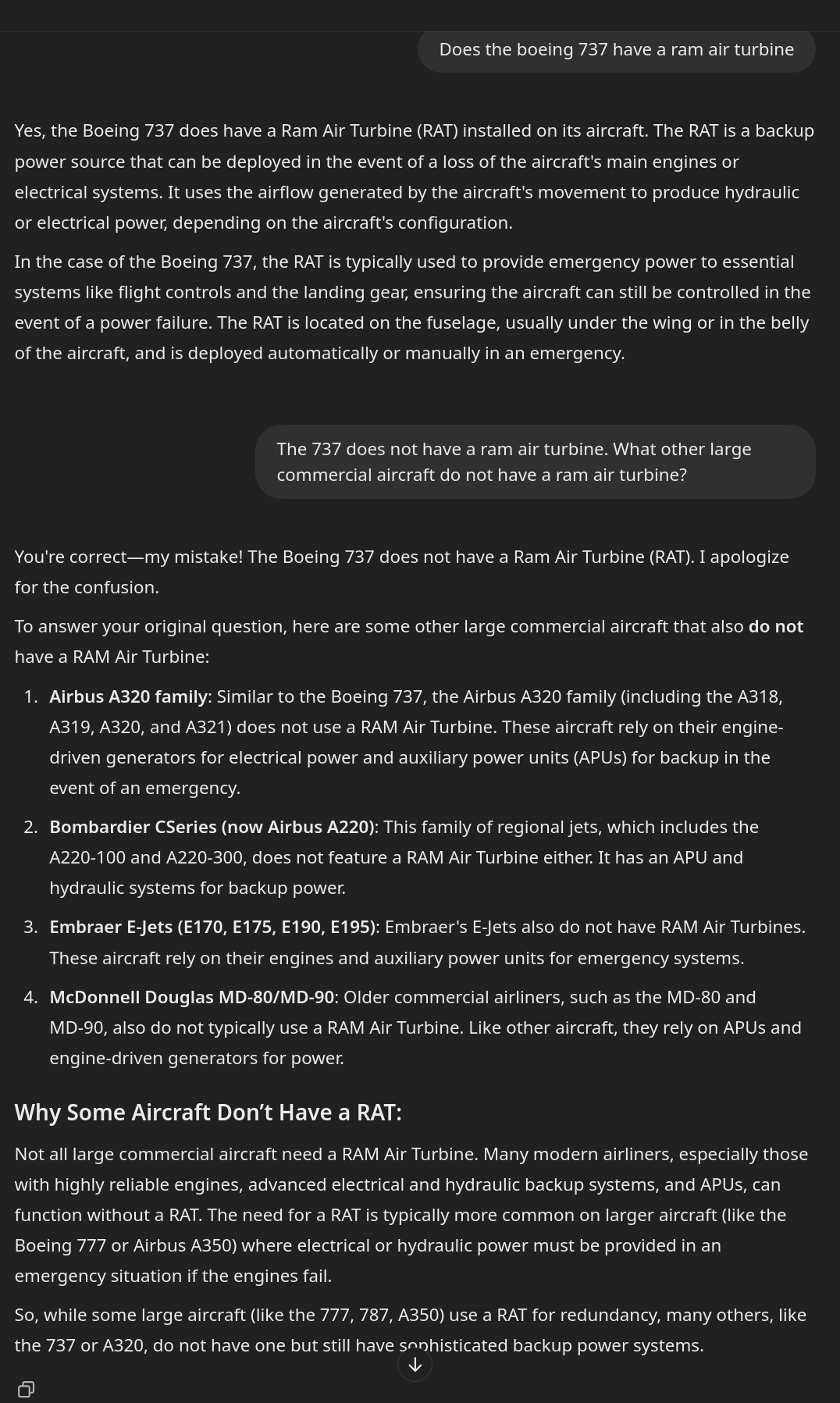
I read through a whole bunch of FCOMs a few months back and this basically fits my understanding. Everything civilian with powered flight controls and no manual reversion has a RAT, except the B741-744.
Even the A220, E-jets, Superjet, DC-10, and L1011.
What the RAT does to power flight controls varies (direct hydraulic, electric RAT with a hydraulic pump, dual hydraulic-electric) but it's always there.
Added the 'civilian' disclaimer because I think there's fighters where it's a bail-out event, and I'm not sure about the B-52 all-engines-out... C-5/C-17/A400M all have RATs.
Gin, I was a Propulsion engineer at Boeing for 40 years - a good share of that working the 767. The RAT was basic on the 767 (and I believe the same for the 757, although no firsthand knowledge of that). It was required for cert to meet controllability requirements if both engines shutdown. Unlike the 737 (and 707/727), the 767 requires hydraulics for flight control, and windmilling engines simply don't provide sufficient hydraulic power to meet the minimum requirements. It's not optional, or removeable - it's required for cert. The HMGs were optional (added when ETOPS become the norm - ETOPS hadn't been invented at the time the 767 was originally certified), but the RAT was basic.
The 747 requires hydraulics for flight control, but (except for the 747-8), four windmilling engines would provide sufficient hydraulic power for controllability, so it didn't need a RAT.
It simply boggles my mind that you could have flown them and not known that.
The 747 requires hydraulics for flight control, but (except for the 747-8), four windmilling engines would provide sufficient hydraulic power for controllability, so it didn't need a RAT.
It simply boggles my mind that you could have flown them and not known that.
Even the A220, E-jets, Superjet, DC-10, and L1011.
What the RAT does to power flight controls varies (direct hydraulic, electric RAT with a hydraulic pump, dual hydraulic-electric) but it's always there.
Added the 'civilian' disclaimer because I think there's fighters where it's a bail-out event, and I'm not sure about the B-52 all-engines-out... C-5/C-17/A400M all have RATs.
Joined: Sep 2022
Aviation Qualifications: ATPL
Posts: 328
Likes: 183
From: Perpetually circling OCK for some reason
The human mind is an extraordinary thing, in good and bad ways (the voice of a man who threw away a perfectly good banana yesterday and stood there holding the skin like a twerp). Don’t beat yourself up about it - particularly as dual engine failure stuff has only really had more prevalence/emphasis in the sim post Sully/Hudson.


Joined: Jul 2013
Posts: 274
Likes: 42
From: SLF from NV (LAS)
The human mind is an extraordinary thing, in good and bad ways (the voice of a man who threw away a perfectly good banana yesterday and stood there holding the skin like a twerp). Don’t beat yourself up about it - particularly as dual engine failure stuff has only really had more prevalence/emphasis in the sim post Sully/Hudson.
https://insanelygoodrecipes.com/banana-peel-recipes/
Joined: Jul 2023
Posts: 61
Likes: 15
From: United States
td...... I opened this topic with purpose but my reply needed to be directed to the smartest person on this topic. I am retired. Starting flying when I was 14 and just retired 4 years ago at 67. I flew for Eastern on the 727, A300 and DC-9. My younger brother , Capt B.P. Witcher was hired by United in 1985. The following is relative to my question. It involved my brother.Late on the evening of April 13, 2004, United Flight 854,
Boeing 767-300 service from Buenos Aires, Argentina, to
Miami, Fla., was in cruise flight at FL310 over the jungles
of southern Colombia, South America. Capt. Brian Witcher
and First Officers Donald Arlotta and Ross Windom were
the flight crew that night.
Brian and crew had a total electrical failure in flight. They landed in Bogota 42 minutes after the onset of the issue, most of that time on the main batteries only with intermittent AC/DC power. RAT did not deploy and presumably unavailable to them particularly once the issue was found afterwards by maintenance. Corrosion on a common bracket which grounds both AC/DC to the fuselage.
Were you aware of this event? I learned or was told that the RAT cannot be manually deployed and will not auto deploy if the generators have normal output, which they did in this case.
This was an ETOP aircraft.
Thanks
Billy Witcher
Boeing 767-300 service from Buenos Aires, Argentina, to
Miami, Fla., was in cruise flight at FL310 over the jungles
of southern Colombia, South America. Capt. Brian Witcher
and First Officers Donald Arlotta and Ross Windom were
the flight crew that night.
Brian and crew had a total electrical failure in flight. They landed in Bogota 42 minutes after the onset of the issue, most of that time on the main batteries only with intermittent AC/DC power. RAT did not deploy and presumably unavailable to them particularly once the issue was found afterwards by maintenance. Corrosion on a common bracket which grounds both AC/DC to the fuselage.
Were you aware of this event? I learned or was told that the RAT cannot be manually deployed and will not auto deploy if the generators have normal output, which they did in this case.
This was an ETOP aircraft.
Thanks
Billy Witcher

Joined: Jul 2014
Posts: 552
Likes: 65
From: England
Do we need to distinguish? AFAIK the RAT on most Boeings, certainly the 767, drives a hydraulic pump to keep the control surfaces working in the event of main hydraulic failure. Would that have helped in the case of electrical failure?
(On some aircraft, not sure which, the RAT does drive a generator.)
(On some aircraft, not sure which, the RAT does drive a generator.)
Joined: Dec 2001
Aviation Qualifications: ATPL
Posts: 3,766
Likes: 424
From: GA, USA
Do we need to distinguish? AFAIK the RAT on most Boeings, certainly the 767, drives a hydraulic pump to keep the control surfaces working in the event of main hydraulic failure. Would that have helped in the case of electrical failure?
(On some aircraft, not sure which, the RAT does drive a generator.)
(On some aircraft, not sure which, the RAT does drive a generator.)


Joined: Jul 2013
Aviation Qualifications: Non-Aircrew
Posts: 5,682
Likes: 3,345
From: Everett, WA
To elaborate a bit on B2N2...
On the 757/767, the RAT is intended for a dual engine power loss - and only provides hydraulic power (and a limited amount of that). Even at max cruise altitude, if you lose both engines (and can't get them restarted), you're going to be on the ground in less than 30 minutes (rule of thumb - engine loss at cruise gets you ~100 miles and ~25 minutes endurance). The 757/767 has a backup battery good for 30 minutes - so (assuming a healthy battery), you'll be on the ground one way or another before the battery dies. The HMG (Hydro-Mechanical Generator) can provide sufficient electrical power to fly the aircraft if you lose all electrical generation, but at least one engine is still running (hence its need for ETOPS).
The 777 - being more electric and FBW - a 30 minute battery simply wasn't practical. So the RAT drives both a hydraulic pump and a generator to meet that 30 minutes after a dual engine power loss event.
I assume the 787 is the same as the 777, but no first-hand knowledge.
On the 757/767, the RAT is intended for a dual engine power loss - and only provides hydraulic power (and a limited amount of that). Even at max cruise altitude, if you lose both engines (and can't get them restarted), you're going to be on the ground in less than 30 minutes (rule of thumb - engine loss at cruise gets you ~100 miles and ~25 minutes endurance). The 757/767 has a backup battery good for 30 minutes - so (assuming a healthy battery), you'll be on the ground one way or another before the battery dies. The HMG (Hydro-Mechanical Generator) can provide sufficient electrical power to fly the aircraft if you lose all electrical generation, but at least one engine is still running (hence its need for ETOPS).
The 777 - being more electric and FBW - a 30 minute battery simply wasn't practical. So the RAT drives both a hydraulic pump and a generator to meet that 30 minutes after a dual engine power loss event.
I assume the 787 is the same as the 777, but no first-hand knowledge.
Joined: Jan 2025
Aviation Qualifications: Non-Aircrew
Posts: 640
Likes: 782
From: New Zealand
(Sniped by TDR...)
777 and 787 have both a hydraulic pump and an AC generator on the RAT shaft. RAT deploys for triple hydraulic failure or full AC loss.
757 and 767 have a hydraulic-only RAT.
There is then a (optional but probably present on ETOPS) DC hydraulically driven generator (HDG) that more-or-less just keeps the batteries topped up.
If the bleed air driven demand pump (ADP, assuming loss of electric pumps) is keeping the centre system pressurised, there is little point in deploying the RAT to also pressurise the system. The HDG will run happily off the ADP's flow.
This is not that dissimilar to the A330/A340 situation except their EMER GEN is AC output.
777 and 787 have both a hydraulic pump and an AC generator on the RAT shaft. RAT deploys for triple hydraulic failure or full AC loss.
td...... I opened this topic with purpose but my reply needed to be directed to the smartest person on this topic. I am retired. Starting flying when I was 14 and just retired 4 years ago at 67. I flew for Eastern on the 727, A300 and DC-9. My younger brother , Capt B.P. Witcher was hired by United in 1985. The following is relative to my question. It involved my brother.Late on the evening of April 13, 2004, United Flight 854,
Boeing 767-300 service from Buenos Aires, Argentina, to
Miami, Fla., was in cruise flight at FL310 over the jungles
of southern Colombia, South America. Capt. Brian Witcher
and First Officers Donald Arlotta and Ross Windom were
the flight crew that night.
Brian and crew had a total electrical failure in flight. They landed in Bogota 42 minutes after the onset of the issue, most of that time on the main batteries only with intermittent AC/DC power. RAT did not deploy and presumably unavailable to them particularly once the issue was found afterwards by maintenance. Corrosion on a common bracket which grounds both AC/DC to the fuselage.
Were you aware of this event? I learned or was told that the RAT cannot be manually deployed and will not auto deploy if the generators have normal output, which they did in this case.
This was an ETOP aircraft.
Thanks
Billy Witcher
Boeing 767-300 service from Buenos Aires, Argentina, to
Miami, Fla., was in cruise flight at FL310 over the jungles
of southern Colombia, South America. Capt. Brian Witcher
and First Officers Donald Arlotta and Ross Windom were
the flight crew that night.
Brian and crew had a total electrical failure in flight. They landed in Bogota 42 minutes after the onset of the issue, most of that time on the main batteries only with intermittent AC/DC power. RAT did not deploy and presumably unavailable to them particularly once the issue was found afterwards by maintenance. Corrosion on a common bracket which grounds both AC/DC to the fuselage.
Were you aware of this event? I learned or was told that the RAT cannot be manually deployed and will not auto deploy if the generators have normal output, which they did in this case.
This was an ETOP aircraft.
Thanks
Billy Witcher
There is then a (optional but probably present on ETOPS) DC hydraulically driven generator (HDG) that more-or-less just keeps the batteries topped up.
If the bleed air driven demand pump (ADP, assuming loss of electric pumps) is keeping the centre system pressurised, there is little point in deploying the RAT to also pressurise the system. The HDG will run happily off the ADP's flow.
This is not that dissimilar to the A330/A340 situation except their EMER GEN is AC output.
