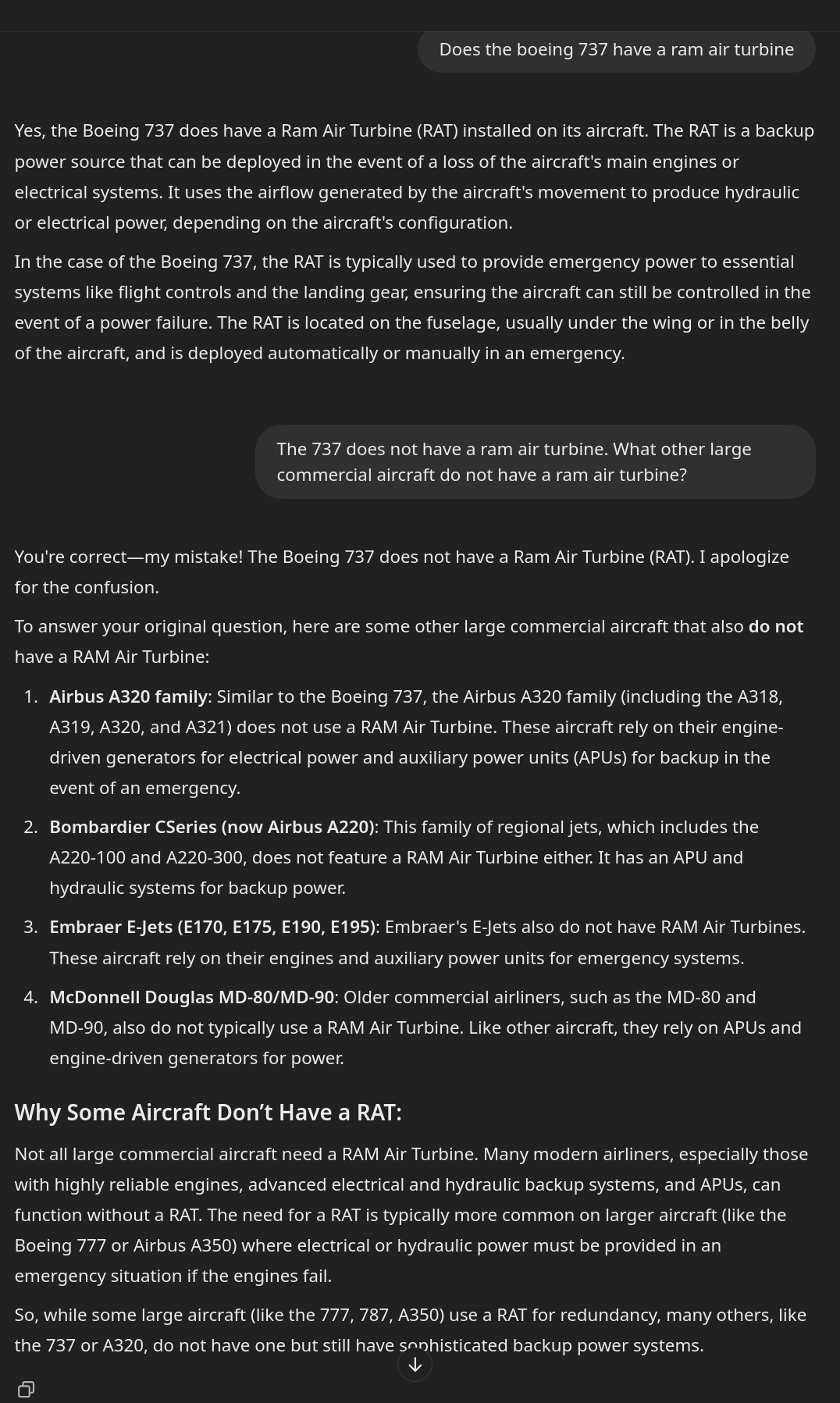
For amusement purposes only, here's a previous ChatGPT question on the same subject:
Originally Posted by
tdracer
Gin, I was a Propulsion engineer at Boeing for 40 years - a good share of that working the 767. The RAT was basic on the 767 (and I believe the same for the 757, although no firsthand knowledge of that). It was required for cert to meet controllability requirements if both engines shutdown. Unlike the 737 (and 707/727), the 767 requires hydraulics for flight control, and windmilling engines simply don't provide sufficient hydraulic power to meet the minimum requirements. It's not optional, or removeable - it's required for cert. The HMGs were optional (added when ETOPS become the norm - ETOPS hadn't been invented at the time the 767 was originally certified), but the RAT was basic.
The 747 requires hydraulics for flight control, but (except for the 747-8), four windmilling engines would provide sufficient hydraulic power for controllability, so it didn't need a RAT.
It simply boggles my mind that you could have flown them and not known that.
I read through a whole bunch of FCOMs a few months back and this basically fits my understanding. Everything civilian with powered flight controls and no manual reversion has a RAT, except the B741-744.
Even the A220, E-jets, Superjet, DC-10, and L1011.
What the RAT does to power flight controls varies (direct hydraulic, electric RAT with a hydraulic pump, dual hydraulic-electric) but it's always there.
Added the 'civilian' disclaimer because I think there's fighters where it's a bail-out event, and I'm not sure about the B-52 all-engines-out... C-5/C-17/A400M all have RATs.