


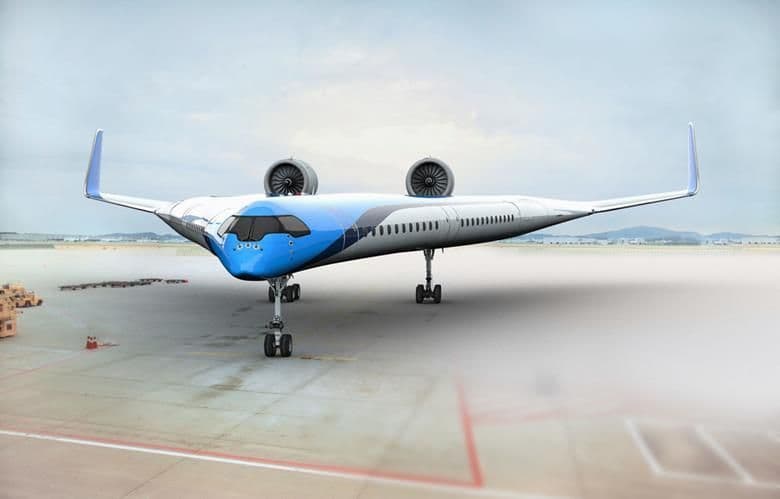
Flying V blended wing concept model flown

Thread Starter


Joined: Feb 2006
Aviation Qualifications: LAME
Posts: 36,145
Likes: 5,739
From: Falling off the end of the thread
Flying V blended wing concept model flown
KLM and Airbus are onboard backing the project, see
https://www.flightglobal.com/aerospa...139999.article
https://www.flightglobal.com/aerospa...139999.article

Joined: Nov 2015
Posts: 289
Likes: 0
From: Paisley, Florida USA
Not to mention the possibly of upsetting the drinks trolley. What could possibly go wrong?
Kidding aside, I think you've hit upon a possible problem with the Flying V configuration. I guess roll rates could be severely limited via software, but what effect would that have on the overall controllability of the aircraft?
Cheers,
Grog
Kidding aside, I think you've hit upon a possible problem with the Flying V configuration. I guess roll rates could be severely limited via software, but what effect would that have on the overall controllability of the aircraft?
Cheers,
Grog


Joined: Jul 2013
Aviation Qualifications: Non-Aircrew
Posts: 5,683
Likes: 3,359
From: Everett, WA
Boeing has been looking at a blended wing-body concept for years - apparently there is a significant drag reduction relative to the conventional wing/tube layout. However Boeing was mainly looking it as a military freighter - at least for the initial implementation. Once all the problems and details were worked out, there were thoughts that it might find its way into the commercial arena.
Granted, they were saying the same thing about the tilt-rotor V-22...
Granted, they were saying the same thing about the tilt-rotor V-22...


Joined: Jan 2008
Posts: 1,269
Likes: 79
From: Denver
I think we had some discussions last year when KLM and Airbus announced the project with sketches. Interesting to see a model flying - although I wish they had included the "rough landing."
Let's see. A flying wing that is also a slender-delta wing that is also a cranked-delta wing that is also a tailess delta that also has a big chunk missing out of the trailing edge.
Rather a mash-up of a B2 with a Concorde and a Draken - with a little Antoni Gaudi thrown in for the interior design....
I won't say "what could go wrong?" But it must have the pitch dynamics of an amphetamine-laced flying squirrel.
Anyway, I wish them well. Certainly inventive. Some design ideas explicated here: https://www.tudelft.nl/en/ae/flying-v/cabin/
Let's see. A flying wing that is also a slender-delta wing that is also a cranked-delta wing that is also a tailess delta that also has a big chunk missing out of the trailing edge.
Rather a mash-up of a B2 with a Concorde and a Draken - with a little Antoni Gaudi thrown in for the interior design....
I won't say "what could go wrong?" But it must have the pitch dynamics of an amphetamine-laced flying squirrel.
Anyway, I wish them well. Certainly inventive. Some design ideas explicated here: https://www.tudelft.nl/en/ae/flying-v/cabin/
Joined: Sep 2007
Posts: 603
Likes: 6
From: London
I'm a complete novice, but presumably this is an example of an unstable design that require totally on computers and redundant aerodynamic controls to keep it in the sky. Given the reliability of computers and modern engineering this should be very safe once perfected but we all know that software can take time to perfect. The Max shows what happens when something goes wrong but as we are talking about a completed new design certification levels will be much higher. The question is what happens in extreme conditions. Can pilots fly it in direct law? Might airlines want to operate as an all freighter for a few months whilst passengers (and some crews) gain confidence?
Excluding concorde it must be the most radical design since the jet age started.
Excluding concorde it must be the most radical design since the jet age started.

Joined: Apr 1998
Posts: 4
Likes: 1
From: Mesopotamos
I guess the pax can press their face on these windows as a backup de-ice system.
Interesting to see what happens if a window pops out or in.
I recall the Mirage with its delta wing needed a very high rate of knots to glide to overcome the delta wing drag. Generally, gliding was only done during dead-stick practice (the figures are incredible) and normal approach required more than normal fuel burn to motor in than other non-delta wing craft.
Interesting to see what happens if a window pops out or in.
I recall the Mirage with its delta wing needed a very high rate of knots to glide to overcome the delta wing drag. Generally, gliding was only done during dead-stick practice (the figures are incredible) and normal approach required more than normal fuel burn to motor in than other non-delta wing craft.
Avoid imitations


Joined: Nov 2000
Aviation Qualifications: ATPL
Posts: 15,116
Likes: 1,091
From: Wandering the FIR and cyberspace often at highly unsociable times
Dealing with icing conditions might be problematical.
Also......“Captain, the bloke in seat A, row thirty two has just had a bird strike”.
Also......“Captain, the bloke in seat A, row thirty two has just had a bird strike”.
Joined: Apr 2015
Posts: 301
Likes: 11
From: Netherlands
Aerodynamically, it will work, there have been more flying wing designs, that operated well enough (for their mission), and modern technology will certainly help in new areas. The problem with non-fuselage aircraft is the survivable crash landing and the 90 seconds certification rule for evacuation. In that case, the wing leading edge may become distorted and the doors may not open. So other means of evacuation exits must be conceived. Jettisonable trailing edges?
Joined: Aug 2001
Posts: 216
Likes: 1
From: Ft. Collins, Colorado USA
Ah yes. Once again the flying wing. I have no doubt that in this day of artifiial stability and fly-by-wire control it can be made to fly. However, as washout says in post #13 is, how do the people in the middle get out in a crash? We have enough problems complying with the "90 second rule" in a tube with a few holes in the sides. How do you do it in a movie theater configuration?
If you want to see a preious try on this concept, go to the New England Ait Museum and see the Burnelli transport of the 1940's being restored. It will give you a feel for the problem.
Incidentally, I saw it when it was being prepped for an Arctic exploration at Teteboro Airport in New Jersey back in the forties. Quite a surprise to see it again at the museum.
If you want to see a preious try on this concept, go to the New England Ait Museum and see the Burnelli transport of the 1940's being restored. It will give you a feel for the problem.
Incidentally, I saw it when it was being prepped for an Arctic exploration at Teteboro Airport in New Jersey back in the forties. Quite a surprise to see it again at the museum.
Joined: Jul 2013
Aviation Qualifications: Non-Aircrew
Posts: 5,683
Likes: 3,359
From: Everett, WA
Which is why Boeing was looking at is mainly as a freighter.
Joined: Jan 2008
Posts: 857
Likes: 0
From: uk
Aerodynamically, it will work, there have been more flying wing designs, that operated well enough (for their mission), and modern technology will certainly help in new areas. The problem with non-fuselage aircraft is the survivable crash landing and the 90 seconds certification rule for evacuation. In that case, the wing leading edge may become distorted and the doors may not open. So other means of evacuation exits must be conceived. Jettisonable trailing edges?
Joined: Jul 2009
Aviation Qualifications: Spotter
Posts: 241
Likes: 50
From: Coast to Coast...
Make it a double decker (no cargo underneath, therefore no increase in fuselage height), maintain 3 abreast, no passengers in the middle. Put cargo in the middle of the wing instead. Sorted.
Joined: Oct 2007
Posts: 782
Likes: 21
From: netherlands
Some one taught me almost anything placed under a certain angle provides lift. Disadvantages of this design seem evident. It looks heavy, cargo seems impractical, staggered aisle probably inefficient, streched versions, etc, etc. Nice for experimentation though.
