


GS mini versus VFE


Joined: Jan 2008
Posts: 2,173
Likes: 51
From: Blighty (Nth. Downs)
Chris Scott I am rather certain that MAX(A;B) is the syntax for exactly the same meaning you explain: the greater of A and B.
.
.
If it is standard terminology, is there a new-age syntax guide available somewhere?


Joined: May 2002
Posts: 379
Likes: 4
From: Sale
Probably not clear in my post, but I meant to say that you can't call it a locked "GS LOCK" speed. If there is a tailwind on approach, the ground speed will increase above this "locked speed".
Vapp + any tailwind will give a higher than minimum groundspeed.
Vapp + any tailwind will give a higher than minimum groundspeed.

Joined: Jan 2008
Posts: 2,173
Likes: 51
From: Blighty (Nth. Downs)
Hi again Uplinker,
Must admit I had Jersey in mind! I assume improvements may have been made to A/THR response since my time. It seemed seemed marginally worse on V2500-engine a/c than on the early CFM-56 ones.
The GS-mini itself works so well in windsheer conditions, provided the managed IAS is used as a target speed, not a minimum speed. The thrust changes required are smaller and less frequent, of course, than those needed in selected IAS. My own preference was to use manual thrust for manual landings. The A320 manual throttle control is excellent - better than any of the other five jet types I flew. (Since then, in today's litigation-conscious environment, manual thrust has been banned in the airline I used to work for. I think that's a backward step.)


Joined: Nov 1999
Aviation Qualifications: ATPL
Posts: 3,150
Likes: 744
From: UK
The largest thing I’ve landed at Jersey so far was a 737-300 at about 50 tonnes, so an A319/320 would probably focus the mind!
As you say, GS mini along with the auto-thrust response and gains etc, have probably been refined and improved via software updates since 1988, and I personally have never had any problem with it, (flown it since 2005). A superb and very clever system in my view.
I agree that A320 is perfectly flyable and easy to fly in fully manual. However, the auto-thrust is now so good, (and of course there is no pitch/power couple), that it is not often necessary to take it out. (I know - I’m being lazy !).
As you say, GS mini along with the auto-thrust response and gains etc, have probably been refined and improved via software updates since 1988, and I personally have never had any problem with it, (flown it since 2005). A superb and very clever system in my view.
I agree that A320 is perfectly flyable and easy to fly in fully manual. However, the auto-thrust is now so good, (and of course there is no pitch/power couple), that it is not often necessary to take it out. (I know - I’m being lazy !).
Joined: Jun 2007
Posts: 3,443
Likes: 39
From: Wanderlust
Citation
I think everyone knows PFD never shows GS even in cruise. So there's no misunderstanding on that. Yes the shifting managed IAS target on PFD makes pilot aware that GS mini is active. Ground speed(not GS mini) is always shown on ND. However on approach in HW the GS displayed on ND is roughly the GS mini. I wasn't able to locate the reference that minimum HW component for GS mini calculation is 10kts. I am thankful to FD for that. Rest of GS mini theory I am aware off.
Just to clarify a common error that I have seen in the GS mini story.
What you see on your PFD is not the GS mini but the IAS Target . The GS mini will never appear anywhere and is internally calculated and never shown to the pilot .
What you see on your PFD is not the GS mini but the IAS Target . The GS mini will never appear anywhere and is internally calculated and never shown to the pilot .
Last edited by vilas; 1st January 2020 at 13:15.
Only half a speed-brake
Joined: Apr 2003
Posts: 4,459
Likes: 136
From: Commuting not home
If that's 21st-century aeronautical syntax, I bow to your superior knowledge, FlightDetent! Or could it simply be the invention of a Francophone technical writer at St. Martin-du-Touch? If it is standard terminology, is there a new-age syntax guide available somewhere?

Back on the topic: The bulletin I provided at post #10 is dated 2004 but taken from FCOM version 2008 (Volumes 1, 2, 3, 4). Shortly afterwards, the whole bookset had been heavily restructured and all blue FCOM bulletins cancelled. Their information was only partly embedded into the main text and I believe for a few years the explanation of GSmini internal workings was lost altogether.
Fast forward today, FCOM says what's shown upthread, and that does NOT include the 10 kt "mandatory rwy HW" that I pointed out.
Yet that's what the machine does. Courtesy of a couple of talented and tolerant colleagues, a little controlled observation was done. The GSmini algorithm that adjusts the Vapp really assumes at least 10 kt headwind component at the threshold. Calm wind, tailwind, at all times.
Last edited by FlightDetent; 3rd January 2020 at 07:12.
Only half a speed-brake
Joined: Apr 2003
Posts: 4,459
Likes: 136
From: Commuting not home
To observe it live without trying too hard, an airport where HWC is less than 10 kt at threshold would be best. With the landing flap out, check ND for TAS - GS and observe that
- for HWC stronger than 10 kt, any variation will be reflected on the Vapp target;
- for HWS slower than 10 kt, adjustments to Vapp target do not happen.
Last edited by FlightDetent; 2nd January 2020 at 19:52.
Joined: Jun 2007
Posts: 3,443
Likes: 39
From: Wanderlust
To observe it live without trying too hard, an airport where HWC is less than 10 kt at threshold would be best. With the landing flap out, check ND for TAS - GS and observe that
- for HWC stronger than 10 kt, any variation will be reflected on the Vapp target;
- for HWS slower than 10 kt, adjustments to Vapp target do not happen.
Only half a speed-brake
Joined: Apr 2003
Posts: 4,459
Likes: 136
From: Commuting not home
There were more pictures and human observations. Behaviour was consistent with the GSmini function adding a margin on top the Vapp from MCDU. It is possible to modify MCDU Vapp to VLS, VLS+5 (auto), VLS+10 (15?) and observe.
The margin (GSmini adjustment) was observed to be the difference between actual HWC and HWC assumed at the runway threshold.
The assumed RWY HWC was the greater of
- expected HWC component calculated based on the MCDU W/V entry
- the low limiting value of at least 10 knots.
= Max ( HWC.rwy ; 10kt )
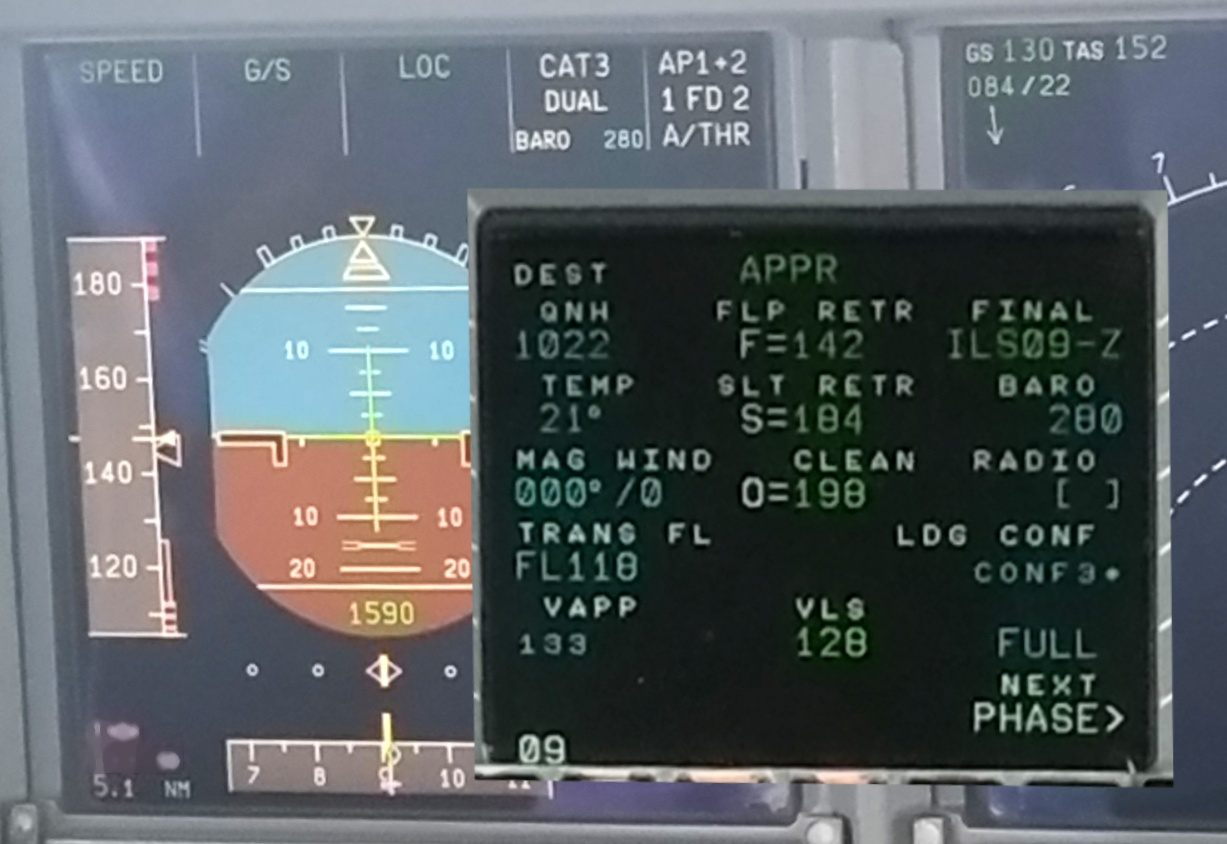
Your suggestion does not fit the pictures already provided, the cut-off would be 5 knots. Check the first one, 1590 RA.
VLS = 128 Vapp = 133
HWC.rwy = 22
HWC.thr = 0
present day FCOM
delta HWC = 22
Vapp + 22 = 155 ===>>> not observed
Vls anchor option
delta HWC = 22
Vls + 22 = 148 kt ====>>> not observed
Bulletin 10 kt cut-off
assumed HWC.rwy = 10 kt
delta HWC = 12 kt
Vapp + 12 = 145 ====> visible on the picture
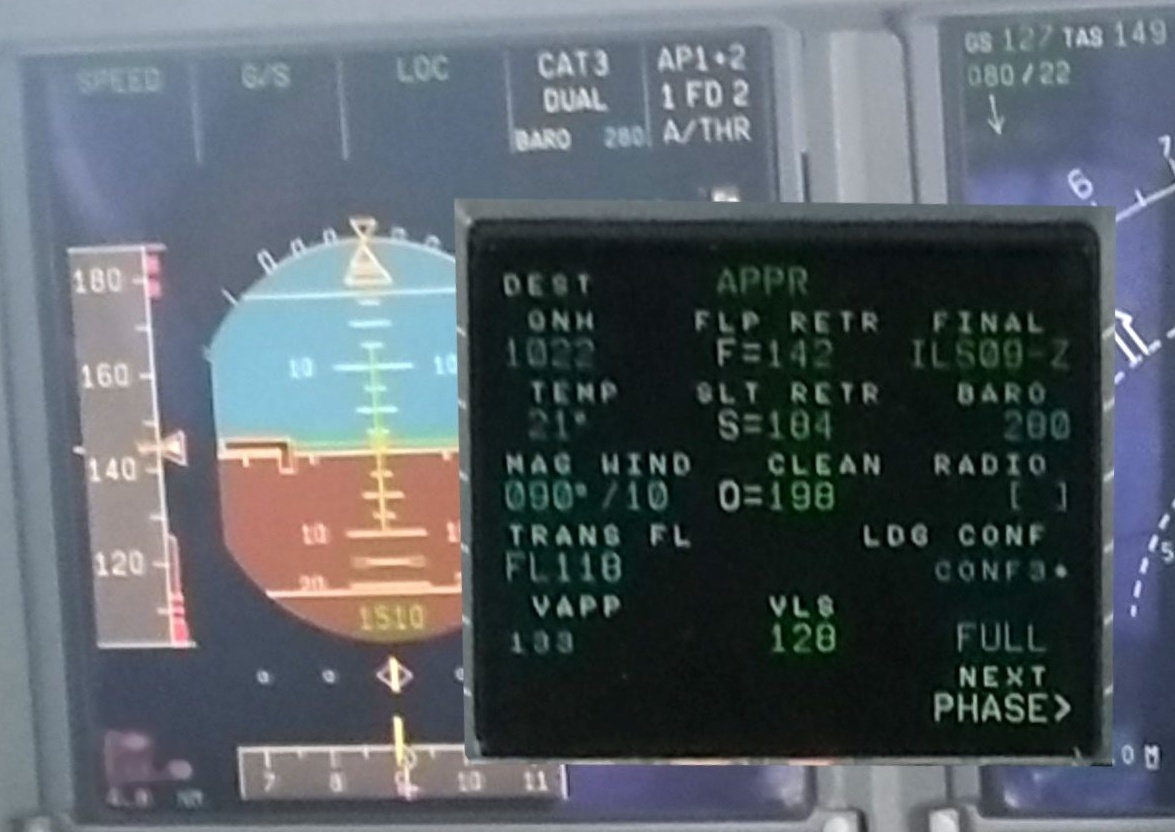
Followed by the other picture RA1510, with manually inserted 10kt HWC at THR into the MCDU. The magenta triangle on speed-tape blinked for recalculation but came back to the same position 145 kt. ,
Changing MCDU HWC.rwy from 0 to 10 kt caused a new computation with an identical result.
The margin (GSmini adjustment) was observed to be the difference between actual HWC and HWC assumed at the runway threshold.
The assumed RWY HWC was the greater of
- expected HWC component calculated based on the MCDU W/V entry
- the low limiting value of at least 10 knots.
= Max ( HWC.rwy ; 10kt )
Your suggestion does not fit the pictures already provided, the cut-off would be 5 knots. Check the first one, 1590 RA.
VLS = 128 Vapp = 133
HWC.rwy = 22
HWC.thr = 0
present day FCOM
delta HWC = 22
Vapp + 22 = 155 ===>>> not observed
Vls anchor option
delta HWC = 22
Vls + 22 = 148 kt ====>>> not observed
Bulletin 10 kt cut-off
assumed HWC.rwy = 10 kt
delta HWC = 12 kt
Vapp + 12 = 145 ====> visible on the picture
Followed by the other picture RA1510, with manually inserted 10kt HWC at THR into the MCDU. The magenta triangle on speed-tape blinked for recalculation but came back to the same position 145 kt. ,
Changing MCDU HWC.rwy from 0 to 10 kt caused a new computation with an identical result.
Last edited by FlightDetent; 3rd January 2020 at 09:26.
Only half a speed-brake
Joined: Apr 2003
Posts: 4,459
Likes: 136
From: Commuting not home
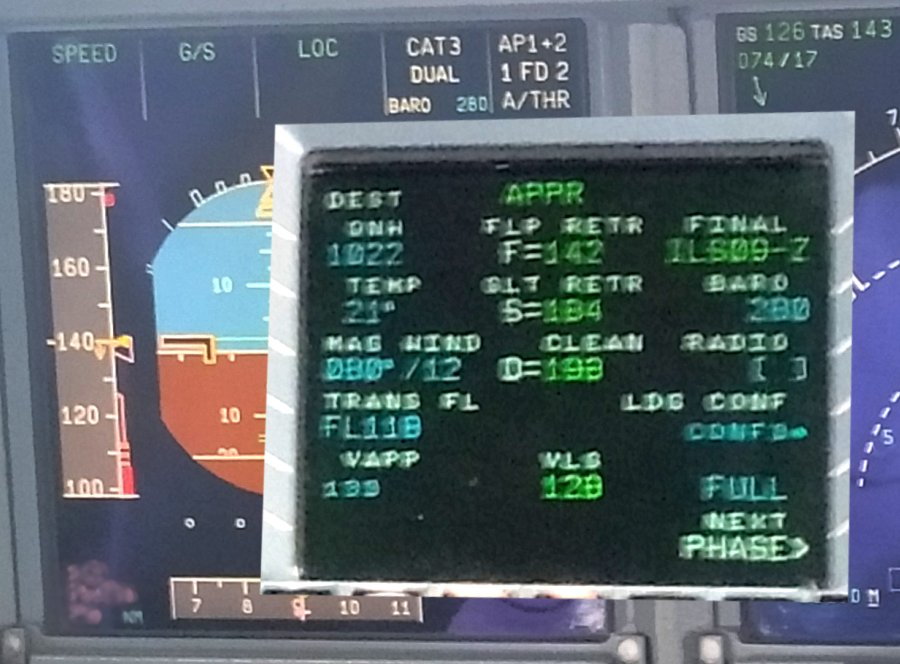
Only with MCDU HWC.rwy greater than 10 knots (12 on the following picture) was the Vapp additive reduced, delta HWC.act and HWC.rwy getting smaller by those 2 knots.
Joined: Jul 2006
Posts: 1,100
Likes: 111
From: Somewhere over the rainbow
Why on earth the FCOM would remove that critical information about that 10 kt threshold? Now I understand the reason I could not figure out why the VAPP with a strong HWC was slower than expected...
Only half a speed-brake
Joined: Apr 2003
Posts: 4,459
Likes: 136
From: Commuting not home
as the saying goes, we showed you ours?
Good question, though. The above is design date around 1985. The technology has progressed, never mind the dead ends, and we're 1/3 of a century ahead.
Carrying a speed additive to cover for the headwind loss is hardly a novel idea, it was a common knowledge that Airbus engineers decided to adopt in the EIS.
Are there any other aeroplanes that would do the same or similar? Or better? There must be a ton of fancy clever suff that can be coded, now that we are well in the iPhone era.
Good question, though. The above is design date around 1985. The technology has progressed, never mind the dead ends, and we're 1/3 of a century ahead.
Carrying a speed additive to cover for the headwind loss is hardly a novel idea, it was a common knowledge that Airbus engineers decided to adopt in the EIS.
Are there any other aeroplanes that would do the same or similar? Or better? There must be a ton of fancy clever suff that can be coded, now that we are well in the iPhone era.
Joined: Jun 2007
Posts: 3,443
Likes: 39
From: Wanderlust
According to a Safety first article the MCDU Vapp calculation has undergone a change from older aircraft.
"AFS Computation of VAPPWhen computed by the AFS, the APPRoach CORrection (APPR COR) used by the AFS isAPPR COR = 1/3 Headwind with 5kt ≤ APPR COR ≤15 kt Excepted on some older A320 aircraft where the APPR COR used by the AFS is 1/3 Headwind + 5kt, limited at 15kt."
"AFS Computation of VAPPWhen computed by the AFS, the APPRoach CORrection (APPR COR) used by the AFS isAPPR COR = 1/3 Headwind with 5kt ≤ APPR COR ≤15 kt Excepted on some older A320 aircraft where the APPR COR used by the AFS is 1/3 Headwind + 5kt, limited at 15kt."
Joined: Jun 2007
Posts: 3,443
Likes: 39
From: Wanderlust
Not a train smash really because Boeing's land every day just fine without it.
Joined: Jan 2008
Posts: 2,173
Likes: 51
From: Blighty (Nth. Downs)
A few times a year I shoot an approach where the wind down to about 1500' is gusting 65+ knots and the wind on the ground is around 25-30 knots.
I find the best way to mitigate a VFE CONF FULL exceedence is to fly a CONF3 landing. Flying selected speed also works just fine but you do cancel the groundspeed mini function. Not a train smash really because Boeing's land every day just fine without it.
I find the best way to mitigate a VFE CONF FULL exceedence is to fly a CONF3 landing. Flying selected speed also works just fine but you do cancel the groundspeed mini function. Not a train smash really because Boeing's land every day just fine without it.
As a retired old fart, I hesitate to argue with a current operator, but I experienced the first 14 years of A320 ops and your scenario remains all too familiar 18 years later.
In those conditions, my airline recommended Config 3 for a better performance margin in wind sheer, but I found the 320 a bit skittish with it and the A/THR sometimes commanding almost idle thrust. So I preferred Config Full. The GS-Mini system allegedly gives a 5 kt margin below Vfe (the subject of this thread), but as you suggest that may not be enough to avoid a short-term exceedance if there's a big gust. Using selected IAS solves that problem, but obviously you lose the safety and handling benefits of GS-Mini.
Can I respectfully suggest you consider the compromise technique described in the second half of my post above, which addresses that scenario?
https://www.pprune.org/tech-log/628054-gs-mini-versus-vfe-3.html#post10642917
Joined: Jun 2007
Posts: 3,443
Likes: 39
From: Wanderlust
In those conditions, my airline recommended Config 3 for a better performance margin in wind sheer, but I found the 320 a bit skittish with it