


Temperature correction on Baro-VNAV approach

Only half a speed-brake

Joined: Apr 2003
Posts: 4,459
Likes: 136
From: Commuting not home
- If there is no obstacle, then there is no nothing to hit.
- If there is one, or essential terrain, it would be properly taken in an account in the OCA/H value, calculated down to the low limits of the temperature bracket for a "lowest denominator pilot" i.e. uncompensated flight.
Should you raise the (D/M)DA for an uncompensated, flattened profile, you move the point of decision further from the THR and that
- invalidates your RVR minima values
- makes it harder or less likely to achieve the required visual reference in inclement weather (and uncovers vulnerability to get-homeitis)
- achieves no geometrical purpose in the terms of terrain clearance, since the underlying OCA has been calculated with a non-corrected altimeter in mind.
Simpler is safer, assuming the math has been done. The AMC achieves both goals.
At the same time, 172_driver shows a nice case where simple=safer has them do it the old way, while Sepp above explains the how to get it approved.
What are the loose ends?
Last edited by FlightDetent; 4th November 2018 at 09:37.

Joined: Jan 2006
Aviation Qualifications: CPL
Posts: 1,410
Likes: 46
From: Between a rock and a hard place
When adjusted, they came in high and hot???? oh well, they landed....That seems okay?
The reason for the terrain warning was obviously high descent rate combined with terrain. They were always above charted altitudes. A correction, had they done so (they weren't required by SOP at the time) would have mitigated the problem.
So don't blame 'fiddling with the FMC' in this case, at least


Joined: Aug 2015
Posts: 64
Likes: 14
From: North
The problem guys is not the final segment as that has been taken into consideration by the procedure makers wih EASA rules. The problem is the way you get to the final segment. Flying for a certain Red Nosed operator to the most northern parts of Europe it is crucial with cold temperature compensations. So even if the final segment is protected down to the temperature that is published on the chart the way from the initial fix via the intermediate segment is not protected and thus the operator must ensure terrain clearance.
Since the 737 in our case has no way to intercept a glide path from a corrected intermediate segment it will start a descent down to the final approach fix (point) and thus penetrating the terrain clearance. That is why we temp correct all altitudes below temp corrected MSA. What people unfamiliar with flying in cold weather tend to forget is that the true height of the aircraft when flying temp. Corrcted altitudes are the same as in ISA STD atmosphere and actually more correct.
As I saw someone saying they add 10% to all altitudes can be conservative or not enough. 10% is only safe to -10 degress anything bellw that has to be corrected more. And then there is of course the effect wind can have on minimun altitudes. I suggest looking at RNAV X in ENEV and start playing with wind and temperature and you will quickly find the need to correct, otherwise cumulus granitus might appear.
Since the 737 in our case has no way to intercept a glide path from a corrected intermediate segment it will start a descent down to the final approach fix (point) and thus penetrating the terrain clearance. That is why we temp correct all altitudes below temp corrected MSA. What people unfamiliar with flying in cold weather tend to forget is that the true height of the aircraft when flying temp. Corrcted altitudes are the same as in ISA STD atmosphere and actually more correct.
As I saw someone saying they add 10% to all altitudes can be conservative or not enough. 10% is only safe to -10 degress anything bellw that has to be corrected more. And then there is of course the effect wind can have on minimun altitudes. I suggest looking at RNAV X in ENEV and start playing with wind and temperature and you will quickly find the need to correct, otherwise cumulus granitus might appear.
Joined: Jun 2002
Posts: 238
Likes: 0
From: Europe
Completely different case though, the ILS is a fixed geometric path in space, the VNAV approach is not. And if you, in direct breach of the relevant AMC, adjust your DA, you put it quite a bit farther away from the runway, whereas an adjusted DA on an ILS simply puts it where it should be anyway. And yes, the DA is taken into account for the minimum temperature of the procedure, in fact it is one major point there, choose a higher temperature and you can accept a lower DA, chose a lower temperature and you have to choose a higher one.
This applies to any type of approach.
Joined: Jan 2014
Posts: 720
Likes: 1
From: N5109.2W10.5
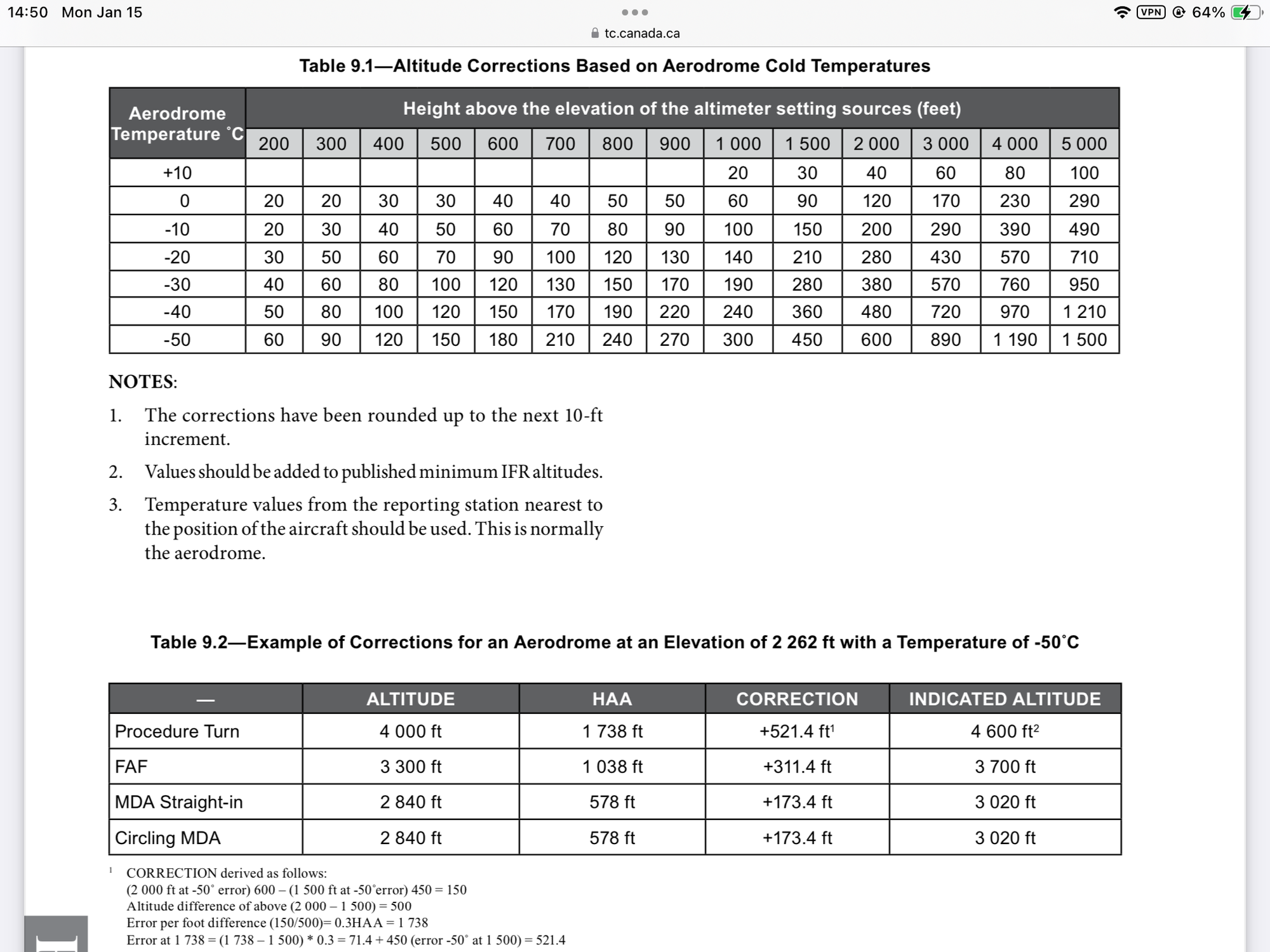
and this altitude needs to be corrected for cold temperature.
This applies to any type of approach.
This applies to any type of approach.
Apparently the real DA is correct at the minimum temperature published. The real DA will be higher during warmer temperature operations - hence still safe.
The only downside is there may be less success in summer.
Only half a speed-brake
Joined: Apr 2003
Posts: 4,459
Likes: 136
From: Commuting not home
LEVC, are you trolling, good sir?  The binding EASA regulation (unless alternative compliance means approved and notified) requires you NOT correct DA on baroVNAV. Valid for 2 years, scrutinized via the NPA process and voted for. Because it is safer. Your last post makes no sense.
The binding EASA regulation (unless alternative compliance means approved and notified) requires you NOT correct DA on baroVNAV. Valid for 2 years, scrutinized via the NPA process and voted for. Because it is safer. Your last post makes no sense.
Joined: Mar 2001
Posts: 4,563
Likes: 35
From: I wouldn't know.
Joined: Jul 2021
Posts: 56
Likes: 4
From: Planet Earth
30C uncompensated VNAV
So you are cleared for a VNAV approach IMC at minima
and its 30 degrees
the chart says uncompensated BARO VNAV above 20 degrees
a penny for your thoughts
any suggestions ?
havent seen hot 🥵 temperature correction?
right you refuse the clearance go the LNAV?
and its 30 degrees
the chart says uncompensated BARO VNAV above 20 degrees
a penny for your thoughts
any suggestions ?
havent seen hot 🥵 temperature correction?
right you refuse the clearance go the LNAV?
Joined: Jan 2005
Aviation Qualifications: ATPL
Posts: 303
Likes: 6
From: NA
My understanding (from a 777 perspective) was that:
- even when temperature corrections were required (and applied), ie increase the DA,
- changes to the FMC altitudes are not permitted (changing the slope), as this ‘may corrupt the database’ and hence the validity of the approach
Only half a speed-brake
Joined: Apr 2003
Posts: 4,459
Likes: 136
From: Commuting not home
[QUOTE=Manual Pitch Trim;11576513a penny for your thoughts
any suggestions ? [/QUOTE] A free one. Find a way to post the chart snippet, as you seem to have misquoted it.
any suggestions ? [/QUOTE] A free one. Find a way to post the chart snippet, as you seem to have misquoted it.
Joined: Mar 2012
Posts: 118
Likes: 36
From: Somewhere
For new EASA rules even LNAV/VNAV, the DA must be corrected.
Temperature compensation
(i) For RNP APCH operations to LNAV/VNAV minima using Baro VNAV:
(A) the flight crew should not commence the approach when the aerodrome temperature is outside the promulgated aerodrome temperature limits for the procedure unless the area navigation system is equipped with approved temperature compensation for the final approach;
(B) when the temperature is within promulgated limits, the flight crew should not make compensation to the altitude at the FAF;
(C) since only the final approach segment is protected by the promulgated aerodrome temperature limits, the flight crew should consider the effect of temperature on terrain and obstacle clearance in other phases of flight.
(ii) For RNP APCH operations to LNAV minima, the flight crew should consider the effect of temperature on terrain and obstacle clearance in all phases of flight, in particular on any step-down fix.
Temperature compensation
(i) For RNP APCH operations to LNAV/VNAV minima using Baro VNAV:
(A) the flight crew should not commence the approach when the aerodrome temperature is outside the promulgated aerodrome temperature limits for the procedure unless the area navigation system is equipped with approved temperature compensation for the final approach;
(B) when the temperature is within promulgated limits, the flight crew should not make compensation to the altitude at the FAF;
(C) since only the final approach segment is protected by the promulgated aerodrome temperature limits, the flight crew should consider the effect of temperature on terrain and obstacle clearance in other phases of flight.
(ii) For RNP APCH operations to LNAV minima, the flight crew should consider the effect of temperature on terrain and obstacle clearance in all phases of flight, in particular on any step-down fix.

Joined: Apr 2004
Posts: 509
Likes: 3
From: United States of Europe
Yes the DA is to be corrected:AMC & GM to Part-CAT
Issue 2, Amendment 21
https://www.easa.europa.eu/en/downloads/136713/en
page 34 refers
Brgds
Issue 2, Amendment 21
https://www.easa.europa.eu/en/downloads/136713/en
page 34 refers
Brgds


Joined: Dec 2002
Aviation Qualifications: ATP+Mil
Posts: 3,985
Likes: 568
From: Where the Quaboag River flows, USA


