


LTAI Missed approach procedure


Joined: Feb 2006
Aviation Qualifications: ATPL
Posts: 490
Likes: 15
From: USA
tommoutrie
You know what? I've read it again. Much more carefully this time. I agree, 1250 is not a condition, it is badly worded, i agree its a continuous climb.
You know what? I've read it again. Much more carefully this time. I agree, 1250 is not a condition, it is badly worded, i agree its a continuous climb.
Yes, the intent is the same as a couple of random examples from the UK AIP -- both are continuous climbs:
EGJB ILS/DME/VOR Rwy 09

EGTE NDB/DME Rwy 26

Is the "conditional" wording above obviously superior to the instructions on the LTAI plates?....
Obviously superior for non-native English speakers?
Joined: Mar 2011
Posts: 1,407
Likes: 0
From: engineer at large
BOAC,
ahhh the love...
First off, I would ask the OP why his airline provides a chart that is outdated....
Second, I would think, really, 1250. leaving that aside, from the current plate...

I see there is no level section, so now I have to figure out what my ragiddy ass aluminum tube needs to use as a DA so I dont cross dat line.

With at least 50' momentary descent, my DA is gonna be 250 HAT, or 426 (??)
so that my minima.
Quick math shows the climb grade at about 5.25%, so again, I hope the boys back in the hood calc'd my weight vs temp right.
I already know that if I am EO, my raggity ass tube aint goin dat way...
I better call for help from ATC if that is the case...
The instructions are very clear, climb to 2000 on bearing 330 then left....
no more 5DME stuff...
EDIT: turn stuff
btw, I sent a question to the Turkish CAA procedure design people..will post regarding
ahhh the love...
First off, I would ask the OP why his airline provides a chart that is outdated....
Second, I would think, really, 1250. leaving that aside, from the current plate...
I see there is no level section, so now I have to figure out what my ragiddy ass aluminum tube needs to use as a DA so I dont cross dat line.
With at least 50' momentary descent, my DA is gonna be 250 HAT, or 426 (??)
so that my minima.
Quick math shows the climb grade at about 5.25%, so again, I hope the boys back in the hood calc'd my weight vs temp right.
I already know that if I am EO, my raggity ass tube aint goin dat way...
I better call for help from ATC if that is the case...
The instructions are very clear, climb to 2000 on bearing 330 then left....
no more 5DME stuff...
EDIT: turn stuff
btw, I sent a question to the Turkish CAA procedure design people..will post regarding
Last edited by FlightPathOBN; 12th June 2013 at 22:12.
Joined: Mar 2002
Aviation Qualifications: ATPL
Posts: 9,226
Likes: 998
From: Seat 1A
I'm glad we got the two non-comms aircraft doing missed approaches crashing into one another sorted out. I note that there are SIX approach frequencies so I assume that the airport is equipped with some modicum of ATC and that collisions over the top between SID, STAR, APP and Missed App probably won't happen any time soon...
It's an ILS. What are you adding 50ft for?
How'd you work that out? There aren't any altitude/distance requirements in the missed approach to meet that I can see.
Originally Posted by OBN
With at least 50' momentary descent, my DA is gonna be 250 HAT, or 426 (??)
so that my minima.
so that my minima.
Originally Posted by OBN
Quick math shows the climb grade at about 5.25%, so again, I hope the boys back in the hood calc'd my weight vs temp right.
Joined: Jul 2011
Posts: 98
Likes: 0
From: FL410
That was not the "original source document!"
You have the ils, not the ils/dme approach! There are many approaches to the 36C, also to the parallel 36R, which all have differing altitudes.....sneaky .....not love!
Last edited by mushroom69; 13th June 2013 at 01:24.
Joined: Jul 2011
Posts: 98
Likes: 0
From: FL410
OBN!
I think you are being very very sleepy or tricky here, as the approach you are referring to is NOT the approach he asked about in the first place!
Adding 50 feet to an ILS........????????? BACK TO SCHOOL!
Adding 50 feet to an ILS........????????? BACK TO SCHOOL!

Joined: Jun 2007
Posts: 3,443
Likes: 39
From: Wanderlust
Hi all
Lot of reasoning and logic about obstacles, incoming trffic etc. have been expressed to decide whether to maintain 1250ft. What is required is straight forward meaning of the procedure as written otherwise everybody will be doing different things. Important information like restricting altitude will always have words like "climb and maintain till passing". In absence of it, it is unrestricted climb. The the 1250ft condition is for the turn provided you are 5DME. There is no gradient mentioned so it minimum 2.1% for twins by regulation.
Lot of reasoning and logic about obstacles, incoming trffic etc. have been expressed to decide whether to maintain 1250ft. What is required is straight forward meaning of the procedure as written otherwise everybody will be doing different things. Important information like restricting altitude will always have words like "climb and maintain till passing". In absence of it, it is unrestricted climb. The the 1250ft condition is for the turn provided you are 5DME. There is no gradient mentioned so it minimum 2.1% for twins by regulation.
Joined: Feb 2006
Aviation Qualifications: ATPL
Posts: 490
Likes: 15
From: USA
mushroom69
Not the same at all.
Please bear with me...
Let's review, then delete the conditional distances from each.
Original Instructions on each approach plate:
LTAI ILS DME-1 36C:
MISSED APCH: Climb on R-330 AYT to 1250', then turn LEFT (not before D5.0 AYT)
climbing to 2700' proceed to VOR then TOPUZ and hold.
EGJB ILS/DME/VOR Rwy 09
----- After DELETING the conditional distances from each instruction -----
LTAI would read::
MISSED APCH: Climb on R-330 AYT to 1250', then turn LEFT,
climbing to 2700' proceed to VOR then TOPUZ and hold.
And EGJB would read:
Climb straight ahead to 1300, then climbing turn right to VOR GUR at 2000...
Are the similarities between the intentions of the procedure designers more apparent, now?
Last edited by Zeffy; 13th June 2013 at 03:09.
Joined: Mar 2002
Aviation Qualifications: ATPL
Posts: 9,226
Likes: 998
From: Seat 1A
Originally Posted by Vilas
There is no gradient mentioned so it minimum 2.1% for twins by regulation.
Per Ardua ad Astraeus
Joined: Mar 2000
Posts: 18,575
Likes: 4
From: UK
OBN - the 'altitude' query referred to your interpretation of the M/A wording for 'ILS/DME2' , not 'ILS', which is unambiguous. Did you ask Turkey why they had drawn the YT 300 track from the IAYT?
Re the wording/confusion over '1250' - LIDO appear to have (sensibly) interpreted it as a continual (but conditional) climb by adding the 'whichever is later' which is so simple and unambiguous. I am sure the intention of Turkey is a continual climb to 2700', but why write words which could cause confusion in a high work-load environment?
I think OBN's confusion over 'adding 50' for an ILS is caused by the use of OCA in AIP's to allow for differing interpretations of DA by national and company rules?
Re the wording/confusion over '1250' - LIDO appear to have (sensibly) interpreted it as a continual (but conditional) climb by adding the 'whichever is later' which is so simple and unambiguous. I am sure the intention of Turkey is a continual climb to 2700', but why write words which could cause confusion in a high work-load environment?
I think OBN's confusion over 'adding 50' for an ILS is caused by the use of OCA in AIP's to allow for differing interpretations of DA by national and company rules?

Joined: Jul 2000
Posts: 1,061
Likes: 20
From: My views - Not my employer!
Flightpath OBN -
I suspect that he doesn't fly for a real airline, more a virtual one...
Check his website (chrome translates it well enough...)
However, this discussion is still a good one.
First off, I would ask the OP why his airline provides a chart that is outdated....
Check his website (chrome translates it well enough...)
However, this discussion is still a good one.
Joined: Jul 2000
Posts: 1,061
Likes: 20
From: My views - Not my employer!
You know what, over the few years I've been doing this job this topic does occasionally show its head.
Wouldn't it be nicer if the first part of the missed approach procedure description always read 'Climb 2700'. Of course you replace 2700 with whatever the initial block is for the procedure in question. Routing to me is secondary (and to be honest nearly always neglected when ATC come back with the heading to fly ) Getting the aircraft climbing (to the correct level) is quite important...
Now, how can we get ICAO to read PPRuNe?
(ps Dear NavTech - Thanks for highlighting the initial block ALT - Soooo useful!)
Wouldn't it be nicer if the first part of the missed approach procedure description always read 'Climb 2700'. Of course you replace 2700 with whatever the initial block is for the procedure in question. Routing to me is secondary (and to be honest nearly always neglected when ATC come back with the heading to fly
) Getting the aircraft climbing (to the correct level) is quite important...Now, how can we get ICAO to read PPRuNe?
(ps Dear NavTech - Thanks for highlighting the initial block ALT - Soooo useful!)
Joined: Mar 2011
Posts: 1,407
Likes: 0
From: engineer at large
I asked Jepp for a clarification on the procedure.
Given the difference in the AIP wording and the Jepp wording, Jepp is going to contact the Turkish Authorities and ask for a clarification of intent for the missed approach procedure.
Once they hear back, they will advise.
Given the difference in the AIP wording and the Jepp wording, Jepp is going to contact the Turkish Authorities and ask for a clarification of intent for the missed approach procedure.
Once they hear back, they will advise.
Thread Starter
Joined: Apr 2010
Posts: 12
Likes: 0
From: Europe
Dear OBN,
I apprecite you for your support.
Also I appreciate everybody for their opinion.
LIDO did my minds clear.
As for FMS boxes.
I saw few times where FMS data base was not agree with charts.
For example look FMS HEGN ILS 34 from HGD VOR hdg and distance to base turn and compare that with Jeppesen chart. You will be surprised.
It's just a simple to check nav data in FMS and in charts.
So, it's not always FMS will help but somtime might add some headache.
I apprecite you for your support.
Also I appreciate everybody for their opinion.
LIDO did my minds clear.
As for FMS boxes.
I saw few times where FMS data base was not agree with charts.
For example look FMS HEGN ILS 34 from HGD VOR hdg and distance to base turn and compare that with Jeppesen chart. You will be surprised.
It's just a simple to check nav data in FMS and in charts.
So, it's not always FMS will help but somtime might add some headache.
Guest
Joined: Apr 2009
Posts: 3,336
Likes: 0
From: On the Beach
Mashuk:
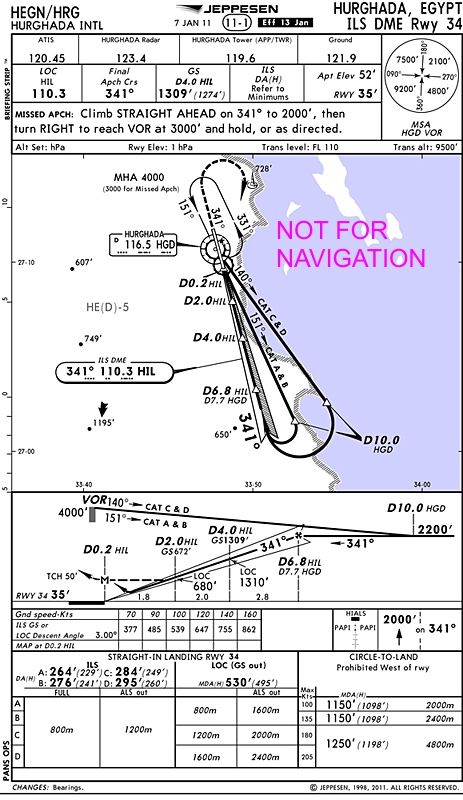
Below is the current Jepp chart for the HEGN ILS DME Rwy 34. I also have a current nav database, which offers two ILS approaches, the A/B base leg and the C/D base leg.
I loaded the approach, which showed a missed approach procedure exactly per the charted missed approach on the Jepp chart; e.g., at the Runway 34 threshold fly a 341 track to 2,000 feet, turn right to HGD VOR, then enter the holding pattern as published.
What's the issue with that?
As for FMS boxes.
I saw few times where FMS data base was not agree with charts.
For example look FMS HEGN ILS 34 from HGD VOR hdg and distance to base turn and compare that with Jeppesen chart. You will be surprised.
It's just a simple to check nav data in FMS and in charts.
So, it's not always FMS will help but somtime might add some headache.
I saw few times where FMS data base was not agree with charts.
For example look FMS HEGN ILS 34 from HGD VOR hdg and distance to base turn and compare that with Jeppesen chart. You will be surprised.
It's just a simple to check nav data in FMS and in charts.
So, it's not always FMS will help but somtime might add some headache.
I loaded the approach, which showed a missed approach procedure exactly per the charted missed approach on the Jepp chart; e.g., at the Runway 34 threshold fly a 341 track to 2,000 feet, turn right to HGD VOR, then enter the holding pattern as published.
What's the issue with that?
Per Ardua ad Astraeus
Joined: Mar 2000
Posts: 18,575
Likes: 4
From: UK
Below is the current Jepp chart for the HEGN ILS DME Rwy 34. I also have a current nav database, which offers two ILS approaches, the A/B base leg and the C/D base leg.
I loaded the approach, which showed a missed approach procedure exactly per the charted missed approach on the Jepp chart; e.g., at the Runway 34 threshold fly a 341 track to 2,000 feet, turn right to HGD VOR, then enter the holding pattern as published.
What's the issue with that?
I loaded the approach, which showed a missed approach procedure exactly per the charted missed approach on the Jepp chart; e.g., at the Runway 34 threshold fly a 341 track to 2,000 feet, turn right to HGD VOR, then enter the holding pattern as published.
What's the issue with that?
For example look FMS HEGN ILS 34 from HGD VOR hdg and distance to base turn and compare that with Jeppesen chart. You will be surprised.
Guest
Joined: Apr 2009
Posts: 3,336
Likes: 0
From: On the Beach
BOAC:
You're right. I was reading too quickly. As I said previously my FMS offers two different base legs, the A/B and the C/D.
They both turn at HGD 10.0 DME but one goes outbound on a 151 track and the other on a 140 track, as per the chart.
You're right. I was reading too quickly. As I said previously my FMS offers two different base legs, the A/B and the C/D.
They both turn at HGD 10.0 DME but one goes outbound on a 151 track and the other on a 140 track, as per the chart.
Thread Starter
Joined: Apr 2010
Posts: 12
Likes: 0
From: Europe
Just build waypoint from HGD VOR R140 D10 DME and compare with waypoint in database. You will see the diference.
In database also different radials.
I will appreciate if anybody explain to me the reason.
In database also different radials.
I will appreciate if anybody explain to me the reason.