


Theory on lift

Joined: May 2003
Posts: 16
Likes: 0
From: SAARLAND
By curiosity I have just found this threat. For a long time I have been looking for reasonable explanation of lift, and guess what I have found one. Not me, but Dr Wolfgang Send. He has a webpage with some good explanations. Www.aniprop.de
The origin of all lift is because more more air is flowing over the top of the wing than underneath. As the separation point of the airflow moves forward and down (that is the interesting fact) from the leading edge at a positive angle of attack, more mass of air is now routed above the wing (might it be a symmetrical wing or whatever). Thus, the air is being accelerated and you get this tube-effect described by Bernoulli resulting in low pressure above the wing and high pressure below. The wing gets sucked up.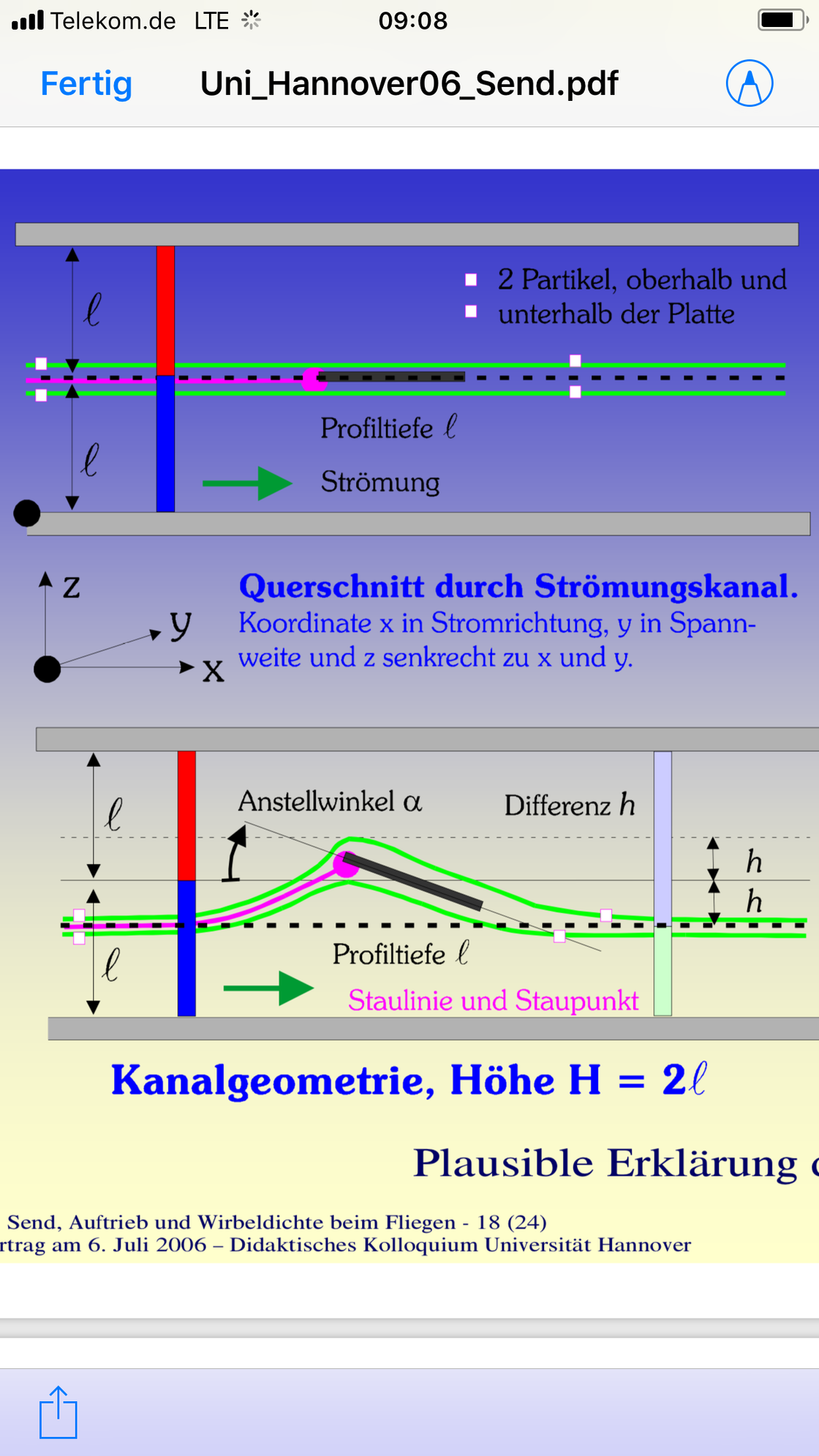
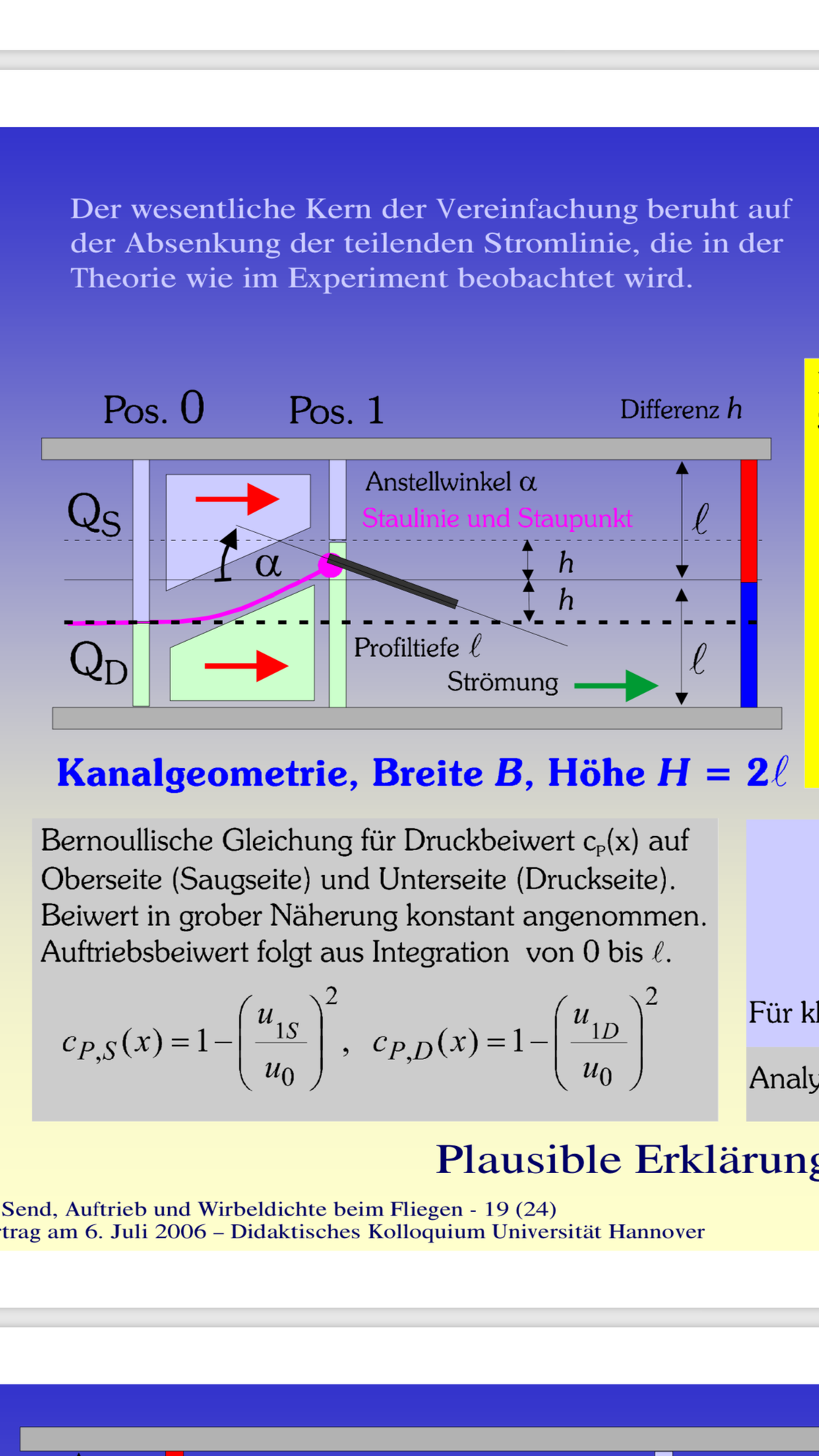
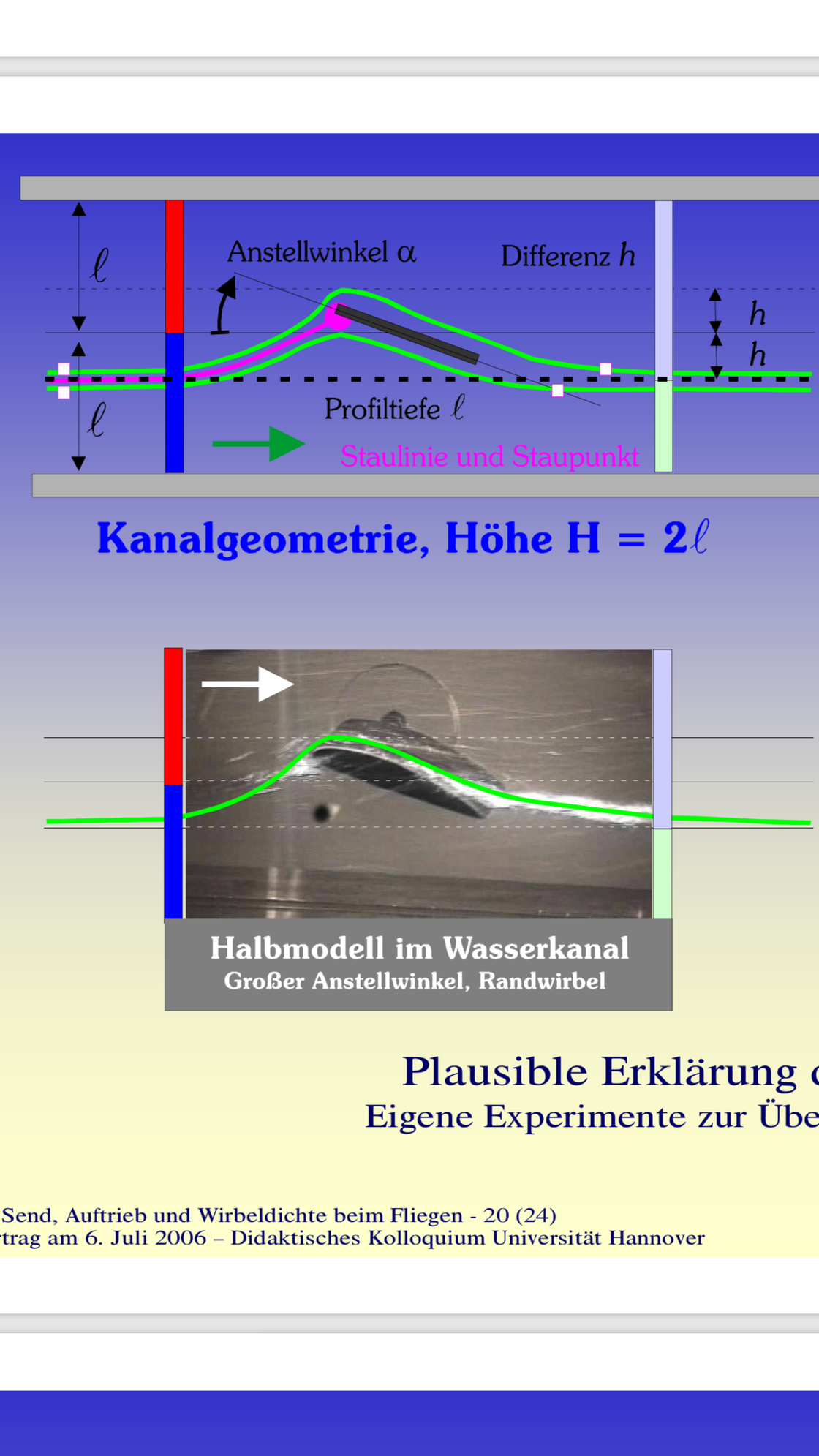
The origin of all lift is because more more air is flowing over the top of the wing than underneath. As the separation point of the airflow moves forward and down (that is the interesting fact) from the leading edge at a positive angle of attack, more mass of air is now routed above the wing (might it be a symmetrical wing or whatever). Thus, the air is being accelerated and you get this tube-effect described by Bernoulli resulting in low pressure above the wing and high pressure below. The wing gets sucked up.


Joined: May 2003
Posts: 16
Likes: 0
From: SAARLAND
Yes sorry, I mean the stagnation point when I talk of seperation point. Sorry. Seperation happens later. As the streamlines separate at the stagnation point, a non native English speaker like me would simply call it seperation point, not taking into account that something else is meant with seperation by definition when the laminar/turbulent flow separates from the wing....
Fleet Manager

Joined: Apr 2001
Aviation Qualifications: ATPL
Posts: 7,448
Likes: 310
From: various places .....
My German is worse than non-existent so I have no idea what the text in the graphics is saying. However, the graphics appear to suggest that the writer does not acknowledge downwash ? Looking at the cited url, I gather that the researcher is a bird flight man. I have read a bit in that area and, interestingly, the natural world flight researchers appear to have a generally better understanding of matters relating to aerodynamics than many of our aeroplane colleagues.
As to why the pilot mantra reflect thinking from a hundred years or so, ago ? Who knows ....
The following youtube video might be of interest to those who haven't seen it or something similar ..
In addition to Arvel Gentry's papers which were referred to earlier in this thread, a related (to the above video link) AeroSoc paper is useful ... no, make that essential, parallel reading (Ackroyd was a very well regarded aeronautical academic) ... https://www.aerosociety.com/media/48...historical.pdf
As to why the pilot mantra reflect thinking from a hundred years or so, ago ? Who knows ....
The following youtube video might be of interest to those who haven't seen it or something similar ..
In addition to Arvel Gentry's papers which were referred to earlier in this thread, a related (to the above video link) AeroSoc paper is useful ... no, make that essential, parallel reading (Ackroyd was a very well regarded aeronautical academic) ... https://www.aerosociety.com/media/48...historical.pdf
Joined: May 2003
Posts: 16
Likes: 0
From: SAARLAND
Hi!
The author also researches the downwash and the vortices....in the 3D case. Pictures above show the 2D case, to illustrate how the phenomenon of lift is initially created by forward movement and down going movement of the stagnation point and showing, that then more air mass is flowing over the wing than underneath with the positive angle of attack. The solution for an infinite wing span (2D case) is without power and only delivers a force component crosswise to the flow. This also shows the video above by the way!
In the 3D case the vortices form as the result of pressure equalization at the edges of the wing. The vortices stay behind streamwise as the wing travels further in the direction of flight. Honestly, it is very complicated. But for me it really helped to understand, and this is a fact, that more air is flowing above the wing.....it is obvious and I have never seen it anywhere before in a book until I have found the explanations of Dr Send. The rest...is very mathematical.
The author also researches the downwash and the vortices....in the 3D case. Pictures above show the 2D case, to illustrate how the phenomenon of lift is initially created by forward movement and down going movement of the stagnation point and showing, that then more air mass is flowing over the wing than underneath with the positive angle of attack. The solution for an infinite wing span (2D case) is without power and only delivers a force component crosswise to the flow. This also shows the video above by the way!
In the 3D case the vortices form as the result of pressure equalization at the edges of the wing. The vortices stay behind streamwise as the wing travels further in the direction of flight. Honestly, it is very complicated. But for me it really helped to understand, and this is a fact, that more air is flowing above the wing.....it is obvious and I have never seen it anywhere before in a book until I have found the explanations of Dr Send. The rest...is very mathematical.

Joined: Dec 2006
Posts: 2,486
Likes: 8
From: The No Transgression Zone
Just to add: one may write Bernoulli's equation for example,as aTaylor Series. One may get better results with the lift equation
edited to adjust punctuation and add a little bit more
edited to adjust punctuation and add a little bit more
Last edited by Pugilistic Animus; 3rd August 2018 at 20:39.
Joined: Feb 2000
Posts: 1,550
Likes: 0
From: Alaska, PNG, etc.
A previous iteration of the FAA's flight training handbook contained the "rejoined at the trailing edge or "equal transit time" fallacy, so I would venture to say that a lot of students in the US were taught that.

