


Explaining Induced Drag??

Thread Starter

Joined: May 2004
Posts: 808
Likes: 0
From: Live near Cardiff (from Scotland)
Explaining Induced Drag??
Hi All,
If you were teaching a student about induced drag how would you explain the tilting aft of the total lift force? Forming the angle for Induced Drag?
I understand the high to low airflow resulting in vortex at wing tip and the downwards part of the vortex acting on the trailing edge of the wing. This produces a downwash.
The part which I`m loosing it, is the average relative airflow/AoA. Why is this formed? Due to the trailing edge downwash?
Thanks.
If you were teaching a student about induced drag how would you explain the tilting aft of the total lift force? Forming the angle for Induced Drag?
I understand the high to low airflow resulting in vortex at wing tip and the downwards part of the vortex acting on the trailing edge of the wing. This produces a downwash.
The part which I`m loosing it, is the average relative airflow/AoA. Why is this formed? Due to the trailing edge downwash?
Thanks.

Joined: Nov 2007
Posts: 712
Likes: 0
From: United Kingdom
If you consider which way the vortices are rotating you'll realise that there is an upward flow of air outside the span of the wing, and a downward flow of air behind the trailing edge of the wing. This downward flow must not be confused with the ordinary downwash. One difference is that the latter is allways accompanied by a corresponding upwash in front of the aerofoil, so that the final direction of the airflow is unaffected. But in the case of the wing-tip vortices the corresponding upward flow is outside the wing span and not in front of it, so that the net direction of flow past the wing is downwards. Therefore the lift - which is at right angles to the airflow - is slightly rearwards, and thus contributes to the drag. This bit of the drag is induced drag.
In a sense, induced drag is part of the lift; so long as we have lift we must have induced drag, and we can never eliminate it altogether however cleverly the wings are designed. But the greater the aspect ratio, the less violent are the wing tip vortices, and the less the induced drag. If you could imagine a wing of infinate aspect ratio, the air would flow over it without any inward or outward deflection i.e. no wing tip vortices and no induced drag. Unfortunately, from a structual point of view, there is a limit to how large the aspect ratio can be. The greater the wing span the greater must be the wing strength; the increase in weight counterbalances any gained advantage. It's all about compromise.
TCF
In a sense, induced drag is part of the lift; so long as we have lift we must have induced drag, and we can never eliminate it altogether however cleverly the wings are designed. But the greater the aspect ratio, the less violent are the wing tip vortices, and the less the induced drag. If you could imagine a wing of infinate aspect ratio, the air would flow over it without any inward or outward deflection i.e. no wing tip vortices and no induced drag. Unfortunately, from a structual point of view, there is a limit to how large the aspect ratio can be. The greater the wing span the greater must be the wing strength; the increase in weight counterbalances any gained advantage. It's all about compromise.
TCF

Joined: Jan 2008
Posts: 1,337
Likes: 59
From: At home
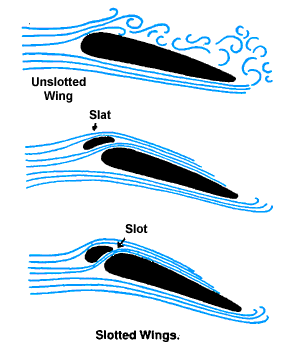
...and slots?
Therefore the lift - which is at right angles to the airflow - is slightly rearwards, and thus contributes to the drag.
Joined: Feb 2008
Posts: 420
Likes: 3
From: In the Old Folks' Home
Conservation of Energy
Try the conservation of energy approach. The aircraft in flight requires a certain amount of energy to maintain a given airspeed. The components of that energy are lift and drag. The energy that is not expended in producing lift is expended in producing drag. That portion of the drag not attributable to profile drag is the induced drag.
Joined: Mar 2005
Posts: 1,338
Likes: 1
From: Uh... Where was I?
Drag is a better word than "resistance" because it has more meaning: the airplane drags air behind it. By reaction, the air exerts a force oposing to the airplanes movement.
induced drag is proportional to the wingtip vortex
Creating a vortex requires imparting energy to the air. That energy comes from the airplane. Induced drag is the force that creates the vortex, and there is no way to eliminate the vortex, but you can reduce it.
induced drag is proportional to the wingtip vortex
Creating a vortex requires imparting energy to the air. That energy comes from the airplane. Induced drag is the force that creates the vortex, and there is no way to eliminate the vortex, but you can reduce it.
Joined: Jun 2002
Posts: 3
Likes: 5
From: Wor Yerm
If you look at the basic lift formula you'll see a few constants and a few bits that have a variable value. The V squared bit means that as you add a few more knots of airspeed, the C/L bit can bit reduced. Conversely, as you reduce airspeed, you'll still need as a much lift but the lift has to be supplied by the C/L element. Which means the air around the wind is having to work harder and the byproduct of that work is induced drag.
PM
PM
Joined: Nov 2007
Posts: 712
Likes: 0
From: United Kingdom
What's wrong with a simple vector diagram?
TCF
Joined: Aug 2000
Posts: 3,648
Likes: 2
From: UK
What's wrong with a simple vector diagram?
Lift is perpendicular to the wing chord.
By definition, lift is perpendicular to the airflow direction, drag is parallel to it. That doesn't change with AOA. What you probably mean is that the total resultant force "is perpendicular to the wing chord". And then you want to...
Resolve that into a vertical (lift) component and a horizontal (drag) component. Higher AOA ==> more drag.

Joined: Mar 2005
Posts: 1,338
Likes: 1
From: Uh... Where was I?
"Vortex drag"
we all know those graphs, but that is not a very satisfactory way to explain induced drag, in my opinion. It can be elegant for math lovers, though.
Think of induced drag as "Vortex drag"
As far as I understand, induced drag and the vortex are related. Forget the infinite and finite comparison. Wing are finite, we agree in that, right?
the total aerodynamic reaction is what matters. If we divide it in two vectors (two is enough!), one at right angles with airplane's flight path and the other parallel, then we have Lift and Drag. Now, part of the total reaction paralel to the flight path is due to viscosity forces: friction drag and form drag (due to airflow separation). They are the parasite drag. Then, there is the effect of the vortex created by air "leaking" from the lower surface to the upper surface, the spanwise flow, etc... It is a physical thing, not a geometrical thing.
The drag due to vortex is the drag due to the "ability" of the wing to deflect air, which is the ability to create a pressure differential between lower and upper surfaces and it is proportional to angle of attack. The CL represents this ability. The slower you fly with the same lift, the more CL you need, the more intense the vortex, the higher the induced drag. The drag due to viscosity is due to friction, nearly independent of the angle of attack. The more air is "processed" by the wing (the more the dynamic pressure) the more the parasite drag.
Think of induced drag as "Vortex drag"
As far as I understand, induced drag and the vortex are related. Forget the infinite and finite comparison. Wing are finite, we agree in that, right?
the total aerodynamic reaction is what matters. If we divide it in two vectors (two is enough!), one at right angles with airplane's flight path and the other parallel, then we have Lift and Drag. Now, part of the total reaction paralel to the flight path is due to viscosity forces: friction drag and form drag (due to airflow separation). They are the parasite drag. Then, there is the effect of the vortex created by air "leaking" from the lower surface to the upper surface, the spanwise flow, etc... It is a physical thing, not a geometrical thing.
The drag due to vortex is the drag due to the "ability" of the wing to deflect air, which is the ability to create a pressure differential between lower and upper surfaces and it is proportional to angle of attack. The CL represents this ability. The slower you fly with the same lift, the more CL you need, the more intense the vortex, the higher the induced drag. The drag due to viscosity is due to friction, nearly independent of the angle of attack. The more air is "processed" by the wing (the more the dynamic pressure) the more the parasite drag.
Joined: Dec 2009
Posts: 80
Likes: 0
From: moon
Just tell the students that a work must be done to rotate that amount of air at the wing tips and that work is stolen from the available power of the airplane, one good example is, two identical airplanes fly at the same speed and one is heavier than the other, the question is why does the heavier one burns more fuel,
Greetings
Greetings


Joined: May 2000
Posts: 3,204
Likes: 2
From: Seattle
...when in fact it's not. Not even when you allow for the loose terminology.
. . .
By definition, lift is perpendicular to the airflow direction, drag is parallel to it. That doesn't change with AOA. What you probably mean is that the total resultant force "is perpendicular to the wing chord". And then you want to...
. . .
But the problem is that the total resultant force does not simply tilt with the AoA to remain perpendicular to the chord line. If you increase the AoA, the total resultant force may change direction, but it doesn't simply tilt back by the same angle as you changed the AoA. If it did, you would have zero induced drag at zero AoA, and the induced drag to lift ratio would simply be the tangent of the AoA. It's not.
. . .
By definition, lift is perpendicular to the airflow direction, drag is parallel to it. That doesn't change with AOA. What you probably mean is that the total resultant force "is perpendicular to the wing chord". And then you want to...
. . .
But the problem is that the total resultant force does not simply tilt with the AoA to remain perpendicular to the chord line. If you increase the AoA, the total resultant force may change direction, but it doesn't simply tilt back by the same angle as you changed the AoA. If it did, you would have zero induced drag at zero AoA, and the induced drag to lift ratio would simply be the tangent of the AoA. It's not.
FEHoppy's diagram is plenty for a beginning flight student or wannabe. Anything more is needlessly confusing.
If you're designing wings for A or B, then have at all the math and CFD.
Joined: Feb 2009
Posts: 2,824
Likes: 110
From: Virginia
Don't think the conservation of energy approach (post 5) works. The energy expended in producing lift is the energy expended in producing induced drag.
Although you can't produce lift without producing drag, the theoretical energy expended just to keep an airplane at a given altitude (independent of the mechanism used) is zero. Otherwise, my desk would be constantly using energy to keep my computer off the floor.
Although you can't produce lift without producing drag, the theoretical energy expended just to keep an airplane at a given altitude (independent of the mechanism used) is zero. Otherwise, my desk would be constantly using energy to keep my computer off the floor.
Joined: Mar 2005
Posts: 1,338
Likes: 1
From: Uh... Where was I?
something in that still does not fit.
An airplane in level flight has lift, but its potential energy remains constant, like the computer on the desk (no vertical distance covered, no work done due to vertical forces).
If speed is constant its kinetic energy is constant, too. However, as it is moving forward while being pushed by the engines thrust, there is work done and energy "spent" in a given distance: fuel energy. In the end, fuel energy is being spent to maintain kinetic energy over distance, or fuel power spent over time.
The question is: What kind of power is being spent to keep the airplane level?
Energywise, Who pays all the bills? It seems to me that the engines do.
The airplane remains level but the air pushed down by the wings does not. I mean: the air dragged forward accounts for drag and the air pushed down accounts for lift.
Aside from the air being moved the air is also being heated, oscillated, etc... Energy is imparted to the air in the form of kinetic energy, heat energy, noise... All of that energy comes from the airplane, which maintains its own energy state constant. Therefore it must all come from the fuel.
We could say that the energy used to push air down is the useful energy (creates the lift force). The rest of the energy is wasted in the air. So we can talk about efficiency, in the sense that a wing can achieve the same lift force wasting more or less energy into the air. The more efficient the wing is, the less air is dragged forward or heated, etc...
But what about the vortex? this is air in motion, but if it was to be accounted as drag this motion should be forward. Or do we have to account it as an extra force the engines have to do to pay "wasted energy"?
An airplane in level flight has lift, but its potential energy remains constant, like the computer on the desk (no vertical distance covered, no work done due to vertical forces).
If speed is constant its kinetic energy is constant, too. However, as it is moving forward while being pushed by the engines thrust, there is work done and energy "spent" in a given distance: fuel energy. In the end, fuel energy is being spent to maintain kinetic energy over distance, or fuel power spent over time.
The question is: What kind of power is being spent to keep the airplane level?
Energywise, Who pays all the bills? It seems to me that the engines do.
The airplane remains level but the air pushed down by the wings does not. I mean: the air dragged forward accounts for drag and the air pushed down accounts for lift.
Aside from the air being moved the air is also being heated, oscillated, etc... Energy is imparted to the air in the form of kinetic energy, heat energy, noise... All of that energy comes from the airplane, which maintains its own energy state constant. Therefore it must all come from the fuel.
We could say that the energy used to push air down is the useful energy (creates the lift force). The rest of the energy is wasted in the air. So we can talk about efficiency, in the sense that a wing can achieve the same lift force wasting more or less energy into the air. The more efficient the wing is, the less air is dragged forward or heated, etc...
But what about the vortex? this is air in motion, but if it was to be accounted as drag this motion should be forward. Or do we have to account it as an extra force the engines have to do to pay "wasted energy"?
Joined: Feb 2009
Posts: 2,824
Likes: 110
From: Virginia
I wonder if induced drag may be so hard to understand because it doesn't exist. In other words, drag is caused because the airplane disturbs the air it passes through. A wing that's producing lift will disturb the air more than one that isn't. Induced drag is a mathematical concept that permits calculating the variation of drag with lift. But does an individual air molecule bouncing off the wing "know" whether it's contributing to induced or parasitic drag?
Joined: Mar 2005
Posts: 1,338
Likes: 1
From: Uh... Where was I?
haha
Indeed, I think we have to put the focus on the air, instead of in the airplane.
Can it be that the airplane with no lift drags air forward and the airplane with lift drags the same air plus some more air which in addition is pushed down?
this would mean that the lifting wing handles more air than the zero lift one.
Indeed, I think we have to put the focus on the air, instead of in the airplane.
Can it be that the airplane with no lift drags air forward and the airplane with lift drags the same air plus some more air which in addition is pushed down?
this would mean that the lifting wing handles more air than the zero lift one.
Thread Starter
Joined: May 2004
Posts: 808
Likes: 0
From: Live near Cardiff (from Scotland)
Brilliant, thanks for such detailed answers.
One final question. Would It be correct to explain the "Effective Relative Airflow" angle on FE Hoppy`s Diagram as a result of the spanwise flow beneath the wing(High-Low)? This forms the new angle?
One final question. Would It be correct to explain the "Effective Relative Airflow" angle on FE Hoppy`s Diagram as a result of the spanwise flow beneath the wing(High-Low)? This forms the new angle?
Joined: Dec 2009
Posts: 80
Likes: 0
From: moon
to me key word is circulation, a cylinder subject to uniform flow, then give some rotation to the sphere, may be at this step you may jump to Joukowski transformations, explain the Kutta condititon , potential flow past an airfoil, and next the circulation, now it is easier to explain downwash and the relative flow angle,
of course all is my own opinion
of course all is my own opinion

