


FAA Grounds 787s


Joined: Jun 2009
Posts: 67
Likes: 1
From: Paris, France
Deep discharge of a single cell presented as a probable cause of the fire
Source: report on a Boeing presentation
Boeing outlines fix for 787 batteries ? The Register
Seems not unreasonable to me. Deep discharge of a cell is known to have the potential to leave it in a state of high internal resistance, where current flowing thanks to either the other cells supplying power, or a recharge attempt, will generate a lot of heat in the cell, causing the effect described.
If that is, several things went wrong
- operating procedures and supervising means should prevent using the battery beyond the point where deep discharge of all elements occurs; and only a defect of a cell should make deep discharge of a single cell possible (as hinted above);
- deep discharge of a single cell (always possible, and a clearly dangerous situation) could be detected by the electronics built into the battery, and trigger a fail-safe mode; if that's not designed-in, that's a mistake for a powerful battery, IMHO; and if it is there and did not work, why?
Boeing outlines fix for 787 batteries ? The Register
(...Boeing) hinted, during a 90-minute presentation and Q&A session in Tokyo, that a “deep discharge” event occurred in one cell of the planes' batteries, heating it to the point at which it vented so much hot electrolyte that an adjacent cell warmed and also vented. A manufacturing fault seems to be the reason such an event was able to occur (...)
If that is, several things went wrong
- operating procedures and supervising means should prevent using the battery beyond the point where deep discharge of all elements occurs; and only a defect of a cell should make deep discharge of a single cell possible (as hinted above);
- deep discharge of a single cell (always possible, and a clearly dangerous situation) could be detected by the electronics built into the battery, and trigger a fail-safe mode; if that's not designed-in, that's a mistake for a powerful battery, IMHO; and if it is there and did not work, why?
Last edited by fgrieu; 17th March 2013 at 10:05.


Joined: Aug 2003
Posts: 259
Likes: 9
From: FR
No doubt, the proposed modifications go in the right direction ... including the new enclosure which is not a fix but a safety feature. Meanwhile, it is a nice demonstration about how people were comfortable calculating probabilities like 1E-9 about a brand new system, with little or no experience operating it in the actual environment.
Joined: Oct 2012
Posts: 224
Likes: 0
From: toofaraway
Boeing's latest proposal ..
The dog sits on the firebox. If he yelps, they've got a problem.
note: this fix is SPA approved. During ETOPS sectors he gets fed and if he's
lucky he lives to work another day. Unlike the canary in the coalmine.

note: this fix is SPA approved. During ETOPS sectors he gets fed and if he's
lucky he lives to work another day. Unlike the canary in the coalmine.
Paxing All Over The World


Joined: May 2001
Posts: 10,843
Likes: 328
From: Hertfordshire, UK.
avogadro

what is the main reason to undergo a test without adressing the root cause of the failure, which, by the way is unknown.
- Money
- Male Pride
Joined: Nov 2008
Posts: 3
Likes: 0
From: Switzerland
In fact fleet hours were only 52,000 so Boeing must substantiate to a critical audience that improvements to the battery system yield at least a 200 fold reduction in risk of failure.
Last edited by Autogeorge; 17th March 2013 at 14:12.
Joined: Jan 2008
Posts: 1,191
Likes: 0
From: lancs.UK
[The failure by itself may not be critical to safe flight
the ONLY time a flight with "dead" batteries can be (grudgingly) considered "safe", is if said aircraft is within gliding distance of a suitable airfield.....and that would be stretching credulity to the limits.
Boeing refuses to abandon the troublesome technology and therefore are reducing the aircraft to an "in-service" development role. I don't have a problem with that, so long as critical safety is not affected Therefore, IMHO, the strategy I outlined many moons ago, seems the only prudent way forward.
Boeing should eat a large slice of humble pie, admit their lack of understanding of the technology and maybe look to the modellers who fly Helis with over a metre diameter rotors on Lithium technology,pushed to it's limits....I'd venture to suggest these amateurs have a vastly lower failure-rate than Boeing have demonstrated and they don't send their depleted cells back to the manufacturer either.....(nor would they pay 16,000 dollars for a 24 cell pack
 )
)If necessary, the sub-cells could be reduced in size and more of them, in order to reduce the potential thermal danger of any single cell going into "meltdown"
and the isolation in a ceramic "jacket" together with fusible connectors would all help to ensure a safe and reliable storage-system
In any event, it is imperative that ALL cells are monitored and balanced.
Looks like they tried to maximise profits by only monitoring clusters of three....I believe the problems this bought -on is known colloquially as a "Cluster fxxk"

Theie "emperor's new clothes" denial of a fire is beyond belief....sit the buggers on a pile of thermite (aluminium-powder plus rust powder , heat to ignition and it reacts strongly enough to melt and join railway-track ) ...then wait for them to deny it was a fire!
Joined: Jun 2009
Posts: 801
Likes: 74
From: Germany
Probable cause
If deep discharge in one cell was the beginning of the thermal runaway of one cell, what was then the cause of this rapid deep discharge? Could the modifications in the box ---- better isolations of the cells itself and between the cells, of the wires, and the moisture draining capability ------- point to a moisture and isolation problem of the old box?
condensation causing a short between the box and one cell (remember the contact of one celll completely gone at the ANA event)? In such an event the evidence would evaporate due to the heat and no trace be left.
The new sealed box could prevent such an event by being airtight until a defined overpressure opens the new vents.
condensation causing a short between the box and one cell (remember the contact of one celll completely gone at the ANA event)? In such an event the evidence would evaporate due to the heat and no trace be left.
The new sealed box could prevent such an event by being airtight until a defined overpressure opens the new vents.
Last edited by RetiredF4; 17th March 2013 at 22:25.
Joined: Jan 2004
Posts: 738
Likes: 4
From: london,uk
If necessary, the sub-cells could be reduced in size and more of them, in order to reduce the potential thermal danger of any single cell going into "meltdown"
and the isolation in a ceramic "jacket" together with fusible connectors would all help to ensure a safe and reliable storage-system
In any event, it is imperative that ALL cells are monitored and balanced.
and the isolation in a ceramic "jacket" together with fusible connectors would all help to ensure a safe and reliable storage-system
In any event, it is imperative that ALL cells are monitored and balanced.
List of battery sizes - Wikipedia, the free encyclopedia
isolated from each other.
Last edited by peter we; 17th March 2013 at 21:28.
Joined: Feb 2013
Posts: 71
Likes: 0
From: Placerville, CA
fgrieu:
My reading of the Boeing description is rather that "deep discharge event" is a carefully phrased reference to what may have been an internal short circuit. This both reduces the cell voltage and increases the cell's resistance to externally driven current, but only after the real damage has been done by the dissipation of the cell's energy inside the sealed case. That is what led to the venting they refer to, not current being forced through a benignly discharged cell.
Seems not unreasonable to me. Deep discharge of a cell is known to have the potential to leave it in a state of high internal resistance, where current flowing thanks to either the other cells supplying power, or a recharge attempt, will generate a lot of heat in the cell, causing the effect described.
Joined: Jun 2009
Posts: 67
Likes: 1
From: Paris, France
About "deep discharge"
I'm still looking at where "deep discharge" was originally used by Boeing. Tried browsing that video for an hour, but missed it. Pointers welcome!
Webcast - Boeing 787 Updates
"Deep discharge" of a cell, without context, is a well-known phenomenon in all kind of batteries, where open-circuit cell voltage drops below some rated minimum. At least in some cells technologies (I do not know for Lithium Cobalt Oxide, much less the particular type used), deep discharge can permanently damage a cell, increasing its internal resistance. If that occurs, it is possible that the cell later overheats when subjected to high current, e.g. from a charger, or from other cells powering the load; the later can only happen in batteries with more than say 3 or 4 cells in series, and with one cell that developed significant imbalance w.r.t. the other ones.
A short circuit inside a cell (even a mild one, usually called leakage, as could occur from moisture) can cause deep discharge of a cell, but is not by itself deep discharge.
Webcast - Boeing 787 Updates
"Deep discharge" of a cell, without context, is a well-known phenomenon in all kind of batteries, where open-circuit cell voltage drops below some rated minimum. At least in some cells technologies (I do not know for Lithium Cobalt Oxide, much less the particular type used), deep discharge can permanently damage a cell, increasing its internal resistance. If that occurs, it is possible that the cell later overheats when subjected to high current, e.g. from a charger, or from other cells powering the load; the later can only happen in batteries with more than say 3 or 4 cells in series, and with one cell that developed significant imbalance w.r.t. the other ones.
A short circuit inside a cell (even a mild one, usually called leakage, as could occur from moisture) can cause deep discharge of a cell, but is not by itself deep discharge.
Last edited by fgrieu; 18th March 2013 at 15:32. Reason: typo, more accurate chemistry name
Joined: Mar 2005
Posts: 86
Likes: 0
From: CA
What amazes me is that Boeing admit that they still don't really know what caused the problem and in the same breath, say they've fixed it.
Boeing's latest proposal ..
The dog sits on the firebox. If he yelps, they've got a problem.
The dog sits on the firebox. If he yelps, they've got a problem.
So, the "Dreamliner" moves to "Scareliner"...and, hopefully not...to "Screamliner"
Joined: Jul 2002
Posts: 19
Likes: 0
From: ZA
This is not a fix
This is a kludge not an engineering solution.
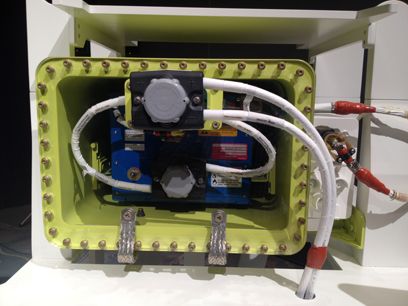
So they put a volatile battery in a strong box (pressure vessel) and connect it to the outside air via a valve. This valve will be exposed to moisture, whatever materials the battery may vomit and freezing temperatures. It may not be called on to operate for years. Does such a valve exist? Has one been certified for this duty?
Methinks they may be creating a bomb.
On the other hand I may just be paranoid and dumb
So they put a volatile battery in a strong box (pressure vessel) and connect it to the outside air via a valve. This valve will be exposed to moisture, whatever materials the battery may vomit and freezing temperatures. It may not be called on to operate for years. Does such a valve exist? Has one been certified for this duty?
Methinks they may be creating a bomb.
On the other hand I may just be paranoid and dumb
Joined: May 2008
Posts: 26
Likes: 0
From: Belgium
F4
"The new sealed box could prevent such an event by being airtight until a defined overpressure opens the new vents"
One would really hope that the system that opens the new vents is big time fail safe. We do not want a bomb - better with leaky hot goo!
One would really hope that the system that opens the new vents is big time fail safe. We do not want a bomb - better with leaky hot goo!
Joined: Feb 2013
Posts: 71
Likes: 0
From: Placerville, CA
mostlylurking:
The webcast mentioned a rupture disk. Very old technology which is far more likely to open before needed than to fail closed. There will also be a sensor to alarm when the disk ruptures.
Does such a valve exist?

Joined: Nov 2000
Posts: 645
Likes: 0
I still can't believe this shortcut-strategy. How can a world class company promote such a strategy? Find the root cause or change the battery type please. This is just asking for trouble and like waiting for the next "discoloured" batteries. Ignoring (not knowing) the basic problem will not make things easier and not save money on the long run.
Joined: May 2002
Posts: 300
Likes: 0
From: MA
A long time ago, I posted something to the effect that fate had been kind to Boeing and the aviation world by presenting us with three separate battery fires, none of which ended in a hull loss or tragedy: the test aircraft which made an emergency landing in Texas, the empty JAL aircraft in BOS, and the ANA aircraft which required an emergency evacuation.
My fear is that fate will not be so kind at some point in the future.
My fear is that fate will not be so kind at some point in the future.


