


FAA Grounds 787s

Joined: Feb 2013
Posts: 78
Likes: 0
From: Seattle, WA
@kenneth house
There was no charge monitoring system attached to the battery that caught fire in 2006 at the Securaplane facility. This improper test set-up was determined to be the cause of the fire, not the design of the battery itself.
Both the JTSB and the NTSB have stated that they could find no faults with the charging system aboard JA829J (JL8) or JA804A (NH692) and both have ruled out overcharging as a possible cause.
those three incidents plus the battery pack that Secura burned up in 2006--do you suppose that overcharging just might possibly be involved here, considering the charred remains of a battery thermal runaway, even though supposedly the FDR did not show evidence of overcharge and thus thermal runaway did not occur.
Both the JTSB and the NTSB have stated that they could find no faults with the charging system aboard JA829J (JL8) or JA804A (NH692) and both have ruled out overcharging as a possible cause.


Joined: Aug 2003
Posts: 259
Likes: 9
From: FR
Presumably "no faults with the charging system" simply means that the units went again through some standard factory tests, and passed. In fact these standard tests probably (hopefully) evolved a bit, it would actually be interesting to read more details about that.
And I am not sure how one can "rule out overcharging" at this stage ... does it simply mean that some thresholds were not (never?) exceeded for some measured physical values (which ones?) and if so, the statement is rather weak.
And I am not sure how one can "rule out overcharging" at this stage ... does it simply mean that some thresholds were not (never?) exceeded for some measured physical values (which ones?) and if so, the statement is rather weak.
Joined: Feb 2013
Posts: 71
Likes: 0
From: Placerville, CA
slf4life:
Actually, they really meant a fire inside the FIRE BOX.
What they are saying is that regardless of to what extent and how violently the battery melts down, and how volatile the liquid and vapor emitted may be, there will not be open flame inside the FIRE BOX. All sorts of exothermic chemical reactions, but not flame. Therefore no chance of fire. This statement was made in technical presentations, not just PR words. You just have to be very careful how the terms are defined.
Earlier comments about how the chemicals in the battery generate their own oxygen and therefore no air was needed to have flame were somewhat misleading. The chemical reactions within the active material and electrodes do not require external oxygen as part of a battery thermal runaway, but they do not release free oxygen nor by themselves count as fire.
The pictures, the '...eliminates the potential for fire' captions are made for public consumption I assume. So I'll be generous and surmise they mean a CABIN fire
What they are saying is that regardless of to what extent and how violently the battery melts down, and how volatile the liquid and vapor emitted may be, there will not be open flame inside the FIRE BOX. All sorts of exothermic chemical reactions, but not flame. Therefore no chance of fire. This statement was made in technical presentations, not just PR words. You just have to be very careful how the terms are defined.
Earlier comments about how the chemicals in the battery generate their own oxygen and therefore no air was needed to have flame were somewhat misleading. The chemical reactions within the active material and electrodes do not require external oxygen as part of a battery thermal runaway, but they do not release free oxygen nor by themselves count as fire.
Joined: Oct 2002
Aviation Qualifications: PPL
Posts: 8,208
Likes: 351
From: London UK
Not my original understanding, but if so why not fill the firebox with nitrogen like the tyres ?

Joined: Jan 2008
Posts: 141
Likes: 14
From: australia
Perhaps we're getting too hung up about the fire. Airport firies and NTSB say there was a fire, and my Gran said there’s no smoke without fire; but Boeing claims there wasn’t one. Who do we believe, who has most credibility?
It may not matter too much because quite apart from fire all Special Certification Conditions must be met. One requires “Safe cell temperatures and pressures must be maintained during any foreseeable charging or discharging condition and during any failure of the charging or battery monitoring system not shown to be extremely remote”. Quantitatively that’s a target of once in 10 million flight hours, whereas real life had 2 failures in 52,000 hours. Modified battery system certainly looks much safer but Boeing must convince skeptics that it’s at least 200 times more reliable. That's challenging.
It may not matter too much because quite apart from fire all Special Certification Conditions must be met. One requires “Safe cell temperatures and pressures must be maintained during any foreseeable charging or discharging condition and during any failure of the charging or battery monitoring system not shown to be extremely remote”. Quantitatively that’s a target of once in 10 million flight hours, whereas real life had 2 failures in 52,000 hours. Modified battery system certainly looks much safer but Boeing must convince skeptics that it’s at least 200 times more reliable. That's challenging.
Joined: Mar 2010
Posts: 115
Likes: 0
From: South Korea
Step 1. Hit the "Quote button" (words inside a balloon icon) from the format bar in the reply screen.
Step 2. Paste in the words you want to quote.
Rinse and repeat as needed.
Step 2. Paste in the words you want to quote.
Rinse and repeat as needed.
Joined: May 2002
Posts: 300
Likes: 0
From: MA
I for one am not going to rush to fly on it - at least on ETOPS routes.
Joined: Feb 2009
Posts: 2,824
Likes: 110
From: Virginia
The box doesn't contain enough oxygen to support combustion for long. So if the products of a thermal runaway ignited, they'd self extinguish pretty quickly without a source of additional oxygen. Of course, you'd still have the heat of the battery event to deal with, but not a significant amount more from combustion.

Joined: Mar 2002
Posts: 4,569
Likes: 1
From: Florida
Except for the fact that the battery generates its own oxygen when "it lets go"
And is a key reason why it is very difficult to put out the fire.......
And is a key reason why it is very difficult to put out the fire.......
In the meantime simply ensure that the thermal heat and products stay confined.
O2 masks ala valujet etal. are yet other examples of controling the risk.
Joined: Jan 2011
Posts: 780
Likes: 89
From: Seattle
ozaub:
Boeing just put the battery in a heavy box and redefined 'safe'. Now, if one cell runs away, its still safe. Since the surrounding components and structure are protected and dangerous gasses will be vented overboard.
Since they still don't understand the root cause of the runaway, 200 times whatever has no meaning. You can't say that this was a statistical anomaly or that we'll be seeing batteries pop every few months from now on. But it won't matter.
Modified battery system certainly looks much safer but Boeing must convince skeptics that it’s at least 200 times more reliable. That's challenging.
Since they still don't understand the root cause of the runaway, 200 times whatever has no meaning. You can't say that this was a statistical anomaly or that we'll be seeing batteries pop every few months from now on. But it won't matter.
Joined: Jan 2008
Posts: 168
Likes: 0
From: Los Angeles
Since they still don't understand the root cause of the runaway, 200 times whatever has no meaning. You can't say that this was a statistical anomaly or that we'll be seeing batteries pop every few months from now on. But it won't matter.
Joined: Jun 2009
Posts: 67
Likes: 1
From: Paris, France
Beyond damage control
Boeing is trying some damage control redefining "thermal runaway" and "fire".
My understanding of the reaction that occurs during thermal runaway (which, that's undisputed, did occur at the cell and battery level) involves recombination of the oxygen originally weakly trapped in the Lithium Cobalt Oxide cathode, with the anode's material (is that graphitic carbon ?). That generates heat (unless I err, chemically in addition of any electrical effect), and smoke, and propagates. Boeing even puts a "fire hazard" sticker on the stuff.

Draw your own conclusions on if thermal runaway at the cell or battery level qualifies as (contained) fire onboard.
That said, we can have some trust that what Boeing proposes greatly reduces the risk that thermal runaway of a cell degenerate into thermal runaway at the battery level; and trust that thermal runaway at the cell or even battery level, if it occurred, will no longer by itself endanger the plane. Only the combination of these events with some other event where the battery is needed could cause a disaster.
Thus questions now are
1) How likely does cell/battery failure remains ?
2) What if a battery no longer supplies adequate power ? There are variants: open or short circuit, degraded voltage source..
3) Are there other oversight of failure modes elsewhere in that plane?
Answering 1) is important, and depends a lot on what the root cause was in the first place. Unfortunately, here we can only speculate. I guess Boeing, and I hope the NTSB/JTSB, have much more information by analyzing the data available on the battery's history, and the other batteries. My guess is they'll get to the bottom of it.
2) Is about airplane safety, and well understood by the specialists (not me).
3) Well, I hope both Boeing and certification authorities are busy at it.
My understanding of the reaction that occurs during thermal runaway (which, that's undisputed, did occur at the cell and battery level) involves recombination of the oxygen originally weakly trapped in the Lithium Cobalt Oxide cathode, with the anode's material (is that graphitic carbon ?). That generates heat (unless I err, chemically in addition of any electrical effect), and smoke, and propagates. Boeing even puts a "fire hazard" sticker on the stuff.
Draw your own conclusions on if thermal runaway at the cell or battery level qualifies as (contained) fire onboard.
That said, we can have some trust that what Boeing proposes greatly reduces the risk that thermal runaway of a cell degenerate into thermal runaway at the battery level; and trust that thermal runaway at the cell or even battery level, if it occurred, will no longer by itself endanger the plane. Only the combination of these events with some other event where the battery is needed could cause a disaster.
Thus questions now are
1) How likely does cell/battery failure remains ?
2) What if a battery no longer supplies adequate power ? There are variants: open or short circuit, degraded voltage source..
3) Are there other oversight of failure modes elsewhere in that plane?
Answering 1) is important, and depends a lot on what the root cause was in the first place. Unfortunately, here we can only speculate. I guess Boeing, and I hope the NTSB/JTSB, have much more information by analyzing the data available on the battery's history, and the other batteries. My guess is they'll get to the bottom of it.
2) Is about airplane safety, and well understood by the specialists (not me).
3) Well, I hope both Boeing and certification authorities are busy at it.
Last edited by fgrieu; 20th March 2013 at 07:31.
Joined: Apr 2008
Posts: 116
Likes: 0
From: back of beyond
Unlike the majority here who seem to think they know better than the qualified guys and girls at Boeing, Thales and Yuasa, I believe that the batteries and associated circuitry are fundamentally well designed and built (and no, I'm not a Boeing fan!)
Well-built batteries should only fail if they are mistreated electrically, and since we know that the entire electrical system was never tested as a whole before the planes started flying, that is where we should look for a root cause.
If this is the case, then the additional margins on charge and discharge adopted by Boeing are a correct measure to enable the battery to absorb abnormal electrical conditions. I would hope that these limits have been worked out on the basis of measurements on actual aircraft, and not plucked out of thin air by the bean-counters.
All this fuss over the battery box is purely political: the FAA mandated that there should be no fire, Boeing believed the batteries wouldn't fail catsatrophically (after all, they ARE an essential system) and perhaps took a rather cavalier attitude towards containment. But they did fail and catch fire, hence the need to show compliance even if all goes well and no other battery will ever catch fire again.
Another reason for the fuss over the box may be to divert attention from the design oversight in not fully testing the complete electrical system before flight, and the consequent self-regulation can of worms.
What would be interesting, and not publicised as far as I know, is how much the battery capacity has been reduced and how this impacts on emergency operations when the battery is doing what it is supposed to do (length of flight without other sources of power, number or duration of brake applications, number of APU start attempts...)
Well-built batteries should only fail if they are mistreated electrically, and since we know that the entire electrical system was never tested as a whole before the planes started flying, that is where we should look for a root cause.
If this is the case, then the additional margins on charge and discharge adopted by Boeing are a correct measure to enable the battery to absorb abnormal electrical conditions. I would hope that these limits have been worked out on the basis of measurements on actual aircraft, and not plucked out of thin air by the bean-counters.
All this fuss over the battery box is purely political: the FAA mandated that there should be no fire, Boeing believed the batteries wouldn't fail catsatrophically (after all, they ARE an essential system) and perhaps took a rather cavalier attitude towards containment. But they did fail and catch fire, hence the need to show compliance even if all goes well and no other battery will ever catch fire again.
Another reason for the fuss over the box may be to divert attention from the design oversight in not fully testing the complete electrical system before flight, and the consequent self-regulation can of worms.
What would be interesting, and not publicised as far as I know, is how much the battery capacity has been reduced and how this impacts on emergency operations when the battery is doing what it is supposed to do (length of flight without other sources of power, number or duration of brake applications, number of APU start attempts...)
More bang for your buck
Joined: Nov 2005
Posts: 3,513
Likes: 1
From: land of the clanger
There are millions of Li-ion batteries being recharged perfectly safely every day in 'cheap' stuff such as phones, laptops, tablets etc with an extremely low failure rate (thermal runaway wise) so it's achievable for Boeing surely.
Guest
Joined: Mar 2006
Posts: 288
Likes: 58
From: Not where I want to be
This is what a small/medium sized Lithium battery looks like when it goes bang. It was brand new, not being charged, not being discharged and it was stored in an air conditioned environment. The amount of soot and gas was incredible and and it took us ages to clean the premises. The acrid smell lingered for months.
It was shipped back to the manufacturer who could not find any cause for the fire. I simply do not trust these batteries anymore.
Per
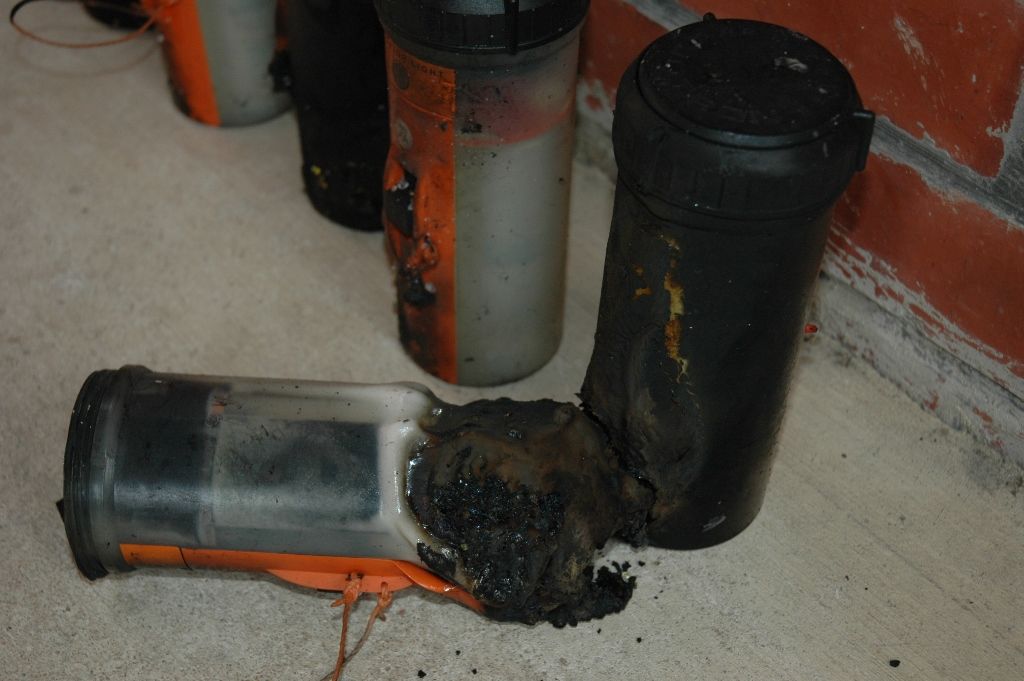
It was shipped back to the manufacturer who could not find any cause for the fire. I simply do not trust these batteries anymore.
Per
Paxing All Over The World


Joined: May 2001
Posts: 10,843
Likes: 328
From: Hertfordshire, UK.
fizz57
But we do know better BECAUSE:-
Had they have tested the complete system in a more rigourous manner that closely replicated in service life, then folks might think that they know less than Boeing and their pals.
Boeing appears to have placed money and marketing above engineering - such as moving head office 2000 miles away to keep their hands clean. Yet, every company that gets to the top of the pile will become over confident and pull itself down several rungs. It is only a question of when, not if.
Unlike the majority here who seem to think they know better than the qualified guys and girls at Boeing, Thales and Yuasa ...
... and since we know that the entire electrical system was never tested as a whole before the planes started flying, that is where we should look for a root cause.
Boeing appears to have placed money and marketing above engineering - such as moving head office 2000 miles away to keep their hands clean. Yet, every company that gets to the top of the pile will become over confident and pull itself down several rungs. It is only a question of when, not if.
Last edited by PAXboy; 20th March 2013 at 13:07. Reason: typographical


