


Helicopter crash New York City


Joined: Aug 2009
Aviation Qualifications: Military
Posts: 9,328
Likes: 2,175
From: Texas
crab, I am not sure that they have found all of the pieces yet. There was some discussion about some of the tail trotor drive shaft sections not having been accounted for a few days back. (They may have been, of course, at this point).
As to how hard water is: yeah, our SAR swimmer deployment limits were 10 feet and 10 kts GS.
Flexible:
From the diagrams many posts up, the Tail Rotor system on the Long Ranger "pushes" in its anti torque function. (In comparison, the Seahawks/Blackhawks I flew had a "pull" tail rotor system).
Would the loss of tail drive not induce a right rotation of the nose rather than the left rotation seen in the video?
Further that thought, if the tail drive was lost as the initiating event, would that not reduce the load on the tail boom (the push is removed) and thus leave something else as the reason for the forward folding (seen on the video) of the tail boom? Some force caused that material failure.
If a tail rotor blade failed, though, or if a pitch link failed, that would set up a vibration that would manifest along the tail boom down to the attach point ... but wouldn't that be at a higher pitch/frequency than the 1 per rev vibration being discussed (as discerned from the audio?)
While discounting nothing, I don't think that the failures you listed would manifest themselves in what was seen on the video...something else seems to have been the initiating event / failure.
As to how hard water is: yeah, our SAR swimmer deployment limits were 10 feet and 10 kts GS.
Flexible:
From the diagrams many posts up, the Tail Rotor system on the Long Ranger "pushes" in its anti torque function. (In comparison, the Seahawks/Blackhawks I flew had a "pull" tail rotor system).
Would the loss of tail drive not induce a right rotation of the nose rather than the left rotation seen in the video?
Further that thought, if the tail drive was lost as the initiating event, would that not reduce the load on the tail boom (the push is removed) and thus leave something else as the reason for the forward folding (seen on the video) of the tail boom? Some force caused that material failure.
If a tail rotor blade failed, though, or if a pitch link failed, that would set up a vibration that would manifest along the tail boom down to the attach point ... but wouldn't that be at a higher pitch/frequency than the 1 per rev vibration being discussed (as discerned from the audio?)
While discounting nothing, I don't think that the failures you listed would manifest themselves in what was seen on the video...something else seems to have been the initiating event / failure.


Joined: Jan 2009
Aviation Qualifications: ATP+Mil
Posts: 344
Likes: 105
From: Sweden
Originally Posted by [email protected]
Surely we have exhausted most reasonable causes and are now going in circles - it must be time now to wait for the NTSB to give the answers.
If the Blancolirio YouTube video (posted earlier) is correct with sounds and timing, the helicopter was flying approx straight and level when these ~1/rev frequency pulsed noice arose.
If the sound matching is correct, I’m having a hard time seeing it is not a clear lead to the cause of the accident.
Joined: Jan 2009
Aviation Qualifications: ATP+Mil
Posts: 344
Likes: 105
From: Sweden

Joined: Jul 2002
Posts: 221
Likes: 18
From: Somewhere, Over the Rainbow

Joined: Apr 2000
Aviation Qualifications: ATP+Mil
Posts: 10,959
Likes: 1,814
From: EGDC
If that is their primary area of concern it would seem to rule out a lot of other theories.
Surely pilots aren't repeatedly experiencing severe vertical bounce without reporting it?
Surely pilots aren't repeatedly experiencing severe vertical bounce without reporting it?
Joined: Nov 2010
Posts: 880
Likes: 225
From: Australia
The Airworthiness Concern Sheet shared by TwinHueyMan in #428 doesn't mention the New York accident, rather a 206L, N9984K, that landed safely in Washington state on 26 Sept 2024 despite substantial damage to the tailboom following continued (vertical) vibrations, see: https://asn.flightsafety.org/wikibase/454639. Still, is there a connection?
I have various comments on a few of the earlier posts:
Lonewolf_50 (#423): From the video you perceive a left yaw motion of the fuselage which you note would be contrary to a loss of tail rotor thrust. But several others perceive a right yaw of the fuselage which would then be consistent with a loss of tail rotor thrust. Watching the video it is hard to tell which direction the yaw actually is (see of example zoomed in clip from 16:39 onwards in the video linked at #391).
JamesT73J (#420): You ask wouldn't the VH hop ever be more than an "uncomfortable experience"? That isn't how some seem to describe it elsewhere on this thread and on the VH blades thread linked by Chock Puller at #361. It sounds scary in some cases.
hanche (#415): You mention an object seen briefly as the tail departs. If you look at the wreckage images in #363, it seems likely the rotors cut various parts of the tailboom so many smaller pieces were probably cut away. It would be very hard to work out which they are in the video, even the original version.
AAKEE (#414): Thanks for the image of your analysis of the audio from the break-up. The NTSB would surely be using that audio to try to help work out what occurred. When you refer to the "rotor assembly winding down" I assume you mean after it had already detached from the fuselage rather than earlier on? My post #340 has a screen shot that suggests one blade might be shorter than the other by that point but that could still be an illusion due to the pixelated image. Other screen shots I attempted didn't show such asymmetry in blade length. If that portion of the rotor departed in the air, it would still need to be determined whether that happened first or only after the rotor(s) struck the tail boom etc.
TwinHueyMan (#411): You feel there is a greater prospect of mast bending on ground impact than when the rotors detached from the helicopter(s). I can see either event could be violent enough to cause the damage that can be seen on the mast(s). To roughly compare one against the other, consider the kinetic energy stored in the rotor at cruise and the energy of a free falling rotor hitting the ground. I roughly estimate the 206L rotor might have 840 kJ of stored energy. If rotor strikes fuselage that can translate to a lot of force or moment exerted on the mast. If rotor is assumed to fall around 500ft (1437' msl - 900' msl) then pessimistically, and neglecting any autorotation or drag, it would hit the ground at around 57 m/s. Assuming the rotor system above the mast is around 140kg, then it collapsing onto the mask on impact would equate to around 230 kJ of energy release, so around 30% of the energy stored in the driven rotor when torn from the fuselage. I realise this is a crude comparison and the reality will all depend on how kinetic energy converts to damage to the components.
wrench1 (#410): You indicate fatigue cracks in blade spar of the Kentucky accident. But are you referring to the loss of the 206L-1 N114AE on 6 June 2013? The NTSB final report makes no reference to "fatigue" and I couldn't find fatigue mentioned in the airframe report of that accident either.
I have various comments on a few of the earlier posts:
Lonewolf_50 (#423): From the video you perceive a left yaw motion of the fuselage which you note would be contrary to a loss of tail rotor thrust. But several others perceive a right yaw of the fuselage which would then be consistent with a loss of tail rotor thrust. Watching the video it is hard to tell which direction the yaw actually is (see of example zoomed in clip from 16:39 onwards in the video linked at #391).
JamesT73J (#420): You ask wouldn't the VH hop ever be more than an "uncomfortable experience"? That isn't how some seem to describe it elsewhere on this thread and on the VH blades thread linked by Chock Puller at #361. It sounds scary in some cases.
hanche (#415): You mention an object seen briefly as the tail departs. If you look at the wreckage images in #363, it seems likely the rotors cut various parts of the tailboom so many smaller pieces were probably cut away. It would be very hard to work out which they are in the video, even the original version.
AAKEE (#414): Thanks for the image of your analysis of the audio from the break-up. The NTSB would surely be using that audio to try to help work out what occurred. When you refer to the "rotor assembly winding down" I assume you mean after it had already detached from the fuselage rather than earlier on? My post #340 has a screen shot that suggests one blade might be shorter than the other by that point but that could still be an illusion due to the pixelated image. Other screen shots I attempted didn't show such asymmetry in blade length. If that portion of the rotor departed in the air, it would still need to be determined whether that happened first or only after the rotor(s) struck the tail boom etc.
TwinHueyMan (#411): You feel there is a greater prospect of mast bending on ground impact than when the rotors detached from the helicopter(s). I can see either event could be violent enough to cause the damage that can be seen on the mast(s). To roughly compare one against the other, consider the kinetic energy stored in the rotor at cruise and the energy of a free falling rotor hitting the ground. I roughly estimate the 206L rotor might have 840 kJ of stored energy. If rotor strikes fuselage that can translate to a lot of force or moment exerted on the mast. If rotor is assumed to fall around 500ft (1437' msl - 900' msl) then pessimistically, and neglecting any autorotation or drag, it would hit the ground at around 57 m/s. Assuming the rotor system above the mast is around 140kg, then it collapsing onto the mask on impact would equate to around 230 kJ of energy release, so around 30% of the energy stored in the driven rotor when torn from the fuselage. I realise this is a crude comparison and the reality will all depend on how kinetic energy converts to damage to the components.
wrench1 (#410): You indicate fatigue cracks in blade spar of the Kentucky accident. But are you referring to the loss of the 206L-1 N114AE on 6 June 2013? The NTSB final report makes no reference to "fatigue" and I couldn't find fatigue mentioned in the airframe report of that accident either.
Last edited by helispotter; 7th May 2025 at 13:29.
Joined: Oct 2006
Aviation Qualifications: A&P
Posts: 1,346
Likes: 270
From: USA
The Airworthiness Concern Sheet shared by TwinHueyMan in #428 doesn't mention the New York accident, rather a 206L, N9984K, that landed safely in Washington state on 26 Sept 2024 despite substantial damage to the tailboom following continued (vertical) vibrations, see: https://asn.flightsafety.org/wikibase/454639. Still, is there a connection?
wrench1 (#410): You indicate fatigue cracks in blade spar of the Kentucky accident. But are you referring to the loss of the 206L-1 N114AE on 6 June 2013? The NTSB final report makes no reference to "fatigue" and I couldn't find fatigue mentioned in the airframe report of that accident either.
Joined: Jul 2002
Posts: 221
Likes: 18
From: Somewhere, Over the Rainbow
Joined: Oct 2003
Posts: 221
Likes: 2
From: Hampshire, UK
Juan Brown has picked up the VHA angle:
Something I need a bit of education about. I understand the 2/rpm bounce from aerodynamic loads on a 2-bladed rotor, There's some reference to the accident aircraft exhibiting tail wag at ground idle. I'm a little confused about the dynamics here; there's no aerodynamic load, is this just balance of a rotating mass? How would composite blades exacerbate this, compared to the OEM aluminium honeycomb blades?
Something I need a bit of education about. I understand the 2/rpm bounce from aerodynamic loads on a 2-bladed rotor, There's some reference to the accident aircraft exhibiting tail wag at ground idle. I'm a little confused about the dynamics here; there's no aerodynamic load, is this just balance of a rotating mass? How would composite blades exacerbate this, compared to the OEM aluminium honeycomb blades?
Joined: Jul 2002
Posts: 221
Likes: 18
From: Somewhere, Over the Rainbow
Originally Posted by JamesT73J;[url=tel:11882801
11882801[/url]]Juan Brown has picked up the VHA angle:
https://youtu.be/z7A7j253jT0
Something I need a bit of education about. I understand the 2/rpm bounce from aerodynamic loads on a 2-bladed rotor, There's some reference to the accident aircraft exhibiting tail wag at ground idle. I'm a little confused about the dynamics here; there's no aerodynamic load, is this just balance of a rotating mass? How would composite blades exacerbate this, compared to the OEM aluminium honeycomb blades?
https://youtu.be/z7A7j253jT0
Something I need a bit of education about. I understand the 2/rpm bounce from aerodynamic loads on a 2-bladed rotor, There's some reference to the accident aircraft exhibiting tail wag at ground idle. I'm a little confused about the dynamics here; there's no aerodynamic load, is this just balance of a rotating mass? How would composite blades exacerbate this, compared to the OEM aluminium honeycomb blades?
Van Horn has stated in their IL that incorrect sweep of the blades can exasperate the in-flight vertical hop occurrence rate/severity.
Joined: Oct 2006
Aviation Qualifications: A&P
Posts: 1,346
Likes: 270
From: USA
Something I need a bit of education about. I understand the 2/rpm bounce from aerodynamic loads on a 2-bladed rotor, There's some reference to the accident aircraft exhibiting tail wag at ground idle. I'm a little confused about the dynamics here; there's no aerodynamic load, is this just balance of a rotating mass? How would composite blades exacerbate this, compared to the OEM aluminium honeycomb blades?

Joined: Feb 2015
Aviation Qualifications: PPL
Posts: 1,758
Likes: 358
From: Cincinnati, Ohio
Bearing in mind that I have nearly 1,000 hours PIC fixed-wing time but about 5 in rotary-wing, i must say that, especially when right seat in a Bell 206 LR, I was amazed at the immense forces to which all drive components, especially the rotor blades, are subjected. Engine(s), gear boxes and drive trains, hubs, swashplates, weights and counterweights, control rods, and blades seem to be locked in mortal combat to see which component can shake its neighbors into catastrophic failure! Hats off to Igor Sikorsky and all who followed into the amazing piece of kit that is the helicopter. No wonder my fixed-wing flight instructor called choppers "Frantic Palm Trees"!
- Ed
- Ed
Joined: Nov 2010
Posts: 880
Likes: 225
From: Australia
From that video, I have merged multiple screen shots. While the footage in the clip starts soon before the helicopter moves behind the building, it isn't clear to me there is any significant altitude change. So what have those people observed?

The preliminary NTSB report indicates altitude data changing from 625' to 675' msl soon before the break-up but the altitude data from ADS-B is possibly only given to a 25' resolution to start with:
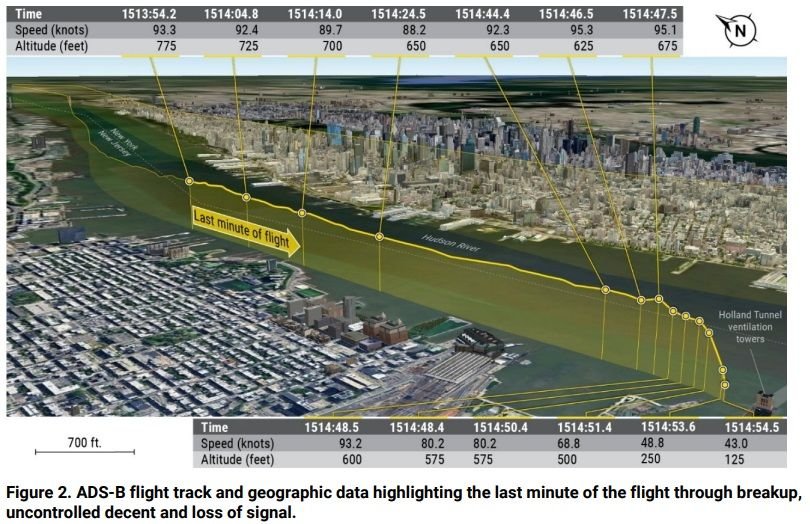
Based on projecting from ground features, the 675' data point in the report would roughly align with the helicopter emerging from behind the building in the video.
There is another point in the NTSB preliminary report that still mystifies me: It says: "...Debris was also recovered... from a rooftop near the Hoboken, New Jersey, transit building". They don't indicate what debris that was though that would have been known. Was this debris significant? Based on the description, that location is around 500m from where the helicopter experienced its sudden yaw and subsequent breakup (location is obscured behind building at lower left in video screen shot above, see my red arrow). So either (1) it already parted the helicopter earlier in its flight, (2) it was thrown back through its initial momentum or (3) it was very light and drifted with the wind to that rooftop location, which is quite separate from where the major debris items landed in the river as seen below (the video camera position is approximately at location "C" with the Ellipse building circled in yellow):

Joined: Oct 2006
Aviation Qualifications: A&P
Posts: 1,346
Likes: 270
From: USA
There is another point in the NTSB preliminary report that still mystifies me: It says: "...Debris was also recovered... from a rooftop near the Hoboken, New Jersey, transit building". They don't indicate what debris that was though that would have been known. Was this debris significant?
Joined: Sep 2011
Posts: 522
Likes: 77
From: USA
The proposed bill to ban tours and all other non-essential NYC helicopter traffic is gathering pace. I just can't see the rich folk driving out to their Hampton estates on a Friday evening. I suspect their political influence will stump this one.
https://nypost.com/2025/05/26/us-new...-federal-bill/
https://nypost.com/2025/05/26/us-new...-federal-bill/
Joined: Nov 2010
Posts: 880
Likes: 225
From: Australia
The proposed bill to ban tours and all other non-essential NYC helicopter traffic is gathering pace...
https://nypost.com/2025/05/26/us-new...-federal-bill/
https://nypost.com/2025/05/26/us-new...-federal-bill/
Even if all of these are counted, it amounts to an average of 0.8 fatalities per year over that 48-year span! I wonder what it reduces to if only fatalities due to scenic tours (or other "non-essential" helicopter flights) are counted? Also, how many 3rd parties were killed as a result of the relevant accidents over all these years?
I wonder how that compares to annual motor vehicle accident fatalities in the New York area? Time to stop all non-essential motor vehicle movements in the NY area???
If there are legitimate safety concerns with how the tour operations are conducted, then by all means address any such issues!
Last edited by helispotter; 27th May 2025 at 12:35.
Joined: Aug 2009
Aviation Qualifications: Military
Posts: 9,328
Likes: 2,175
From: Texas
"Supporters of a tourist-chopper ban argue that the tragic incident last month wasn’t an isolated incident, with at least 38 fatalities tied to helicopter crashes in New York City since 1977, according to The Associated Press".
Even if all of these are counted, it amounts to an average of 0.8 fatalities per year over that 48-year span! I wonder what it reduces to if only fatalities due to scenic tours (or other "non-essential" helicopter flights are counted? If there are legitimate safety concerns with how the tour operations are conducted, then by all means address any such issues!
Even if all of these are counted, it amounts to an average of 0.8 fatalities per year over that 48-year span! I wonder what it reduces to if only fatalities due to scenic tours (or other "non-essential" helicopter flights are counted? If there are legitimate safety concerns with how the tour operations are conducted, then by all means address any such issues!
You'll notice that they don't cite how many people got into a helicopter, took their tour, and then got out. That would be in the millions, possibly tens of millions, over the course of almost 50 years.

Joined: Jan 2008
Posts: 315
Likes: 57
From: LONDON
Part of the NY Post article has: "Supporters of a tourist-chopper ban argue that the tragic incident last month wasn’t an isolated incident, with at least 38 fatalities tied to helicopter crashes in New York City since 1977, ...
....
I wonder how that compares to annual motor vehicle accident fatalities in the New York area? Time to stop all non-essential motor vehicle movements in the NY area???
....
I wonder how that compares to annual motor vehicle accident fatalities in the New York area? Time to stop all non-essential motor vehicle movements in the NY area???
Mayor Adams Announces Traffic Deaths Reach Historic Low During First Quarter of 2025