


Helicopter crash New York City


Joined: Dec 2000
Aviation Qualifications: Non-Aircrew
Posts: 724
Likes: 40
From: Arlington, Tx. US


Joined: Oct 2006
Aviation Qualifications: A&P
Posts: 1,346
Likes: 270
From: USA
It is my understanding that the “vertical hop” with Van Horn blades is asynchronous with main rotor 1/rev which makes it completely different from the “hop” with Bell blades. With Bell blades the “hop” at certain torque settings (ground and flight) is at 1/rev and is aggravated by a swashplate with freeplay when the sum of the forces on the swashplate oscillates through zero. With Bell blades this “feature” is never at a level that would be considered violent. The VH “hop” sounds more like it is sourced from a rotor mode coincident with an airframe/pylon mode.
Joined: Dec 2000
Aviation Qualifications: Non-Aircrew
Posts: 724
Likes: 40
From: Arlington, Tx. US
Bell calls it collective bounce which I believe is the same term VH uses in its bulletin on the matter which goes into more detail. I just used the same terminology as the previous poster. I've always been instructed its main cause was pilot vs collective interaction that was magnified due to improper collective system friction which was addressed in the Bell OSN. There are also a number of other docs on the issue and it’s my understanding any 2-blade teetering system is susceptible to it regardless of blade type.

Joined: Oct 1999
Aviation Qualifications: ATPL
Posts: 7,371
Likes: 926
From: Den Haag
What you are describing is PIO (pilot induced oscillation) and it is not limited to two bladed helicopters. What I am alluding to is actual “slop” in the swashplate assembly due to worn components. If these are present the swashplate has a degree of freedom to pump the rotor independent of actual control position. This occurs when the sum of the pitch link loads oscillates through zero which is around the 40% torque range. If the pitch link loads between blades are equal this zone can entered without a perceived change in vibration. If the mean pitch link load between blades are not equal (generally due to sloppy track and balance) this imbalance pumps the rotor without crew input.
Joined: Oct 2006
Aviation Qualifications: A&P
Posts: 1,346
Likes: 270
From: USA
What you are describing is PIO (pilot induced oscillation) and it is not limited to two bladed helicopters. What I am alluding to is actual “slop” in the swashplate assembly due to worn components. If these are present the swashplate has a degree of freedom to pump the rotor independent of actual control position.
Joined: Nov 2010
Posts: 880
Likes: 225
From: Australia
It is my understanding that the “vertical hop” with Van Horn blades is asynchronous with main rotor 1/rev which makes it completely different from the “hop” with Bell blades. With Bell blades the “hop” at certain torque settings (ground and flight) is at 1/rev and is aggravated by a swashplate with freeplay when the sum of the forces on the swashplate oscillates through zero. With Bell blades this “feature” is never at a level that would be considered violent. The VH “hop” sounds more like it is sourced from a rotor mode coincident with an airframe/pylon mode.
I still have an uneasy feeling that blades with different mass and stiffness characteristics than OEM Bell blades might be adversely interacting with the Nodamatic system in a way that hasn't been fully understood by VH, Bell or regulators? Furthermore, I feel it might be possible any "hop" may not be doing much good to the securing arrangement for the inertia masses in the blade tips. So the need for the tap testing (and VH has a more recent reminder of the importance of this on their website) and the incidence of "hopping" could be linked. Speculation?... sure, I accept it is. The sooner NTSB has findings on New York accident and TSB has findings on latest Long Ranger loss, the better.
Last edited by helispotter; 8th August 2025 at 01:34.
Joined: Dec 2000
Aviation Qualifications: Non-Aircrew
Posts: 724
Likes: 40
From: Arlington, Tx. US
Helispotter,
I mean it is not related to any rotor harmonic or sub-harmonic, so no .5, 1, 2 etc /revs. These are generally at a natural frequency of the rotor, pylon, and/or airframe. For an asynchronous to become a problem the “and” is the operable term. It generally takes a gust exciting the rotor at a frequency close to a fixed system mode which results in a response in such a manner that it can feed back into the rotor to sustain or amplify the vibration.
I mean it is not related to any rotor harmonic or sub-harmonic, so no .5, 1, 2 etc /revs. These are generally at a natural frequency of the rotor, pylon, and/or airframe. For an asynchronous to become a problem the “and” is the operable term. It generally takes a gust exciting the rotor at a frequency close to a fixed system mode which results in a response in such a manner that it can feed back into the rotor to sustain or amplify the vibration.
Joined: Nov 2010
Posts: 880
Likes: 225
From: Australia
Helispotter,
I mean it is not related to any rotor harmonic or sub-harmonic, so no .5, 1, 2 etc /revs. These are generally at a natural frequency of the rotor, pylon, and/or airframe. For an asynchronous to become a problem the “and” is the operable term. It generally takes a gust exciting the rotor at a frequency close to a fixed system mode which results in a response in such a manner that it can feed back into the rotor to sustain or amplify the vibration.
I mean it is not related to any rotor harmonic or sub-harmonic, so no .5, 1, 2 etc /revs. These are generally at a natural frequency of the rotor, pylon, and/or airframe. For an asynchronous to become a problem the “and” is the operable term. It generally takes a gust exciting the rotor at a frequency close to a fixed system mode which results in a response in such a manner that it can feed back into the rotor to sustain or amplify the vibration.
You earlier wrote: "...Bell blades the “hop” at certain torque settings (ground and flight) is at 1/rev and is aggravated...". So this must be different to the 2/rev vibration that Bell has intentionally tried to tune out with the Nodamatic suspension? Is the "Bell hop" mentioned here something that comes and goes?
You also earlier wrote : "The VH “hop” sounds more like it is sourced from a rotor mode coincident with an airframe/pylon mode". Do you mean the various natural frequencies for the rotor and airframe/pylon? Are you also suggesting an initial disturbance such as effect of a gust is perhaps setting off a vibration at such natural frequencies that isn't being naturally damped out, along the lines of flutter?
Last edited by helispotter; 8th August 2025 at 21:51.
Joined: Oct 2006
Aviation Qualifications: A&P
Posts: 1,346
Likes: 270
From: USA
Van Horn Info letter
FAA ACS
Incident mentioned in ACS
TSB Report of accident with Bell blades installed

Joined: Apr 2008
Aviation Qualifications: SLF
Posts: 1,112
Likes: 227
From: troposphere
Joined: Nov 2010
Posts: 880
Likes: 225
From: Australia
Joined: Dec 2000
Aviation Qualifications: Non-Aircrew
Posts: 724
Likes: 40
From: Arlington, Tx. US
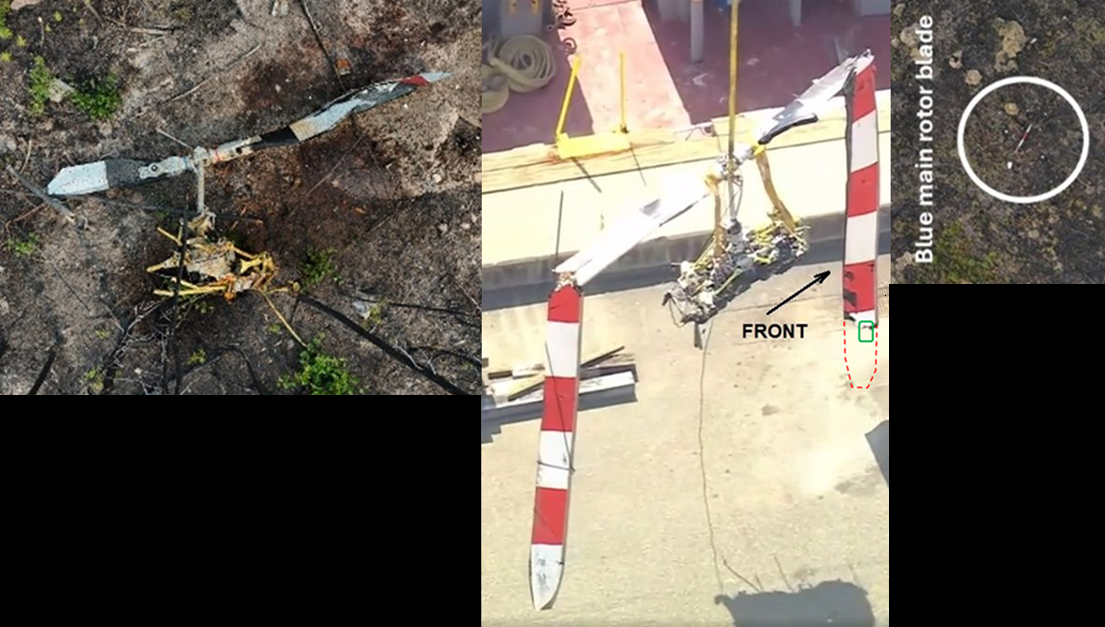
The most disturbing thing to me is that the span location of the blade failure on the Canada accident is no where near the span location of the suspect failure on the New York accident (post 259, this thread). This indicates two separate root causes. It is interesting that both aircraft were operated in roles known for high GAG cycle rates.
Joined: Aug 2006
Aviation Qualifications: LAME
Posts: 264
Likes: 55
From: Hedge
The most disturbing thing to me is that the span location of the blade failure on the Canada accident is no where near the span location of the suspect failure on the New York accident (post 259, this thread). This indicates two separate root causes. It is interesting that both aircraft were operated in roles known for high GAG cycle rates.
Hard to identify weak points unless they present, and when they do tends to be sudden.
Still leaning towards harmonic feedback into Nodal Beam system though.
Previous posts I have made will explain thinking.

Joined: Dec 2004
Posts: 178
Likes: 5
From: Great White North
And then, there's this one, with detailed analysis of the fractured blades 
Air transportation safety investigation A19P0142 - Transportation Safety Board of Canada
Fly Safe, Always
Air transportation safety investigation A19P0142 - Transportation Safety Board of Canada
Fly Safe, Always
Joined: Oct 1999
Aviation Qualifications: ATPL
Posts: 7,371
Likes: 926
From: Den Haag
And then, there's this one, with detailed analysis of the fractured blades
Air transportation safety investigation A19P0142 - Transportation Safety Board of Canada
Fly Safe, Always
Air transportation safety investigation A19P0142 - Transportation Safety Board of Canada
Fly Safe, Always
Joined: Nov 2010
Posts: 727
Likes: 47
From: Earth
OK, so who has experienced the so-called "VH hop" and lived to tell the tale? I am still confused as to whether it is concentrated around a defined frequency or is vibrations all over the show (sort of a "white noise"). Would any pilot that has experienced this even be able to characterise it compared to the regular vibrations they are familiar with from their helicopter?
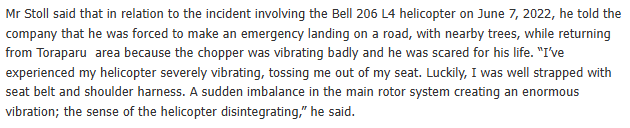
https://demerarawaves.com/2022/12/07...pper-grounded/
Joined: Nov 2010
Posts: 727
Likes: 47
From: Earth
The most disturbing thing to me is that the span location of the blade failure on the Canada accident is no where near the span location of the suspect failure on the New York accident (post 259, this thread). This indicates two separate root causes. It is interesting that both aircraft were operated in roles known for high GAG cycle rates.
Joined: Nov 2010
Posts: 880
Likes: 225
From: Australia
Oh, and I think Cassandra Forde should be taken up in that helicopter when it is equally lightly loaded to see if she also encounters what the pilot did!