


Helicopter crash New York City


Joined: Dec 2000
Aviation Qualifications: Non-Aircrew
Posts: 724
Likes: 40
From: Arlington, Tx. US
Hello Otto,
It was John Honaker. Not a scratch. Jerry Carter has just run up the ship for initial flight. Had a Vibrex problem and shutdown I fixed it and John hopped in. Fifteen minutes later and we would have lost him for sure.
Gene Colvin told me when he was testing the HH-43 Huskie at extreme c.g. while an Air Force test pilot he got a blade into the airframe in flight. As the ship was coming apart he couldn't get the door open. The front bubble imploded and he bailed out through the opening.
It was John Honaker. Not a scratch. Jerry Carter has just run up the ship for initial flight. Had a Vibrex problem and shutdown I fixed it and John hopped in. Fifteen minutes later and we would have lost him for sure.
Gene Colvin told me when he was testing the HH-43 Huskie at extreme c.g. while an Air Force test pilot he got a blade into the airframe in flight. As the ship was coming apart he couldn't get the door open. The front bubble imploded and he bailed out through the opening.


Joined: Oct 2007
Posts: 2,515
Likes: 151
From: A better place.
I am a subscriber. Apparently I am entitled to "gift" a few articles per month, so try this link:
https://www.nytimes.com/2025/04/12/n...smid=url-share
https://www.nytimes.com/2025/04/12/n...smid=url-share
Guest

Joined: Jul 2017
Aviation Qualifications: Spotter
Posts: 840
Likes: 236
From: UK
Before a Fatal HelicopterCrash, 2 MidairBreakdowns and UnpaidBills
The charter firm whose helicopter plunged into theHudson River, killing the pilot and a family of five, hadbeen struggling financially, records show.
By Patrick McGeehanMichael Rothfeldand Christopher Maag
April 12, 2025
As federal investigators began the long job of examining what caused a sightseeing helicopter to crash into the Hudson River on Thursday, killing all six people on board, details began to emerge about the small company that made the doomed flight — and its operator’s checkered history.
Public records and interviews with pilots and other members of the helicopter industry showed that the company, which has operated as New York Helicopter Charter, had long been seen as an also-ran in the competitive business of taking tourists for aerial views of landmarks in and around New York City.
Its fleet was smaller and older than those of the biggest operators in the metropolitan area, where a single helicopter can earn up to $5,000 an hour.
Its owner and chief executive, Michael Roth, had developed a reputation for being slow to pay and quick to sue. After a sightseeing flight in 2013 ended in an emergency landing in the Hudson, Mr. Roth sued a company that had performed maintenance on its aircraft, saying it was to blame for the near disaster.
He accused the operator of one heliport in Manhattan of “ripping us off” and later sued the operator of another heliport to regain access there after being accused of failing to make good on past debts. He has also sued lenders over loan agreements, one of which he called “criminally usurious” in a court filing.
“He’s had disputes with everybody,” said John Kjekstad, a longtime sightseeing tour operator who said he has known Mr. Roth for 40 years. “That’s him.”
Even before the Covid pandemic wiped out tourism in New York, Mr. Roth’s company had fallen into tough financial straits. His company filed for bankruptcy in 2019 and had one its helicopters repossessed late last year, just eight months into its lease. Court records show that Mr. Roth reconstituted the business as New York Helicopter Tours after it failed under its former name.
Reached by phone on Friday, Mr. Roth said: “I can’t talk to you. Have a nice day.”
Mr. Roth has said he has been in the charter helicopter business for 30 years, dating to the 1990s, when there was less competition, and regulation, and a generally easier acceptance of helicopters as a mode of a travel in a crowded, urban area. He started New York Helicopter Charter in August 1998, state records show.
His company earned about $5 million a year from the 1990s well into the 2000s, financial records show. There were no reports of crashes or other distressing incidents involving the firm in those years.
The first public signs of trouble came in the 2010s, when aircraft operated by New York Helicopter Charter were involved in two incidents in the span of two years.
In 2013, a pilot ferrying a family of four Swedish tourists over the Hudson River heard a loud popping sound and began to lose power. As they descended toward the water, the pilot inflated pontoons that held the helicopter upright and he and the passengers escaped uninjured.
In 2015, another of its helicopters was lifting off from a base in New Jersey when the pilot began to lose control before he could set the aircraft back down. An investigative report of the incident described it as a “hard landing.” The pilot was not hurt.
By then, the airspace over the metropolitan area had become more crowded, prompting residents and their elected officials to press for limitations on the aerial sightseeing industry. Local officials urged the Federal Aviation Administration to curtail the flights or ban them altogether, citing excessive noise and fears of deadly collisions.
By Mr. Roth’s telling, New York Helicopter Charter was dealt a serious blow by a decision city officials made in January 2017 to reduce helicopter traffic. In court papers, Mr. Roth said that decision forced the company to cut the number of takeoffs and landings in half. At the same time, its landing fees at the Lower Manhattan heliport substantially increased, Mr. Roth said in court papers.
More recently, the company and its owner appear to have struggled financially, consistently failing to pay bills, according to records of lawsuits filed to collect debts and judgments from government agencies.
In October 2019, New York Helicopter Charter filed in Manhattan federal court for the Chapter 11 bankruptcy proceeding, which, in an effort for the business to become viable, can allow debtors to organize their financial affairs while continuing to operate.
As part of the case, Mr. Roth testified that the changes in city rules had a “substantial” effect on his business. The company, which cut its payroll from 30 employees to 13, planned to return to profitability by expanding operations in New Jersey and through a Miami affiliate, he added.
At the time, the company’s revenues appeared to be steadily declining. Its income had ranged from $4.6 million to $5.8 million a year since the 1990s, but it dropped to $3.9 million in 2018, and just $2.1 million in the first 10 months of 2019, according to filings in the bankruptcy.
The bankruptcy ended in 2022, leaving many creditors unpaid, but the financial problems continued. In 2024, Mr. Roth resolved two New York state tax liens totaling more than $70,000, and his company paid a $45,000 judgment from the New York State Workers’ Compensation Board, records show. But another workers’ compensation judgment, for $21,500, appears to have gone unpaid. Records indicate that a federal tax lien in his own name for more than $225,000 is also still outstanding.
A New Jersey media company that produced brochures for Mr. Roth’s new firm, New York Helicopter Tours LLC, sued that company last year over $35,000 in unpaid bills; an arbitrator awarded the media company $14,700.
At the time, the company was relying in part on a model of helicopter, the Bell 206, that has fallen out of favor with many tour operators, said Jack Cress, a former Marine Corps helicopter pilot who has worked as a helicopter crash investigator for 50 years. Originally produced for the United States military in the early 1960s, the 206 is smaller than its modern equivalents and can seat fewer paying passengers, Mr. Cress said.
He added that civilian tour operators often fly heavier payloads than does the military, and they also fly more often — placing the aircraft under more stress while exposing them to the waters of the Hudson River, which can force salt into the internal systems and cause corrosion.
Still, after emerging from bankruptcy, New York Helicopter appeared to be recovering. It added to its fleet by leasing a Bell 407 helicopter from PHI MRO Services, based in Lafayette, La.
In a July announcement of the transaction, Mr. Roth said, “This new helicopter will allow us to expand our capabilities and continue to provide world-class tours and charters to the New York area.”
He added that his company looked forward to a “long and continued relationship” with PHI MRO, and to making more additions to its fleet.
Five months later, PHI repossessed the helicopter, saying in a subsequent lawsuit that New York Helicopter had failed to make lease payments or to return the aircraft as Mr. Roth had said he would do. While disputing PHI’s bill, Mr. Roth sent an email that accused the company of failing to provide necessary parts. In all capital letters, Mr. Roth added a request to advise “WHERE YOU WOULD LIKE US TO DROP OFF HELICOPTER ASAP.”
PHI did not wait long for that delivery. On Dec. 13, the company “peaceably and without objection” took back its helicopter, it said in a court filing. Calls to PHI’s offices in Louisiana were not returned on Friday. Its lawsuit, seeking $1.5 million in damages from New York Helicopter, is still pending.
Mr. Kjekstad said the repossession of the Bell 407 was a definite setback for Mr. Roth’s business.
“The 407 is a better helicopter for what we do in our business,” he said.
One of Mr. Roth’s remaining helicopters was a Bell 206 L-4, built in 2004 and owned by a firm in Louisiana. In September, that helicopter was found to have a mechanical problem in its main rotor gearbox, according to a service difficulty report filed with the Federal Aviation Administration. The report noted that bits of metal had been found in the oil of the helicopter’s transmission assembly, a possible sign of worn components.
It was this helicopter that Agustín Escobar boarded on Thursday with his wife, Mercè Camprubí Montal, and their three children — Agustín, 10, Mercè, 8, and Víctor, 4 — for a tour over Manhattan. Mr. Escobar was the chief executive for rail infrastructure for the technology company Siemens, and his family was on vacation to celebrate Ms. Camprubí’s birthday.
At the controls was Seankese Johnson, 36, a U.S. Navy veteran who had started flying for New York Helicopter only this year.
Mr. Johnson and his passengers took off and looped around the Statue of Liberty, then cruised up the Hudson to the George Washington Bridge.
They had made it most of the way back to the heliport when the aircraft broke apart and dove into the water, killing everyone onboard.
Bianca Pallaro and William K. Rashbaum contributed reporting. Susan C. Beachy and Sheelagh McNeill contributed research.
Patrick McGeehan is a Times reporter who covers the economy of New York City and its airports and other transportation hubs.
Michael Rothfeld is an investigative reporter in New York, writing in-depth stories focused on the city’s government, business and personalities.
Christopher Maag is a reporter covering the New York City region for The Times.
A version of this article appears in print on April 13, 2025, Section A, Page 30 of the New York edition with the headline: Before a Fatal Helicopter Crash, 2 Midair Breakdowns and Unpaid Bills.
The charter firm whose helicopter plunged into theHudson River, killing the pilot and a family of five, hadbeen struggling financially, records show.
By Patrick McGeehanMichael Rothfeldand Christopher Maag
April 12, 2025
As federal investigators began the long job of examining what caused a sightseeing helicopter to crash into the Hudson River on Thursday, killing all six people on board, details began to emerge about the small company that made the doomed flight — and its operator’s checkered history.
Public records and interviews with pilots and other members of the helicopter industry showed that the company, which has operated as New York Helicopter Charter, had long been seen as an also-ran in the competitive business of taking tourists for aerial views of landmarks in and around New York City.
Its fleet was smaller and older than those of the biggest operators in the metropolitan area, where a single helicopter can earn up to $5,000 an hour.
Its owner and chief executive, Michael Roth, had developed a reputation for being slow to pay and quick to sue. After a sightseeing flight in 2013 ended in an emergency landing in the Hudson, Mr. Roth sued a company that had performed maintenance on its aircraft, saying it was to blame for the near disaster.
He accused the operator of one heliport in Manhattan of “ripping us off” and later sued the operator of another heliport to regain access there after being accused of failing to make good on past debts. He has also sued lenders over loan agreements, one of which he called “criminally usurious” in a court filing.
“He’s had disputes with everybody,” said John Kjekstad, a longtime sightseeing tour operator who said he has known Mr. Roth for 40 years. “That’s him.”
Even before the Covid pandemic wiped out tourism in New York, Mr. Roth’s company had fallen into tough financial straits. His company filed for bankruptcy in 2019 and had one its helicopters repossessed late last year, just eight months into its lease. Court records show that Mr. Roth reconstituted the business as New York Helicopter Tours after it failed under its former name.
Reached by phone on Friday, Mr. Roth said: “I can’t talk to you. Have a nice day.”
Mr. Roth has said he has been in the charter helicopter business for 30 years, dating to the 1990s, when there was less competition, and regulation, and a generally easier acceptance of helicopters as a mode of a travel in a crowded, urban area. He started New York Helicopter Charter in August 1998, state records show.
His company earned about $5 million a year from the 1990s well into the 2000s, financial records show. There were no reports of crashes or other distressing incidents involving the firm in those years.
The first public signs of trouble came in the 2010s, when aircraft operated by New York Helicopter Charter were involved in two incidents in the span of two years.
In 2013, a pilot ferrying a family of four Swedish tourists over the Hudson River heard a loud popping sound and began to lose power. As they descended toward the water, the pilot inflated pontoons that held the helicopter upright and he and the passengers escaped uninjured.
In 2015, another of its helicopters was lifting off from a base in New Jersey when the pilot began to lose control before he could set the aircraft back down. An investigative report of the incident described it as a “hard landing.” The pilot was not hurt.
By then, the airspace over the metropolitan area had become more crowded, prompting residents and their elected officials to press for limitations on the aerial sightseeing industry. Local officials urged the Federal Aviation Administration to curtail the flights or ban them altogether, citing excessive noise and fears of deadly collisions.
By Mr. Roth’s telling, New York Helicopter Charter was dealt a serious blow by a decision city officials made in January 2017 to reduce helicopter traffic. In court papers, Mr. Roth said that decision forced the company to cut the number of takeoffs and landings in half. At the same time, its landing fees at the Lower Manhattan heliport substantially increased, Mr. Roth said in court papers.
More recently, the company and its owner appear to have struggled financially, consistently failing to pay bills, according to records of lawsuits filed to collect debts and judgments from government agencies.
In October 2019, New York Helicopter Charter filed in Manhattan federal court for the Chapter 11 bankruptcy proceeding, which, in an effort for the business to become viable, can allow debtors to organize their financial affairs while continuing to operate.
As part of the case, Mr. Roth testified that the changes in city rules had a “substantial” effect on his business. The company, which cut its payroll from 30 employees to 13, planned to return to profitability by expanding operations in New Jersey and through a Miami affiliate, he added.
At the time, the company’s revenues appeared to be steadily declining. Its income had ranged from $4.6 million to $5.8 million a year since the 1990s, but it dropped to $3.9 million in 2018, and just $2.1 million in the first 10 months of 2019, according to filings in the bankruptcy.
The bankruptcy ended in 2022, leaving many creditors unpaid, but the financial problems continued. In 2024, Mr. Roth resolved two New York state tax liens totaling more than $70,000, and his company paid a $45,000 judgment from the New York State Workers’ Compensation Board, records show. But another workers’ compensation judgment, for $21,500, appears to have gone unpaid. Records indicate that a federal tax lien in his own name for more than $225,000 is also still outstanding.
A New Jersey media company that produced brochures for Mr. Roth’s new firm, New York Helicopter Tours LLC, sued that company last year over $35,000 in unpaid bills; an arbitrator awarded the media company $14,700.
At the time, the company was relying in part on a model of helicopter, the Bell 206, that has fallen out of favor with many tour operators, said Jack Cress, a former Marine Corps helicopter pilot who has worked as a helicopter crash investigator for 50 years. Originally produced for the United States military in the early 1960s, the 206 is smaller than its modern equivalents and can seat fewer paying passengers, Mr. Cress said.
He added that civilian tour operators often fly heavier payloads than does the military, and they also fly more often — placing the aircraft under more stress while exposing them to the waters of the Hudson River, which can force salt into the internal systems and cause corrosion.
Still, after emerging from bankruptcy, New York Helicopter appeared to be recovering. It added to its fleet by leasing a Bell 407 helicopter from PHI MRO Services, based in Lafayette, La.
In a July announcement of the transaction, Mr. Roth said, “This new helicopter will allow us to expand our capabilities and continue to provide world-class tours and charters to the New York area.”
He added that his company looked forward to a “long and continued relationship” with PHI MRO, and to making more additions to its fleet.
Five months later, PHI repossessed the helicopter, saying in a subsequent lawsuit that New York Helicopter had failed to make lease payments or to return the aircraft as Mr. Roth had said he would do. While disputing PHI’s bill, Mr. Roth sent an email that accused the company of failing to provide necessary parts. In all capital letters, Mr. Roth added a request to advise “WHERE YOU WOULD LIKE US TO DROP OFF HELICOPTER ASAP.”
PHI did not wait long for that delivery. On Dec. 13, the company “peaceably and without objection” took back its helicopter, it said in a court filing. Calls to PHI’s offices in Louisiana were not returned on Friday. Its lawsuit, seeking $1.5 million in damages from New York Helicopter, is still pending.
Mr. Kjekstad said the repossession of the Bell 407 was a definite setback for Mr. Roth’s business.
“The 407 is a better helicopter for what we do in our business,” he said.
One of Mr. Roth’s remaining helicopters was a Bell 206 L-4, built in 2004 and owned by a firm in Louisiana. In September, that helicopter was found to have a mechanical problem in its main rotor gearbox, according to a service difficulty report filed with the Federal Aviation Administration. The report noted that bits of metal had been found in the oil of the helicopter’s transmission assembly, a possible sign of worn components.
It was this helicopter that Agustín Escobar boarded on Thursday with his wife, Mercè Camprubí Montal, and their three children — Agustín, 10, Mercè, 8, and Víctor, 4 — for a tour over Manhattan. Mr. Escobar was the chief executive for rail infrastructure for the technology company Siemens, and his family was on vacation to celebrate Ms. Camprubí’s birthday.
At the controls was Seankese Johnson, 36, a U.S. Navy veteran who had started flying for New York Helicopter only this year.
Mr. Johnson and his passengers took off and looped around the Statue of Liberty, then cruised up the Hudson to the George Washington Bridge.
They had made it most of the way back to the heliport when the aircraft broke apart and dove into the water, killing everyone onboard.
Bianca Pallaro and William K. Rashbaum contributed reporting. Susan C. Beachy and Sheelagh McNeill contributed research.
Patrick McGeehan is a Times reporter who covers the economy of New York City and its airports and other transportation hubs.
Michael Rothfeld is an investigative reporter in New York, writing in-depth stories focused on the city’s government, business and personalities.
Christopher Maag is a reporter covering the New York City region for The Times.
A version of this article appears in print on April 13, 2025, Section A, Page 30 of the New York edition with the headline: Before a Fatal Helicopter Crash, 2 Midair Breakdowns and Unpaid Bills.

Joined: Nov 2000
Aviation Qualifications: PPL
Posts: 85
Likes: 0
From: Annecy
And then ? One would expect that this would lead to a complete overhaul of the transmission, I'd expect the reporter to pursue that angle.
Joined: Nov 2018
Posts: 58
Likes: 52
From: VA
I think there's very little chance the freewheeling unit could be expected to accelerate a 1000# fuselage and 800# of pax from ZERO to 180 deg/sec as fast as the video shows the tail swinging 90 degrees.
The formsprag would instantly explode with that much load applied in milliseconds if it froze. The only thing with enough muscle to snap the tail around that fast is the tail rotor. I just can't imagine anything that would stomp full right pedal in straight & level cruise. I do see ways the MRGB could progressively tear away first, and in the process, fold the tailboom into. I just am baffled. I am anxious to see the main rotor assembly when it comes up.
The formsprag would instantly explode with that much load applied in milliseconds if it froze. The only thing with enough muscle to snap the tail around that fast is the tail rotor. I just can't imagine anything that would stomp full right pedal in straight & level cruise. I do see ways the MRGB could progressively tear away first, and in the process, fold the tailboom into. I just am baffled. I am anxious to see the main rotor assembly when it comes up.
Joined: Nov 2018
Posts: 58
Likes: 52
From: VA
Really depends on what was found. For example on an EC145 certain categories of chips/metal found only require a filter and chip detector inspection every 10 flight hours for 50 flight hours (or something similar, I do not have the AMM open).
Joined: Feb 2008
Posts: 16
Likes: 0
From: Moved a bit west...
I once witnessed (from extremely close range) an AH-1W running on the ground at 100% rpm release an internal main rotor blade weight due to a decade old manufacturing error. When the weight departed it:
1. Blew the end of the blade off,
2. Snapped the main transmission horizontally in half,
3. As the rotor/top case exited the still attached controls put in full pitch,
4. The aircraft was lifted 6’ or so by the control tubes which then failed dropping the fuselage back to the ground,
5. The now unattached rotor climbed 80’ before loosing energy and crashing down in front of the airframe.
The magnitude of the unbalance was so large the xmsn was snapped within one revolution of the rotor so no large 1/rev forces were transmitted to the fuselage. The only fuselage damage was to the cross tubes on one side. The pilot commented that he heard a bang, the aircraft smoothly lifted before falling back to the ground. The airframe was refurbished and returned to service.
if the weight had been less and not immediately snapped the xmsn case, the excessive 1/rev would probably have broken the pilot’s neck and damaged at least the tailboom.
So back to this thread. It is plausible a failure in a blade caused excessive 1/rev which buckled the tailboom and put in full tail rotor pitch through the still connected controls tubes causing the observed yaw. Then a combination of 1/rev loads and aero forces caused the rotor/xmsn/nodal beam to depart with the rotor appearing to fly away intact.
Won’t know until we see both blades.
1. Blew the end of the blade off,
2. Snapped the main transmission horizontally in half,
3. As the rotor/top case exited the still attached controls put in full pitch,
4. The aircraft was lifted 6’ or so by the control tubes which then failed dropping the fuselage back to the ground,
5. The now unattached rotor climbed 80’ before loosing energy and crashing down in front of the airframe.
The magnitude of the unbalance was so large the xmsn was snapped within one revolution of the rotor so no large 1/rev forces were transmitted to the fuselage. The only fuselage damage was to the cross tubes on one side. The pilot commented that he heard a bang, the aircraft smoothly lifted before falling back to the ground. The airframe was refurbished and returned to service.
if the weight had been less and not immediately snapped the xmsn case, the excessive 1/rev would probably have broken the pilot’s neck and damaged at least the tailboom.
So back to this thread. It is plausible a failure in a blade caused excessive 1/rev which buckled the tailboom and put in full tail rotor pitch through the still connected controls tubes causing the observed yaw. Then a combination of 1/rev loads and aero forces caused the rotor/xmsn/nodal beam to depart with the rotor appearing to fly away intact.
Won’t know until we see both blades.
Joined: Feb 2008
Posts: 16
Likes: 0
From: Moved a bit west...
A gearbox in the process of total seizure would suffer a sudden increase in torque applied to the casing, exactly where those forces would occur would depend on what was seizing . If a catastrophic failure of the casing were to occur, almost anything could happen to anything bolted to it, or nearby.
Joined: Nov 2010
Posts: 880
Likes: 225
From: Australia
The nodal arms have up and down stops that limit the travel. In Post 127 just below the break in the lift link, you will see one of the up stops. Once the nodal arms hits those stops that result is directly transmitted to the airframe which you will feel in the aircraft. For example, if the minimum blade angle or autorotation RPM is not set properly, the nodal beams will bounce against the down stops and produce a noticeable "knock" in the cockpit with the collective full down. The common "fix" is to simply pull a bit of collective to pull the beams off the stops, however, the correct fix is to adjust the min blade angle or auto rpm.
It is difficult to find clear images of the Nodamatic suspension on-line, but to give others an impression of what it consists of, following gives an overall view of the system on an unrelated 206L wreck:

In some of the grainy footage shown on the web, it does seem possible that a portion of the cabin top was pulled away with the main rotor (as was suggested in an earlier post) given the size and shape of what is seen hanging from the mast as this portion falls.
Additional to the link with footage of the break-up from ABC News shared by Flexible Response at #139, the ABC also showed somewhat zoomed in and slowed down versions of the same footage from 0:54 in this update:
In #184, Dick Smith asked re status of rotor recovery. The Wikipedia entry for this accident indicates search is underway using a side scan sonar to identify wreckage. However wiki notes that parts already recovered as of April 11 include the forward portion of the tail boom (assuming this doesn't mean the remnants of boom still connected to the main fuselage?), horizontal stabiliser finlets and vertical fin.
Purveyor of Egg Liqueur to Lucifer


Joined: Nov 2002
Aviation Qualifications: ATPL
Posts: 4,752
Likes: 64
From: Alles über die platz
Dave has it all summed up with a full explanation...
"I'm sure it was something to do with the main rotor disc not holding the helicopter where it should be"
https://fb.watch/yYPtGeBVEo/
"I'm sure it was something to do with the main rotor disc not holding the helicopter where it should be"
https://fb.watch/yYPtGeBVEo/
Joined: Aug 2008
Aviation Qualifications: PPL
Posts: 298
Likes: 29
From: KOLM and KBVS
Dave has it all summed up with a full explanation...
"I'm sure it was something to do with the main rotor disc not holding the helicopter where it should be"
https://fb.watch/yYPtGeBVEo/
"I'm sure it was something to do with the main rotor disc not holding the helicopter where it should be"
https://fb.watch/yYPtGeBVEo/
Word escape me.
Joined: Dec 2000
Aviation Qualifications: Non-Aircrew
Posts: 724
Likes: 40
From: Arlington, Tx. US
Anecdote: in development of an ejection system for the crew of the AH-1G Cobra they shot a running cobra down a track on a rocket sled and initiated the ejection. During the sequence one blade was severed and then the mast with the remainder of the rotor was severed. The combined blade/hub/mast flew in a straight line down range much farther than anticipated sending observers diving for cover. As this assembly overflew the camera the distance it travelled was unclear from the film, but was considerable.
Joined: Apr 2025
Posts: 13
Likes: 8
From: Canberra
I was reviewing this news report from 13news that included the newer footage of the chopper emerging from behind a building and I noticed something in a frame just before the yaw.
In that frame there are two dots that appear just behind the chopper, so faint as to be almost invisible, and possibly artifacts in the video, but I thought I would share the relevant frame grab in case it does show something exiting the chopper.

In that frame there are two dots that appear just behind the chopper, so faint as to be almost invisible, and possibly artifacts in the video, but I thought I would share the relevant frame grab in case it does show something exiting the chopper.
Joined: Oct 2006
Aviation Qualifications: A&P
Posts: 1,346
Likes: 270
From: USA
Joined: Apr 2000
Aviation Qualifications: ATP+Mil
Posts: 10,959
Likes: 1,814
From: EGDC
Dave has it all summed up with a full explanation...
"I'm sure it was something to do with the main rotor disc not holding the helicopter where it should be"
https://fb.watch/yYPtGeBVEo/
"I'm sure it was something to do with the main rotor disc not holding the helicopter where it should be"
https://fb.watch/yYPtGeBVEo/
Joined: Feb 2008
Posts: 16
Likes: 0
From: Moved a bit west...
But the video footage of this accident shows the rotor system rotating around what appears to be its intended axis, i.e. the main rotor mast, rather than a displaced one.
Joined: Mar 2019
Posts: 22
Likes: 1
From: Cartersville, GA
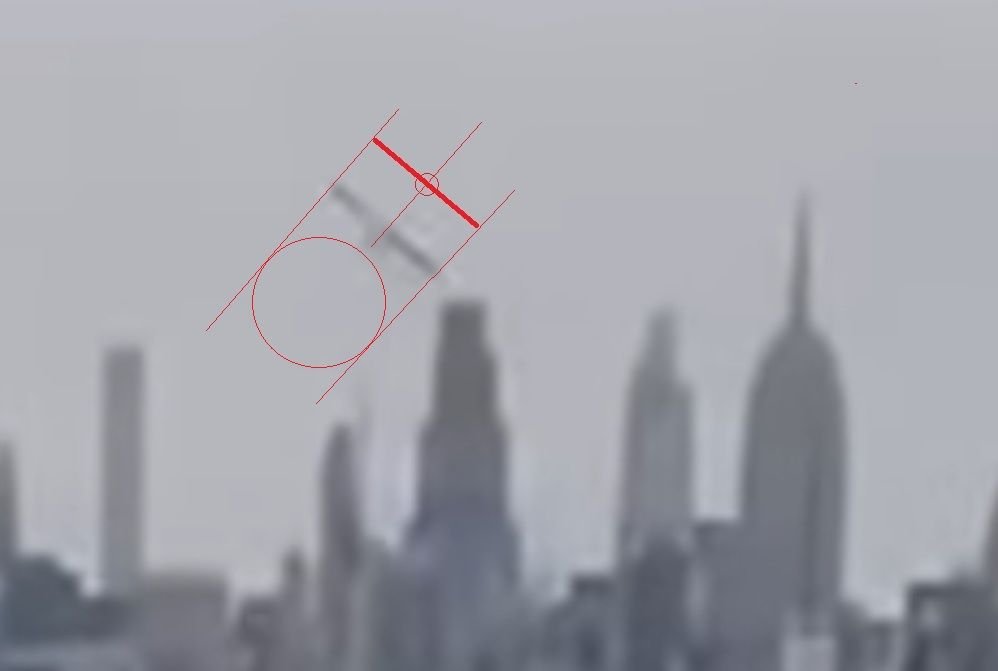
Blades, mast, & gearbox In-tact and Spinning Free
I was just doing my unscientific dive into the falling rotor system. After zooming and watching the few seconds as the rotor was falling, It appears there was no "wobbling" as it was spinning, the blades appeared to be the same length, and they appeared to not be bent. The stable nature of the spinning rotor seems to indicate that the unsymmetrical mass at the gearbox-end of the mast IS NOT SPINNING. I would have a hard time believing the gearbox seized or locked-up. I'd appreciate others' thoughts.
Joined: Mar 2019
Posts: 22
Likes: 1
From: Cartersville, GA
No expert here. I don't have any time in a 206, just a 205. I was investigator in over 1000 vehicle accidents as a State Trooper. LOL. I would not argue against your idea that a "progressive tear-away" could be a feasible explanation. I saw the video of the two large helicopters in Kuwait a few decades ago. They were straight & level in line abreast (side-by-side). Then they got inches too close and rotor tips started striking, barely. Within one second, the tailboom had folded and flew off the aircraft sending the fuselage spinning to the ground. The tailboom is very, very light and weak. It HAS to be. My point is, in the first few milliseconds of a "tear-away" event like you describe, the boom could be broken off.
Last edited by bryancobb; 14th April 2025 at 17:03. Reason: add video