


Broward County accident...


Joined: Sep 2007
Posts: 368
Likes: 21
From: I am not sure where we are, but at least it is getting dark
In the absence of information, assume the worst and act accordingly.
Reminds me of one pilot that had a TR chip caution and parked it in the nearest carpark. Tourists were a bit miffed about the bus trip home and it turned out to be a false alarm.
Then there was the other guy who decided to return to base only to have the gearbox depart enroute.
You can over analyse and find reasons to justify any course of action if you try hard enough.
First priority should always be to save your ass, not to cover it.
Reminds me of one pilot that had a TR chip caution and parked it in the nearest carpark. Tourists were a bit miffed about the bus trip home and it turned out to be a false alarm.
Then there was the other guy who decided to return to base only to have the gearbox depart enroute.
You can over analyse and find reasons to justify any course of action if you try hard enough.
First priority should always be to save your ass, not to cover it.
If I had assumed I was about to have a structural failure last time I had a fire light, I would have had to land in tall trees. In my case that would've been the entirely wrong call and I could've killed or hurt myself and my passengers doing so.
In this case here it was different. The failure also happened rather quickly, even though it looks like an eternity when you watch it from the comfort of home on video.
But we don't know what indications the pilot had. Hindsight, that's all.


Joined: Sep 2001
Posts: 301
Likes: 16
From: Australia.
I find it hard to believe that anyone, who knows that they have an uncontained fire on board, would not elect to land immediately.
I've had 1 baggage bay and 3 engine fire warnings in my time, all of them proved to be false indications. All of them had no secondary indications, and had we continued to follow the checklist, three would have resulted in a ditching. The "confirm the fire" part of the checklist is perhaps not given the consideration it deserves, and usually offers no guidance as to what to do if you cannot confirm the fire at that time.

Joined: Feb 2006
Aviation Qualifications: LAME
Posts: 36,137
Likes: 5,738
From: Falling off the end of the thread

Joined: Apr 2000
Aviation Qualifications: ATP+Mil
Posts: 10,959
Likes: 1,814
From: EGDC
I have no doubt that he was unaware of the fire - my point was that he may well have followed his training and delayed shutting down a failed engine until he had time to refer to the check list.
In this case that could well turn out to have been a mistake but that is with 20/20 hindsight.
In this case that could well turn out to have been a mistake but that is with 20/20 hindsight.
Thread Starter
Joined: Oct 2006
Aviation Qualifications: A&P
Posts: 1,348
Likes: 271
From: USA
The initial FAA notice lists the accident as due to unknown circumstances.
Last edited by wrench1; 31st August 2023 at 15:30. Reason: Feel better?
Joined: Nov 2006
Posts: 1,951
Likes: 90
From: After all, what’s more important than proving to someone on the internet that they’re wrong? - Manson
Originally Posted by [email protected]
I have no doubt that he was unaware of the fire - my point was that he may well have followed his training and delayed shutting down a failed engine until he had time to refer to the check list.
In this case that could well turn out to have been a mistake but that is with 20/20 hindsight.
In this case that could well turn out to have been a mistake but that is with 20/20 hindsight.
Below would be following the RFM.
Note the reference to memory items and the requirement to "perform immediately" with the grey background when it arises.
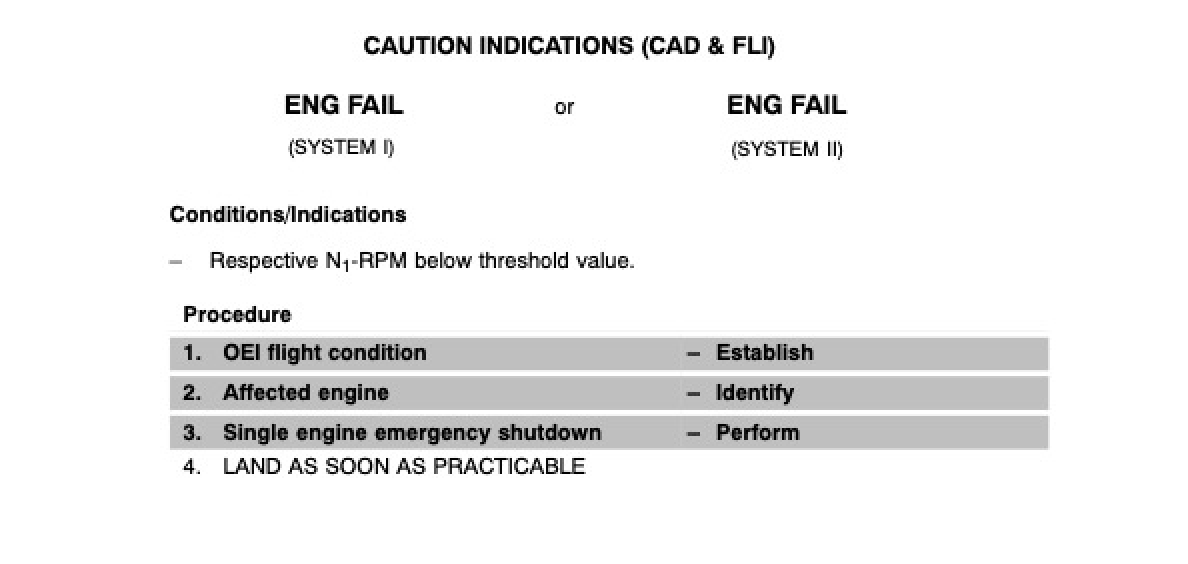

OEI Flight condition - Establish - means - a condition where you can operate effectively with the "normal" engine within OEI limits
Affected Engine - Identify - means - all the Captions which will be numerous in addition to instrumentation.
Single Engine Emergency Shutdown - Perform - means ENG MAIN sw - IDLE, Check indications (confirm), then OFF.
Fire in flight only has one additional item - EMER OFF switch - which closes the fuel supply valve. IF you have Engine Fire Extinguisher fitted it will automatically fire when FIRE is active, fuel valve is closed and N1 < 55% - there is no way to activate it manually.
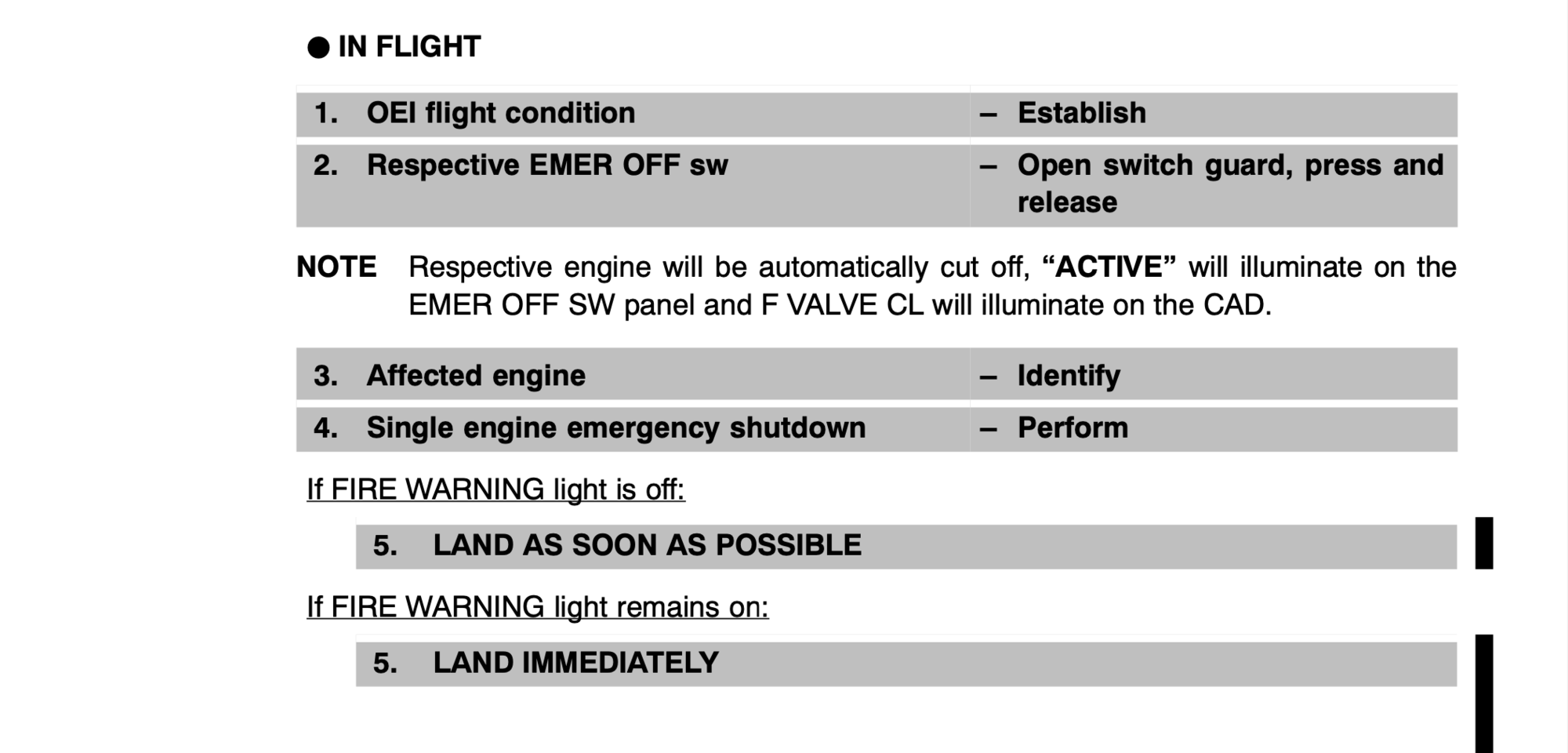
The extracts are from a CPDS type RFM which this particular aircraft may not have been but the items are the same.

Joined: Jun 2016
Aviation Qualifications: CPL
Posts: 1,318
Likes: 387
From: Brantisvogan
The initial FAA report lists the accident as due to unknown circumstances.
Joined: Nov 2006
Posts: 803
Likes: 52
From: Pensacola, Florida
A lot of people are criticizing this EC135 pilot for not landing sooner. We know the pilot had an engine failure - he reported that to the Tower as his reason for returning. Once the engine quit, he had a couple of things to do (e.g. secure the engine, set OEI power, attain best OEI speed, start a turn back to the airport). A lot going on and a lot going through his mind. Sure, these things don't take forever, but they eat up seconds. And in his case, he only had seconds. (And honestly, who among us - actual pilots, that is - thinks that if we get a fire, our helicopter will come apart so quickly? That's some pretty scary !!!!!) A lot of people assume that he also knew that he was on fire. We do not know this...yet. But we will. Maybe it was not a catastrophic engine failure. Maybe the fire was aft of the detectors and did not set them off (which is what it looks like to me).
At PHI, when I checked out in the BO-105, we were anecdotally told of an incident in which an in-flight fire occurred, but the tail boom fell off before the guy could get it on the ground (or perhaps it was just after he landed on the water - I forget). The point was to take EVERY fire light seriously. Perform a tight turn to see if you were leaving a smoke trail, or look at your shadow on the water if you could see it...or have a pax slide the rear door open and look. Those things were all well and good, but in the summer, I'd often climb that Bolkow up to 4,500 or 5,500 feet where the air was cool, the viz was better and there was less traffic. And it would take at least a minute or two to get down, even in a screaming descent. Which brings me to my point: What if the EC135 pilot had been higher...higher to the point that he could not get it on the ground quickly enough even if he had decided to LAND IMMEDIATELY? I cannot say for sure what I would do in this very specific case, but with an engine out and that big airport right behind me, with the field boundary nearly within gliding distance, I might have just turned around and gone back too. Until we hear what this EC135 guy has to say, I'm going to give him a huge benefit of the doubt.
At PHI, when I checked out in the BO-105, we were anecdotally told of an incident in which an in-flight fire occurred, but the tail boom fell off before the guy could get it on the ground (or perhaps it was just after he landed on the water - I forget). The point was to take EVERY fire light seriously. Perform a tight turn to see if you were leaving a smoke trail, or look at your shadow on the water if you could see it...or have a pax slide the rear door open and look. Those things were all well and good, but in the summer, I'd often climb that Bolkow up to 4,500 or 5,500 feet where the air was cool, the viz was better and there was less traffic. And it would take at least a minute or two to get down, even in a screaming descent. Which brings me to my point: What if the EC135 pilot had been higher...higher to the point that he could not get it on the ground quickly enough even if he had decided to LAND IMMEDIATELY? I cannot say for sure what I would do in this very specific case, but with an engine out and that big airport right behind me, with the field boundary nearly within gliding distance, I might have just turned around and gone back too. Until we hear what this EC135 guy has to say, I'm going to give him a huge benefit of the doubt.
Joined: Mar 2005
Aviation Qualifications: Military
Posts: 6,563
Likes: 952
From: Aus
That looks to me like the battery compartment
Joined: Jun 2016
Aviation Qualifications: CPL
Posts: 1,318
Likes: 387
From: Brantisvogan
They did the best they could, under the circumstances. Hindsight is perfect vision, we will have to wait for the detail to become public knowledge before drawing conclusions, but discussing the could-have, would-have and should-haves shouldn't be considered a negative.
It can be a very fine line between success and failure, one that may be outside of anyones control.
Thread Starter
Joined: Oct 2006
Aviation Qualifications: A&P
Posts: 1,348
Likes: 271
From: USA
But you have to put it into context. The process to repair a 135 tailboom requires hot bond temperatures of about 125 C. The T1 fire detectors actuate at 210 C - 270 C. Composite structural strength becomes compromised starting around 300 C. And any fuel/oil fire will burn at a much higher temperature. Given the use of heat resistant composites (800+ C) is regulated to areas that may see high heat or fire like an engine bay, the rest of the structures use various standard methods. For reference, most aluminum structures begin to structurally degrade at 600+C.

Joined: Oct 2012
Posts: 161
Likes: 5
From: UK
Company policy overrides the RFM procedure? Unless there is an approved supplement?
Below would be following the RFM.
Note the reference to memory items and the requirement to "perform immediately" with the grey background when it arises.
OEI Flight condition - Establish - means - a condition where you can operate effectively with the "normal" engine within OEI limits
Affected Engine - Identify - means - all the Captions which will be numerous in addition to instrumentation.
Single Engine Emergency Shutdown - Perform - means ENG MAIN sw - IDLE, Check indications (confirm), then OFF.
Fire in flight only has one additional item - EMER OFF switch - which closes the fuel supply valve. IF you have Engine Fire Extinguisher fitted it will automatically fire when FIRE is active, fuel valve is closed and N1 < 55% - there is no way to activate it manually.
The extracts are from a CPDS type RFM which this particular aircraft may not have been but the items are the same.
Below would be following the RFM.
Note the reference to memory items and the requirement to "perform immediately" with the grey background when it arises.
OEI Flight condition - Establish - means - a condition where you can operate effectively with the "normal" engine within OEI limits
Affected Engine - Identify - means - all the Captions which will be numerous in addition to instrumentation.
Single Engine Emergency Shutdown - Perform - means ENG MAIN sw - IDLE, Check indications (confirm), then OFF.
Fire in flight only has one additional item - EMER OFF switch - which closes the fuel supply valve. IF you have Engine Fire Extinguisher fitted it will automatically fire when FIRE is active, fuel valve is closed and N1 < 55% - there is no way to activate it manually.
The extracts are from a CPDS type RFM which this particular aircraft may not have been but the items are the same.
One minor inaccuracy is the N1 has to be < 50% for the fire bottle to go off.
Thread Starter
Joined: Oct 2006
Aviation Qualifications: A&P
Posts: 1,348
Likes: 271
From: USA
Interesting side discussion. I wonder if this was a Public Use ops and who was overseeing the "piece-mealing" of parts and maintenance?
As the agency mourns Monday's fatal crash of its air rescue helicopter, Sheriff Gregory Tony says it’s time for action. He said he met with the county’s mayor and assistant administrator Tuesday, and was assured the county would provide funding for two new helicopters.
“Fire rescue helicopter that we’re utilizing has been around since 1999, we’ve been piece-mealing parts for years to maintain the flight capability,” Tony said at that meeting.
“Listening back to my statements from June,” the sheriff said Tuesday, “You probably heard more of an awareness tone of, 'hey, we need to get this done,' because eventually the aircraft are not gonna be capable of flying and the risk factor of one falling out of the sky was too great, and now it’s happened.”
Joined: Apr 2000
Aviation Qualifications: ATP+Mil
Posts: 10,959
Likes: 1,814
From: EGDC
There's no reason you can't keep a 24 year old helicopter flying safely for many more years unless you fail to invest in maintenance and parts at the right time - it rather looks like that is where the investigation may have to do some digging.
They have sadly just learned the reason for the old saying 'If you think safety is expensive, try having a crash'.
They have sadly just learned the reason for the old saying 'If you think safety is expensive, try having a crash'.
Joined: Nov 2006
Posts: 282
Likes: 85
From: UK

Joined: Feb 2006
Posts: 1,067
Likes: 40
From: On the big blue planet
Joined: Dec 2006
Posts: 1,303
Likes: 23
From: UK and MALTA
Given the short flight time, fire trailing and persistent and the pilot reporting and engine failure.....maybe a turbine burst (looking like engine failure with zero Tq/Nf), That savages the tail boom flange area with shrapnel. Meanwhile the Gas Generator is still working and the FADEC response to Zero NF is to open the fuel to max chat. The fire escaping from the compromised combustion chamber finishes the job. I have no idea why the pilot did not have a fire warning or if he missed this in the mix of confusing indications.
With an engine fully failed (ie all parts stop rotating) the fuel pressure becomes zero everywhere in that firewall box and the chances of a persistent fire almost zero. Maybe!
DB
With an engine fully failed (ie all parts stop rotating) the fuel pressure becomes zero everywhere in that firewall box and the chances of a persistent fire almost zero. Maybe!
DB
Joined: Mar 2012
Posts: 386
Likes: 4
From: steady
