


Minimum Height for 180° Auto in the Cruise


Joined: Nov 2006
Posts: 803
Likes: 52
From: Pensacola, Florida
PHI used to have us do 180 autos from 500 feet in a 206B during every year during Recurrent. No big deal. The key was to initiate the aft cyclic input first, or at least simultaneously with putting the pitch down. If you put the collective down first, the nose WILL drop and...guess what...the helicopter will start to descend. You'll be at "something less" than 500' as you get stabilized in autorotation. So it's imperative that you get the nose up (not just maintain it at level) which of course also helps slow the decay of the NR. As you make your 180 turn, now it's important maintain a level cabin attitude and not to dive for the runway or pull the nose up further. A level cabin attitude will keep the speed in the ballpark without staring at the gauge. And who cares if you arrive at the flare with 50 or 60 knots - the a/c certainly doesn't.
We did 300-foot 180's too, but they were a wild, nearly aerobatic maneuver that are fun but no one was expected to try in real life.
Having done as many practice 180's as I've done in my career (both before and after PHI), I'm utterly convinced that if the engine really does quit while tootling along downwind at 500' agl, most pilots (probably even me) will land straight ahead and not even try to get it back around into the wind. (I mean, do I *really* remember what's back there?) Thankfully, the 180-degree auto is more of an academic procedure these days, since it derives from a time when helicopters were powered by big, six-cylinder piston engines, spinning at 3200 rpm (yikes!) and that did have a tendency to quit, as opposed to our modern turbines which almost never do unless we run them out of fuel. If I flew an R-44, I'd probably practice them. A lot.
We did 300-foot 180's too, but they were a wild, nearly aerobatic maneuver that are fun but no one was expected to try in real life.
Having done as many practice 180's as I've done in my career (both before and after PHI), I'm utterly convinced that if the engine really does quit while tootling along downwind at 500' agl, most pilots (probably even me) will land straight ahead and not even try to get it back around into the wind. (I mean, do I *really* remember what's back there?) Thankfully, the 180-degree auto is more of an academic procedure these days, since it derives from a time when helicopters were powered by big, six-cylinder piston engines, spinning at 3200 rpm (yikes!) and that did have a tendency to quit, as opposed to our modern turbines which almost never do unless we run them out of fuel. If I flew an R-44, I'd probably practice them. A lot.


Joined: Sep 2018
Aviation Qualifications: CPL
Posts: 888
Likes: 65
From: California
Right, my lowest 180 was from about 500' in an R22 to a clearing on a hill with power recovery. The instructor and I worked our way down from 1000' down in small steps, but in the end the flare started in the turn. Just gives one more confidence in the capability of the machine and yourself.
In real life, I would recommend not flying lower than 1000'. 3000' is my go to altitude today for cruise.
In real life, I would recommend not flying lower than 1000'. 3000' is my go to altitude today for cruise.
Joined: Sep 2018
Aviation Qualifications: CPL
Posts: 888
Likes: 65
From: California
If you've reduced your airspeed to a hover in an auto, then pitching the nose down will not induce low-g, therefore there'd be no risk of mast bumping. The same goes for pitching down to recover from VRS.


Joined: Sep 2003
Posts: 2,081
Likes: 189
From: Redding CA, or on a fire somewhere

Originally Posted by [email protected]
Things to note on Gordy's video are:
The Low Nr warning is on for most of the turn (not unsafe and I suspect well within limits) but decays further when the nose is pushed down to recapture the speed (negative flare effect)
The Low Nr warning is on for most of the turn (not unsafe and I suspect well within limits) but decays further when the nose is pushed down to recapture the speed (negative flare effect)
Originally Posted by [email protected]
The RoD is still high (2500' fpm) as he starts the flare - t
Originally Posted by [email protected]
The only time I can think you would use this technique for real is if the only landing area is pretty much right underneath you and the wind isn't too strong when the donk stops. A good handling exercise though.
Guest
Joined: Jul 2017
Aviation Qualifications: Spotter
Posts: 840
Likes: 236
From: UK
a twin lowers the risk of injury/death when over sea/mountains/cities etc, but for any other flying you are just paying a cost/weight penalty dragging an extra engine around
two properly trained pilots is always safer than two engines
two properly trained pilots is always safer than two engines
Thread Starter
Joined: Mar 2005
Aviation Qualifications: Military
Posts: 6,563
Likes: 952
From: Aus
NEVER do touchdowns to grass unless a real auto---the risk of rollover is too great
Joined: Jul 2004
Posts: 447
Likes: 30
From: Europe
Shawn (Coyle) once told me, autorotations to the grass are harder on the airframe, because they prevent the skids to spread out. Just saying ...
Hi Robbie, why would you think it is safer to cruise at 800' instead of 3000'? Much more time to work things out if the donk stops. For example to restart it. And lots more things to see.
Well, that is a new one, Crab does not know a flying technique. I am with Gordy here. This technique has some advantages beyond spots right below you. I see it more as a technique that gives me more mental capacity to find the right spot. And you do not have to stop completely. When the donk stops, all I have to do immediately is flare. If I remember right from the safety course, at cruise speed the flare will give you about 7 seconds before the NR starts to drop without touching the collective. That's a long time to get the collective down. I never waited the 7 seconds though. Don't have the nerves (don't try this at home kids). I just slowly lower the collective. But in a normal auto, I jump on the collective, flare a bit to bring the speed to 60, look at the ball to fly coordinated, adjust the NR and so on. All that in way less than 7 seconds. Only then I have the time to look at the landing spot, but I already have lost quite a bit of altitude. With that other technique, I am still at the original altitude or even higher. I then stop the flare and everything is just calm and less stressful. I then put the nose towards the landing spot and might take on a bit of speed to reach it. I can adjust my gliding distance without going trough S-turns. From my training experience, the entry point for the 180 autorotation does not differ for either technique.
I personally think, that when I have to autorotate for real, I will take the NEXT best spot. I will not use the one at the optimal gliding distance. I think I will take one that is much closer. One I am absolutely sure I can reach.
Depending on the helicopter I am flying, the sight picture right in front of you is more or less obstructed by the instrument panel. Therefore the spot I will choose, will be more often than not to my right and close by. What I just said is pure theory fuelled by the experience of many nasty throttle chops by various mean instructors since I never had an engine failure. I go knocking on wood now.
Hi Robbie, why would you think it is safer to cruise at 800' instead of 3000'? Much more time to work things out if the donk stops. For example to restart it. And lots more things to see.
Well, that is a new one, Crab does not know a flying technique. I am with Gordy here. This technique has some advantages beyond spots right below you. I see it more as a technique that gives me more mental capacity to find the right spot. And you do not have to stop completely. When the donk stops, all I have to do immediately is flare. If I remember right from the safety course, at cruise speed the flare will give you about 7 seconds before the NR starts to drop without touching the collective. That's a long time to get the collective down. I never waited the 7 seconds though. Don't have the nerves (don't try this at home kids). I just slowly lower the collective. But in a normal auto, I jump on the collective, flare a bit to bring the speed to 60, look at the ball to fly coordinated, adjust the NR and so on. All that in way less than 7 seconds. Only then I have the time to look at the landing spot, but I already have lost quite a bit of altitude. With that other technique, I am still at the original altitude or even higher. I then stop the flare and everything is just calm and less stressful. I then put the nose towards the landing spot and might take on a bit of speed to reach it. I can adjust my gliding distance without going trough S-turns. From my training experience, the entry point for the 180 autorotation does not differ for either technique.
I personally think, that when I have to autorotate for real, I will take the NEXT best spot. I will not use the one at the optimal gliding distance. I think I will take one that is much closer. One I am absolutely sure I can reach.
Depending on the helicopter I am flying, the sight picture right in front of you is more or less obstructed by the instrument panel. Therefore the spot I will choose, will be more often than not to my right and close by. What I just said is pure theory fuelled by the experience of many nasty throttle chops by various mean instructors since I never had an engine failure. I go knocking on wood now.

Joined: Feb 2006
Posts: 1,067
Likes: 40
From: On the big blue planet
We even did solo ARs with UH-1 to grass. Ok, not realy solo, but 2 student pilots
Skadi
Avoid imitations


Joined: Nov 2000
Aviation Qualifications: ATPL
Posts: 15,110
Likes: 1,083
From: Wandering the FIR and cyberspace often at highly unsociable times
I’ve flown with some pilots where their equivalent weight in fuel would have been more useful.

Joined: Apr 2000
Aviation Qualifications: ATP+Mil
Posts: 10,959
Likes: 1,814
From: EGDC
Just for the record......the RPM Warning can be for low or high Rotor RPM and there is an associated Warning Audio sound for certain low RPM situations.
Joined: Apr 2000
Aviation Qualifications: ATP+Mil
Posts: 10,959
Likes: 1,814
From: EGDC
That is the engine out light---there is no low RPM warning in this particular Huey.
Nah--this is an old steam gauge not an instantnaeous VSI, I can assure you the ROD was about 1,000 fpm at entry. The 2,500 was in the nose dive to gain our speed back, and we had somewhat levelled by about 100' short of the flare, 200' agl
This technique is good for areas where you have only a toght spot to go as your descent profile is steeper, allowing you to almost geet it into a confined area.
Joined: Apr 2000
Aviation Qualifications: ATP+Mil
Posts: 10,959
Likes: 1,814
From: EGDC
Well, that is a new one, Crab does not know a flying technique.
'Get close - stay close' is the best mantra for a forced landing.
The effectiveness of the flare on entry depends on your cruise speed - from 100 kts you will get a decent benefit but not as much as at 140 kts and in the real case you will use a lot of that flare effect just to recover the Nr which will start to decay immediately the donkey quits.
If your cruise speed is high and you react quickly you could well get a climb or at least delay the descent with flare but don't base your expectations on practising it without a throttle chop or a delay in taking recovery action, that is false hope.
Co-ordinating the entry to auto is a well used term but it is a variable feast depending on conditions - fast cruise, lead more with cyclic, slow speed or hover, lead with lever (quickly).
We used to demonstrate Nr decay to our QHI students from 1000' downwind in the circuit - chop the throttle and do nothing until the Nr was approaching the bottom limit. Then show how a flare and turn (loading the disc) spins up the Nr again and complete a 180 to the EOL.
Joined: Jul 2004
Posts: 447
Likes: 30
From: Europe
Originally Posted by [email protected]
Never had a problem with grass stopping the skids from spreading on an EOL.
Oh and crab, believe me, by far most of my autorotations in training were throttle chops without warning. Whenever there was a dull moment, one could be sure it got exciting again any second. Everywhere, at any time of the day. The autorotations during nighttime to an unlit runway were particularly exciting. I had to stare down along the beam of the landing light until I saw the runway, that was the moment to flare. My instructor never let me turn the runway lights on. Never. Just once I wanted to see the ground light up, but no. Everything always to the unlit runway. Chased foxes around the runway though.

Joined: Jun 2002
Aviation Qualifications: PPL
Posts: 5,100
Likes: 321
From: east ESSEX
Well,here`s a few`endings`,after things have gone `quiet`...
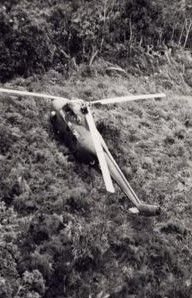
Tail rotor and gearbox both departed,landed on a hilltop,luckily a tree stump burst a tyre,so we didn`t roll off.

Engine surged over a mangrove swamp(middle pic, going L-R),about a mile over `shark and croc infested estuary,taking 6 pilots to help the Navy on a troop lift.Had to fly at min.RRPM,170 ,for range ,as I ..did not wish to get wet,then a wild,flaring turn pointing at the beach.Unfortunately ,nose-wheels dug in a blade hit the sand ,then sliced the tail.....This happened 10 days after the t/r failure.
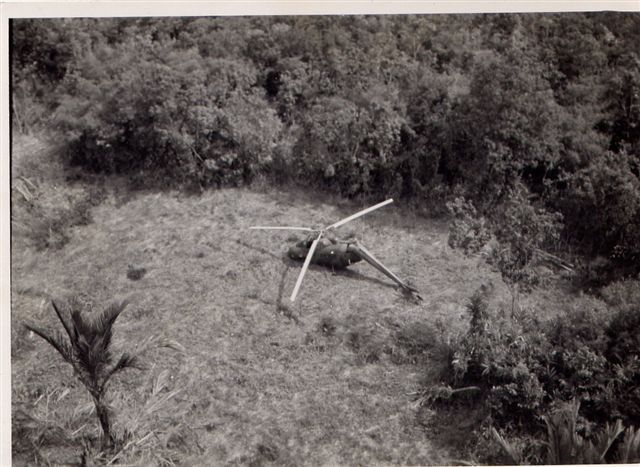
New Squadron co-pilot flying approach to hill-top LZ ,gets low/slow,pulls big handfull of collective,forgets to use pedals,engine surges,and down the hillside we go`.,scrabbling for airspeed and RRPM,,BETWEEN THE TREES INTO A LOG FILLED SWAMP,NOSEWHEELS DIG IN,AND WE STOP...He made Gp.Capt,and Staish later..I didn`t..!
No animals /pilots/crew were injured,no nearby schools were terrorised,and flying suits were soon cleaned..
Moral is..if crashing is inevitable,never give up,and fly it under control as long as you can...
NB..ALL aircraft were repaired within weeks after recovery by Belvedere....
Tail rotor and gearbox both departed,landed on a hilltop,luckily a tree stump burst a tyre,so we didn`t roll off.
Engine surged over a mangrove swamp(middle pic, going L-R),about a mile over `shark and croc infested estuary,taking 6 pilots to help the Navy on a troop lift.Had to fly at min.RRPM,170 ,for range ,as I ..did not wish to get wet,then a wild,flaring turn pointing at the beach.Unfortunately ,nose-wheels dug in a blade hit the sand ,then sliced the tail.....This happened 10 days after the t/r failure.
New Squadron co-pilot flying approach to hill-top LZ ,gets low/slow,pulls big handfull of collective,forgets to use pedals,engine surges,and down the hillside we go`.,scrabbling for airspeed and RRPM,,BETWEEN THE TREES INTO A LOG FILLED SWAMP,NOSEWHEELS DIG IN,AND WE STOP...He made Gp.Capt,and Staish later..I didn`t..!
No animals /pilots/crew were injured,no nearby schools were terrorised,and flying suits were soon cleaned..
Moral is..if crashing is inevitable,never give up,and fly it under control as long as you can...
NB..ALL aircraft were repaired within weeks after recovery by Belvedere....
Joined: Apr 2000
Aviation Qualifications: ATP+Mil
Posts: 10,959
Likes: 1,814
From: EGDC
Rotorbee - whenever you fly with an instructor on a training sortie, you know he will turn things off on you so you are waiting for it and prepared mentally to a degree you probably aren't when tooling around by yourself or with pax.
Joined: Sep 2018
Aviation Qualifications: CPL
Posts: 888
Likes: 65
From: California
Joined: Jul 2004
Posts: 447
Likes: 30
From: Europe
Yes Crab, but do you have a better idea for training? At least with the repetition of autos you get to a point, where if the nose yaws suddenly, you just lower the collective and that buys you time. And let me add this, the clues in training are also wrong. I can feel the throttle turning when the instructor chops it. I can even feel it, when he/she touches it. Or see it in my peripheral vision (a clue is when he leans forward to cover his hand). Here a simulator is better, but in the sim, everybody knows also that everything will go wrong.
I do tool around on my own, I am an instructor after all, but not with pax, that's for sure.
I do tool around on my own, I am an instructor after all, but not with pax, that's for sure.