


Hanging one side low


Joined: Apr 2000
Aviation Qualifications: ATP+Mil
Posts: 10,959
Likes: 1,814
From: EGDC
Blimey Jeep and you an A1 an'all, fancy not knowing simple stuff like that!!!
No, I am taking the p*** mate, good luck with the bag, it doesn't sound much fun- especially for an old knacker like you!!!!
Flygunz, you are just too anal for remembering the page ref in the PoF book, I will just go and look in the copy PD gave me to see if you are right!
No, I am taking the p*** mate, good luck with the bag, it doesn't sound much fun- especially for an old knacker like you!!!!
Flygunz, you are just too anal for remembering the page ref in the PoF book, I will just go and look in the copy PD gave me to see if you are right!


Joined: Jun 2002
Aviation Qualifications: PPL
Posts: 5,099
Likes: 321
From: east ESSEX
one-hung low
The reason the fuselage hangs low is primarily determined by the position of the tail rotor in relation to the a/c`s CofG,Longitudinal,lateral and vertical. The moments derived by the t/r in producing "t/r drift" or "translating effect" have to be opposed by the moments produced by the rotor,and it doesn`t matter what type of rotor it is,rigid,semi-rigid,teetering,etc,those factors relate to sensitivity,response,and control power.If you are in a hover at fully fwd.c of g,and note the a/c attitude,then go to fully aft and hover, the a/c attitude will be more "left side down"(for CCW rotor rotn.)If you can now change the lateral CofG,you will now see an even greater variation in attitudes,and finally ,if you can find the vertical CofG and change it from it`s normal position,usually fairly high on modern helos,and use depleted uranium to lower it sufficiently(even as an u/s load-rigidly attached) and always using the same a/c weight,you can draw a matrix of attitude/weight(K)/CofG(lat/long/vert.).From the known a/c attitudes ,the position of the t/r relative to the a/c CofG can be ascertained and should show that an aft,high and left CofG will give the most adverse left roll!Of course ,if you are French and dress the other way,then you`ll roll right,and if you`re Oz then use a mirror-This ,of course could all be b*****ks,as this Chilean red is slipping down too easily,and I might have it all wrong!!!! 

Joined: Mar 2020
Posts: 2
Likes: 0
From: Rio de Janeiro
Why helicopter takes off one side first?
I´m helicopter pilot in Brazil and CFI.
When I´m teaching a new student, they keep asking me why a Robinson helicopter takes off the right side first.
I lot of friends here, explain that the reason is ´cause the main tank is at the right side, so the aircraft is havier in this side. But I really dont believe in it. The tank is so near to the main rotor shaft that I dont believe that the small amount of weight can change so drastically th CG.
When you have to taxi the helicopter and you are in a low fuel condition, the R66 for example, seems to have this condition maximised.
At second, I thought It could be as a result of tail rotor thrust, so to compensate this force, the main rotor shaft is tilted a little to the right. But this is just a guest. And I couldnt find anything in the maintenance manual that could validate my guest.
This morning I was in a Helicenter here and I was watching a Squirrel (Eurocopter AS-350) landing and it was easy to see the same thing happening.
Well, I still think that it has something to do with the engineering stuff, not just a matter of weight.
Can someone help me with this and explain why the helicopter takes off and land one side first?
When I´m teaching a new student, they keep asking me why a Robinson helicopter takes off the right side first.
I lot of friends here, explain that the reason is ´cause the main tank is at the right side, so the aircraft is havier in this side. But I really dont believe in it. The tank is so near to the main rotor shaft that I dont believe that the small amount of weight can change so drastically th CG.
When you have to taxi the helicopter and you are in a low fuel condition, the R66 for example, seems to have this condition maximised.
At second, I thought It could be as a result of tail rotor thrust, so to compensate this force, the main rotor shaft is tilted a little to the right. But this is just a guest. And I couldnt find anything in the maintenance manual that could validate my guest.
This morning I was in a Helicenter here and I was watching a Squirrel (Eurocopter AS-350) landing and it was easy to see the same thing happening.
Well, I still think that it has something to do with the engineering stuff, not just a matter of weight.
Can someone help me with this and explain why the helicopter takes off and land one side first?

Joined: Nov 2000
Posts: 4,330
Likes: 74
From: White Waltham, Prestwick & Calgary
Or rather one skid hanging low, depending on which way the rotors spin. Helicopters using anticlockwise rotation will have the tail rotor thrust slightly out of alignment with the main rotor, because they are set to be level with each other in the cruise. As a result, the TR thrust line is below the level of the MR hub and will produce a couple that makes the left skid lower in the hover - the reverse for clockwise rotating rotors.
Should an anticlockwise rotating helicopter end up hovering right skid low, you've left the refuelling hose in
Phil
Should an anticlockwise rotating helicopter end up hovering right skid low, you've left the refuelling hose in
Phil

Joined: Dec 2011
Posts: 3
Likes: 0
From: US
From the Helicopter Flying Handbook (FAA-H-8083-21B) Chapter 9 states:
"Helicopters usually hover left side low due to the tail rotor thrust being counteracted by the main rotor tilt."
Left side low implies a anticlockwise rotation of the main rotor.
"Helicopters usually hover left side low due to the tail rotor thrust being counteracted by the main rotor tilt."
Left side low implies a anticlockwise rotation of the main rotor.
Joined: Jan 2000
Posts: 811
Likes: 11
From: Bar to Bar
Or rather one skid hanging low, depending on which way the rotors spin. Helicopters using anticlockwise rotation will have the tail rotor thrust slightly out of alignment with the main rotor, because they are set to be level with each other in the cruise. As a result, the TR thrust line is below the level of the MR hub and will produce a couple that makes the left skid lower in the hover - the reverse for clockwise rotating rotors.
Should an anticlockwise rotating helicopter end up hovering right skid low, you've left the refuelling hose in
Phil
Should an anticlockwise rotating helicopter end up hovering right skid low, you've left the refuelling hose in
Phil
Joined: Mar 2002
Posts: 243
Likes: 1
From: West of zero
Joined: Jul 1999
Posts: 3,931
Likes: 142
From: Warrington, UK
Hmm...am I the only one who thinks an instructor should know that?
Maybe he should go here:
Principles of Flight books
Maybe he should go here:
Principles of Flight books

Joined: Dec 2006
Posts: 431
Likes: 41
From: yes
Or rather one skid hanging low, depending on which way the rotors spin. Helicopters using anticlockwise rotation will have the tail rotor thrust slightly out of alignment with the main rotor, because they are set to be level with each other in the cruise. As a result, the TR thrust line is below the level of the MR hub and will produce a couple that makes the left skid lower in the hover - the reverse for clockwise rotating rotors.
Should an anticlockwise rotating helicopter end up hovering right skid low, you've left the refuelling hose in
Phil
Should an anticlockwise rotating helicopter end up hovering right skid low, you've left the refuelling hose in
Phil
Hanging one side low

Joined: Sep 2002
Aviation Qualifications: CPL
Posts: 4,721
Likes: 636
From: Great South East, tired and retired
You have two opposing Moments.
The first is the T/R thrust, acting to the right and lower than the rotor head, and the other half of the moment is the horizontal component of the main rotor thrust, which has been set at an angle to oppose the drift effect. This first moment tries to roll the aircraft to the left.
Opposing that, once the aircraft rolls a little bit, is the CG, which is no longer in line with the vertical component of the rotor thrust. It acts straight down, and is off set to the right from the main rotor thrust, acting straight up. This moment tries to roll the aircraft right.
The two moments fight a little, the more the T/R moment tries to roll to the left, the more the CG moment is offset and opposes that roll.
(
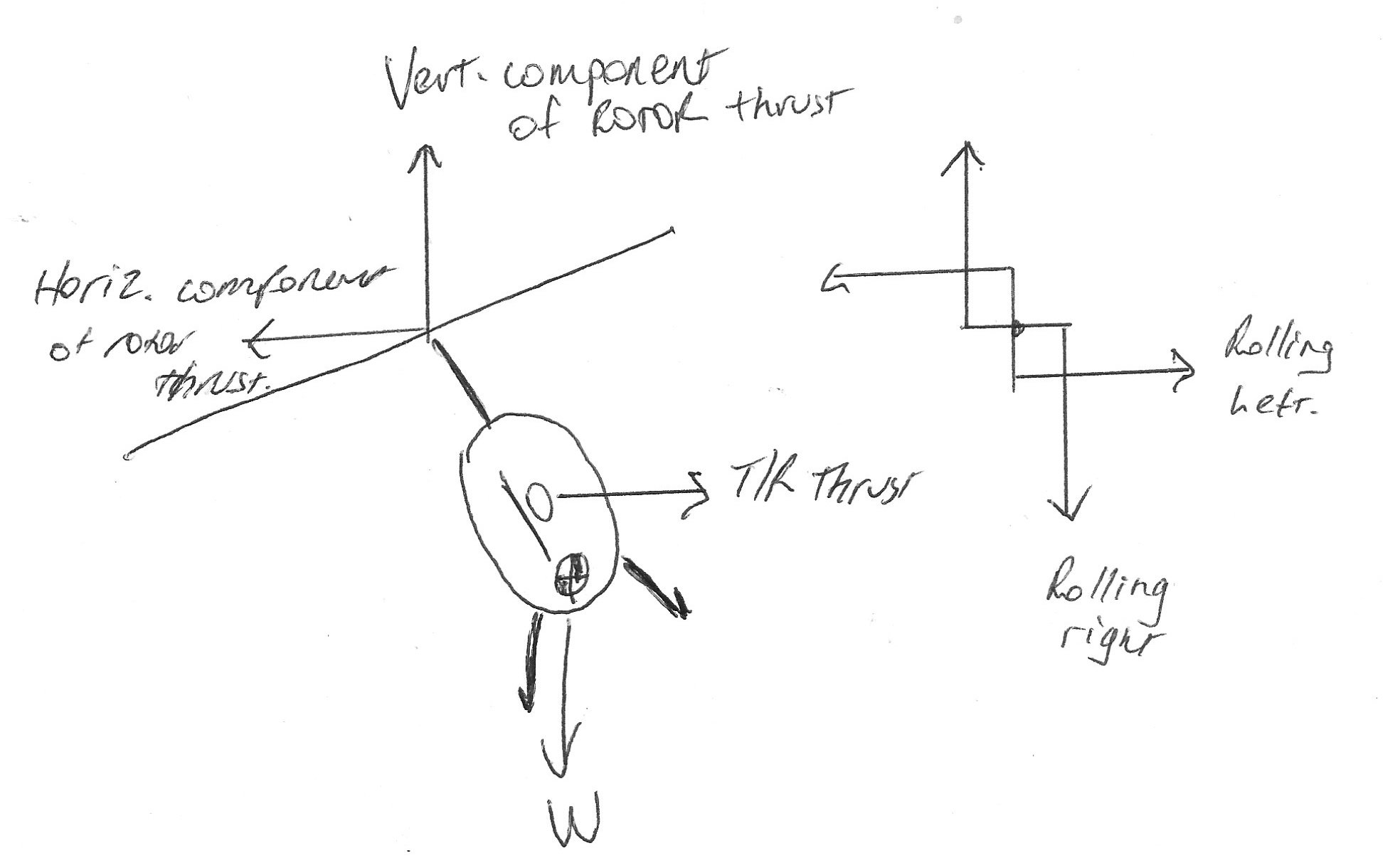
The first is the T/R thrust, acting to the right and lower than the rotor head, and the other half of the moment is the horizontal component of the main rotor thrust, which has been set at an angle to oppose the drift effect. This first moment tries to roll the aircraft to the left.
Opposing that, once the aircraft rolls a little bit, is the CG, which is no longer in line with the vertical component of the rotor thrust. It acts straight down, and is off set to the right from the main rotor thrust, acting straight up. This moment tries to roll the aircraft right.
The two moments fight a little, the more the T/R moment tries to roll to the left, the more the CG moment is offset and opposes that roll.
(
Last edited by Ascend Charlie; 20th March 2020 at 23:44.


Joined: Jul 2002
Aviation Qualifications: ATPL(H)
Posts: 3,052
Likes: 56
From: UK

Joined: Apr 2000
Aviation Qualifications: ATP+Mil
Posts: 10,959
Likes: 1,814
From: EGDC
The right roll in ACs diagram (opposing TR roll) is a result of the arm between the action of the TR thrust and the vertical position of the C of G. All forces act around the C of G whether it be vertical, horizontal or lateral. I believe that was the point Nick Lappos was making 18 years ago.