


Are planes today really that much more automated than 50 years ago?

Thread Starter
Joined: Apr 2025
Posts: 30
Likes: 0
From: Milky Way Galaxy
Are planes today really that much more automated than 50 years ago?
I am not a pilot, but I am a huge aviation enthusiast. I was watching on yt the other day about a cargo MD-80 pilot who used to once fly the 320 but then later voluntarily came back to the MD-80, when asked why he did it, he said it was because the MD-80 was more "fun" and was "real hands-on flying" compared to a computer flying itself.
I saw another video, this time it was a Canadian 737-200 pilot (yk those 737s in Canada that are equipped with gravel-kits and fly short haul cargo into gravel strips).
When asked why he prefers this specific career path, he said the same thing, that the 737-200 was much more fun to fly than the other modern airliners that he was generally used to.
This made me wonder, how much more automated are planes today compared to the past? How much more automated is an Airbus A220 compared to maybe a MD-80 or 737-200?
For pilots, do ya'll ever get bored in the cockpit sometimes? Maybe during cruise with the autopilot doing everything?
Do u guys ever miss the older days of jet-age, due to the less automation/more hand-flying and skills required by the pilots back then? Among pilots, is this modern trend of more automation generally hated or welcomed?
Finally, are ya'll ever concerned that even though this automation might not be able to completely replace pilots, it might still one day significantly diminish the pilot's role in the cockpit and reduce his importance due to more automation/less skill required?
I saw another video, this time it was a Canadian 737-200 pilot (yk those 737s in Canada that are equipped with gravel-kits and fly short haul cargo into gravel strips).
When asked why he prefers this specific career path, he said the same thing, that the 737-200 was much more fun to fly than the other modern airliners that he was generally used to.
This made me wonder, how much more automated are planes today compared to the past? How much more automated is an Airbus A220 compared to maybe a MD-80 or 737-200?
For pilots, do ya'll ever get bored in the cockpit sometimes? Maybe during cruise with the autopilot doing everything?
Do u guys ever miss the older days of jet-age, due to the less automation/more hand-flying and skills required by the pilots back then? Among pilots, is this modern trend of more automation generally hated or welcomed?
Finally, are ya'll ever concerned that even though this automation might not be able to completely replace pilots, it might still one day significantly diminish the pilot's role in the cockpit and reduce his importance due to more automation/less skill required?
Last edited by 777Supremecist; 20th February 2026 at 07:53.

I REALLY SHOULDN'T BE HERE

Joined: Dec 2005
Posts: 2,457
Likes: 544
From: TOD
*This thread might be a better fit for another forum rather than Tech Log*
Depending on the route and airspace sometimes workload is low for an extended period. These are usually opportunities to look at alternates in more detail, look up recent company notices, run performance calculations, have a look at some technical/SOP stuff maybe. There is only so much of that you can do though and usually you end up chatting to your colleague to pass the time.
Less automated aircraft are usually more engaging to fly but even a cursory look on flight radar 24 show how congested the skies are in many places around the globe - way more than thirty years ago. As much as I enjoyed flying the turboprop with useless automatics which I started out commercial flying on, the high quality automation on the Airbus I fly now decreases workload which gives me more capacity to monitor what’s going on in the environment: traffic, weather etc. Most of us don’t go to work to have fun (that’s not to say that the job isn’t fun and rewarding: it frequently is) but rather to do a high quality job that will keep the passengers safe and ourselves employed.
Personally I would be more concerned about skill atrophy rather than reduction in the importance of the pilot per se.
Do u guys ever miss the older days of jet-age, due to the less automation/more hand-flying and skills required by the pilots back then? Among pilots, is this modern trend of more automation generally hated or welcomed?
Finally, are ya'll ever concerned that even though this automation might not be able to completely replace pilots, it might still one day significantly reduce the pilot's role/importance in the cockpit due to more automation/less skill required?
Thread Starter
Joined: Apr 2025
Posts: 30
Likes: 0
From: Milky Way Galaxy
How so exactly? As far as I can tell, (as a non-pilot*), it seems like even though most of the general cruising part of flight is done by automation, the rest, including the take-off/approach/landing are done manually by the pilots, right? I’m curious, which part (or parts) would be the victim of the skill atrophy here?
I REALLY SHOULDN'T BE HERE
Joined: Dec 2005
Posts: 2,457
Likes: 544
From: TOD
By way of example, the vast, vast majority approaches used by modern jet airlines use approach modes which guide and correct the aircraft’s position laterally, vertically and with auto thrust to control the speed. The pilot just has to monitor and disconnect at the appropriate time with the aircraft usually on a stable trajectory towards the touchdown zone.
Depending on where you fly to you might have a few more offset approaches or circling manoeuvres but for most major operators in Europe at least, this would be the exception rather than the norm.
Back when you were flying more basic types with lower levels of automation you used to have to monitor and make adjustments to the speed and trajectory either through changing targets for the autopilot or by manually manipulating the controls whilst also monitoring and reading and interpreting the data being provided by the ground based navigation aid (VOR, DME, NDB). On top of this, every time you altered the aircraft’s configuration or the wind changed you would have to take this into account (reducing ground speed requires a reducing rate of descent for a constant angle) usually with a change of thrust required. The automation on modern types takes this workload away and all we have to do is monitor the automatics making the corrections and flying the profile. With modern RNAV approaches there is no ground based aid to compare the trajectory against so the monitoring demands are also reduced. There is still plenty to pay attention to but the workload is less than half of what it used to be.
A skill which is not practiced is a skill which is wasting. There are certain failures and combination of failures which will render the automation inoperable. When these exceedingly rare failures occur we still have to perform to the same level as when we were flying approaches described above weekly. It is not impossible but it would certainly be a stretch for lots of today’s pilots (especially those who have only flown modern, highly automated types) to guide the aircraft smoothly along an older style non-precision approach as described above. This is why we occasionally get to fly these sorts of profiles in the simulator.
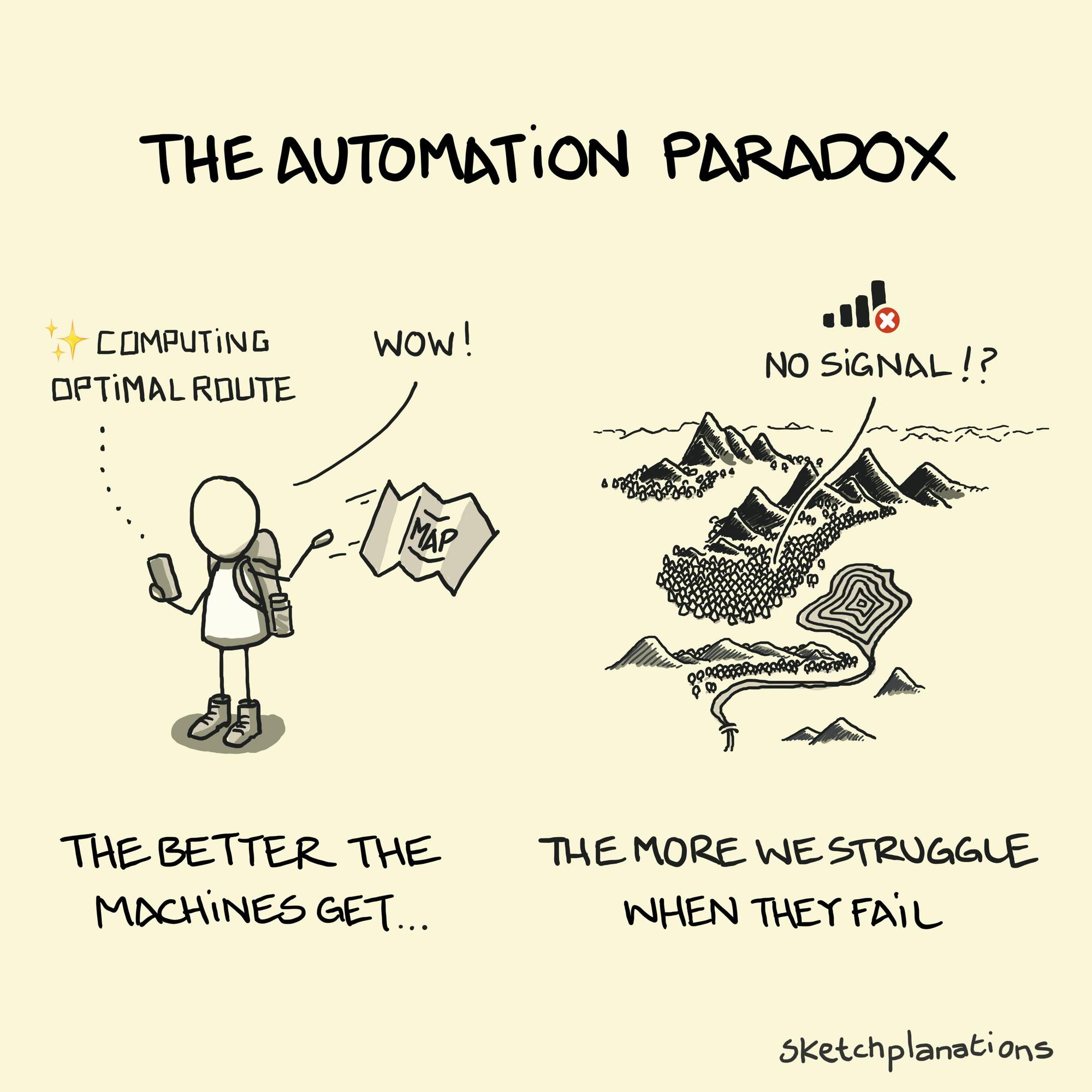
If you go back further, to early generation jet and even earlier piston engined airliners the workload involved with keeping those powerplants within operating parameters was considerable. As someone who has never flown an non-fadec airliner, I can only imagine how busy those flight decks were - it was a whole other level of complication. The evidence is pretty clear though - as automation has improved the hull loss rates have also improved. What we cannot afford to do as pilots is to be over reliant on automation or monitor it insufficiently - there are plenty of accidents where this has been a factor (Asiana San Francisco, Turkish Schipol, Emirates Dubai, Air France South Atlantic). We need to understand what it is and is not doing at any particular moment.
Depending on where you fly to you might have a few more offset approaches or circling manoeuvres but for most major operators in Europe at least, this would be the exception rather than the norm.
Back when you were flying more basic types with lower levels of automation you used to have to monitor and make adjustments to the speed and trajectory either through changing targets for the autopilot or by manually manipulating the controls whilst also monitoring and reading and interpreting the data being provided by the ground based navigation aid (VOR, DME, NDB). On top of this, every time you altered the aircraft’s configuration or the wind changed you would have to take this into account (reducing ground speed requires a reducing rate of descent for a constant angle) usually with a change of thrust required. The automation on modern types takes this workload away and all we have to do is monitor the automatics making the corrections and flying the profile. With modern RNAV approaches there is no ground based aid to compare the trajectory against so the monitoring demands are also reduced. There is still plenty to pay attention to but the workload is less than half of what it used to be.
A skill which is not practiced is a skill which is wasting. There are certain failures and combination of failures which will render the automation inoperable. When these exceedingly rare failures occur we still have to perform to the same level as when we were flying approaches described above weekly. It is not impossible but it would certainly be a stretch for lots of today’s pilots (especially those who have only flown modern, highly automated types) to guide the aircraft smoothly along an older style non-precision approach as described above. This is why we occasionally get to fly these sorts of profiles in the simulator.
If you go back further, to early generation jet and even earlier piston engined airliners the workload involved with keeping those powerplants within operating parameters was considerable. As someone who has never flown an non-fadec airliner, I can only imagine how busy those flight decks were - it was a whole other level of complication. The evidence is pretty clear though - as automation has improved the hull loss rates have also improved. What we cannot afford to do as pilots is to be over reliant on automation or monitor it insufficiently - there are plenty of accidents where this has been a factor (Asiana San Francisco, Turkish Schipol, Emirates Dubai, Air France South Atlantic). We need to understand what it is and is not doing at any particular moment.
Last edited by speedrestriction; 20th February 2026 at 08:44.
Joined: Dec 2005
Aviation Qualifications: ATPL
Posts: 4,971
Likes: 326
From: Hong Kong

Joined: Apr 2009
Aviation Qualifications: Non-Aircrew
Posts: 1,571
Likes: 649
From: DM33
The original MD-80 series aircraft had a pair of digital flight guidance computers with fail passive autoland (only one DFGC required for autoland). It also had optional single or dual HUD. That made it technologically advanced for that time.
However, it used iron vertical and direction gyros, had no GPS, had no FMS, and had no means of navigation except compass, ADF, VOR/DME, and LOC/GS.
Ask your pilot friend if that is what he was flying and what he wanted to go back to.
Last edited by EXDAC; 24th February 2026 at 20:54. Reason: Add ADF

Joined: Feb 2010
Aviation Qualifications: CPL
Posts: 361
Likes: 28
From: Vienna (FAA CPL/CFI)
While I agree a J3 Cub is as real as you can get, the BD700 can go from 400 AGL autopilot on and fly for 8-10 hours then 50 feet AP off for the ILS and land. The automation takes care of everything. So we are systems monitors in this case, and we train for non normals and emergencies. Systems knowledge is key and so is the software. What is foreflight really telling us… vs what’s in the AFM


Joined: Dec 1998
Aviation Qualifications: ATPL
Posts: 575
Likes: 398
From: UK
The only time I get bored is when approaching a busy airport like Doha, where you’re sometimes made to go miles downwind, and you’re dragging it in on a 20 mile final below the glide etc. which is tedious and takes all the skill / challenge out of flying an approach. But this isn’t the aircraft, it’s the traffic environment. And sometimes on a very long flight, but it usually means I’m going / been somewhere nice. Would I want to go back to the days of flying NDB letdowns in the Caribbean etc? No thanks. There are plenty of challenging approaches out there no matter how much automation you have, just with less chance of flying into the ground. Flying a big aircraft safely on a steep approach / short runway / high altitude (low density) airport / crosswind etc is professionally satisfying.
And because we more often than not fly way inside the envelope of the aircraft, with long approaches etc it’s easy to forget sometimes what a high performance machine you’re flying
and how fast you’re going. A full thrust takeoff or go-around in wind shear can be quite startling how much thrust and performance is suddenly in your hands.
And because we more often than not fly way inside the envelope of the aircraft, with long approaches etc it’s easy to forget sometimes what a high performance machine you’re flying
and how fast you’re going. A full thrust takeoff or go-around in wind shear can be quite startling how much thrust and performance is suddenly in your hands.
Last edited by Propellerhead; 24th February 2026 at 15:12.


