


Growing Evidence That The Upturn Is Upon Us

Joined: Dec 2005
Posts: 1,164
Likes: 0
From: UK
WWW,
Oil was never a sideshow. The oil price spike earlier this year claimed more victims than any previous recession or even Sept 11th ever did(the data is there for those who wish to google it). More airlines fell as a result of unsustainable fuel costs than could have been possibly predicted. Fuel hedging will do nothing to alevaite those problems over the coming year. Those are the facts. 'Yes' the recession will claim its expected toll in 2009, but the downfall might have been an awful lot less painless, minus obsene fuel costs.
And 'flipping burgers', as you repeatedly suggest, is patronising and condescending. There are thousands of good people(pilots included) out there that are facing unemployment and extremely tough times this xmas and next year. They dont have the luxury of an Ezy pilots salary coming in.
Oil was never a sideshow. The oil price spike earlier this year claimed more victims than any previous recession or even Sept 11th ever did(the data is there for those who wish to google it). More airlines fell as a result of unsustainable fuel costs than could have been possibly predicted. Fuel hedging will do nothing to alevaite those problems over the coming year. Those are the facts. 'Yes' the recession will claim its expected toll in 2009, but the downfall might have been an awful lot less painless, minus obsene fuel costs.
And 'flipping burgers', as you repeatedly suggest, is patronising and condescending. There are thousands of good people(pilots included) out there that are facing unemployment and extremely tough times this xmas and next year. They dont have the luxury of an Ezy pilots salary coming in.
Last edited by MIKECR; 26th November 2008 at 23:39.

Joined: Nov 2003
Posts: 252
Likes: 0
From: Canada

Wee Weasley Welshman,
The issue of what role the oil price has played in the economic downturn is the one point I disagree with you on in your general prognosis. Whilst I agree that the major driver of the downturn in the UK specifically has been the credit crunch and the subsequent housing market crash, the credit crunch itself on a global scale (caused by American mortgage defaults) was caused by the oil price.
What other reason can explain why the first neighbourhoods in American cities to experience housing price falls were the exurbs (where lifestyles have by far the heaviest reliance on cheap fuel), followed by the suburbs? As the crash has played out, these have also been the areas that have been hit the hardest. All this points to the credit crunch being an effect, not the primary cause.
One way to prove or disprove this theory will be to observe how the regional property markets in the US behave once the effects of $50 oil is taken into account. Although it's probably too early to tell yet, since oil price variations historically take 12 months to filter through.
Of course, another factor that led to the housing crunch was the rising interest rate (and irresponsibly-arranged mortgages resetting to unaffordable levels). But the reason base rates were increased was to combat rising inflation - again brought about by the oil price.
Interesting point about the Baltic Dry
The issue of what role the oil price has played in the economic downturn is the one point I disagree with you on in your general prognosis. Whilst I agree that the major driver of the downturn in the UK specifically has been the credit crunch and the subsequent housing market crash, the credit crunch itself on a global scale (caused by American mortgage defaults) was caused by the oil price.
What other reason can explain why the first neighbourhoods in American cities to experience housing price falls were the exurbs (where lifestyles have by far the heaviest reliance on cheap fuel), followed by the suburbs? As the crash has played out, these have also been the areas that have been hit the hardest. All this points to the credit crunch being an effect, not the primary cause.
One way to prove or disprove this theory will be to observe how the regional property markets in the US behave once the effects of $50 oil is taken into account. Although it's probably too early to tell yet, since oil price variations historically take 12 months to filter through.
Of course, another factor that led to the housing crunch was the rising interest rate (and irresponsibly-arranged mortgages resetting to unaffordable levels). But the reason base rates were increased was to combat rising inflation - again brought about by the oil price.
Interesting point about the Baltic Dry
Joined: Dec 1999
Posts: 1,606
Likes: 0
From: UK
Chinese airline growth collapses
Southern comfort - FT.com
Published: November 27 2008 09:08 | Last updated: November 27 2008 11:35
A climber scaling a rock-face needs three points of contact to make progress. China’s economic ascent, say officials, will be assured if it maintains a trio of major state-owned airlines.
That commitment made sense on paper six years ago, when the government forcibly consolidated a fragmented industry. Between them, the three carved up the Chinese mainland: China Southern in Guangzhou, China Eastern in Shanghai, and Air China – the intercontinental flag carrier – in Beijing. But the economic contraction, and the wretched state of balance sheets, should be forcing a rethink.
An industry set up for growth – in staffing, order books and capital structure – is now experiencing the opposite. Fuel surcharges have priced out travellers who had just started to embrace air travel as a viable alternative to road or rail. Air traffic in China rose 2.4 per cent in the first ten months to 160m passengers, according to the aviation regulator – well short of the anticipated 14 per cent surge. The three national champs have lost over four-fifths of their market capitalisations this year.
China Eastern, the weakest carrier, with 15 times more debt than equity, has suspended its shares while it holds out for state aid. China Southern announced late on Wednesday that it had secured a Rmb3bn ($440m) capital injection. Handy, but barely enough to cover one-tenth of the bank loans and aircraft leasing obligations it faces next year.
The state can continue to tweak taxes and ignore unpaid landing fees. But more radical action is needed. As cross-border consolidation is not an option – like America, China limits foreign ownership of carriers to 25 per cent for a single shareholder, and 49 per cent in aggregate – the answers must come from within.
Li Jiaxiang, former chairman of Air China, now head of the industry regulator, has repeatedly pushed for a megalithic Chinese airline to match Delta-Northwest. Soon, he may find that officials start to listen.
Quick point on Baltic Dry - looks disasterous, and certainly is for some shippers. Point is that it measures short-term spot market charters. In a recession, these marginal charters evaporate, and shippers rely on the long-term contracts already agreed. It is not a measure of total demand, but marginal demand, so careful what conclusions you draw. (i.e. long periods of low indices would be a disaster for everyone - it is a disaster for some only at the moment).
Published: November 27 2008 09:08 | Last updated: November 27 2008 11:35
A climber scaling a rock-face needs three points of contact to make progress. China’s economic ascent, say officials, will be assured if it maintains a trio of major state-owned airlines.
That commitment made sense on paper six years ago, when the government forcibly consolidated a fragmented industry. Between them, the three carved up the Chinese mainland: China Southern in Guangzhou, China Eastern in Shanghai, and Air China – the intercontinental flag carrier – in Beijing. But the economic contraction, and the wretched state of balance sheets, should be forcing a rethink.
An industry set up for growth – in staffing, order books and capital structure – is now experiencing the opposite. Fuel surcharges have priced out travellers who had just started to embrace air travel as a viable alternative to road or rail. Air traffic in China rose 2.4 per cent in the first ten months to 160m passengers, according to the aviation regulator – well short of the anticipated 14 per cent surge. The three national champs have lost over four-fifths of their market capitalisations this year.
China Eastern, the weakest carrier, with 15 times more debt than equity, has suspended its shares while it holds out for state aid. China Southern announced late on Wednesday that it had secured a Rmb3bn ($440m) capital injection. Handy, but barely enough to cover one-tenth of the bank loans and aircraft leasing obligations it faces next year.
The state can continue to tweak taxes and ignore unpaid landing fees. But more radical action is needed. As cross-border consolidation is not an option – like America, China limits foreign ownership of carriers to 25 per cent for a single shareholder, and 49 per cent in aggregate – the answers must come from within.
Li Jiaxiang, former chairman of Air China, now head of the industry regulator, has repeatedly pushed for a megalithic Chinese airline to match Delta-Northwest. Soon, he may find that officials start to listen.
Quick point on Baltic Dry - looks disasterous, and certainly is for some shippers. Point is that it measures short-term spot market charters. In a recession, these marginal charters evaporate, and shippers rely on the long-term contracts already agreed. It is not a measure of total demand, but marginal demand, so careful what conclusions you draw. (i.e. long periods of low indices would be a disaster for everyone - it is a disaster for some only at the moment).
Joined: Apr 2008
Posts: 92
Likes: 0
From: Socialist Republic of Europe
WWW is right. Oil price was at worst the trigger, not the cause.
The cause was twofold: cheap credit extended to people who couldn't afford it even when it was still cheap, and a housing bubble.
The banks screwed up the risk spreading when they valued the loans too highly, and in the process they made such complicated arrangements that it was impossible to judge who actually was at risk. Therefore no-one knew whether any debt-based assets owned by a company would be defaulted on. Therefore suddenly banks didn't know whether other banks could cover their debts, so stopped lending to each other. This was bound to happen as soon as there was any extra pressure on home-owners' budgets, like oil price increases, so those struggling most defaulted.
The banks had to stop giving the cheap credit, and spooked the housing market which burst the bubble, worsening the whole problem by making sure that most of those bad loans would not be recovered by the sale of the house on which they were secured, as they were in negative equity.
This graph gets to the heart of the issue.
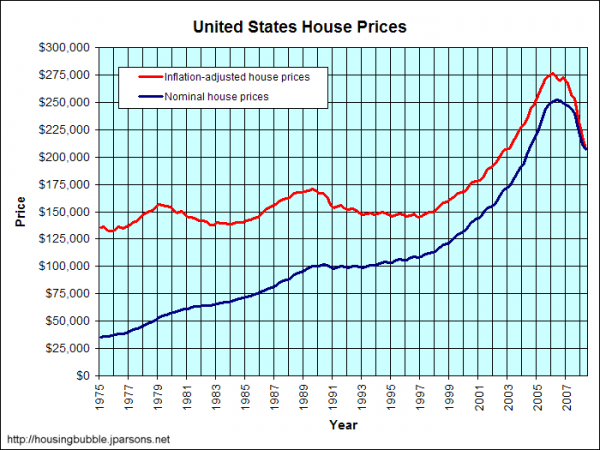
The cause was twofold: cheap credit extended to people who couldn't afford it even when it was still cheap, and a housing bubble.
The banks screwed up the risk spreading when they valued the loans too highly, and in the process they made such complicated arrangements that it was impossible to judge who actually was at risk. Therefore no-one knew whether any debt-based assets owned by a company would be defaulted on. Therefore suddenly banks didn't know whether other banks could cover their debts, so stopped lending to each other. This was bound to happen as soon as there was any extra pressure on home-owners' budgets, like oil price increases, so those struggling most defaulted.
The banks had to stop giving the cheap credit, and spooked the housing market which burst the bubble, worsening the whole problem by making sure that most of those bad loans would not be recovered by the sale of the house on which they were secured, as they were in negative equity.
This graph gets to the heart of the issue.
Joined: Oct 2008
Posts: 138
Likes: 0
From: wherever I can fly for money!
BDI
WWW
I totally agree..absolutely correct evidence-base!
BUT ... this is only for today and tomorrow...& it's not an accurate indicator for what could happen on the long run
Cheers
Unlike stock and commodities markets, the Baltic Dry Index is totally devoid of speculative players.
This index can be used as an overall economic indicator as it shows where end prices are heading for items that use the raw materials that are shipped in dry bulk.
BUT ... this is only for today and tomorrow...& it's not an accurate indicator for what could happen on the long run
Cheers

Joined: Oct 2008
Posts: 138
Likes: 0
From: wherever I can fly for money!
today's cut back are tomorrow's shortages
I would perfer saying: today's cut back plus today's supply = limiting tomorrow's shortages (the least)!
...and so on..bit by bit until the sum is shifting to the positive side of the scale.
Well it's really impossible to tell how/when the mess is gonna end up...but actually it's not that type of endless vicious circle...it will come to break..just let's save the dimes & be patient folks!!
Thank god we are all here in just a rumour's network...talking to each other only... or otherwise we will always keep it on the negative side and never get out of hell!

Good luck
Joined: Dec 1999
Posts: 1,606
Likes: 0
From: UK
BMI warns of biggest loss in its history - FT
BMI British Midland, the second biggest airline operating at London Heathrow, has warned employees it will suffer the largest loss in its history this year.
Nigel Turner, chief executive, has told staff the group had to restructure as it seeks "to ride out what is probably the worst crisis the aviation industry has faced".
He warned the airline, which is shortly to be taken over by Germany's Lufthansa, expected to remain in loss in 2009 despite "further aggressive action on costs".
BMI would be "in intensive care for some considerable time", he said.
The disclosure of the rapid deterioration in the group's finances comes only four weeks after Lufthansa disclosed that Sir Michael Bishop, BMI chairman, had decided to exercise his option, agreed in a deal struck nine years ago, to force the German carrier to take over his majority stake.
Lufthansa, which already owns a stake of 30 per cent minus one share, will pay about €400m (£334m) for Sir Michael's stake of 50 per cent plus one share. The remaining 20 per cent stake in the lossmaking group is held by SAS Scandinavian Airlines, which also wants to dispose of its holding.
In a memorandum to the group's 5,000 staff, Mr Turner said: "Our financial results this year will produce the largest loss we have ever recorded by a considerable margin." BMI made an operating loss of £29m in 2001 and a pre-tax loss of £19.6m in 2002.
He said: "The combination of falling consumer demand and increases to costs in areas wholly outside of our control, like airport charges, makes our task extremely difficult." A previous agreement under which Lufthansa and SAS carried the bulk of BMI losses expired at the end of 2007.
Mr Turner also warned employees they should expect little relief from the Lufthansa takeover, which is expected to be completed in mid-January.
"Be under no illusions, they will not be prepared to sit back and watch us lose money," he said. "They will, and do, expect us to reshape the business to remove unprofitable flying to the greatest extent possible."
Mr Turner said BMI would freeze pay in 2010 and the directors would have no pay increase in 2009.
The airline would honour the terms of its present three-year pay deal, which included an increase of inflation plus half of 1 per cent in 2009, which would add costs of £7m next year and which the group could not afford, he said.
The airline was planning to cut capacity in its BMIbaby low-cost subsidiary by about 15 per cent next summer. It is cutting the fleet from 20 to 17 by returning aircraft at the end of their leases.
Lufthansa said earlier this month it would consider disposing of the BMIbaby business next year.
Nigel Turner, chief executive, has told staff the group had to restructure as it seeks "to ride out what is probably the worst crisis the aviation industry has faced".
He warned the airline, which is shortly to be taken over by Germany's Lufthansa, expected to remain in loss in 2009 despite "further aggressive action on costs".
BMI would be "in intensive care for some considerable time", he said.
The disclosure of the rapid deterioration in the group's finances comes only four weeks after Lufthansa disclosed that Sir Michael Bishop, BMI chairman, had decided to exercise his option, agreed in a deal struck nine years ago, to force the German carrier to take over his majority stake.
Lufthansa, which already owns a stake of 30 per cent minus one share, will pay about €400m (£334m) for Sir Michael's stake of 50 per cent plus one share. The remaining 20 per cent stake in the lossmaking group is held by SAS Scandinavian Airlines, which also wants to dispose of its holding.
In a memorandum to the group's 5,000 staff, Mr Turner said: "Our financial results this year will produce the largest loss we have ever recorded by a considerable margin." BMI made an operating loss of £29m in 2001 and a pre-tax loss of £19.6m in 2002.
He said: "The combination of falling consumer demand and increases to costs in areas wholly outside of our control, like airport charges, makes our task extremely difficult." A previous agreement under which Lufthansa and SAS carried the bulk of BMI losses expired at the end of 2007.
Mr Turner also warned employees they should expect little relief from the Lufthansa takeover, which is expected to be completed in mid-January.
"Be under no illusions, they will not be prepared to sit back and watch us lose money," he said. "They will, and do, expect us to reshape the business to remove unprofitable flying to the greatest extent possible."
Mr Turner said BMI would freeze pay in 2010 and the directors would have no pay increase in 2009.
The airline would honour the terms of its present three-year pay deal, which included an increase of inflation plus half of 1 per cent in 2009, which would add costs of £7m next year and which the group could not afford, he said.
The airline was planning to cut capacity in its BMIbaby low-cost subsidiary by about 15 per cent next summer. It is cutting the fleet from 20 to 17 by returning aircraft at the end of their leases.
Lufthansa said earlier this month it would consider disposing of the BMIbaby business next year.
Joined: May 2008
Posts: 346
Likes: 0
From: FL 350
We’re still worse off than in 1997
Darling’s ‘giveaway’ will bypass the middle classe
We are still worse off than in 1997
Ryanair in new Aer Lingus offer
The budget airline Ryanair is to make a fresh takeover offer for the Irish carrier Aer Lingus.
BBC NEWS | Business | Ryanair in new Aer Lingus offer

Joined: Sep 2007
Posts: 102
Likes: 0
From: Spain
Airlines to return to profit soon
Interview with Maurice Flannigan - Exec Vice Chairman of Emirates on Radio 5 live Wake up to Money programme this morning.
His view is that the reduction in the price of oil will allow carriers to reduce their prices and get more pax on-board which in turn will bring back profitability.
BBC - Radio - Podcasts - Wake Up To Money
His view is that the reduction in the price of oil will allow carriers to reduce their prices and get more pax on-board which in turn will bring back profitability.
BBC - Radio - Podcasts - Wake Up To Money
Last edited by 32SQDN; 2nd December 2008 at 08:18.


Joined: Feb 2000
Aviation Qualifications: ATPL
Posts: 17,503
Likes: 1,846
From: England
Japanese car sales have plummeted at a pace not seen since the bleak economic days of the early 1970s. Confirming fears that Japan has crashed into its sharpest downturn since the Second World War, November sales of cars, lorries and buses plunged by 27.3 per cent from the previous year.
Big big numbers. Still - oils down to under $48 a barrel this morning so everything will be fine..
WWW
Big big numbers. Still - oils down to under $48 a barrel this morning so everything will be fine..
WWW
Joined: Feb 2008
Posts: 159
Likes: 0
From: Basingstoke
WWW is right.
The oil price spike was simply a large splash of petrol on the flickering fire that is the global credit crisis/recession. For some of the small operators, the flash of fire was enough to finish them off.
A broad brush statement I know, but it's going to get worse before it gets any better.
The oil price spike was simply a large splash of petrol on the flickering fire that is the global credit crisis/recession. For some of the small operators, the flash of fire was enough to finish them off.
A broad brush statement I know, but it's going to get worse before it gets any better.
Joined: Nov 2004
Posts: 474
Likes: 0
From: The Desert but shortly to be HK!)
There is also a flip side to low oil prices... Gulf carriers have seen huge expansion in recent years and with a breakeven oil price for the economy in the UAE at c$40 there is actually an acute shortage of liquidity in Gulf banking markets now. You can expect the expansion of Gulf airlines to slow considerably over the next 12-18 months..... another source of recruitment is going to dry up....
Also now talk of a BS/Quantas merger.... = more job losses and experienced pilots in the queue ahead of wanabees.
You really would need to get you head examined to do an integrated course now.
Also now talk of a BS/Quantas merger.... = more job losses and experienced pilots in the queue ahead of wanabees.
You really would need to get you head examined to do an integrated course now.
Last edited by Grass strip basher; 2nd December 2008 at 14:10.

Joined: Apr 2001
Posts: 355
Likes: 0
On one side the 'experts' on this site were predicting oil at $200 by Xmas ..and, on the other oil price has no influence whatsoever!! (something which will be laughed at by Airlines which hedged).
Perhaps the Wannabes forum should get back to it's roots, and the wannabe 'experts' should leave their sometimes infantile interpretations of National press coverage where it belongs!
Anyone can regurgitate news coverage, but it would be a much more impressive member/moderator or whatever, who could point others in a positive direction towards the jobs which still exist or a plan to structure their training accordingly in a POSITIVE manner.
And, Yes, its bad out there but the end of the World is NOT upon us!
I would love to see a REAL economists views on some of the comments made here!!!
Having said all that we have no vacancies here but a number of regionals have,... but hours and contacts are what it's all about right now.
Perhaps the Wannabes forum should get back to it's roots, and the wannabe 'experts' should leave their sometimes infantile interpretations of National press coverage where it belongs!
Anyone can regurgitate news coverage, but it would be a much more impressive member/moderator or whatever, who could point others in a positive direction towards the jobs which still exist or a plan to structure their training accordingly in a POSITIVE manner.
And, Yes, its bad out there but the end of the World is NOT upon us!
I would love to see a REAL economists views on some of the comments made here!!!
Having said all that we have no vacancies here but a number of regionals have,... but hours and contacts are what it's all about right now.
Joined: Jun 2008
Posts: 18
Likes: 0
From: London
You really would need to get you head examined to do an integrated course now

In all seriousness though, blanket statements such as this do little to progress the debate - it may well be your opinion that those thinking of starting on an integrated course need their heads examining, but for every person who blindly wanders into an integrated FTO, credit card in hand, expecting to walk straight into the RHS of a 737 on finishing the course, there are several who have spent months and months weighing up whether or not this is the right time for them to start integrated training and have come to the conclusion that it is. Believe it or not, they are not all wrong.
Incidentally, I don't fall into either group - I'm still weighing things up.
Joined: Dec 1999
Posts: 1,606
Likes: 0
From: UK
given that most of them are junior bankers (that's with a 'B' )
I strongly recall www mentioning that "oil is a sideshow" long before it rose to $150, then fell - even if it was predicted to rise to $200, you miss the point that we were heading towards, and are now in a recession.
I hardly think it inconsistent both to predict the price of a good, and also claim the good is not the most relevant to the discussion - it is a separate point.
This thread serves a specific purpose: those who are uninformed and do not read the media - or perhaps do not realise is applicability to airlines - are the target audience. If you feel you know it all, or that the financial community are all wrong, then feel free to spend you cash or hold you view.
Joined: Dec 1999
Posts: 1,606
Likes: 0
From: UK
For the record, I don't make predictions, so let me phrase this carefully.
I expect that airlines are now at the bottom of their recession at present. I believe that cutbacks to capacity and delivery delays will serve their purpose in ensuring that some airlines are profitable despite travel having declines to near 1998 level. Fuel prices have abated, and tough discussions with employees and suppliers will allow them to ride the remainder of the bottom of this recession.
I fully expect consumer spending to tank further, but the airlines themselves to be an investment that will hold flat for a while longer - retailers and industrial machinery will be the focus for the next year of depressing financial news.
However, in consideration of all this, I do not know what will happen, nor will I attempt to predict what will happen. I will do as I have always done and position myself to ride the recession out.
What this means for wannabes is: position yourself adequately, and considering that all those new orders are likely to be delayed (while older aircraft are retired), think well about when the upturn in recruiting is likely to be - it will not be just as the economy starts recovering in - say - 2011, but more likely 2014.
Be informed, be educated, don't bet the ranch.
I expect that airlines are now at the bottom of their recession at present. I believe that cutbacks to capacity and delivery delays will serve their purpose in ensuring that some airlines are profitable despite travel having declines to near 1998 level. Fuel prices have abated, and tough discussions with employees and suppliers will allow them to ride the remainder of the bottom of this recession.
I fully expect consumer spending to tank further, but the airlines themselves to be an investment that will hold flat for a while longer - retailers and industrial machinery will be the focus for the next year of depressing financial news.
However, in consideration of all this, I do not know what will happen, nor will I attempt to predict what will happen. I will do as I have always done and position myself to ride the recession out.
What this means for wannabes is: position yourself adequately, and considering that all those new orders are likely to be delayed (while older aircraft are retired), think well about when the upturn in recruiting is likely to be - it will not be just as the economy starts recovering in - say - 2011, but more likely 2014.
Be informed, be educated, don't bet the ranch.
Joined: Feb 2000
Aviation Qualifications: ATPL
Posts: 17,503
Likes: 1,846
From: England
Clear Prop!! wrote:
Which experts were those that predicted $200 oil? Wasn't me. Could you post a link back? My recollection is that the OPEC spokesmans comments on $200 oil was posted by someone. I was calling it a bubble and saying it was a sideshow long before it burst.
Of course oil price does matter. But some seemed to believe that the only cloud on the airline horizon was the price of crude rising. When in fact that was a minor headache.
What is infantile and where is regurgitation about showing how something like the Baltic Dry Index has fallen off a cliff? Or pointing to Japanese car sales returning to the dire years of the 1970's in their collapse?
You want me to point people in a positive manner as to job opportunities remaining and training plans that make sense.
There are no jobs. Don't train.
That's all I can honestly say.
WWW
On one side the 'experts' on this site were predicting oil at $200 by Xmas ..and, on the other oil price has no influence whatsoever!! (something which will be laughed at by Airlines which hedged).
Perhaps the Wannabes forum should get back to it's roots, and the wannabe 'experts' should leave their sometimes infantile interpretations of National press coverage where it belongs!
Anyone can regurgitate news coverage, but it would be a much more impressive member/moderator or whatever, who could point others in a positive direction towards the jobs which still exist or a plan to structure their training accordingly in a POSITIVE manner.
Perhaps the Wannabes forum should get back to it's roots, and the wannabe 'experts' should leave their sometimes infantile interpretations of National press coverage where it belongs!
Anyone can regurgitate news coverage, but it would be a much more impressive member/moderator or whatever, who could point others in a positive direction towards the jobs which still exist or a plan to structure their training accordingly in a POSITIVE manner.
Which experts were those that predicted $200 oil? Wasn't me. Could you post a link back? My recollection is that the OPEC spokesmans comments on $200 oil was posted by someone. I was calling it a bubble and saying it was a sideshow long before it burst.
Of course oil price does matter. But some seemed to believe that the only cloud on the airline horizon was the price of crude rising. When in fact that was a minor headache.
What is infantile and where is regurgitation about showing how something like the Baltic Dry Index has fallen off a cliff? Or pointing to Japanese car sales returning to the dire years of the 1970's in their collapse?
You want me to point people in a positive manner as to job opportunities remaining and training plans that make sense.
There are no jobs. Don't train.
That's all I can honestly say.
WWW