


Can A320 brakes overheat on departure?

Thread Starter

Joined: Apr 2005
Posts: 728
Likes: 28
From: Perth WA
Can A320 brakes overheat on departure?
Quick question as per title....after departure announcement that breaks overheated and dropping under carriage to.let them.cool before heading onward to destination. Never thought breaks overheat on departure?;


Joined: Apr 2004
Aviation Qualifications: LAME
Posts: 2,280
Likes: 186
From: Dorset UK
If you have a long taxi to the runway with lots of stop-starts or riding the brakes to control speed, then the brakes could be quite hot at the start of the TO roll. There will also be a lot of heat in the tyres and maybe a dragging brake.
After TO when the gear is retracted there is no airflow to cool the brakes and an overheat warning could be triggered.
After TO when the gear is retracted there is no airflow to cool the brakes and an overheat warning could be triggered.
Joined: Jul 2005
Posts: 227
Likes: 14
From: Here and there....currently here.
Could be a problem with the brake pack dragging/binding. Not enough to have a braking effect, but enough to cause friction and heat. Changed brake units a number of times during a wheel change when we found they wheel was difficult to spin, but no reports by the crew of excessive brake temp disparity.


Joined: Nov 1999
Aviation Qualifications: ATPL
Posts: 3,144
Likes: 741
From: UK
I think it was Antalya, (in Turkey), where we often had high brake temperatures. A hot airfield in the summer and it has a VERY long taxi between our gate and the northerly runway, and the brakes were sometimes approaching 300° as we got to the final holding point - this was in A320,321 with no brake fans and in the days of two engine taxi.
One thing you can do is try to use only the coolest brakes to allow more cooling to the hottest side, and use the coolest brake at any holds, leaving the hottest brake released to cool down a little. Bit fiddly to do on the toe pedals but not impossible. After take-off, leave the gear down for a short while to cool off the brakes before putting the gear away.
One thing you can do is try to use only the coolest brakes to allow more cooling to the hottest side, and use the coolest brake at any holds, leaving the hottest brake released to cool down a little. Bit fiddly to do on the toe pedals but not impossible. After take-off, leave the gear down for a short while to cool off the brakes before putting the gear away.

Joined: Sep 2010
Aviation Qualifications: ATPL
Posts: 884
Likes: 233
From: by the seaside
My last lot changed braking technique during taxiing..allow speed to build then harsh brake to a low speed and fully release. Gentle braking heats them up more. We lost an aircraft moons ago from brake fire after take off.

Joined: Apr 2002
Aviation Qualifications: PPL
Posts: 1,264
Likes: 57
From: Surrey, UK ;
I recall one hot summer day at Denver on a TED A320 (about 12 years ago and I was a pax) with a short turn around, parking at the holding point for 10 mins (after a very long taxi) to let the brakes cool sufficiently for take off. I think they were also left hanging for a while when airborne..
Joined: Mar 2001
Posts: 4,562
Likes: 33
From: I wouldn't know.
That has been the official brake SOP both on the 737 and A320 in the airlines i flew/fly. And at some airports one has to repeatedly use that, like Stuttgart (EDDS) on taxi out for runway 25, or any straight taxiway with a light A319 and engine ice on. At the same time SOP is to have the brake fan on as long as even one brake indicates over 100 C on the way to the runway.
Joined: Jun 2006
Aviation Qualifications: ATP+Mil
Posts: 957
Likes: 786
From: 350/3 Compton
That has been the official brake SOP both on the 737 and A320 in the airlines i flew/fly. And at some airports one has to repeatedly use that, like Stuttgart (EDDS) on taxi out for runway 25, or any straight taxiway with a light A319 and engine ice on. At the same time SOP is to have the brake fan on as long as even one brake indicates over 100 C on the way to the runway.
Mog
Joined: Apr 2022
Posts: 267
Likes: 21
From: France
Well, if brakes are so hot you deem reasonable to let the gear down to cool them, because they're too hot to get into the airplane, they were also probably much too hot for takeoff !
Joined: Dec 2002
Posts: 2,769
Likes: 346
From: UK
CV, perhaps my point wasn't clear enough.
The brake pack could be hot from previous landings.
With cooling, the taxi / takeoff limits would be respected.
During the cooling there would be some heat flow from the pack into the tyres; without tyre temp measurement, limits have to be deduced from brake temp, cooling time, and possibly previous flights.
Thus the taxi / takeoff temps could be within limits, but the brakes should be further cooled after take off to minimise heat flow, heat build up in the tyres, in the wheel bay.
The brake pack could be hot from previous landings.
With cooling, the taxi / takeoff limits would be respected.
During the cooling there would be some heat flow from the pack into the tyres; without tyre temp measurement, limits have to be deduced from brake temp, cooling time, and possibly previous flights.
Thus the taxi / takeoff temps could be within limits, but the brakes should be further cooled after take off to minimise heat flow, heat build up in the tyres, in the wheel bay.
Joined: Nov 1998
Posts: 2,135
Likes: 77
From: 🇬🇧🇪🇸
 Proper operation of carbon brakes
A long read here, but explains all you need to know:
https://code7700.com/pdfs/carbon_brakes_airbus.pdf
https://code7700.com/pdfs/carbon_brakes_airbus.pdf
Joined: Oct 2010
Posts: 422
Likes: 5
From: 5° above the Equator, 75° left of Greenwich
Speaking of brakes hot after departure...
This was the first flight of the day for this aircraft (A320 with CFM engines), one engine taxi out (approximately a 20 min taxi). Normal temps (60-70 ish °c, as per the image) before takeoff. Short flight, around 35 min, and this was near TOD (descent prep and briefing was complete) and then this happened...
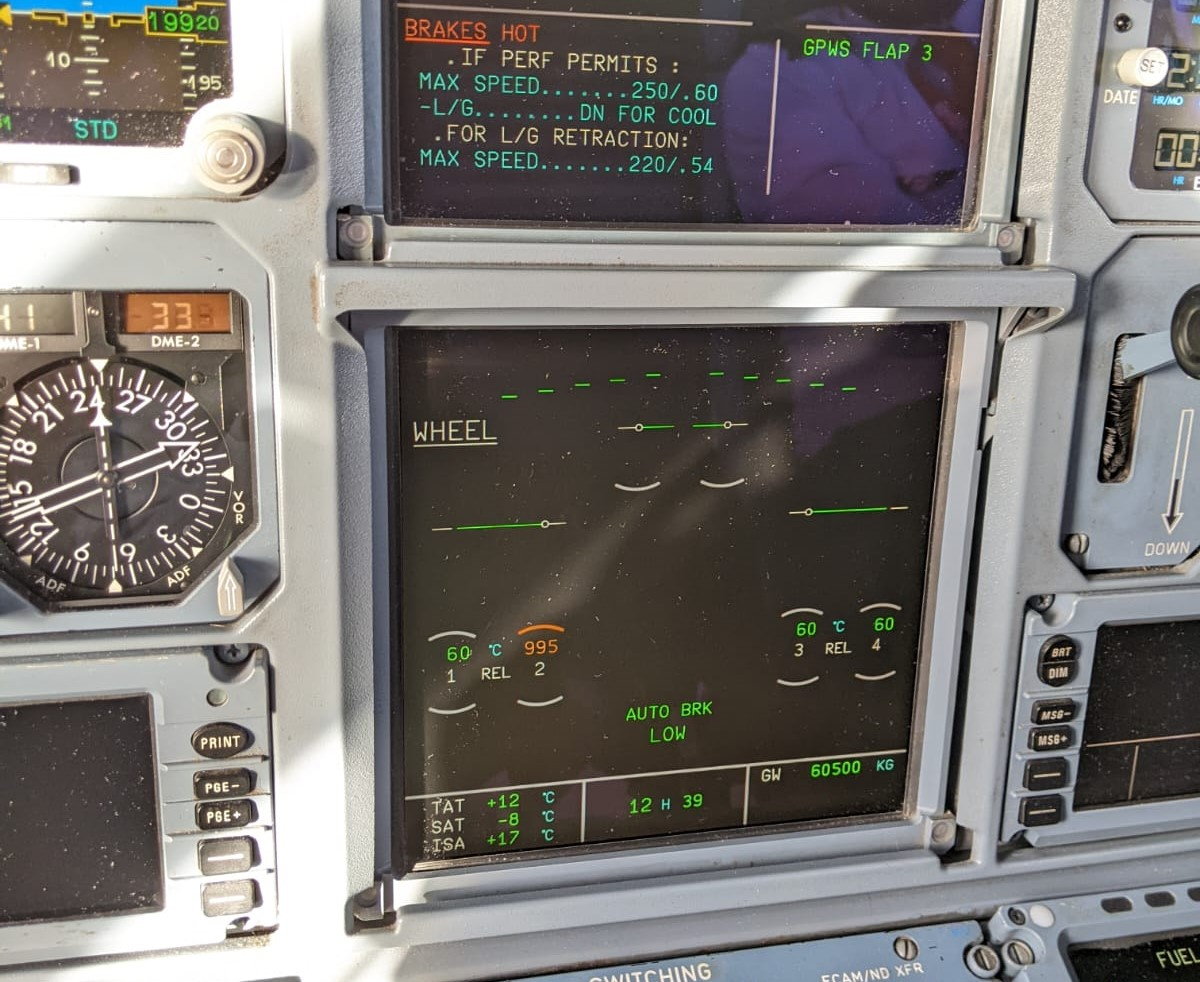
When the master caution ringed, I took a look at the SD and managed to catch the temp on the affected brake going back to 600-some degrees for a sec, then back to 995.
I assessed the whole thing as a spurious indication, discussed the situation with the FO and we disregarded the ECAM alert; when lowering the landing gear while configuring the aircraft to land, the temp immediately when back down to 60 C. In hindsight, it probably should have been better, for sake of peace of mind, to lower the landing gear as per the ECAM, then confirm it as completely false (assuming the affected brake temp would've behaved as it did when we lowered the gear), and then bringing the gear back up. But hey, you learn...
When discussing the whole thing with maintenance personnel, they wanted to know if the alert had happened on ground or in flight as, apparently, there is a brake failure scenario (on ground) in which the brake disintegrates (I forget the exact term they used) and the problem manifests itself with an unusually high brake temperature.
Any of you guys have any info on this?
This was the first flight of the day for this aircraft (A320 with CFM engines), one engine taxi out (approximately a 20 min taxi). Normal temps (60-70 ish °c, as per the image) before takeoff. Short flight, around 35 min, and this was near TOD (descent prep and briefing was complete) and then this happened...
When the master caution ringed, I took a look at the SD and managed to catch the temp on the affected brake going back to 600-some degrees for a sec, then back to 995.
I assessed the whole thing as a spurious indication, discussed the situation with the FO and we disregarded the ECAM alert; when lowering the landing gear while configuring the aircraft to land, the temp immediately when back down to 60 C. In hindsight, it probably should have been better, for sake of peace of mind, to lower the landing gear as per the ECAM, then confirm it as completely false (assuming the affected brake temp would've behaved as it did when we lowered the gear), and then bringing the gear back up. But hey, you learn...
When discussing the whole thing with maintenance personnel, they wanted to know if the alert had happened on ground or in flight as, apparently, there is a brake failure scenario (on ground) in which the brake disintegrates (I forget the exact term they used) and the problem manifests itself with an unusually high brake temperature.
Any of you guys have any info on this?

Joined: Apr 2008
Aviation Qualifications: LAME
Posts: 94
Likes: 7
From: UK
Runway de-icing fluid lowers the temperature at which carbon brakes oxidise. See here: https://skybrary.aero/sites/default/...shelf/2701.pdf

Joined: May 2011
Aviation Qualifications: LAME
Posts: 237
Likes: 7
From: Surrey UK
Hot brakes, mostly when left in park post landing and taxi, can cause the wheel fusible plugs to melt (wheel hub at about 200*C) and tyres to deflate. I had one such incident, narrow body, in Riyadh, a replacement wheel had to be flown in. Also a wide body, with a full set of new brakes glowing after reaching the terminal, luckily the crew had released the park brake after chocks in and I had two air conditioning units on standby for the cabin and used these with great results.
