


LAHSO in UK?

Thread Starter

Joined: Jan 2026
Aviation Qualifications: Spotter
Posts: 2
Likes: 0
From: London
LAHSO in UK?
I was reading through CAP493 (MATS Part 1) this evening, as you do, and I came upon this curious paragraph:
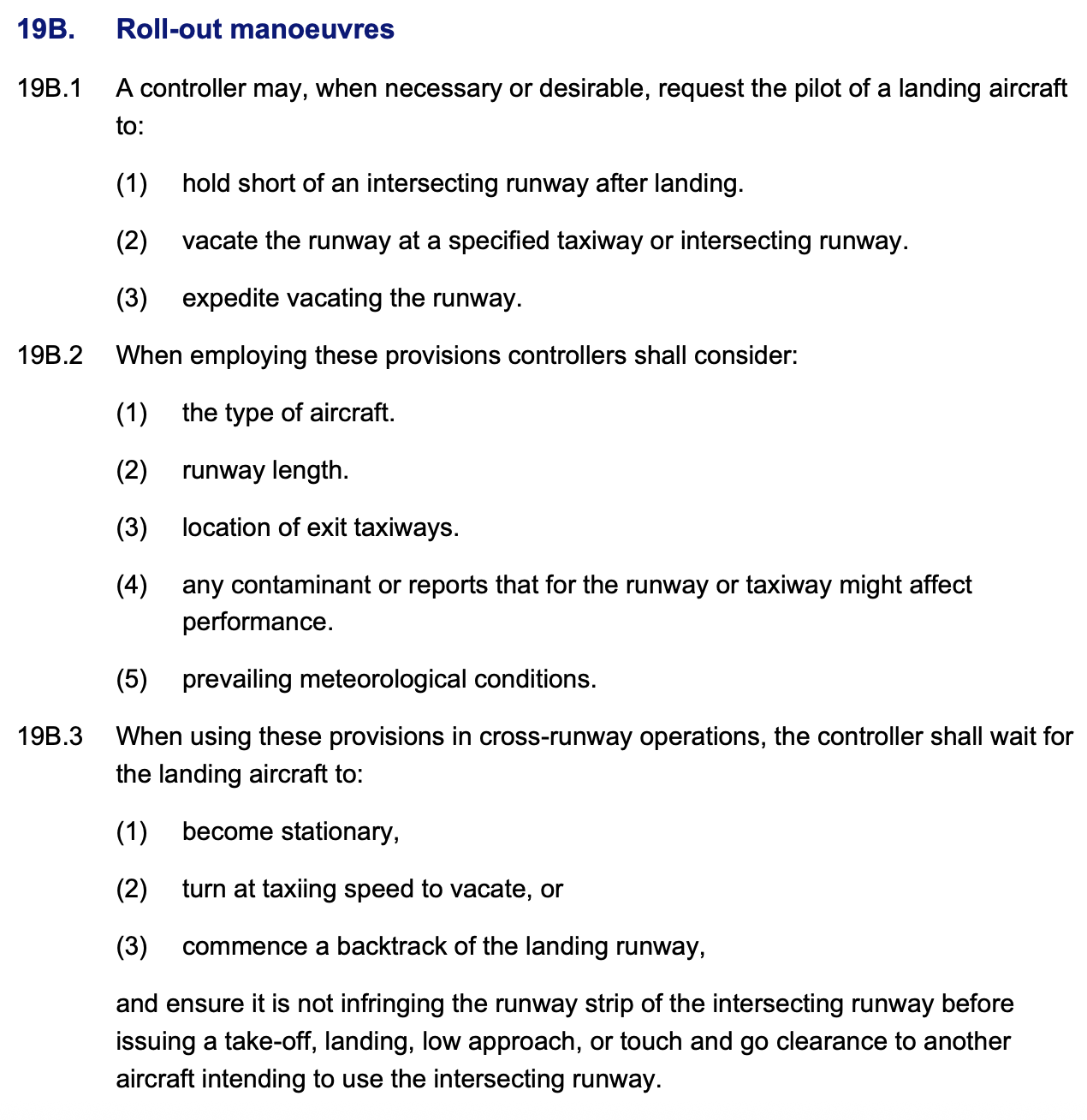
Does this mean that it is possible to get an American-style "cleared to land, hold short runway...." in the UK?? Not too sure where it would be used, or why (given 19B.3). Does anyone have any information on this?
Does this mean that it is possible to get an American-style "cleared to land, hold short runway...." in the UK?? Not too sure where it would be used, or why (given 19B.3). Does anyone have any information on this?


Joined: Apr 1999
Aviation Qualifications: ATPL
Posts: 2,640
Likes: 300
From: In front of a computer
FAA style LAHSO isn’t used in the UK and the airline I worked for prohibited us from accepting such clearances - they even added a remark to our flight plan “LAHSO not authorised”
Didn’t stop Chicago trying it on - they got a firm “unable” from me.
Didn’t stop Chicago trying it on - they got a firm “unable” from me.

Joined: Jan 2026
Aviation Qualifications: PPL
Posts: 1
Likes: 0
From: Cambridge
recent addition
This section was added to CAP493 in september of 2025, effective date october 31st 2025. this is VERY new. I highly doubt that it would have been effective when such a prohibition was in place from your airline
Joined: Apr 2009
Aviation Qualifications: Non-Aircrew
Posts: 1,571
Likes: 649
From: DM33
LAHSO was common at KPRC when I used to fly there.
Fixed wing aircraft usually used 21/3 (L&R) but helicopter training was conducted on 30/12. The helicopters were required to LAHSO 3R/21L. Full length of 3R/21L was always available.
Is there similar helicopter training on intersecting runways in UK?
Fixed wing aircraft usually used 21/3 (L&R) but helicopter training was conducted on 30/12. The helicopters were required to LAHSO 3R/21L. Full length of 3R/21L was always available.
Is there similar helicopter training on intersecting runways in UK?


Joined: Nov 2005
Aviation Qualifications: PPL
Posts: 12,446
Likes: 367
From: Wildest Surrey
LAHSO was common at KPRC when I used to fly there.
Fixed wing aircraft usually used 21/3 (L&R) but helicopter training was conducted on 30/12. The helicopters were required to LAHSO 3R/21L. Full length of 3R/21L was always available.
Is there similar helicopter training on intersecting runways in UK?
Fixed wing aircraft usually used 21/3 (L&R) but helicopter training was conducted on 30/12. The helicopters were required to LAHSO 3R/21L. Full length of 3R/21L was always available.
Is there similar helicopter training on intersecting runways in UK?
Joined: Dec 1999
Posts: 4,432
Likes: 33
From: LHR/EGLL
This isn't land and hold short as would be practiced in the USA (i.e. to instruct an aircraft on approach to land and hold short of a crossing runway to allow independent ops)
This is about requesting a pilot, after landing and while decelerating, or even after stopping, as it says in the third section, to hold short of an intersection. Only once that is achieved (i.e. holding short), would the controller then commit something on to the runway in front of the holding aircraft. This is mainly aimed at holding short of a cross runway during backtrack, as it says in 19B3(3)
This is about requesting a pilot, after landing and while decelerating, or even after stopping, as it says in the third section, to hold short of an intersection. Only once that is achieved (i.e. holding short), would the controller then commit something on to the runway in front of the holding aircraft. This is mainly aimed at holding short of a cross runway during backtrack, as it says in 19B3(3)

Joined: Apr 2001
Aviation Qualifications: ATP+Mil
Posts: 4,914
Likes: 608
From: surfing, watching for sharks
Fly to all the major airports, LAHSO is still a tool in ATC's toolbox when needed. As far as insurance, nothing communicated to my airline that it's use is frowned upon.

Joined: Jul 2018
Posts: 26
Likes: 2
From: North
I was reading through CAP493 (MATS Part 1) this evening, as you do, and I came upon this curious paragraph:
Does this mean that it is possible to get an American-style "cleared to land, hold short runway...." in the UK?? Not too sure where it would be used, or why (given 19B.3). Does anyone have any information on this?
Does this mean that it is possible to get an American-style "cleared to land, hold short runway...." in the UK?? Not too sure where it would be used, or why (given 19B.3). Does anyone have any information on this?
I agree that 19B.3 would seem to preclude its use like it's used in the USA. I'm struggling to imagine a scenario in which it would be used here. Assume an airport with two crossing runways (a simple cross shape for example, rwy 18/36 and 27/09). One a/c cleared to land on 18, instructed "LAHS runway 27" or whatever. Another a/c lined up on 27 awaiting departure. 19B.3 means departure can't roll until the first one has landed and is not going to infringe 27. Under current procedures this is exactly the same. If the arrival naturally stopped / vacated short of 27 you'd launch the departure at that point. If it rolled through, you would issue instructions to stop it backtracking through the intersection if you wanted to roll the departure. Either way, allowing for some sort of braking failure or even a long float / deep landing as it does, it doesn't allow for any more flexibility than we already have.
The only scenario I can think of (in my example) is when you want the arrival to vacate onto rwy 27, eg for taxi to parking, but it's obstructed with the departure who's lined up. That seems like a very niche and rare reason to introduce a heavily-restricted version of a procedure we've never used before? Other than some sort of plan for alignment with international procedures perhaps.
Would love to hear any actual, likely benefits from more experienced ATCOs (or pilots) who can spot what I've missed!
Joined: Mar 2026
Aviation Qualifications: ATCO
Posts: 1
Likes: 0
From: Dubai
LAHSO isn’t really used in the UK the way it is in the US. The rule in CAP493 mainly allows ATC to ask an aircraft to hold short of an intersection after landing or while slowing down, not the American-style “cleared to land, hold short” clearance during approach. In practice it’s rarely used and current UK procedures already cover most situations without needing true LAHSO operations.

Joined: Jul 2023
Posts: 163
Likes: 225
From: Wiltshire
Reading that amendment as an ex-controller, it seems to me it only states something which was OK to do anyway, but someone has decided should be in black and white, and I’m generally against that kind of thing. Reading it in ‘lawyer mode’, it’s appallingly badly written, with the term, ‘landing aircraft’ in particular being roundly abused by way of a missing, ‘previously’, and there being a glaring, ‘and shall not’ missing after ‘is not’ in the final sub-para. 3/10 must try harder to the editor of MATS Pt 1 from me (a shame, as I always thought it was very well written).
Joined: Dec 1999
Posts: 4,432
Likes: 33
From: LHR/EGLL
Reading that amendment as an ex-controller, it seems to me it only states something which was OK to do anyway, but someone has decided should be in black and white, and I’m generally against that kind of thing. Reading it in ‘lawyer mode’, it’s appallingly badly written, with the term, ‘landing aircraft’ in particular being roundly abused by way of a missing, ‘previously’, and there being a glaring, ‘and shall not’ missing after ‘is not’ in the final sub-para. 3/10 must try harder to the editor of MATS Pt 1 from me (a shame, as I always thought it was very well written).
Joined: Dec 2020
Aviation Qualifications: ATCO
Posts: 297
Likes: 236
From: Home
I was involved with MATS 1 when ICAO introduced LAHSO - it was universally agreed to be a bad idea that wouldn’t be included in the UK book. But the extract posted above feels awfully familiar and I’d have sworn that it’s been in the manual somewhere for years.
I’ve been out of the CAA for years now and haven’t really followed what’s happened in the books in recent years, nor in actual practice, but I can’t help feeling that losing the MATS 1 would be a big backward step. I hope - as Gonzo suggests - that all of the good stuff, like interpreting the ICAO stuff, is kept somehow.
I’ve been out of the CAA for years now and haven’t really followed what’s happened in the books in recent years, nor in actual practice, but I can’t help feeling that losing the MATS 1 would be a big backward step. I hope - as Gonzo suggests - that all of the good stuff, like interpreting the ICAO stuff, is kept somehow.
Joined: Jan 2001
Posts: 624
Likes: 17
From: Deepest darkest Inbredland....
Given what Gonzo has just said, I'm going to guess that OJT will become even more fun with newbies with nice shiny licences! A bit like 15/20 years ago, but worse. Thank goodness I retired a couple of years ago.

Joined: Nov 2006
Posts: 282
Likes: 85
From: UK
I was involved with MATS 1 when ICAO introduced LAHSO - it was universally agreed to be a bad idea that wouldn’t be included in the UK book. But the extract posted above feels awfully familiar and I’d have sworn that it’s been in the manual somewhere for years.
I’ve been out of the CAA for years now and haven’t really followed what’s happened in the books in recent years, nor in actual practice, but I can’t help feeling that losing the MATS 1 would be a big backward step. I hope - as Gonzo suggests - that all of the good stuff, like interpreting the ICAO stuff, is kept somehow.
I’ve been out of the CAA for years now and haven’t really followed what’s happened in the books in recent years, nor in actual practice, but I can’t help feeling that losing the MATS 1 would be a big backward step. I hope - as Gonzo suggests - that all of the good stuff, like interpreting the ICAO stuff, is kept somehow.

