


Deadside or Upwind?

Thread Starter

Joined: Feb 2018
Posts: 1
Likes: 0
From: Lincolnshire
 Deadside or Upwind?
Evening All
When joining the circuit for the active runway to land, and approaching from non-active side of the pattern that is deadside why should we call this Upwind as when departing the active runway for a circuit or departing the field this is called Upwind?
When joining the circuit for the active runway to land, and approaching from non-active side of the pattern that is deadside why should we call this Upwind as when departing the active runway for a circuit or departing the field this is called Upwind?


Joined: Sep 2000
Posts: 1,174
Likes: 5
From: South of England
Glider 90 - I am not quite certain from your phrasing the precise point that you are querying, but the following may be relevant, certainly in the UK. The standard circuit terminology is published in CAP 413 (UK), which is derived from ICAO PANS-ATM. Each is a masterpiece of inadequate terminology insofar as no designations are given to the first two legs of a circuit immediately after departure. Common practice in ATC training is to use the terms "climb-out" and "crosswind" respectively and but there is no formal authority for this. Also, CAP 413 uses the dreadful expression (in the text) of "upwind threshold" instead of "end" - a runway direction has one threshold and one end! Hence, there can be no precise meaning for the term upwind, rather that it is a general term indicating that area relative to the runway-in-use. CAP 413 adds to the confusion by giving an example of traffic information being passed as G-CD, traffic is a Cherokee upwind and a Tomahawk late downwind. Perhaps this is what you are querying. In this case, where is the pilot supposed to look for the Cherokee - on climb-out, crosswind or even at the start of the downwind leg before reaching the downwind report position? I have drawn this anomaly to the attention of CAA but am not holding my breath.
2 s
2 s
Last edited by 2 sheds; 10th March 2019 at 17:18. Reason: correction as spotted by +TSRA


Joined: Oct 2007
Aviation Qualifications: ATPL
Posts: 1,028
Likes: 121
From: Wherever I go, there I am
CAP 413 adds to the confusion by giving an example of traffic information being passed as G-CD, traffic is a Cherokee upwind and a Tomahawk late downwind. Perhaps this is what you are querying. In this case, where is the pilot supposed to look for the Tomahawk - on climb-out, crosswind or even at the start of the downwind leg before reaching the downwind report position? I have drawn this anomaly to the attention of CAA but am not holding my breath.
When joining the circuit for the active runway to land, and approaching from non-active side of the pattern that is deadside why should we call this Upwind as when departing the active runway for a circuit or departing the field this is called Upwind?
This diagram describes what you learn in the UK (from CAP413):

This diagram describes what you learn in Canada or the United States (from the FAA Aeronautical Information Manual as obtained from Air Facts with a notation from me about the wind direction):
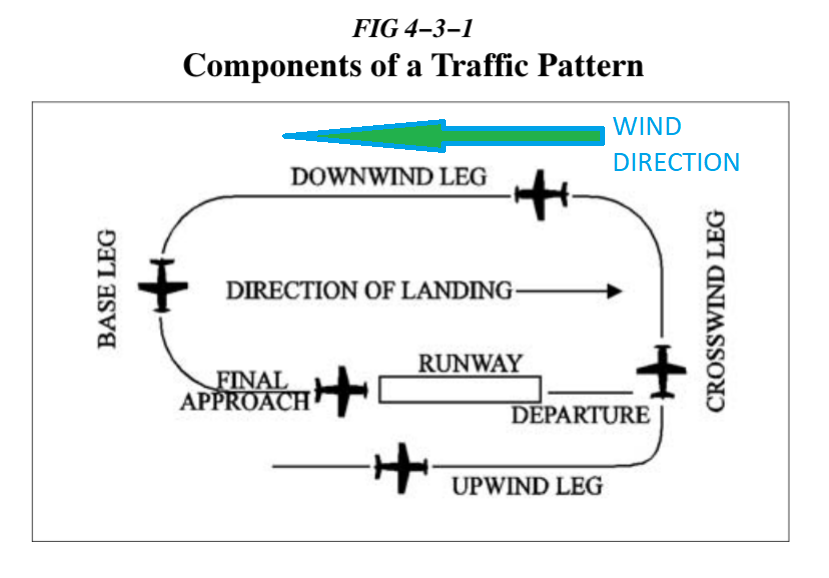
So, depending on where you are geographical, either of the terms is correct.
In almost 20 years flying, I've found our beloved industry is notorious for people sharing and teaching their opinion of how things should be, rather than how they are. In this case, both terms are correct for different situations. Dead Side is not appropriate in Canada or the U.S, whereas upwind (or non-traffic side) is. Likewise, Upwind is not appropriate in the UK as Deadside is used to describe the same position.
It's akin to calling the landing gear the undercarriage. Some will pick a hill to die on over that debate!

It is simply a lack of knowledge, sometimes bordering on laxity, that comes from exposure; that is, most flight instructors train just in their jurisdiction so only know what they've been taught. Then, they get a student who either learned it a different way or is reading from a book published elsewhere, and that instructor will tell the student they are flat out wrong. The student is not wrong, given the proper context.
And a fact without context is just a belief.
Last edited by +TSRA; 10th March 2019 at 15:44. Reason: Spacing
Thread Starter
Joined: Feb 2018
Posts: 1
Likes: 0
From: Lincolnshire
+TSRA
You have answered my question with the UK have different terms for been in the circuit, compared to Canada & USA. Why don't they just make everything standard across the globe and this would erase any confusion!!
You have answered my question with the UK have different terms for been in the circuit, compared to Canada & USA. Why don't they just make everything standard across the globe and this would erase any confusion!!
Joined: Sep 2000
Posts: 1,174
Likes: 5
From: South of England
+TSRA
Cheers
2 s
- Very observant, thank you - I have corrected the aircraft type.
- No, I didn't confuse the CAA; I merely queried the undefined (in ICAO and UK) term "upwind". And your comment is indeed taken as a ;-) !
- You are quite right that many other states have there own variations or additions such as joining the downwind leg at a defined angle if the circuit is active, the specification of a mid-point position on the downwind leg etc.
- However, as the OP is based in Lincolnshire, I assumed that he was talking UK procedures - and I made that clear. In the UK, use of the term upwind in this context is inappropriate because, as in ICAO, it is not defined and therefore can be misinterpreted.
- The UK CAA really needs to address this subject - including the issue of direct joins on either base leg or crosswind, and whether under ATC, AFIS, AGCS or no radio service. After two fatal collisions in the circuit in recent years, the responsibility was essentially left with the aerodrome operator or ANSP, thus creating the probability of even more local variations with resultant confusion.
Cheers
2 s


Joined: Nov 2005
Aviation Qualifications: PPL
Posts: 12,458
Likes: 368
From: Wildest Surrey
+TSR
Cheers
2 s
- The UK CAA really needs to address this subject - including the issue of direct joins on either base leg or crosswind, and whether under ATC, AFIS, AGCS or no radio service. After two fatal collisions in the circuit in recent years, the responsibility was essentially left with the aerodrome operator or ANSP, thus creating the probability of even more local variations with resultant confusion.
Cheers
2 s

Joined: Sep 2000
Posts: 1,174
Likes: 5
From: South of England
Course if everybody phoned for PPR and briefing..........
2 s
