


Nepal Plane Crash


Joined: Mar 2006
Aviation Qualifications: ATPL
Posts: 399
Likes: 155
From: Western Europe
Bizarre that this sort of event can happen with an experienced trainer.

Joined: Jan 2006
Aviation Qualifications: CPL
Posts: 1,410
Likes: 46
From: Between a rock and a hard place
Thanks all for the extracts, I am also a confused non-turbo prop pilot, so bare with me.
Torque at 0 % doesn't necessairly mean exactly 0, does it? That to me imploed fuel is cut off, which doesn't seem to be the case? The engine has free turbine, has it not? Any flow over the turbine wheel would create some torque on the prop shaft, even at idle. Or is 0 a ghost number from lack of proper recording?
Torque at 0 % doesn't necessairly mean exactly 0, does it? That to me imploed fuel is cut off, which doesn't seem to be the case? The engine has free turbine, has it not? Any flow over the turbine wheel would create some torque on the prop shaft, even at idle. Or is 0 a ghost number from lack of proper recording?

Guest
Joined: Mar 2011
Posts: 107
Likes: 26
From: Around
While I hate to point fingers and have avoided it as much as possible in previous posts, it's becoming very clear what happened. It's certainly a human error.
The other issue that stands out to me is that F30 was called for (not moved) and the condition levers placed into FTR but then F30 was stated as in position. This is unlikely to occur in the time line stated. As soon as the CLs got to feather the ACW goes off line, some residual hydraulic pressure may remain to drive the flaps to 30 but not likely. Also as soon as ACW goes off line you know about it. It's an electrical aircraft.
The other issue that stands out to me is that F30 was called for (not moved) and the condition levers placed into FTR but then F30 was stated as in position. This is unlikely to occur in the time line stated. As soon as the CLs got to feather the ACW goes off line, some residual hydraulic pressure may remain to drive the flaps to 30 but not likely. Also as soon as ACW goes off line you know about it. It's an electrical aircraft.
Some questions to those in the know.
1. On the ATR, are the condition levers and the flap lever adjacent to each other? Yes they are next to each other but I have never seen a crew mistake the two. Both CLs have independent triggers so it would require some thought and intent to lift both at the same time
2. a. How are the condition levers and how is the flap lever protected against inadvertent movement? Latch triggers on the CLs. The Flap (which is ergonomically the shape of a flap needs to be lifted them placed into position.
b. Do the levers themselves have to be pulled out of a detent or is there a little latch mounted beneath the lever that has to be pulled to open the latch? Yes
c. Are there differences between the respective levers latch types or is the required action to unlatch the lever the same on both? As above, very very different levers and mechanisms
d. Are there differences between ATR subvariants? Yes but very minor, but a rather moot point. This crew (I believe) have only operated the 500 variant
1. On the ATR, are the condition levers and the flap lever adjacent to each other? Yes they are next to each other but I have never seen a crew mistake the two. Both CLs have independent triggers so it would require some thought and intent to lift both at the same time
2. a. How are the condition levers and how is the flap lever protected against inadvertent movement? Latch triggers on the CLs. The Flap (which is ergonomically the shape of a flap needs to be lifted them placed into position.
b. Do the levers themselves have to be pulled out of a detent or is there a little latch mounted beneath the lever that has to be pulled to open the latch? Yes
c. Are there differences between the respective levers latch types or is the required action to unlatch the lever the same on both? As above, very very different levers and mechanisms
d. Are there differences between ATR subvariants? Yes but very minor, but a rather moot point. This crew (I believe) have only operated the 500 variant

Joined: Oct 2013
Posts: 78
Likes: 0
From: Stag Lane
While I hate to point fingers and have avoided it as much as possible in previous posts, it's becoming very clear what happened. It's certainly a human error.
The other issue that stands out to me is that F30 was called for (not moved) and the condition levers placed into FTR but then F30 was stated as in position. This is unlikely to occur in the time line stated. As soon as the CLs got to feather the ACW goes off line, some residual hydraulic pressure may remain to drive the flaps to 30 but not likely. Also as soon as ACW goes off line you know about it. It's an electrical aircraft.
The other issue that stands out to me is that F30 was called for (not moved) and the condition levers placed into FTR but then F30 was stated as in position. This is unlikely to occur in the time line stated. As soon as the CLs got to feather the ACW goes off line, some residual hydraulic pressure may remain to drive the flaps to 30 but not likely. Also as soon as ACW goes off line you know about it. It's an electrical aircraft.

Joined: Mar 2018
Posts: 74
Likes: 9
From: Kathmandu
Flap 15 and Condition Auto would be lining up . The Width of the top knobs seems similar . Can something like this be messed up especially by the PM .
Last edited by Yo_You_Not_You_you; 16th February 2023 at 08:12.


Joined: Mar 2002
Aviation Qualifications: CPL
Posts: 3,396
Likes: 328
From: near an aeroplane

An image for those who don't want to suffer the music in the Youtube video above.
The last sentence of paragraph 1.1.5 states that a click was recorded and a flap 'surface' movement to 30 degrees was recorded. At that time, the props were still feathered. For someone not familiar with the type (or turboprops), what power would have been available to drive the flaps to 30 degrees at that time?
Pegase Driver

Joined: May 1997
Aviation Qualifications: ATCO
Posts: 4,456
Likes: 1,168
From: Europe
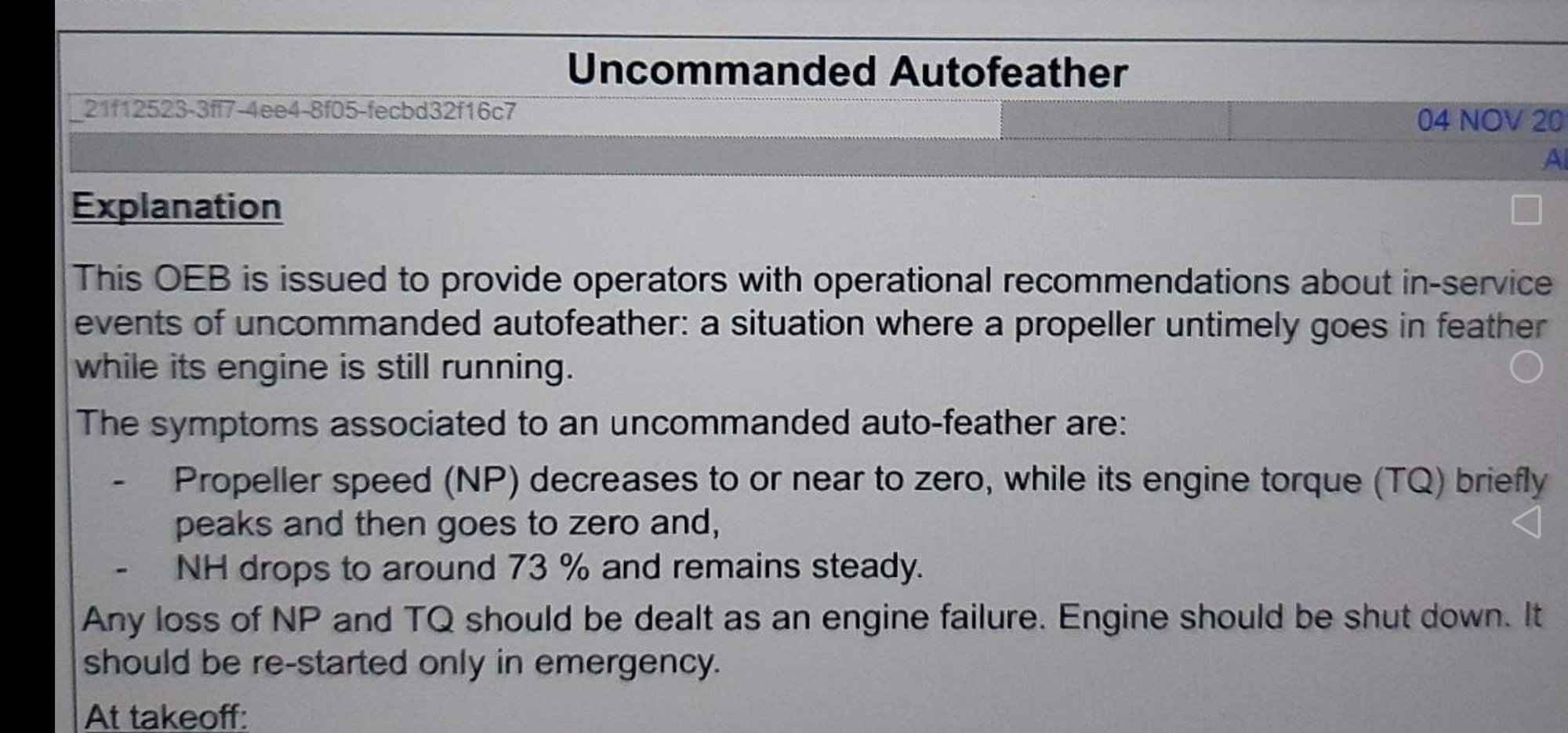
While the uncommanded auto-feather looks one of the probable causes, I have read somewhere that there should be a mecahnism that prevent to do this on both engines at the same time . So that safety would have failed too ?
Joined: Feb 2009
Posts: 946
Likes: 445
From: Austria
@Boom, thank You for the answers. Together with the picture of the quadrant, it does seem to point into a certain direction.
1. The propellers feathered at the same time the flaps were supposed to go to 30. It stretches my imagination a bit to assume an unscheduled feather to strike both engines right at this time, without autofeather armed and bypassing all the internal safety nets such as the mentioned lockout on the far engine.
2. Looking at the quadrant, not only are the flap lever and the condition levers right beside each other. Also, their respective position may well have been quite similar. I obviously stand to be corrected here, but I gathered that the condition levers are normally in "AUTO" in this flight phase - the flap lever was in position 15°, so they were rather adjacent to each other. Additionally, the required travel from 15° to 30° on the flap levers seems rather similar to the travel from AUTO to FTR on the condition levers. The haptic differences between two versus one lever and the very different unlatching actions seem to be the only remaining 2 cheese layers that prevent a misselection in a rather high-workload situation in which the often-performed selection may be performed without looking at what lever is being grabbed.
About the engines and their connection to the hydraulic pumps, as the question was asked: On a PW120, the hydraulic pump is mounted on the propeller reduction gear box along with the variable frequency AC generator and other things. The turbomachinery drives the DC starter generator that generally speaking provides the low(er) watt systems. If one propeller is feathered and the other is running, the good engine will provide power to the failed engines hydraulic system in some way (be it via an AC electric auxiliary pump or a unidirectional PTU), but with all engines feathered, hydraulics will generally end up unpressurised, whether or not the turbomachinery is still running.
1. The propellers feathered at the same time the flaps were supposed to go to 30. It stretches my imagination a bit to assume an unscheduled feather to strike both engines right at this time, without autofeather armed and bypassing all the internal safety nets such as the mentioned lockout on the far engine.
2. Looking at the quadrant, not only are the flap lever and the condition levers right beside each other. Also, their respective position may well have been quite similar. I obviously stand to be corrected here, but I gathered that the condition levers are normally in "AUTO" in this flight phase - the flap lever was in position 15°, so they were rather adjacent to each other. Additionally, the required travel from 15° to 30° on the flap levers seems rather similar to the travel from AUTO to FTR on the condition levers. The haptic differences between two versus one lever and the very different unlatching actions seem to be the only remaining 2 cheese layers that prevent a misselection in a rather high-workload situation in which the often-performed selection may be performed without looking at what lever is being grabbed.
About the engines and their connection to the hydraulic pumps, as the question was asked:
Last edited by Tu.114; 16th February 2023 at 11:37.
Joined: Feb 2010
Posts: 138
Likes: 0
From: Norden
Auto-feather can feather only one side.
This was commanded feathering so no protection against feathering both sides.
The ACW and hydraulic loss was mentioned and explained in post #500.In addition the flight spoilers are lost as well.
On the old 72 with 4 blade propeller and without PEC the „Automatic Propeller Changeover to MAX RPM“ might have saved the day.
This was commanded feathering so no protection against feathering both sides.
The ACW and hydraulic loss was mentioned and explained in post #500.In addition the flight spoilers are lost as well.
On the old 72 with 4 blade propeller and without PEC the „Automatic Propeller Changeover to MAX RPM“ might have saved the day.
Joined: Feb 2010
Posts: 138
Likes: 0
From: Norden
About the engines and their connection to the hydraulic pumps, as the question was asked: On a PW120, the hydraulic pump is mounted on the propeller reduction gear box along with the variable frequency AC generator and other things. The turbomachinery drives the DC starter generator that generally speaking provides the low(er) watt systems. If one propeller is feathered and the other is running, the good engine will provide power to the failed engines hydraulic system in some way (be it via an AC electric auxiliary pump or a unidirectional PTU), but with all engines feathered, hydraulics will generally end up unpressurised, whether or not the turbomachinery is still running.
On theATR there is no hydraulic coming from the engine.
The hydraulic pumps are electrical driven and located in the belly.If one engine is running with Np above 66% both ACW buses are supplied and both hydraulic pumps are running.
Joined: Feb 2009
Posts: 946
Likes: 445
From: Austria
Thank You for the correction, I´ll amend my previous post shortly.
Still, it means that with both propellers feathered, there is no hydraulic power on the ATR, correct?
By the way, are any of the primary flight controls hydraulically powered on the ATR? With a total hydraulic loss, are there any implications to the aircraft controlability?
Still, it means that with both propellers feathered, there is no hydraulic power on the ATR, correct?
By the way, are any of the primary flight controls hydraulically powered on the ATR? With a total hydraulic loss, are there any implications to the aircraft controlability?
Joined: Mar 2002
Aviation Qualifications: CPL
Posts: 3,396
Likes: 328
From: near an aeroplane
The frequency-wild generators
drop off line when the propeller rpm falls below 70%. In
operational terms, this means that when the propellers’
rpm are reduced prior to feathering following the
aircraft’s arrival on stand, the Green and Blue system
AC pumps will cease operating. This will cause the
DC pump, powered from starter/generators on the
high-speed engine spools, to cut in, thus maintaining
pressure in the Blue system.
drop off line when the propeller rpm falls below 70%. In
operational terms, this means that when the propellers’
rpm are reduced prior to feathering following the
aircraft’s arrival on stand, the Green and Blue system
AC pumps will cease operating. This will cause the
DC pump, powered from starter/generators on the
high-speed engine spools, to cut in, thus maintaining
pressure in the Blue system.
Also:
Each hydraulic system is provided with a 0.2 litre
accumulator, which damps out pressure surges and
compensates for pump response time in the event of
high demand.
accumulator, which damps out pressure surges and
compensates for pump response time in the event of
high demand.
Joined: Feb 2010
Posts: 138
Likes: 0
From: Norden
Think i was wrong.I missed the signal „LDG Lever down“ in the wiring manual.Sorry.
The DC AUX Pump should take over when blue hyd press is low,at least one engine running(signal is oil press) and the LDG is selected down.
Operation of flaps should be possible now.
Movement will be slower due to much smaller pump.
Flight spoilers should work as well.
The DC AUX Pump should take over when blue hyd press is low,at least one engine running(signal is oil press) and the LDG is selected down.
Operation of flaps should be possible now.
Movement will be slower due to much smaller pump.
Flight spoilers should work as well.
Joined: May 2005
Posts: 1,121
Likes: 12
From: Milton Keynes
As one contributor commented at the time, and on listening to the first video posted, there is, now we know more, remarkably little prop noise. A few questions
Is there any kind of protection on the ATR to prevent what is quite a simply made error - even an audible cancellable warning.
- sorry just found this - but isn't this a case of if it can happen it will so should there be. Even on a little RV-7 I fly in there is a "flaps flaps" audible warning when they move
Had the error been detected quickly would this have been recoverable. Presume so.
Tragic out come from moving the wrong lever.
Is there any kind of protection on the ATR to prevent what is quite a simply made error - even an audible cancellable warning.
This was commanded feathering so no protection against feathering both sides
Had the error been detected quickly would this have been recoverable. Presume so.
Tragic out come from moving the wrong lever.

Joined: May 2010
Posts: 1,571
Likes: 374
From: PLanet Earth
2. Looking at the quadrant, not only are the flap lever and the condition levers right beside each other. Also, their respective position may well have been quite similar. I obviously stand to be corrected here, but I gathered that the condition levers are normally in "AUTO" in this flight phase - the flap lever was in position 15°, so they were rather adjacent to each other. Additionally, the required travel from 15° to 30° on the flap levers seems rather similar to the travel from AUTO to FTR on the condition levers.
Buuuut:
The haptic differences between two versus one lever and the very different unlatching actions seem to be the only remaining 2 cheese layers that prevent a misselection in a rather high-workload situation in which the often-performed selection may be performed without looking at what lever is being grabbed.
The chances that in this case indeed a mix- up did happen appear to be high. Remains pretty puzzling, though. Also that apparently no one checked position of the levers even when after applying power nothing happened. Normally even peripheral vision should have been enough to ring a bell. And all this in bright daylight. And no cacophony of alerts, No direct emergency that would have caused havoc in the cockpit. Nothing which would explain why it a) happened in the first place and b) wasn't detected afterwards. But from the basic facts we know chances are still very high that exactly this happened.
Pegase Driver
Joined: May 1997
Aviation Qualifications: ATCO
Posts: 4,456
Likes: 1,168
From: Europe
The shape of the levers and the unlatching mechanism are indeed veeeery different.
Joined: Jul 2009
Aviation Qualifications: PPL
Posts: 167
Likes: 56
From: France
Indeed the position is quite close to each other.
... Also that apparently no one checked position of the levers even when after applying power nothing happened. Normally even peripheral vision should have been enough to ring a bell. And all this in bright daylight. ... But from the basic facts we know chances are still very high that exactly this happened.
... Also that apparently no one checked position of the levers even when after applying power nothing happened. Normally even peripheral vision should have been enough to ring a bell. And all this in bright daylight. ... But from the basic facts we know chances are still very high that exactly this happened.
10:56:32: The PF then called for “FLAPS 30” at 10:56:32, and the PM replied, “Flaps 30 and descending”. The ...(FDR) data did not record any flap surface movement at that time. Instead, the propeller rotation speed (Np) of both engines decreased simultaneously to less than 25%1 and the torque (Tq) started decreasing to 0%, which is consistent with both propellers going into the feathered condition2. ..
10:56:54, another click was heard, followed by the flaps surface movement to the 30 degrees position...
That sounds to me like someone noticed the mistake after 20 s and pulled the flap levers to 30. Clandestine correction of error with no comment on the CVR and no check / correction of the condition levers?
Joined: Jul 1999
Posts: 444
Likes: 5
From: England
If an error can be made, however unlikely, humans will find a way of making it. They will even hear, see and confirm what they expect to happen. Neither pilot seemed to notice a sudden and complete loss of power. Well, why would they, it wasn't in the mental model.