


AF447 final crew conversation - Thread No. 1

Join Date: Oct 2009
Location: UK
Posts: 1,270
Likes: 0
Received 0 Likes
on
0 Posts
Hi Organfreak,
Me too!
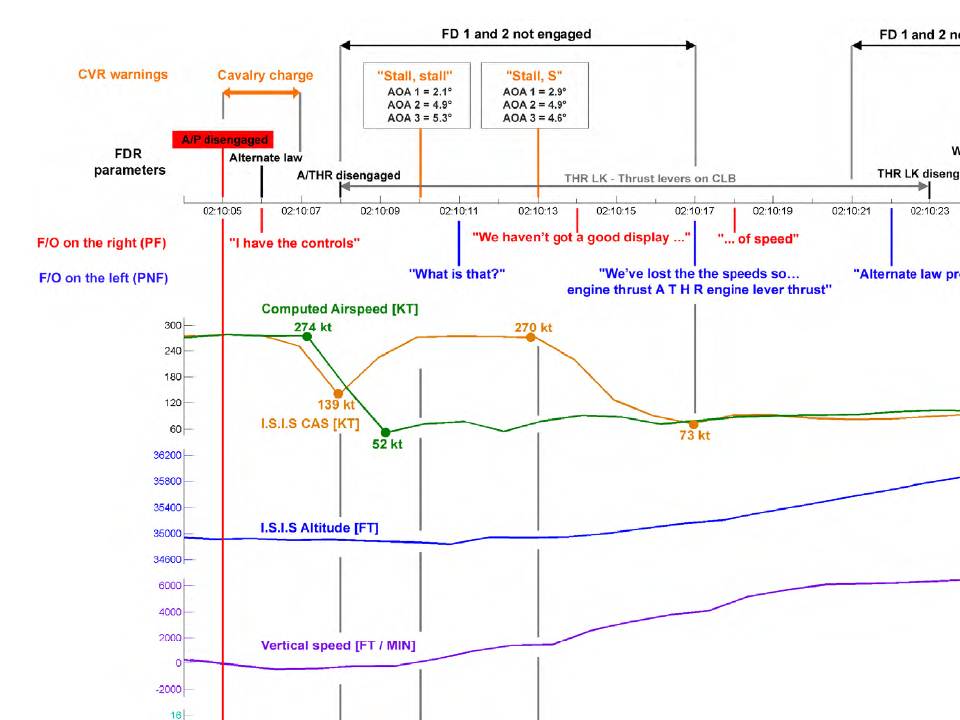
The report of July 11, page 29 shows quite clearly that the AP (probably No2 (FO's side)) disengaged at 02:10:05. The FO's IAS is not recorded, but the ISIS shows a speed drop from 02:10:06 and the Capt's IAS shows a drop from 02:10:07. I assume the FO's IAS showed a speed drop at 02:10:05 which caused the AP to fail.
I suggest you disregard the "The pilots noticed it by reference eleven seconds AFTER the Cavalry Charge, yes?" red herring.
This hamster wheel is makin' me dizzy!
The report of July 11, page 29 shows quite clearly that the AP (probably No2 (FO's side)) disengaged at 02:10:05. The FO's IAS is not recorded, but the ISIS shows a speed drop from 02:10:06 and the Capt's IAS shows a drop from 02:10:07. I assume the FO's IAS showed a speed drop at 02:10:05 which caused the AP to fail.
I suggest you disregard the "The pilots noticed it by reference eleven seconds AFTER the Cavalry Charge, yes?" red herring.

Join Date: Oct 2011
Location: invalid value
Posts: 39
Likes: 0
Received 0 Likes
on
0 Posts
Originally Posted by Lyman
Loss of Autopilot does not drive an immediate degradation to Alternate Law, does it?
I woud be interested in your patient reply, with explanations. My small child can say "NO" endlessly.
EG: Does the Autopilot not make use of the spoilers?
Join Date: Aug 2009
Location: Germany
Age: 67
Posts: 1,777
Likes: 0
Received 0 Likes
on
0 Posts

Hi,
ChristiaanJ
I do not dispute
But you find this lack of interest on the part of regulators and certification bodies as something satisfactory?
ChristiaanJ
What I was saying is that, so far, I've not yet seen any reports of substantial research into the 'unusual' pitot icing leading to UAS events, or any 'proposals for rule making' based on such research.
But you find this lack of interest on the part of regulators and certification bodies as something satisfactory?
Join Date: Aug 2011
Location: Grassy Valley
Posts: 2,074
Likes: 0
Received 0 Likes
on
0 Posts
A thread about the conversation between/among the piots? All PF says at a/p loss is "I have the controls"?
Does this suggest the pilot also knew the Flight Law had degraded? No. My point is that the all important question is what he knew, and when. He makes no mention of the Plane's conversion to Alternate? No mention of the loss of AirData? Does he illuminate the type of Alternate? No. Does he believe he is still in Normal Law, and speeds are not unreliable? This all is first verbalized many seconds later. Red Herring?
Neither does he call for the book, and establish other than a mundane reversion to manual control.
This raises no questions amongst the illuminates here?
The salient point is not what has been discovered, it is of no meaning to the crew/pax. What is important is if he was flying without a basic set of start points, how could such a thing happen?
There is also, of course, the possibility that the ironclad conclusions of some are in an area that not even the BEA has ventured, nor will they.
Does this suggest the pilot also knew the Flight Law had degraded? No. My point is that the all important question is what he knew, and when. He makes no mention of the Plane's conversion to Alternate? No mention of the loss of AirData? Does he illuminate the type of Alternate? No. Does he believe he is still in Normal Law, and speeds are not unreliable? This all is first verbalized many seconds later. Red Herring?
Neither does he call for the book, and establish other than a mundane reversion to manual control.
This raises no questions amongst the illuminates here?
The salient point is not what has been discovered, it is of no meaning to the crew/pax. What is important is if he was flying without a basic set of start points, how could such a thing happen?
There is also, of course, the possibility that the ironclad conclusions of some are in an area that not even the BEA has ventured, nor will they.
Join Date: Jun 2009
Location: NNW of Antipodes
Age: 81
Posts: 1,330
Received 0 Likes
on
0 Posts

The proposed EASA amendments (NPA 2011-03 ~ Appendix P) have been added in green, plus 3 UAS events are plotted.
EDIT :: Some additional background:-
A common characteristic in most Unreliable Air Speed (UAS) events was the proximity to deep convective/tropical storm cloud formations; hence the EASA NPA 2011-03 Appendix P proposal is primarily a "deep convective cloud" extension to the existing JAR intermittent maximum envelope. This hypothesis is based on the often rapid onset of UAS events, the lack of airframe icing, some observations of strong moisture on the windscreen (e.g., rain reported but suspected to be melting ice crystals), and the proximity to such cloud formations, is that the aircraft are likely encountering an area of high ice water content[1]. The observations of low or no reflectivity on the pilot’s radar are consistent with flight through ice particles, possibly concentrated at small sizes[2].
Refs:- (BEA Interim Report No.3 - p.77)
[1]The background noise changed rapidly around 2 h 09 min 46. This change in the background noise was identified as possibly being characteristic of the presence of ice crystals but did not give rise to any specific comments from the crew, the phenomenon being little known to pilots at the time.
[2]The conversations in the cockpit did not reveal any malfunction of the weather radar and indicate that the latter displayed a usable image.
Last edited by mm43; 19th Feb 2012 at 19:20.
Join Date: Jan 2005
Location: France
Posts: 2,315
Likes: 0
Received 0 Likes
on
0 Posts
I've skip-read it and will read it again, even if it is not quite my field.
But at first sight, I've not seen an unequivocal requirement for re-defining the pitot tube certification requirements.
Join Date: Feb 2011
Location: Nearby SBBR and SDAM
Posts: 875
Likes: 0
Received 0 Likes
on
0 Posts
Sub heated AS probes and GIGO*
Hi,
It seems almost ridiculous the fact the aviation industry is still today using sub heated Pitot's.
A very simple device, so important, an essential input to the A/C complex IT Systems, seems to be not advancing to a "changing environment".
And clearly, the trigger of a serious accident where the System and the crew were not capable to deal with the consequences of it's VERY BRIEF failure in presenting consistent output.
Another almost ridiculous fact was a DESIGN FLAW that allowed Garbage In generate Garbage Out affecting an essential System output, the aural Stall alarm. An essential input to a crew facing an unprecedented situation.
This first issue IMO should be addressed earlier by Airbus SAS and the patent filed (of a LASER based sensor) shows a tentative to face the problem.
And the 30+ UAS incidents shows the (previous) vulnerability.
GIGO
(*) "Garbage" generated in the design
It seems almost ridiculous the fact the aviation industry is still today using sub heated Pitot's.
A very simple device, so important, an essential input to the A/C complex IT Systems, seems to be not advancing to a "changing environment".
And clearly, the trigger of a serious accident where the System and the crew were not capable to deal with the consequences of it's VERY BRIEF failure in presenting consistent output.
Another almost ridiculous fact was a DESIGN FLAW that allowed Garbage In generate Garbage Out affecting an essential System output, the aural Stall alarm. An essential input to a crew facing an unprecedented situation.
This first issue IMO should be addressed earlier by Airbus SAS and the patent filed (of a LASER based sensor) shows a tentative to face the problem.
And the 30+ UAS incidents shows the (previous) vulnerability.
GIGO
(*) "Garbage" generated in the design
Last edited by RR_NDB; 19th Feb 2012 at 03:11. Reason: glitch: I type laser and the web page shows l@ser
Join Date: Feb 2011
Location: Nearby SBBR and SDAM
Posts: 875
Likes: 0
Received 0 Likes
on
0 Posts
Sub heated Pitot's
Hi,
These companies no longer invest in R&D? And the bureaucrats do not rely on the TECHNICAL experts or not pay attention to the REGISTERED incidents?
Remember the patent filed by Airbus SAS using OPTICAL approach.
The problem is above Engineering level, you know. The HIGH ROCKS failed and probably are still failing to solve the problem.
And the short duration of the "inconsistent output" of current probes suggest we are near the required electric power.
IMHO this is a typical INERTIA of bureaucrats. It seems lack of diligent Technical experts in order to KILL the problem.
Analog devices are no longer "attractive"? The Engineers are losing the ESSENTIAL feeling due the "Digital revolution"?
Like pilots under the FANTASTIC digital paraphernalia losing the basic ability to fly safely when they need it most?
A design that put triple redundancy to deal with (sensor) failures that OBVIOUSLY will occur SIMULTANEOUSLY is RIDICULOUS, IMHO.
And after all, not train adequately the crew to operate these A/C is
These companies no longer invest in R&D? And the bureaucrats do not rely on the TECHNICAL experts or not pay attention to the REGISTERED incidents?
What I was saying is that, so far, I've not yet seen any reports of substantial research into the 'unusual' pitot icing leading to UAS events, or any 'proposals for rule making' based on such research.
As an engineer, I design to specs.
And the short duration of the "inconsistent output" of current probes suggest we are near the required electric power.
IMHO this is a typical INERTIA of bureaucrats. It seems lack of diligent Technical experts in order to KILL the problem.
Analog devices are no longer "attractive"? The Engineers are losing the ESSENTIAL feeling due the "Digital revolution"?
Like pilots under the FANTASTIC digital paraphernalia losing the basic ability to fly safely when they need it most?
A design that put triple redundancy to deal with (sensor) failures that OBVIOUSLY will occur SIMULTANEOUSLY is RIDICULOUS, IMHO.
And after all, not train adequately the crew to operate these A/C is
Join Date: Feb 2011
Location: Nearby SBBR and SDAM
Posts: 875
Likes: 0
Received 0 Likes
on
0 Posts
The Blame Game
Hi,
Organfreak,
The human machine interface (during crisis) has not a place in your list? The fact that the entire crew failed to even understand timely what was occurring is not important?
Or your
includes this issue?

Organfreak,
The human machine interface (during crisis) has not a place in your list? The fact that the entire crew failed to even understand timely what was occurring is not important?
Or your
7. Deficiencies in the Airbus instrumentation and control design in terms of stall warning behavior, angle-of-attack display, auto-trim, and the list is long.....
Last edited by RR_NDB; 19th Feb 2012 at 18:43. Reason: To include argument from another post
Join Date: Feb 2011
Location: Nearby SBBR and SDAM
Posts: 875
Likes: 0
Received 0 Likes
on
0 Posts
Sensors reliability and GIGO (garbage "per design")
Join Date: Oct 2011
Location: Lower Skunk Cabbageland, WA
Age: 74
Posts: 354
Likes: 0
Received 0 Likes
on
0 Posts
The Blame Game
@RR_NDB:
Yes, of course, and you're right that I was careless when I assumed that was taken into account in point seven (quoted below), as well as my remarks about poor training. Point seven:
Guess I was thinking that the above deficiencies, IMO of course, were a part and parcel of their lack of situational awareness. Anyway, nothing meant to be definitive about what I wrote, just the musings of a bystander trying to make sense of it all. When the final report comes in summer, it'll be none too soon, eh?
Organfreak,
The human machine interface (during crisis) has not a place in your list? The fact that the entire crew failed to even understand timely what was occurring is not important?
The human machine interface (during crisis) has not a place in your list? The fact that the entire crew failed to even understand timely what was occurring is not important?
7. Deficiencies in the Airbus instrumentation and control design in terms of stall warning behavior, angle-of-attack display, auto-trim, and the list is long.....
Join Date: Jul 2009
Location: France - mostly
Age: 84
Posts: 1,682
Likes: 0
Received 0 Likes
on
0 Posts
Originally Posted by ChristiaanJ
I've not seen an unequivocal requirement for re-defining the pitot tube certification requirements.
The basis for the proposed CS-25 Appendix P ice crystal certification environment is described in FAA Technical Report DOT/FAA/AR-09/13
Join Date: Aug 2009
Location: Germany
Age: 67
Posts: 1,777
Likes: 0
Received 0 Likes
on
0 Posts
An aircraft upset can be defined as an airplane unintentionally exceeding the parameters normally experienced in line operations. This may concern unusual attitudes (large pitch or bank attitudes), and also inappropriate airspeeds which may result in stall of the airplane. Because the normal response of the airplane to pilot input may be altered during an upset, it is important to train pilots to adopt alternate control strategies to sustain or regain controlled flight. To do this effectively in a flight simulator, the simulator should realistically reflect the aircraft behaviour in upset conditions. However, current flight simulator technology is incapable of reproducing upset conditions, and aviation professionals are conservative in advocating the use of simulators for upset recovery training because the risk of negative transfer-of-training. The SUPRA project is aiming at developing simulator technologies that allow for better upset recovery training. The project will last for three years and will result in guidelines on simulator requirements (aerodynamic modelling and motion cueing) to be presented at an international workshop which will be organized in August 2012.
Join Date: Jan 2005
Location: France
Posts: 2,315
Likes: 0
Received 0 Likes
on
0 Posts
HN39,
Thanks for the link! Oops, another 80-odd pages to plow through.....
The FAA tech report seems to deal with engine icing at first sight, but I'll refrain from comments until I've read it.
Thanks for the link! Oops, another 80-odd pages to plow through.....
The FAA tech report seems to deal with engine icing at first sight, but I'll refrain from comments until I've read it.
Join Date: Feb 2011
Location: Nearby SBBR and SDAM
Posts: 875
Likes: 0
Received 0 Likes
on
0 Posts
Human machine interface and the K.I.S.S. principle
Hi,
Organfreak,
Antagonic factors poses important challenges to the design of the “interface" in complex Systems.
CRM, developed after DC8-61 flight 173 in Portland is IMO closely related to the interface design challenge:
1) What is happening? (relatively simple to present)
2) Which are the priorities (a complex task for the interface and the crew)
The crew always should be helped to deal with the issues.
Based in what we learned (not so much) on AF447 we may say the crew barely understood what was happening. And only realized (partially) in the final moments of their plunge.
This is a very important fact. We may say the System failed, at least in three important points:
1) In order to deal with, and present fast and precise information on the SIMPLE (and BRIEF) failure of an important "input" (AS data) to the STABILITY of the plane System. AS probes with a previous history of problems. (Simultaneous "failures")
2) In order to present CLEARLY and with all necessary methods, the REAL EMERGENCY: Plane plunging near TERMINAL SPEED. With ETA to sea level in just 4 minutes.
3) In order to provide "automated" resources to allow the crew fly the plane.
Actually the crew never learned the trigger factor and the short duration of the sensors failure.
And they never elected the top priority, very probable due current deficiencies in the human machine interface.
The silent move of THS made things worse instead to help the crew with useful output to facilitate the urgent need to "make the plane fly again".
The probable "pilot error" in the end, IMO could be applicable during sections of 350 to 380 climb. To PF (absurdly) not trained for hand flying at cruise level.
During the descent, the many facts we learned, suggests important deficiencies in an essential sub System, the man-machine interface.
Thus compromising the ability and the performance of the entire crew. IMO, the human machine interface must be improved urgently and a complex R&D is required for.
K.I.S.S. principle
Mac
PS
Complex CRM issues (involving plane System) inducing entire crew to important errors. Plane System being imho, the most relevant factor, from apogee to sea level.
Organfreak,
...were a part and parcel of their lack of situational awareness.
Leonardo da Vinci: Simplicity is the ultimate sophistication.
CRM, developed after DC8-61 flight 173 in Portland is IMO closely related to the interface design challenge:
1) What is happening? (relatively simple to present)
2) Which are the priorities (a complex task for the interface and the crew)
The crew always should be helped to deal with the issues.
Based in what we learned (not so much) on AF447 we may say the crew barely understood what was happening. And only realized (partially) in the final moments of their plunge.
This is a very important fact. We may say the System failed, at least in three important points:
1) In order to deal with, and present fast and precise information on the SIMPLE (and BRIEF) failure of an important "input" (AS data) to the STABILITY of the plane System. AS probes with a previous history of problems. (Simultaneous "failures")
2) In order to present CLEARLY and with all necessary methods, the REAL EMERGENCY: Plane plunging near TERMINAL SPEED. With ETA to sea level in just 4 minutes.
3) In order to provide "automated" resources to allow the crew fly the plane.
Actually the crew never learned the trigger factor and the short duration of the sensors failure.
And they never elected the top priority, very probable due current deficiencies in the human machine interface.
The silent move of THS made things worse instead to help the crew with useful output to facilitate the urgent need to "make the plane fly again".
The probable "pilot error" in the end, IMO could be applicable during sections of 350 to 380 climb. To PF (absurdly) not trained for hand flying at cruise level.
During the descent, the many facts we learned, suggests important deficiencies in an essential sub System, the man-machine interface.
Thus compromising the ability and the performance of the entire crew. IMO, the human machine interface must be improved urgently and a complex R&D is required for.
Antoine de Saint Exupéry's "It seems that perfection is reached not when there is nothing left to add, but when there is nothing left to take away".
Mac
PS
Complex CRM issues (involving plane System) inducing entire crew to important errors. Plane System being imho, the most relevant factor, from apogee to sea level.
Join Date: Aug 2011
Location: Grassy Valley
Posts: 2,074
Likes: 0
Received 0 Likes
on
0 Posts
to present what the a/c did right, and what the pilots (obviuousy, not even
RR NDB
Frustrating. All along, here, I have noticed a tendency for many to present what the a/c did right, and what the pilots bitched up. Odd, since there is ample fuel to go around both ways. I appreciate your take on the matter at hand. I recall that the UAS here, was the 33rd in a recorded sequence, and yet there seems a lack of urgency on the part of the line and the airframe side to give it proper credence.
No awareness of the cause of the a/p drop is apparent in the CVR. Yet wouldn't both pilots be quite aware of the progress of the flightpath and attendant parameters? "What's with the speeds"? "G is constant, noise level is ok, wtf?"
Hamburt says the a/c was in ALII immediately, yet the pilot makes no mention of the degradation in Law, merely, "I have the controls." Something so important, along with a notice of fluctuating IAS deserves not a mention? No discussion of the handling differences twixt NL and ALII? "Watch your lateral, remember the bank is touchy in this regime". No Protection, etc. Only, "Lost the speeds, Alternate Law". And that many seconds after the PF has started hand flying?
What about the several seconds prior to a/p drop? Would the a/c, in autoflight, not react to ADR with "corrections" noticeable on the flight deck? No flight path changes? Nothing untoward due faulty sensors, just a cavalry charge instant? And wouldn't these excursions produce a heightened sense of awareness in our pilots?
It is so hard to imagine such a quiet, passive, and reactive flight deck. It only starts to appear real when the a/c is already in dire trouble, banking to and fro, climbing way too quickly, etc. Something is missing here, if only a completely lacking CRM. Reading for on toward three years about this has not lessened my sense of a very incomplete story presented by the authority.
Ultimately, not even BEA will present "This is what happened".
(And my favorite. "Less is more." Mies van der rohe)
Frustrating. All along, here, I have noticed a tendency for many to present what the a/c did right, and what the pilots bitched up. Odd, since there is ample fuel to go around both ways. I appreciate your take on the matter at hand. I recall that the UAS here, was the 33rd in a recorded sequence, and yet there seems a lack of urgency on the part of the line and the airframe side to give it proper credence.
No awareness of the cause of the a/p drop is apparent in the CVR. Yet wouldn't both pilots be quite aware of the progress of the flightpath and attendant parameters? "What's with the speeds"? "G is constant, noise level is ok, wtf?"
Hamburt says the a/c was in ALII immediately, yet the pilot makes no mention of the degradation in Law, merely, "I have the controls." Something so important, along with a notice of fluctuating IAS deserves not a mention? No discussion of the handling differences twixt NL and ALII? "Watch your lateral, remember the bank is touchy in this regime". No Protection, etc. Only, "Lost the speeds, Alternate Law". And that many seconds after the PF has started hand flying?
What about the several seconds prior to a/p drop? Would the a/c, in autoflight, not react to ADR with "corrections" noticeable on the flight deck? No flight path changes? Nothing untoward due faulty sensors, just a cavalry charge instant? And wouldn't these excursions produce a heightened sense of awareness in our pilots?
It is so hard to imagine such a quiet, passive, and reactive flight deck. It only starts to appear real when the a/c is already in dire trouble, banking to and fro, climbing way too quickly, etc. Something is missing here, if only a completely lacking CRM. Reading for on toward three years about this has not lessened my sense of a very incomplete story presented by the authority.
Ultimately, not even BEA will present "This is what happened".
(And my favorite. "Less is more." Mies van der rohe)
Join Date: Aug 2005
Location: fl
Posts: 2,525
Likes: 0
Received 0 Likes
on
0 Posts
I don't think these two flying pilot had a clue what was going on and the captain was taking his required rest. Sad. Hate to say it but I think it is time to put this crash to rest. Bye.
Join Date: Aug 2009
Location: Germany
Age: 67
Posts: 1,777
Likes: 0
Received 0 Likes
on
0 Posts
Hi,
You are right .. put all this into hibernation and set the alarm clock to the release date of the final report of the BEA.
We have time to take a well deserved rest as the report will be published in a few months
Although for those who are impatient and curious .. they can certainly have the final report by reading everything that was posted in this forum.
The key is to choose the right things .. but certainly the analysis and recommendations to be made by the BEA are already written in this forum
Some may say "I told you so"
Hate to say it but I think it is time to put this crash to rest
We have time to take a well deserved rest as the report will be published in a few months
Although for those who are impatient and curious .. they can certainly have the final report by reading everything that was posted in this forum.
The key is to choose the right things .. but certainly the analysis and recommendations to be made by the BEA are already written in this forum
Some may say "I told you so"