


A320 Selected speed below 700 ft

Thread Starter
Joined: Jul 2024
Posts: 5
Likes: 1
From: Schweiz
A320 Selected speed below 700 ft
Hi I am new here, so not sure its in the correct place.
A320 Situation: on short final below 700 ft late landing clearance received crosswind 10 kts gusting 20 kts.
It is advisable to go selected speed and add half of the difference (5kts)?
thanks for your answers.
A320 Situation: on short final below 700 ft late landing clearance received crosswind 10 kts gusting 20 kts.
It is advisable to go selected speed and add half of the difference (5kts)?
thanks for your answers.

Joined: Sep 2022
Aviation Qualifications: ATPL
Posts: 328
Likes: 183
From: Perpetually circling OCK for some reason
No. The 320 GS function works admirably and below 700 feet you should be flying the aircraft the way you did the performance calculations for, not arbitrarily inventing procedures.


Joined: Nov 1999
Aviation Qualifications: ATPL
Posts: 3,147
Likes: 741
From: UK
+1
Why would you, (9airbus), want to do that ? You have flown all the way down the approach with groundspeed mini and the auto-thrust looking after you and maintaining your aircraft energy - why take that away in the last 30 seconds very close to the ground, and risk losing energy and destabilising ??
Use groundspeed mini and the auto-thrust - they have been designed and developed to deal with this sort of thing, and they do so very well.
Don't be alarmed if the engines spool up with a headwind gust, they won't increase your groundspeed, and won't destabilise your landing.
Why would you, (9airbus), want to do that ? You have flown all the way down the approach with groundspeed mini and the auto-thrust looking after you and maintaining your aircraft energy - why take that away in the last 30 seconds very close to the ground, and risk losing energy and destabilising ??
Use groundspeed mini and the auto-thrust - they have been designed and developed to deal with this sort of thing, and they do so very well.
Don't be alarmed if the engines spool up with a headwind gust, they won't increase your groundspeed, and won't destabilise your landing.
Joined: Nov 1999
Aviation Qualifications: ATPL
Posts: 3,147
Likes: 741
From: UK
GS mini takes tailwind gusts into account as well as headwind gusts, (within certain limits).
GS Mini reacts to the instantaneous head or tailwind gusts, and is automatically smoothly reduced so as not to command high speed changes in the flare.
Pulling selected speed stops GS Mini from working, and that could reduce the aircraft energy below a safe level. As Fursty Ferret says; GS Mini should be programmed with the Tower Wind before commencing the approach; not overridden on short finals.
Old conventional systems have to fly fixed IAS, because any change in IAS affects the pitch trim, so this would cause the aircraft to deviate. Airbus FBW auto-trims, (and also designs-out the pitch/power couple), so the designers could look again at the situation and did not need to stay with fixed IAS.
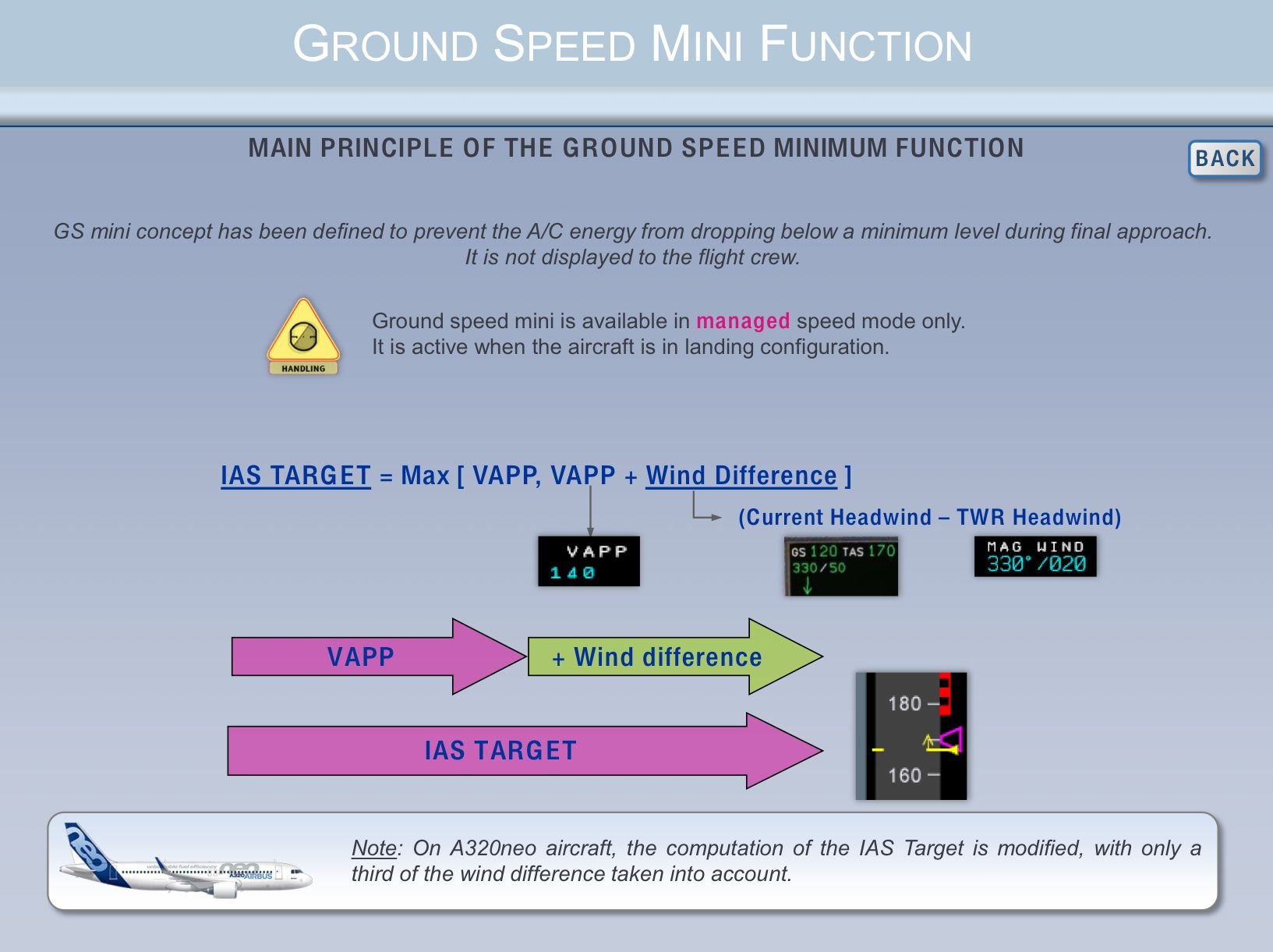
GS Mini takes the reported Tower Wind into account and computes a minimum groundspeed - and therefore a minimum energy - instead of a fixed IAS. In practice therefore, it reacts the opposite way round from the old conventional constant IAS systems - GS Mini will call for increased thrust during a headwind gust, and vice versa, (within certain limits). It does this to preserve energy, so if you cancel or override an IAS or thrust increase commanded by GS Mini, you are reducing the aircraft energy, which could leave you in a bad place.
GS Mini reacts to the instantaneous head or tailwind gusts, and is automatically smoothly reduced so as not to command high speed changes in the flare.
Pulling selected speed stops GS Mini from working, and that could reduce the aircraft energy below a safe level. As Fursty Ferret says; GS Mini should be programmed with the Tower Wind before commencing the approach; not overridden on short finals.
Old conventional systems have to fly fixed IAS, because any change in IAS affects the pitch trim, so this would cause the aircraft to deviate. Airbus FBW auto-trims, (and also designs-out the pitch/power couple), so the designers could look again at the situation and did not need to stay with fixed IAS.
GS Mini takes the reported Tower Wind into account and computes a minimum groundspeed - and therefore a minimum energy - instead of a fixed IAS. In practice therefore, it reacts the opposite way round from the old conventional constant IAS systems - GS Mini will call for increased thrust during a headwind gust, and vice versa, (within certain limits). It does this to preserve energy, so if you cancel or override an IAS or thrust increase commanded by GS Mini, you are reducing the aircraft energy, which could leave you in a bad place.


Joined: Sep 2011
Posts: 351
Likes: 148
From: FL390
GS mini takes tailwind gusts into account as well as headwind gusts, (within certain limits)
Having experienced a shift to a tailwind below 100ft when the tower reported calm winds, I can tell you from first hand and a sore back that the GS mini does bugger all in this situation.
Joined: Nov 1999
Aviation Qualifications: ATPL
Posts: 3,147
Likes: 741
From: UK
My old FCOMs are packed away and my electronic FCOM is not playing, but I will look when I have worked down my "to do list" of house maintenance projects a little further !
I sometimes slightly delayed retarding the thrust levers if my RoD just going into the flare seemed higher than normal.
I sometimes slightly delayed retarding the thrust levers if my RoD just going into the flare seemed higher than normal.
Joined: Mar 2012
Posts: 2,605
Likes: 154
From: Having a margarita on the beach
GS mini function is not related to increasing/decreasing tailwinds, it is an energy management tool for increasing/decreasing headwind components.
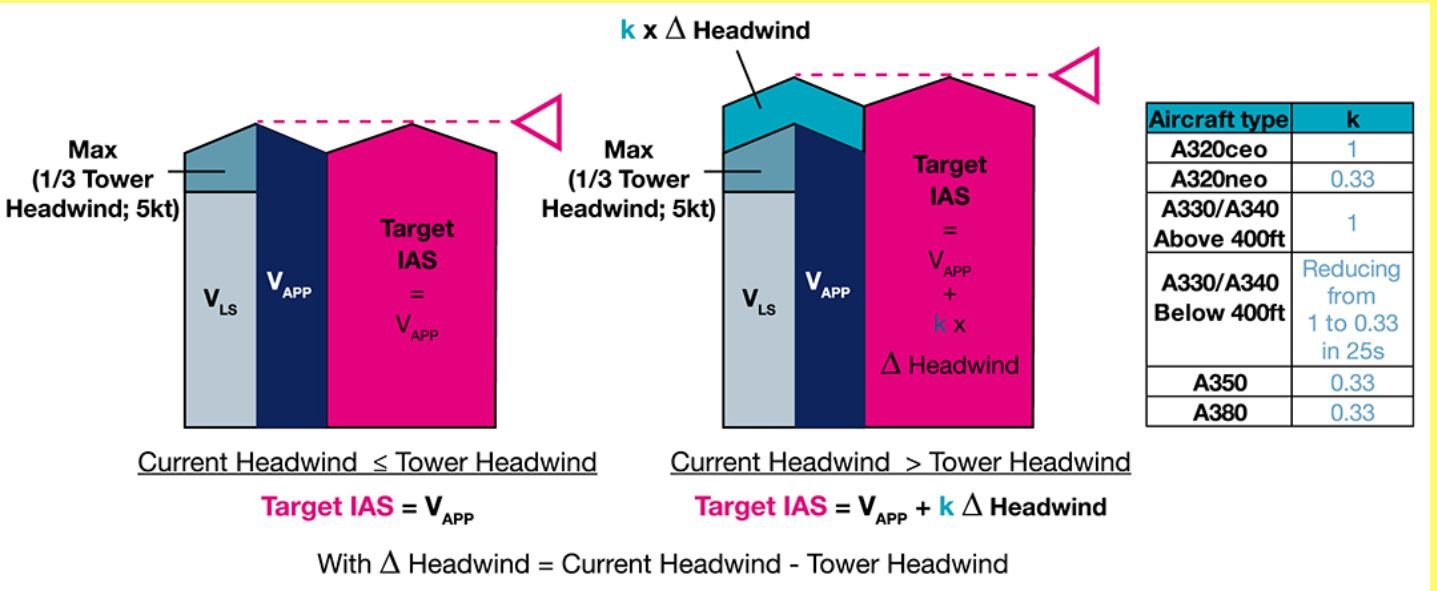
The k factor reduction does not apply to the A320ceo.


Joined: Nov 2010
Posts: 1,167
Likes: 180
From: USA
My company allows for us to land with selected speed, but it is definitely not recommended. Use cases are being close to a 737, with a lot of HW on the approach, but lower winds on the field. GS-mini eats up the separation.
Gusty crosswind does not have the same impact on energy as gusty headwind. You will be correcting LOC more than GS, but that does not affect power, so I would not go selected because of crosswind gusts. And I will disagree with most here, I do think it is okay to use selected if the HW gusts increase on short final. GS-MINI is great, but it doesn't have an additive for gusts. AB does recommend an additive for gusts, so....
Joined: Nov 2010
Posts: 1,167
Likes: 180
From: USA
+1
Why would you, (9airbus), want to do that ? You have flown all the way down the approach with groundspeed mini and the auto-thrust looking after you and maintaining your aircraft energy - why take that away in the last 30 seconds very close to the ground, and risk losing energy and destabilising ??
Use groundspeed mini and the auto-thrust - they have been designed and developed to deal with this sort of thing, and they do so very well.
Don't be alarmed if the engines spool up with a headwind gust, they won't increase your groundspeed, and won't destabilise your landing.
Why would you, (9airbus), want to do that ? You have flown all the way down the approach with groundspeed mini and the auto-thrust looking after you and maintaining your aircraft energy - why take that away in the last 30 seconds very close to the ground, and risk losing energy and destabilising ??
Use groundspeed mini and the auto-thrust - they have been designed and developed to deal with this sort of thing, and they do so very well.
Don't be alarmed if the engines spool up with a headwind gust, they won't increase your groundspeed, and won't destabilise your landing.
Joined: Mar 2012
Posts: 2,605
Likes: 154
From: Having a margarita on the beach
Last edited by sonicbum; 2nd August 2024 at 07:03.

Joined: Mar 2006
Posts: 2,633
Likes: 137
From: USA
If the wind is causing the airspeed to jump around too much, I’d just disconnect the AT and leave the speed managed.
You’ll be able to see what GS mini is doing, while flying a speed that you feel is more sensible. Win-win
You’ll be able to see what GS mini is doing, while flying a speed that you feel is more sensible. Win-win
Joined: Nov 1999
Aviation Qualifications: ATPL
Posts: 3,147
Likes: 741
From: UK
By reacting to gusts like that, the auto-thrust is working as designed and keeping you safe. Why prevent it ?
From the Airbus A320 Family Instructor Support manual: UDY0102 Jan 2001:

In the case of a tailwind gust:

And, Hans; the whole point of GS Mini is to react to gusts and adjust the thrust to stay above a minimum energy, so it most certainly DOES adjust for gusts !! - that is its whole purpose.
Why disable this vital system just because you don't like the engines spooling up like that ? We cannot know the instantaneous wind*, so how do we know what is a safe speed/ energy/ thrust setting ?
* the three ADIRS do though
.
From the Airbus A320 Family Instructor Support manual: UDY0102 Jan 2001:
In the case of a tailwind gust:
Why disable this vital system just because you don't like the engines spooling up like that ? We cannot know the instantaneous wind*, so how do we know what is a safe speed/ energy/ thrust setting ?
* the three ADIRS do though
.
Last edited by Uplinker; 2nd August 2024 at 09:44.
Joined: Mar 2012
Posts: 2,605
Likes: 154
From: Having a margarita on the beach
The great advantage is to have the IAS increasing with headwind increase, hence if the headwind components drops or shifts to a tailwind the aircraft will not be in a low energy state with IAS dropping and low thrust.
In case of an approach with wind calm or 0/0, an increase in tailwind will be dealt in the same way on an Airbus FBW with managed speed as any other type, i.e. there will be the need to increase thrust to maintain the computed Vapp (Vls+5).
Joined: Nov 2010
Posts: 1,167
Likes: 180
From: USA
By reacting to gusts like that, the auto-thrust is working as designed and keeping you safe. Why prevent it ?
From the Airbus A320 Family Instructor Support manual: UDY0102 Jan 2001:
And, Hans; the whole point of GS Mini is to react to gusts and adjust the thrust to stay above a minimum energy, so it most certainly DOES adjust for gusts !! - that is its whole purpose.
Why disable this vital system just because you don't like the engines spooling up like that ? We cannot know the instantaneous wind*, so how do we know what is a safe speed/ energy/ thrust setting ?
* the three ADIRS do though
.
From the Airbus A320 Family Instructor Support manual: UDY0102 Jan 2001:
And, Hans; the whole point of GS Mini is to react to gusts and adjust the thrust to stay above a minimum energy, so it most certainly DOES adjust for gusts !! - that is its whole purpose.
Why disable this vital system just because you don't like the engines spooling up like that ? We cannot know the instantaneous wind*, so how do we know what is a safe speed/ energy/ thrust setting ?
* the three ADIRS do though
.
Also, the original question was specifically for Xwind gusts, and GS mini is just about a HW component addition to Vfas, no addition for Xwind.
And I am definitely not suggesting using selected just because your magenta bug seems too high/going up and you don't understand GSmini.....
Joined: Jul 2009
Aviation Qualifications: Spotter
Posts: 241
Likes: 50
From: Coast to Coast...
I think I found the right thread to hijack (sorry)...
If Vapp = 130 Kts and GS Mini has you indicating 141 Kts at below 500ft, is that classed as a "stabilised approach"? If so, why.
Thanks
If Vapp = 130 Kts and GS Mini has you indicating 141 Kts at below 500ft, is that classed as a "stabilised approach"? If so, why.
Thanks
Joined: Mar 2012
Posts: 2,605
Likes: 154
From: Having a margarita on the beach
Target speed is Vapp + GS mini compensation. Hence your reference is the “magenta” bug (Target speed) on the speed indicator.As long as your indicated airspeed is within the specified margins from the Target Speed your approach is stabilized.
Momentary deviations due to environmental conditions are obviously accepted.
In gusty headwind conditions VTGT will vary all the time, so as long as you are close enough to that speed you are stabilized.
Joined: Nov 1999
Aviation Qualifications: ATPL
Posts: 3,147
Likes: 741
From: UK
@SA, no problem; It is still stabilised because even though the engines might spool up; your groundspeed won't significantly change, and when meeting the runway it is actually the groundspeed that is important - as long as the wings are still safely flying, which they will be, because they will be between VLS and VFE.
So, although it might sound and seem as if the aircraft is suddenly going to accelerate forwards, it actually isn't; it will actually "stay where it was" on the path and ground speed that it was on before the gust.
The increase in IAS will not destabilise the aircraft path, (as it would in conventional constant-IAS types), because the FBW automatically corrects the trim for the IAS change AND nulls-out the pitch-power couple.
The engines will remain spooled-up, which is also a stability requirement, as you know, and the effect of GS Mini is reduced approaching the flare anyway.
So, although it might sound and seem as if the aircraft is suddenly going to accelerate forwards, it actually isn't; it will actually "stay where it was" on the path and ground speed that it was on before the gust.
The increase in IAS will not destabilise the aircraft path, (as it would in conventional constant-IAS types), because the FBW automatically corrects the trim for the IAS change AND nulls-out the pitch-power couple.
The engines will remain spooled-up, which is also a stability requirement, as you know, and the effect of GS Mini is reduced approaching the flare anyway.

