


Descent on the ILS

Thread Starter

Joined: Mar 2006
Posts: 354
Likes: 39
From: s england
Descent on the ILS
It’s not without some trepidation that I ask this so please be gentle and offer verifiable answers rather than opinion.
You are flying into an airfield surrounded by terrain. You’re cleared via a STAR which ends at the IAF you are cleared to descend to the altitude at the IAF which on the chart is the same figure with a line underneath it a distance of 18 nm to touchdown and is approximately a 3 degree slope. You are cleared ILS.
But it’s hot ISA + 10 you hit the IAF at the defined altitude intercepting the LOC with a half scale fly down on the GS.
There are 3 other step down altitudes on the chart each with a black line below them.
The last of the 3 is the IF at 10 nm
Do you
a) arm the GS capture the glide from above?whilst that will certainly mean the indicated ( as opposed to a baro corrected altimeter) will be below the charted altitude
or
b) use FMC /FMGC to descend ensuring you are at/above the charted altitudes until after the FAF/P then correct to the GS?
I appreciate this isn’t a terrain issue but what do ATC expect outside the FAF could they clear low level VFR traffic below you at say 10/15 nm?
You are flying into an airfield surrounded by terrain. You’re cleared via a STAR which ends at the IAF you are cleared to descend to the altitude at the IAF which on the chart is the same figure with a line underneath it a distance of 18 nm to touchdown and is approximately a 3 degree slope. You are cleared ILS.
But it’s hot ISA + 10 you hit the IAF at the defined altitude intercepting the LOC with a half scale fly down on the GS.
There are 3 other step down altitudes on the chart each with a black line below them.
The last of the 3 is the IF at 10 nm
Do you
a) arm the GS capture the glide from above?whilst that will certainly mean the indicated ( as opposed to a baro corrected altimeter) will be below the charted altitude
or
b) use FMC /FMGC to descend ensuring you are at/above the charted altitudes until after the FAF/P then correct to the GS?
I appreciate this isn’t a terrain issue but what do ATC expect outside the FAF could they clear low level VFR traffic below you at say 10/15 nm?

Joined: Dec 2005
Aviation Qualifications: ATPL
Posts: 4,998
Likes: 341
From: Hong Kong
A verifiable answer requires a verifiable question. Where exactly is this approach? It doesn't seem all that realistic that you would have an at-or-above constraint that's above the glide slope.
Joined: Apr 2008
Posts: 469
Likes: 0
From: Victoria
What he mentions sound very much like Alicante runway 10 ILS Z
I would hit the 18 DME at the required altitude with at flaps 1 then arm the approach as you’re cleared. You should be hitting the step down altitudes at approximately the altitudes you need to be at.
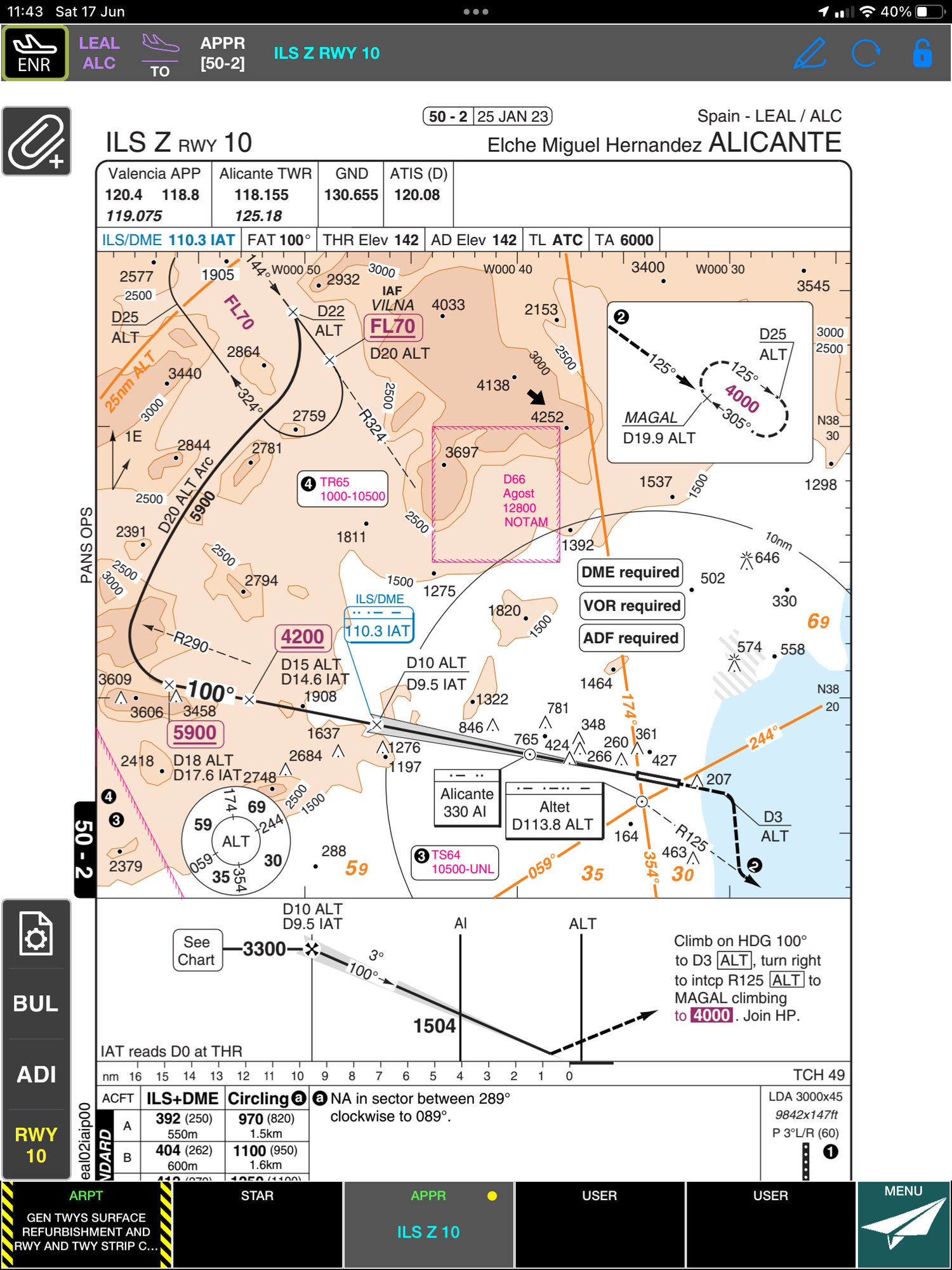
I would hit the 18 DME at the required altitude with at flaps 1 then arm the approach as you’re cleared. You should be hitting the step down altitudes at approximately the altitudes you need to be at.
Joined: Dec 2003
Posts: 2,349
Likes: 845
From: Tring, UK
What SW1 says.
If you are cleared for the ILS / cleared descent with the glide slope, then you would expect ATC to have checked for any conflicting traffic. Established on an ILS in ISA+ conditions, you will always indicate below charted altitudes at checkpoints irrespective of how far from the airfield you are, but you know that in advance and why that is.
If you are cleared for the ILS / cleared descent with the glide slope, then you would expect ATC to have checked for any conflicting traffic. Established on an ILS in ISA+ conditions, you will always indicate below charted altitudes at checkpoints irrespective of how far from the airfield you are, but you know that in advance and why that is.
Thread Starter
Joined: Mar 2006
Posts: 354
Likes: 39
From: s england
It doesn’t matter where it is the principle is the same ( except perhaps local variations).
in this case the IAF altitude in ISA is above the glide presumably for terrain.
The Q is outside of ie. before the FAF can you follow the GS if your indicated altitude is below that on the chart when it has a black not below line on the chart because it’s hot?
in this case the IAF altitude in ISA is above the glide presumably for terrain.
The Q is outside of ie. before the FAF can you follow the GS if your indicated altitude is below that on the chart when it has a black not below line on the chart because it’s hot?
Thread Starter
Joined: Mar 2006
Posts: 354
Likes: 39
From: s england
What SW1 says.
If you are cleared for the ILS / cleared descent with the glide slope, then you would expect ATC to have checked for any conflicting traffic. Established on an ILS in ISA+ conditions, you will always indicate below charted altitudes at checkpoints irrespective of how far from the airfield you are, but you know that in advance and why that is.
If you are cleared for the ILS / cleared descent with the glide slope, then you would expect ATC to have checked for any conflicting traffic. Established on an ILS in ISA+ conditions, you will always indicate below charted altitudes at checkpoints irrespective of how far from the airfield you are, but you know that in advance and why that is.
i think cleared descent with the GS is different do you have a reference?
Thread Starter
Joined: Mar 2006
Posts: 354
Likes: 39
From: s england
it’s not ALC but it’s similar I agree but the fixes outside the FAF are a little less challenging. If y the 4200 at D14.6 was say 5000 would you accept descent on the GS if at 14.6 the baro read 4600’.
Joined: Sep 2013
Posts: 28
Likes: 1
From: Utterly
It's not spelt out in PANS Ops per se but you need to know which parts apply, eg where a MHA differs from a MORA and the difference between a FAF and a FAP. I wouldn't be arming the approach at 18d in ALC as the GS DOC is only 10nm.
If you enter the ISA deviation into the FMC it will correct the vertical profile, but that won't help with the hard altitudes as they correspond to baro derived indicated altitudes and the ISA + would have you at an true altitude which is higher than the indicated altitude and the FMC vertical profile and the raw GS would show you are high on profile because you are.
It's the same problem as a cold temperature correction to indicated altitude, but has an energy issue rather than a terrain threat, maybe use a higher drag profile in order to avoid the risk of high energy as you will need a higher descent rate until inside the GS DOC.
It is also possible that the hard altitudes apply only to the Localiser procedure and not the full ILS as the FAP is not a hard altitude unlike the FAF even if they are co located, the FAF is for the non precision approach and the FAP is for the precision approach where it is assumed that the electronic GS inside the DOC is the more accurate as it is not subject to temperature and pressure errors.
Cleared descent with the GS when established on the localiser is a UK difference from ICAO due airspace, elsewhere you will be cleared for the approach from before the IAF.
If you enter the ISA deviation into the FMC it will correct the vertical profile, but that won't help with the hard altitudes as they correspond to baro derived indicated altitudes and the ISA + would have you at an true altitude which is higher than the indicated altitude and the FMC vertical profile and the raw GS would show you are high on profile because you are.
It's the same problem as a cold temperature correction to indicated altitude, but has an energy issue rather than a terrain threat, maybe use a higher drag profile in order to avoid the risk of high energy as you will need a higher descent rate until inside the GS DOC.
It is also possible that the hard altitudes apply only to the Localiser procedure and not the full ILS as the FAP is not a hard altitude unlike the FAF even if they are co located, the FAF is for the non precision approach and the FAP is for the precision approach where it is assumed that the electronic GS inside the DOC is the more accurate as it is not subject to temperature and pressure errors.
Cleared descent with the GS when established on the localiser is a UK difference from ICAO due airspace, elsewhere you will be cleared for the approach from before the IAF.
Thread Starter
Joined: Mar 2006
Posts: 354
Likes: 39
From: s england

Joined: Sep 2016
Posts: 937
Likes: 67
From: USA
In FAA land (the only one I can speak for) all stepdown altitudes prior to the FAF must be complied with. And yes, on hot days this may keep you above the glideslope. Probably comes up very seldom, but we do have notes at some airports to watch out for it (ORD and LAX, not by coincidence both often intercepting the localizer very far out).
Joined: Sep 2013
Posts: 28
Likes: 1
From: Utterly
I would add that the minimum altitudes for the approach are published precisely because the GS cannot be relied upon outside it's DOC.

Joined: Jun 2007
Posts: 3,443
Likes: 39
From: Wanderlust
Yes it does and you are correct, but we're not talking about the LOC, ICAO Annex 10 gives you a range of 10nm for a standard GS unless a different range is published in the individual airfield AIP and since the subject of the discussion is the vertical bit, it is worth noting that it is different to the LOC which covers the horizontal bit.
I would add that the minimum altitudes for the approach are published precisely because the GS cannot be relied upon outside it's DOC.
I would add that the minimum altitudes for the approach are published precisely because the GS cannot be relied upon outside it's DOC.
Joined: Sep 2013
Posts: 28
Likes: 1
From: Utterly
Thanks Vilas, the Glideslope performance criteria is given in ICAO annex 10 Ch 3 ref 3.1.5.3.1 "coverage" and the GS should not be used outside 10nm unless promulgated in the individual Airfield AIP or by NOTAM.

Joined: Dec 1998
Posts: 54
Likes: 0
From: Denmark
The GS only provides terrain clearnce in the final segment, which starts at the FAP.
Before the FAP, the minimum altitudes of the intermediate and initial segments provide terrain clearance. As the descent gradients in the initial and intermediate segments can be greater than in the final segment, these minimum altitudes could be above the GS - whether it’s a hot day or not.
Before the FAP, the minimum altitudes of the intermediate and initial segments provide terrain clearance. As the descent gradients in the initial and intermediate segments can be greater than in the final segment, these minimum altitudes could be above the GS - whether it’s a hot day or not.

Joined: Dec 2002
Aviation Qualifications: ATP+Mil
Posts: 3,985
Likes: 568
From: Where the Quaboag River flows, USA
The GS only provides terrain clearnce in the final segment, which starts at the FAP.
Before the FAP, the minimum altitudes of the intermediate and initial segments provide terrain clearance. As the descent gradients in the initial and intermediate segments can be greater than in the final segment, these minimum altitudes could be above the GS - whether it’s a hot day or not.
Before the FAP, the minimum altitudes of the intermediate and initial segments provide terrain clearance. As the descent gradients in the initial and intermediate segments can be greater than in the final segment, these minimum altitudes could be above the GS - whether it’s a hot day or not.
Joined: Oct 2006
Posts: 370
Likes: 16
From: 1313 Mockingbird Lane
Let me guess.
VHHH 25R approach?
What an absolute joke.
Waiting for somebody to clip the top of Tai Mo Shan and they can kiss goodbye to their US$20 Billion (yes you read correctly) 3rd runway.
VHHH 25R approach?
What an absolute joke.
Waiting for somebody to clip the top of Tai Mo Shan and they can kiss goodbye to their US$20 Billion (yes you read correctly) 3rd runway.

Joined: Jun 2023
Posts: 1
Likes: 0
From: Uk
It doesn’t matter where it is the principle is the same ( except perhaps local variations).
in this case the IAF altitude in ISA is above the glide presumably for terrain.
The Q is outside of ie. before the FAF can you follow the GS if your indicated altitude is below that on the chart when it has a black not below line on the chart because it’s hot?
in this case the IAF altitude in ISA is above the glide presumably for terrain.
The Q is outside of ie. before the FAF can you follow the GS if your indicated altitude is below that on the chart when it has a black not below line on the chart because it’s hot?
BARO corrections work both ways hot/cold to MOCA, MFRA, MSA, Platforms. Of course cold the more significant one
had an interesting TCAS event in to a US Airfield whilst on the glide. Hot temps ISA +15 territory. Airfield under the ILS has traffic departing to maintain an altitude below the ILS. We saw a -700ft Sep on the ND, ATC claimed it was more.
throws up the question that in warm altitudes an aircraft on the GS (fixed height above the ground) may not have separation to an aircraft maintaining an altitude below (in hot conditions).