


Port & Starboard versus Left and Right

Joined: Apr 2009
Aviation Qualifications: Non-Aircrew
Posts: 1,601
Likes: 704
From: DM33


Avoid imitations


Joined: Nov 2000
Aviation Qualifications: ATPL
Posts: 15,116
Likes: 1,091
From: Wandering the FIR and cyberspace often at highly unsociable times

Joined: Aug 2010
Posts: 224
Likes: 113
From: UK
Avoid imitations
Joined: Nov 2000
Aviation Qualifications: ATPL
Posts: 15,116
Likes: 1,091
From: Wandering the FIR and cyberspace often at highly unsociable times
Clearly he was winding you up.
No sailor would ever misuse the word "abaft" to means moving in a sternwards didection. Never ever. 'Abaft' can only describe a relative position. "The helm is abaft the mainmast". The destroyer turned abaft the cruiser".
It cannot possibly be used as a direction of motion. That is described as 'astern'. A vessel - or a helo - can move astern, it can never move abaft unless it moves abaft relative to something else as the term expresses where it moved, not in what manner or direction.
No sailor would ever misuse the word "abaft" to means moving in a sternwards didection. Never ever. 'Abaft' can only describe a relative position. "The helm is abaft the mainmast". The destroyer turned abaft the cruiser".
It cannot possibly be used as a direction of motion. That is described as 'astern'. A vessel - or a helo - can move astern, it can never move abaft unless it moves abaft relative to something else as the term expresses where it moved, not in what manner or direction.




Joined: Feb 2021
Posts: 2
Likes: 1
From: E Midlands
which is where the stage left / stage right used in the theatre comes from - an actor stood in the middle of the stage facing the audience , up stage and down stage is due to raked stages wheerhe the 'back' Upstage is higher that the front 'downstage' to give the audience a better view of the action


Joined: Jan 2007
Posts: 2,454
Likes: 212
From: Location: Location!
During my RAF QHI course I was teamed up with a Royal Navy pilot.
When spot turning the helicopter I’d been trained to announce “TAIL GOING LEFT”, “TAIL GOING RIGHT” or “MOVING BACK” etc as required for the benefit of crew cooperation.
My RN colleague used to instead say stuff like “TURNING TO PORT”, “TURNING TO STARB’D” and “GOING ABAFT!”
I think he just did it to confuse me, but I did get used to it and sometimes imitated him with a pirate accent.
When spot turning the helicopter I’d been trained to announce “TAIL GOING LEFT”, “TAIL GOING RIGHT” or “MOVING BACK” etc as required for the benefit of crew cooperation.
My RN colleague used to instead say stuff like “TURNING TO PORT”, “TURNING TO STARB’D” and “GOING ABAFT!”
I think he just did it to confuse me, but I did get used to it and sometimes imitated him with a pirate accent.

Jack
Avoid imitations
Joined: Nov 2000
Aviation Qualifications: ATPL
Posts: 15,116
Likes: 1,091
From: Wandering the FIR and cyberspace often at highly unsociable times
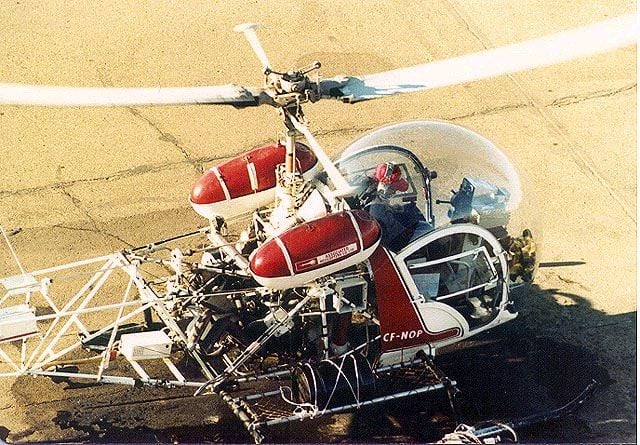
Unless you fly a Bell 47.

And what about tandem seated fixed wing aircraft?
Joined: Jan 2019
Aviation Qualifications: LAME
Posts: 806
Likes: 645
From: Cumbria
Joined: Jan 1999
Posts: 1,378
Likes: 174
From: England
There is a potential 'gotcha' with left/right identification on engines, as in:
'Looks like we'll have to shut it down.'
'Agreed. Make sure we get the right engine.'
Referring to '1' and '2' (on a twin, as used to be the case) would remove the problem.
'Looks like we'll have to shut it down.'
'Agreed. Make sure we get the right engine.'
Referring to '1' and '2' (on a twin, as used to be the case) would remove the problem.

Joined: Jul 2013
Aviation Qualifications: Non-Aircrew
Posts: 5,683
Likes: 3,358
From: Everett, WA
That's actually an interesting question. Since the early B-36s didn't have the jets, I'm guessing the prop engines were 1-6, and when the jets got added they were 7-8 on the left and 9-10 on the right.
But that's just an educated guess - does anyone know for sure?
But that's just an educated guess - does anyone know for sure?