


LNAV/VNAV@VNAV minima difference


Joined: Dec 2003
Posts: 2,348
Likes: 839
From: Tring, UK
It’s the difference between a 3D (LNAV + VNAV) and 2D (LNAV + V/S, FPA, etc.) approach. With LNAV/VNAV you have lateral and vertical path guidance but with LNAV you are only getting a lateral path, hence separate minima.
There is also the steeper approach on the noise abatement trial procedure, which will have a different obstacle profile, as FlyingStone points out. The LNAV minima are the same as you are not using vertical guidance.
There is also the steeper approach on the noise abatement trial procedure, which will have a different obstacle profile, as FlyingStone points out. The LNAV minima are the same as you are not using vertical guidance.
Joined: Feb 2004
Posts: 64
Likes: 0
From: Cornwall
Look at the change in Circling minima, there’s a close in obstruction. LNAV minima will assume a dive and drive type approach where as the LNAV/VNAV will give a glide path with a corresponding obstruction clearance surface which may clear obstructions in the LNAV only area.
LNAV+V and LNAV/V (depending on brand of electronic wizardry) is the difference between advisory and mandatory guidance.
LNAV+V and LNAV/V (depending on brand of electronic wizardry) is the difference between advisory and mandatory guidance.
Only half a speed-brake
Joined: Apr 2003
Posts: 4,459
Likes: 136
From: Commuting not home
The newer, TEMPO chart, refers you to AIP SUP 40/2019 - https://www.aurora.nats.co.uk/htmlAI...040-en-GB.html
The SUP actually includes the charts and there it says, from the CAA mouth direct OCA(H) for LNAV/VNAV.
But already you knew that.
Neither of which explains what was the reason for VNAV label on the previous version RNAV (GNSS) Z. Checking with the AIP again, https://www.aurora.nats.co.uk/htmlAI...ics/124009.pdf the CAA called it LNAV/VNAV already there.
Apparently the nice LSY people for some reason changed the labelling on the original chart, but not on the TEMPO one.
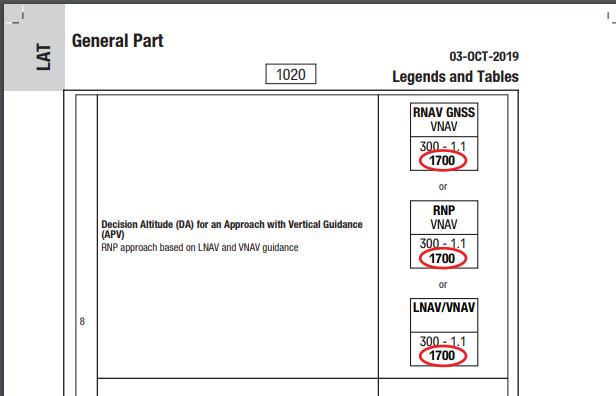
Voila. In LSY graphical language There are 3 different methods how they depict the same minima (my screen is from the LAT chapter, also available to you in FIV under the "Manuals" link from the top-level menu).
The SUP actually includes the charts and there it says, from the CAA mouth direct OCA(H) for LNAV/VNAV.
But already you knew that.
Neither of which explains what was the reason for VNAV label on the previous version RNAV (GNSS) Z. Checking with the AIP again, https://www.aurora.nats.co.uk/htmlAI...ics/124009.pdf the CAA called it LNAV/VNAV already there.
Apparently the nice LSY people for some reason changed the labelling on the original chart, but not on the TEMPO one.
Voila. In LSY graphical language There are 3 different methods how they depict the same minima (my screen is from the LAT chapter, also available to you in FIV under the "Manuals" link from the top-level menu).
Joined: Jan 2004
Posts: 3,246
Likes: 202
From: Here and there
Look at the change in Circling minima, there’s a close in obstruction. LNAV minima will assume a dive and drive type approach where as the LNAV/VNAV will give a glide path with a corresponding obstruction clearance surface which may clear obstructions in the LNAV only area.
LNAV+V and LNAV/V (depending on brand of electronic wizardry) is the difference between advisory and mandatory guidance.
LNAV+V and LNAV/V (depending on brand of electronic wizardry) is the difference between advisory and mandatory guidance.
 That is true. Thanks
Joined: Jun 2004
Posts: 1,394
Likes: 0
From: Just Around The Corner
My idea is that an LNAV/VNAV minima , is a procedure based on GPS signal not corrected by ground station,
VNAV ( or Baro-VNAV ) is an APV procedure ( Approach with Vertical Guidance ) flown with reference to baro altitude , hence the need
for higher minima.
VNAV ( or Baro-VNAV ) is an APV procedure ( Approach with Vertical Guidance ) flown with reference to baro altitude , hence the need
for higher minima.
Only half a speed-brake
Joined: Apr 2003
Posts: 4,459
Likes: 136
From: Commuting not home
That seems at odds with the reason for UK AIP SUP 40/2019 as well as the chart producer's explanatory guide on minima box labelling.
Both charts in the AIP have LNAV/VNAV designation on them. Only the LIDO re-draw of those has the sleek looking (and confusing) version on the older chart.
Both charts in the AIP have LNAV/VNAV designation on them. Only the LIDO re-draw of those has the sleek looking (and confusing) version on the older chart.
Last edited by FlightDetent; 7th April 2020 at 12:52.


Joined: Dec 1999
Posts: 1,174
Likes: 123
From: uk
Unusually, I find myself in agreement with Flight Detent. The LIDO legends and tables section will tell you the LNAV/VNAV and VNAV are the same type of approach - RNP approach based on LNAV and VNAV guidance.
rgds
rgds
Only half a speed-brake
Joined: Apr 2003
Posts: 4,459
Likes: 136
From: Commuting not home
In this particular case, it is a live operational trial of a steeper angle procedure, while the old RNAV-Z use is suspended.
Not sure if anyone's mentioned it here yet, the details are available from the full AIP SUP for this [UK 40/2019]
Not sure if anyone's mentioned it here yet, the details are available from the full AIP SUP for this [UK 40/2019]

Joined: Aug 2017
Posts: 214
Likes: 4
From: UK
Do you use Vert RNP 125 when flying LNAV minima, using LNAV/VNAV minima the aircraft is to be within +/- 75' of profile in the final approach segment, the UK (Standard Doc 24) says this applies to both 2D & 3D approaches EASA doc's are clear on this when flying LNAV/VNAV minima but I can't see/find clarity on the required tolerance on 2D and I know some 737 European operators don't use 125 for RNP flown to LNAV minima (CDFA) using either VNAV or V/S
Joined: Dec 2005
Aviation Qualifications: ATPL
Posts: 4,993
Likes: 339
From: Hong Kong
They're the same


