


Question for A330 drivers

Thread Starter

Joined: Aug 2004
Posts: 164
Likes: 0
From: italy
Question for A330 drivers
Hi guys
I have a small question.....an unfortunately not only one......
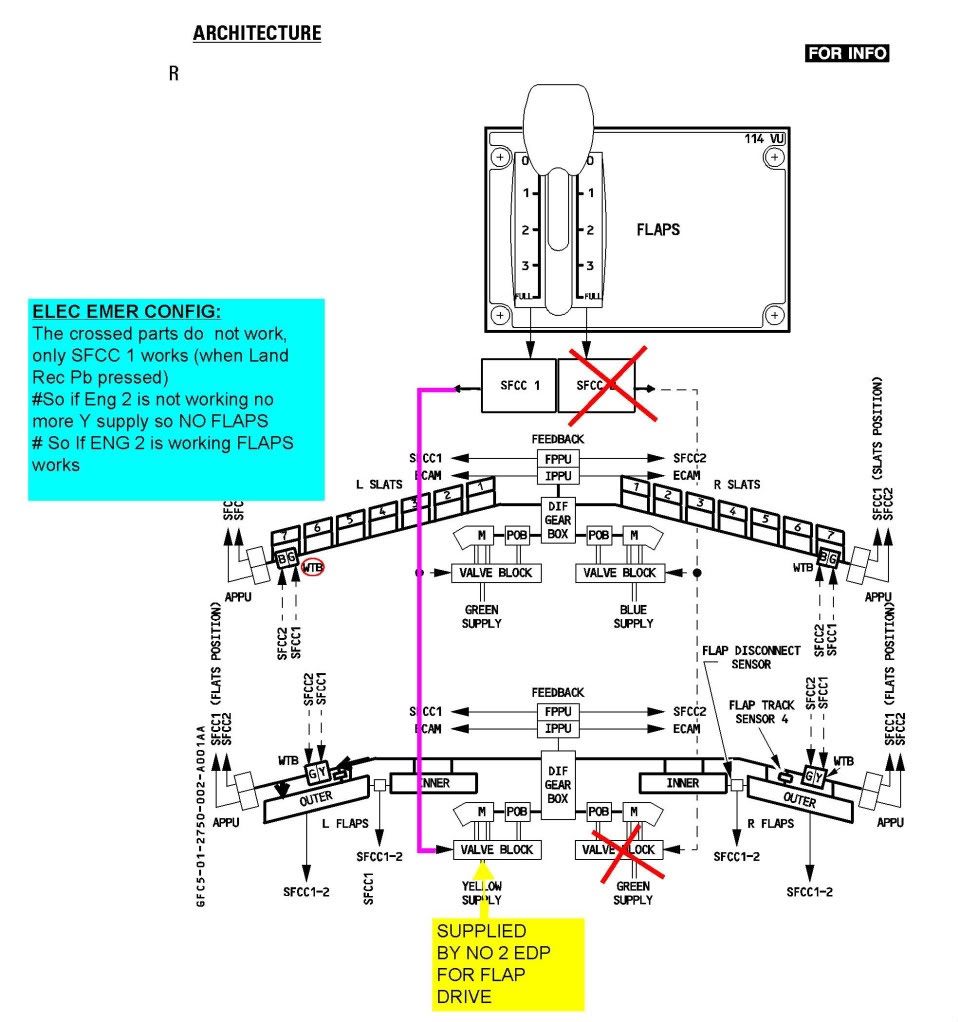
ELEC EMER CONF with gen 1 off/inop and engine 2 inop: flaps are not working...
Same configuration but with gen 2 inop/off and engine 1 inop: flaps are working.
Do you know why this difference??
Thanks
Michelda
I have a small question.....an unfortunately not only one......
ELEC EMER CONF with gen 1 off/inop and engine 2 inop: flaps are not working...
Same configuration but with gen 2 inop/off and engine 1 inop: flaps are working.
Do you know why this difference??
Thanks
Michelda

Joined: Mar 2006
Posts: 1,974
Likes: 0
From: Choroni, sometimes
Good morning,
I'm not current on 330, flew A300 for some years.
I guess in emer elc config only SFCC1 is working.
What about hyd systems with one eng inop on 330? Do you still have all three?
Which hyd system drives the flaps?
Maybe there you will find the answer....
I'm not current on 330, flew A300 for some years.
I guess in emer elc config only SFCC1 is working.
What about hyd systems with one eng inop on 330? Do you still have all three?
Which hyd system drives the flaps?
Maybe there you will find the answer....


Thread Starter
Joined: Aug 2004
Posts: 164
Likes: 0
From: italy
I found this information in emer conf 03.02.24 ( note at the end of procedure)
Your answer can be correct, but in this case what happen in case of eng 1 fault and idg 2 inop???
Thanks for your answer
Michelda
Your answer can be correct, but in this case what happen in case of eng 1 fault and idg 2 inop???
Thanks for your answer
Michelda
Joined: Feb 2001
Posts: 243
Likes: 1
From: Milkway Galaxy
but in this case what happen in case of eng 1 fault and idg 2 inop???
Normally FCOM 3.02 pages does not specify the combined failures, but ECAM does. That`s why ECAM steps always reliable at very complex cases resulted from combined failures, which normally pilot cannot do simply as reading from FCOm 3.02.
That`s whay I am interested how did you come to this conclusion as simply reading FCOM 3.02.24 pages.
Can you specify the page no please 3.02.24 P??, pin point please.
ADDED LATER: Disregard my question I found it at 3.02.24 P11. Thanks
Last edited by JABBARA; 2nd January 2011 at 21:46.
Joined: Aug 2003
Posts: 489
Likes: 0
From: England
I agree with the above comments that with GEN 1 inop and ENG 2 failed; the aircraft will be in EMER ELEC CONFIG with flaps inop.
However, the QRH Summary for EMER ELEC CONFIG assumes that flaps will be available. It gives a VAPP of VREF+5 using FLAP3 with associated landing distances (a factor of 1.2 on a dry runway). I think that with flaps at 0, the delta VREF should be 30 knots with a landing distance factor 1.6 dry. Bearing in mind that the QRH summary is intended to provide the information to apply the landing distance procedure, obviating the need to refer to QRH 2.40, then it appears that the pilots could be led into making an approach 25 knots too slow.
Any thoughts?
However, the QRH Summary for EMER ELEC CONFIG assumes that flaps will be available. It gives a VAPP of VREF+5 using FLAP3 with associated landing distances (a factor of 1.2 on a dry runway). I think that with flaps at 0, the delta VREF should be 30 knots with a landing distance factor 1.6 dry. Bearing in mind that the QRH summary is intended to provide the information to apply the landing distance procedure, obviating the need to refer to QRH 2.40, then it appears that the pilots could be led into making an approach 25 knots too slow.
Any thoughts?
Joined: Feb 2001
Posts: 243
Likes: 1
From: Milkway Galaxy
Brain Potter, a good point you noticed.
A quick answer which comes to my mind
Quote from my post
In your scenario, probably
FCTL FLAPS FAULT/LOCKED
ECAM willl also display, so when calculating Vapp you have to consider its effect as well.
But in any case, since the Vls always represents actual configuration, on the final if you see a Vapp above Vls your speed calculation is correct. If not, this means your speed calculation is wrong. Then simply fly a speed above Vls.
A quick answer which comes to my mind
Quote from my post
That`s why ECAM steps always reliable at very complex cases resulted from combined failures, which normally pilot cannot do simply as reading from FCOm 3.02
FCTL FLAPS FAULT/LOCKED
ECAM willl also display, so when calculating Vapp you have to consider its effect as well.
But in any case, since the Vls always represents actual configuration, on the final if you see a Vapp above Vls your speed calculation is correct. If not, this means your speed calculation is wrong. Then simply fly a speed above Vls.
